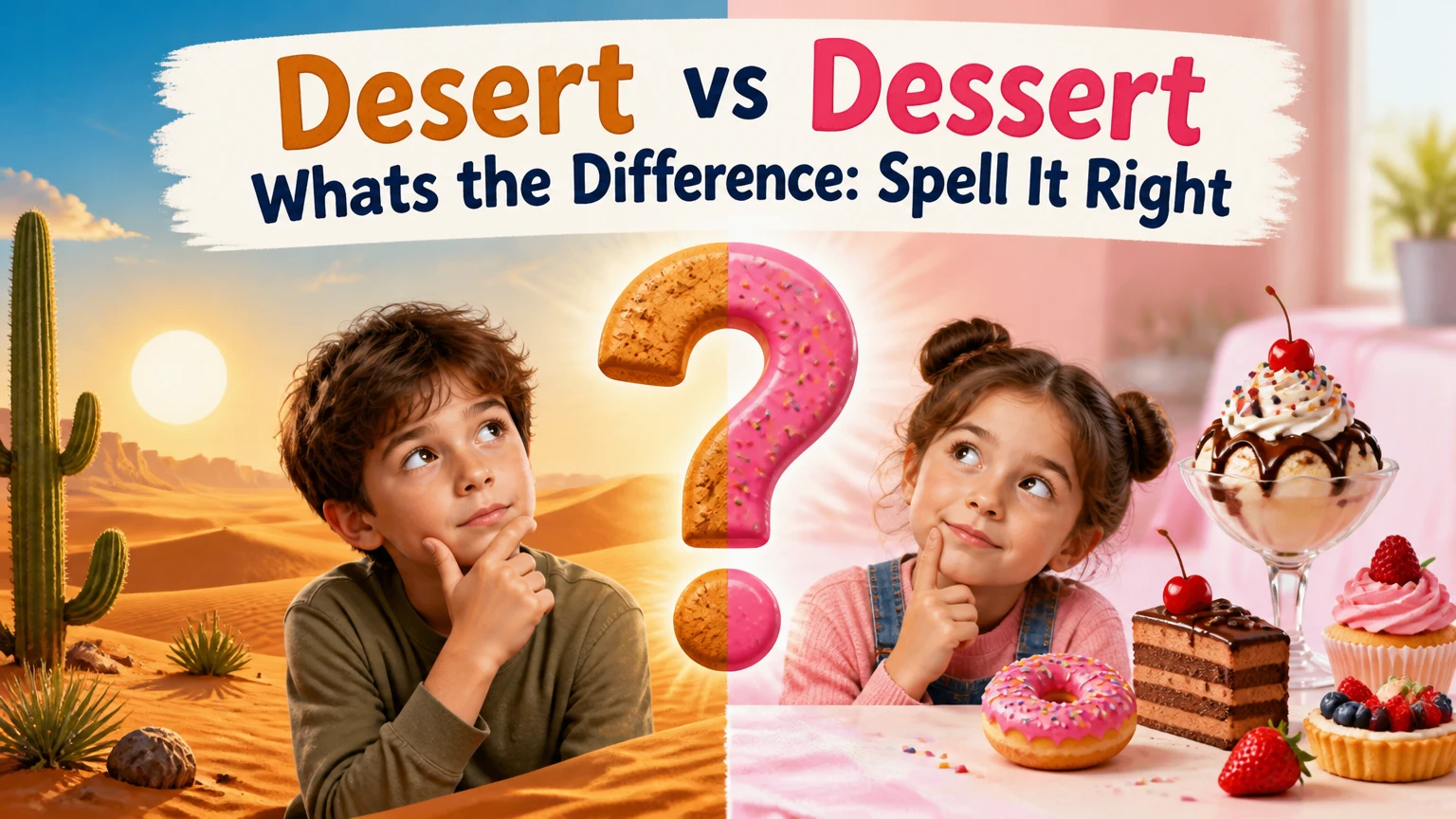
Desert and dessert differ in meaning, spelling, and pronunciation. A desert is usually a dry region with very low precipitation, while a dessert is a sweet food course commonly served after a meal. The spelling clue is simple: dessert has two s letters because many people want a second serving.
Key Facts at a Glance
- A desert is a dry geographic environment; a dessert is a food.
- The noun desert is usually pronounced DEZ-ert /ˈdɛzərt/.
- The noun dessert is pronounced deh-ZURT /dɪˈzɜːrt/ or /dɪˈzɝːt/.
- The verb desert, meaning “to abandon,” is pronounced like dessert.
- Polar regions can be deserts because they receive very little precipitation.
- The mnemonic “a second serving of dessert” connects the extra s with the extra portion.
What Is the Difference Between Desert and Dessert?
The difference between desert and dessert is both semantic and phonological: the words refer to unrelated concepts and normally receive different stress patterns. Desert names a landscape, as in “The Sahara is a desert,” while dessert names a sweet dish, as in “We ordered chocolate cake for dessert.”
The two nouns are not homophones in standard English. The first syllable receives the stress in DEZ-ert, but the second syllable receives the stress in deh-ZURT. That stress change helps listeners distinguish the words even when context is brief.
| Feature | Desert | Dessert |
|---|---|---|
| Core meaning | Dry land region | Sweet food course |
| Spelling | One s | Two s letters |
| Noun pronunciation | DEZ-ert | deh-ZURT |
| Common example | Sahara Desert | Apple pie for dessert |
| Word domain | Geography and ecology | Cooking and dining |
| Related form | Deserted, desertification | Dessert menu, dessert wine |
The fastest editing test is substitution. If the sentence could use “cake,” “ice cream,” or “pudding,” choose dessert. If the sentence could use “Sahara,” “Mojave,” or “dry region,” choose desert.
Why Does Dessert Have Two S’s?
Dessert has two s letters because its spelling comes through French desservir, meaning “to clear the table,” and because the extra-letter mnemonic links dessert with a second serving. The spelling is historical rather than a description of sweetness, sugar, or portion size.
The French verb desservir originally referred to removing dishes after a meal. In English, dessert developed into the course served after the main meal. The word’s meaning later broadened to include sweets eaten outside a formal meal, such as ice cream from a shop.
The mnemonic is more useful than the etymology for everyday writing:
You always want a second serving of dessert, so dessert has two s letters.
The mnemonic is not a grammatical rule. It is a spelling aid. Some diners do not want another serving, and some desserts are savory or small, but the extra s remains.
How Do You Spell Desert?
Desert, meaning a dry landscape or an abandoned condition, is spelled with one s. Examples include “the Atacama Desert,” “a desert island,” and “the village was deserted after the evacuation.”
The related adjective is desert in compounds such as desert climate and desert plant. The related past-tense adjective is deserted, as in “a deserted road.” The word desertification also contains one s after the initial de.
How Do You Spell Dessert?
Dessert, meaning a sweet course or sweet dish, is spelled with two s letters. Examples include “dessert menu,” “fruit dessert,” and “the restaurant served dessert at 9 p.m.”
The plural is desserts, not desserties or desserts’ unless possession is intended. The plural adds one final s to the existing spelling, producing three consecutive written s letters across the word ending: desserts has the sequence ss inside the word and a final s.
How Are Desert and Dessert Pronounced?
The noun desert, meaning dry land, is pronounced DEZ-ert, while the noun dessert is pronounced deh-ZURT. The verb desert, meaning abandon, uses the second pronunciation, so context determines whether a listener hears the landscape word or the abandonment verb.
| Word and meaning | Stress | Approximate pronunciation | Example |
|---|---|---|---|
| desert, dry land | First syllable | DEZ-ert | “The desert is cold at night.” |
| dessert, sweet food | Second syllable | deh-ZURT | “We shared dessert.” |
| desert, abandon | Second syllable | deh-ZURT | “Do not desert your team.” |
| deserted, abandoned | First syllable | DEZ-er-tid | “The station looked deserted.” |
English stress changes can create different meanings without changing spelling. Desert is therefore a heteronym, a word whose pronunciation changes according to meaning. Dictionaries commonly mark the landscape noun with first-syllable stress and the verb with second-syllable stress.
Is Desert a Homophone of Dessert?
Desert and dessert are not complete homophones when desert means a dry region, because the words have different stress and vowel quality. Desert, the verb meaning “abandon,” is pronounced like dessert, making those two uses sound alike in many varieties of English.
Writers should not rely on pronunciation alone. A sentence such as “They will desert the village” requires the verb, while “They crossed the desert” requires the landscape noun. Spelling and grammatical function resolve the ambiguity.
What Is a Desert?
A desert is a region where potential evaporation generally exceeds precipitation and annual precipitation is very low. A widely used geographic benchmark is less than about 250 millimeters, or 10 inches, of precipitation per year, although climate classification systems use additional measures such as temperature and aridity.
Deserts are not defined solely by heat. Antarctica is the world’s largest desert because its interior receives extremely little precipitation, even though most of that precipitation falls as snow. Cold deserts also occur in Central Asia and the Great Basin of the United States.
The U.S. National Park Service describes deserts through limited moisture and specialized adaptations rather than through temperature alone. Plants such as saguaro cacti store water, while animals including kangaroo rats reduce water loss through highly efficient kidneys.
What Creates a Desert?
Atmospheric circulation, mountain rain shadows, cold ocean currents, and distance from moisture sources create most deserts. Descending air near the subtropics suppresses cloud formation, mountains remove moisture from prevailing winds, and cold coastal water can stabilize air so thoroughly that rain rarely reaches land.
| Formation mechanism | Physical process | Named example | Typical result |
|---|---|---|---|
| Subtropical circulation | Dry air descends near 20-30° latitude | Sahara Desert | Hot, clear conditions |
| Rain shadow | Mountains force moist air upward | Great Basin Desert | Dry inland basin |
| Cold ocean current | Cool water limits evaporation and clouds | Atacama Desert | Coastal aridity |
| Continental interior | Moisture decreases far from oceans | Gobi Desert | Cold winters, dry climate |
| Polar cold | Very low atmospheric moisture | Antarctic Desert | Snowfall below 250 mm annually |
A desert can therefore be hot, cold, windy, foggy, rocky, sandy, or ice-covered. Sand dunes are visually distinctive but cover only part of many deserts; gravel plains, exposed bedrock, salt flats, and frozen surfaces are also common.
What Are the Main Types of Desert?
The main desert categories are subtropical, cold winter, coastal, and polar deserts. Each type has a different temperature pattern and moisture mechanism, so “desert” does not predict one universal landscape or travel condition.
| Desert type | Climate pattern | Example | Distinctive feature |
|---|---|---|---|
| Subtropical | Hot summers, mild winters | Sahara | Large dune and gravel systems |
| Cold winter | Hot summers, freezing winters | Gobi | Strong seasonal temperature range |
| Coastal | Cool, dry coastlines | Namib | Fog can support specialized life |
| Polar | Freezing temperatures | Antarctica | Precipitation mainly as snow |
| Highland | Thin, cold, dry air | Ladakh | Elevation controls climate |
The Sahara Desert is the largest hot desert, while the Antarctic Desert is the largest desert overall, covering roughly 14.2 million square kilometers. The Atacama Desert is among the driest nonpolar deserts, and parts of its hyperarid core have recorded exceptionally long intervals with little or no measurable rain.
The often-repeated temperature record of 56.7°C, or 134°F, at Furnace Creek in Death Valley in 1913 is disputed by the World Meteorological Organization because of questions about the observation. It should be presented as a historical reported record, not an unquestioned measurement.
What Is a Dessert?
A dessert is a sweet food or course commonly eaten after a main meal. Cakes, fruit pies, ice cream, custards, pastries, puddings, chocolate, and many regional sweets fit the everyday definition, although modern menus sometimes use dessert for a small sweet course served at any point in a tasting sequence.
Desserts differ in structure and preparation. Cakes depend on a set batter and gas retention, custards depend on controlled protein coagulation, and frozen desserts depend on managing ice crystals, fat, air, and temperature. A dessert is therefore a culinary category rather than one specific recipe.
| Dessert category | Main structure or process | Examples | Typical preparation time |
|---|---|---|---|
| Baked goods | Flour structure and leavening | Cake, brownie, muffin | 30-90 minutes |
| Pastries | Shortcrust or laminated dough | Tart, pie, éclair | 1-24 hours |
| Confections | Sugar, fat, or chocolate control | Fudge, praline, truffle | 30 minutes-3 days |
| Frozen desserts | Ice crystallization and aeration | Ice cream, sorbet | 2-24 hours |
| Custards | Egg, starch, or gelatin setting | Flan, mousse, panna cotta | 30 minutes-12 hours |
| Fruit desserts | Fresh, baked, poached, or dried fruit | Crumble, compote | 15-75 minutes |
Can Dessert Be Savory?
Dessert is usually sweet, but culinary usage can become flexible in experimental tasting menus. A course labeled dessert may include cheese, olive oil, herbs, vegetables, or fermented ingredients when the chef treats it as the final course, although a savory dish is not automatically a dessert in ordinary English.
Regional food traditions also complicate the category. Cheese may follow a meal in some European dining customs, while a cheese course and a sweet dessert remain separate menu categories in many English-speaking restaurants. Context determines whether dessert describes flavor, position, or both.
Desert vs Dessert Whats the Difference in Common Phrases?
The correct word depends on the phrase’s meaning, not on whether the sentence mentions travel, food, or a place. Desert island means an isolated island, dessert wine is a sweet or fortified wine, and desert tortoise names an animal adapted to arid habitat.
| Correct phrase | Meaning | Incorrect substitution | Why it fails |
|---|---|---|---|
| Desert island | Remote, uninhabited island | Dessert island | Implies an island made of food |
| Desert tortoise | Tortoise of arid regions | Dessert tortoise | Changes habitat into a meal |
| Dessert menu | List of sweet dishes | Desert menu | Suggests a dry-land menu |
| Dessert wine | Sweet wine style | Desert wine | Loses the culinary meaning |
| Desert climate | Very dry climate | Dessert climate | Uses a food spelling |
| Just deserts | Appropriate reward or punishment | Just desserts | Common modern misspelling |
The phrase desert island does not necessarily mean the island has a desert climate. In the expression “desert island,” desert is related to the older sense of a deserted or uninhabited place. A tropical island can be a desert island in the literary or popular phrase.
What Does Just Deserts Mean?
Just deserts means the appropriate reward or punishment that someone deserves. The phrase uses deserts, pronounced like “deh-ZURTS,” from the noun desert meaning “what a person deserves,” not from the food word dessert.
“Just desserts” is widespread because readers associate the phrase with food, but traditional dictionaries identify just deserts as the standard spelling. The singular noun is rare in ordinary modern writing, while the plural phrase remains established.
How Can You Remember the Difference?
Use a two-part memory system: meaning first, spelling second. If the word names land, use desert with one s; if it names a sweet course, use dessert with two s letters and connect the second s to a second serving.
- Replace the word with Sahara. If the sentence still makes sense, write desert.
- Replace the word with cake or ice cream. If the sentence still makes sense, write dessert.
- Check pronunciation. DEZ-ert usually means dry land; deh-ZURT means sweet food or abandon.
- Check the phrase. Desert island and desert tortoise use the landscape spelling.
- Check the idiom. Write just deserts for deserved consequences.
The substitution method works better than memorizing isolated letters because it tests the semantic role of the word. Spelling mnemonics help recall, but context determines the final choice.
What Are the Most Common Mistakes?
The most common mistake is choosing a spelling from sound alone, especially when a speaker uses the verb desert or has a regional pronunciation. Writers also confuse deserted with desserted, even though deserted means abandoned and has no culinary connection.
| Mistake | Correct form | Intended meaning | Corrected sentence |
|---|---|---|---|
| Hot dessert landscape | Hot desert landscape | Dry region | “The hot desert landscape lacked shade.” |
| Chocolate desert | Chocolate dessert | Sweet food | “The chocolate dessert contained ganache.” |
| Desserted village | Deserted village | Abandoned place | “A deserted village remained near the mine.” |
| Dessert island | Desert island | Isolated island | “The novel begins on a desert island.” |
| Just desserts | Just deserts | Deserved result | “The fraudster received his just deserts.” |
| Desert menu | Dessert menu | Sweet-food list | “The dessert menu included four pastries.” |
A second mistake involves desertification. Desertification means land degradation in dry areas caused by factors such as persistent drought, vegetation loss, poor land management, and erosion. It does not mean that every desert is expanding in a simple, uniform ring.
A third mistake treats deserts as permanently lifeless. Deserts contain adapted plants, reptiles, mammals, insects, microbes, and seasonal wildflowers. Rainfall can be scarce yet ecologically significant, because a brief storm may trigger germination, insect emergence, and short-lived plant growth.
Which Word Should You Use in a Sentence?
Choose desert for land, abandonment, or deserved consequences, and choose dessert for sweet food. The same spelling, desert, covers several meanings, so grammar and pronunciation must be checked alongside context.
- “The desert receives little rain.”
Geographic noun, pronounced DEZ-ert. - “The soldier refused to desert his unit.”
Verb meaning abandon, pronounced deh-ZURT. - “The restaurant serves dessert after dinner.”
Culinary noun, pronounced deh-ZURT. - “The abandoned station looked deserted.”
Adjective meaning empty or abandoned. - “The defendant got his just deserts.”
Idiom meaning an appropriate consequence.
The sentence “We ate dessert in the desert” is grammatically correct and illustrates the distinction clearly. The people ate a sweet food while located in a dry region.
What Should Travelers and Cooks Know About the Two Terms?
Travelers should treat a desert as an environment defined by water scarcity, while cooks should treat dessert as a recipe category governed by ingredients, temperature, and structure. The two words share similar letters but require entirely different practical knowledge.
| Situation | Relevant term | Practical fact | Typical figure or example |
|---|---|---|---|
| Desert day hike | Desert | Water planning matters | At least 3-4 liters may be needed, depending on heat and route |
| Desert night camp | Desert | Temperatures can fall sharply | Freeze risk occurs in high-elevation deserts |
| Cake preparation | Dessert | Oven stability affects structure | Avoid opening the oven during early rise |
| Custard preparation | Dessert | Excess heat causes curdling | Many egg custards set around 80-85°C |
| Remote desert trek | Desert | Navigation and communication matter | Carry map, compass, charged satellite communicator |
| Restaurant ordering | Dessert | Course position identifies the meaning | Menu section after entrées |
Water requirements vary with body size, exertion, humidity, temperature, route length, and access to resupply. A fixed quantity such as 4.5 liters per person per day can be a planning starting point for some hot, remote trips, not a universal safety rule. Local land managers and current weather forecasts should override generic figures.
Dessert preparation also depends on technique. A collapsed cake may result from underbaking, excessive leavening, weak structure, or premature oven opening. A split custard usually indicates overheating or poor temperature control, and gentle reheating with whisking may rescue some mixtures but not all.
What Are the Limits of the Simple Definitions?
The simple definitions are useful but incomplete. Desert can mean a dry biome, an abandoned place in compounds, a verb meaning abandon, or a noun meaning deserved treatment; dessert normally means sweet food but can stretch in modern culinary contexts.
The pronunciation rule also has limits. Accents vary, and unstressed vowels may sound different across the United States, the United Kingdom, Australia, and other English-speaking regions. Spelling remains the reliable method in writing.
The precipitation threshold is another practical benchmark rather than a universal boundary for every climate classification system. Scientists may use aridity indices that compare precipitation with potential evapotranspiration, which captures how quickly an environment loses available water.
FAQ
Is the Sahara a desert or dessert?
The Sahara is a desert, because it is a vast dry region in North Africa. The word has one s and is pronounced DEZ-ert. A dessert could be eaten in the Sahara, but the landscape itself is never spelled dessert.
Is Antarctica a desert?
Antarctica is a polar desert because much of the continent receives very little precipitation. Antarctica is cold rather than hot, but temperature does not determine whether an environment is a desert. Limited moisture is the defining characteristic.
Why do desert and dessert sound different?
The landscape noun desert is pronounced DEZ-ert, with first-syllable stress. The food noun dessert is pronounced deh-ZURT, with second-syllable stress. The verb desert, meaning abandon, shares the second pronunciation with dessert.
Is it desert island or dessert island?
The standard phrase is desert island, spelled with one s. In that expression, desert means isolated or uninhabited rather than necessarily covered by sand. A tropical island can therefore be called a desert island in a story.
Is “just desserts” correct?
The traditional and dictionary-supported expression is just deserts, with one s in deserts. It means an appropriate reward or punishment. Just desserts is a common modern misspelling caused by association with food, although some informal usage treats it as an intentional pun.
Can dessert refer to something besides a sweet dish?
Dessert usually refers to a sweet dish or final sweet course. Experimental restaurants may serve unusual savory or vegetable-based final courses under the dessert heading, but ordinary usage still associates the word with sweetness and post-meal service.
The Bottom Line
Desert vs dessert whats the difference is resolved by meaning: desert means dry land, abandonment, or deserved consequences, while dessert means a sweet food course. Remember one s for the Sahara and two s letters for a second serving of dessert, then use context to confirm the choice.