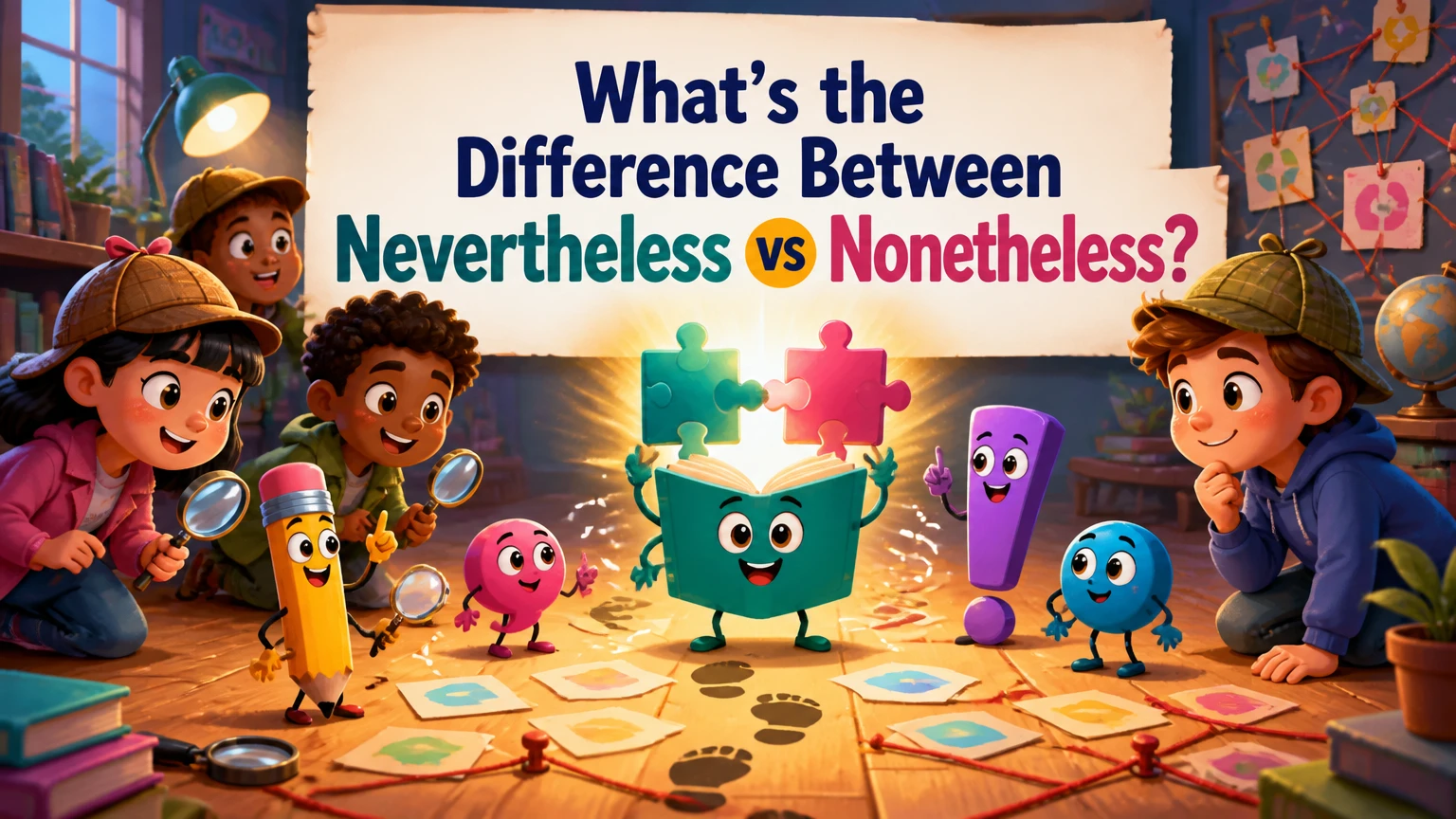
Nevertheless and nonetheless have the same core meaning: “in spite of that,” “even so,” or “all the same.” In modern English, they are interchangeable conjunctive adverbs that signal contrast or concession, although nevertheless is often the more familiar choice and neither word is inherently better for qualitative or quantitative statements.
Key Facts / At a Glance
Nevertheless and nonetheless both express a result that remains true despite a previous fact.
Both words can function as conjunctive adverbs connecting related independent clauses.
A semicolon or a sentence break is normally required before either word when it links two independent clauses.
Nevertheless has 12 letters and is commonly pronounced with four syllables.
Nonetheless has 10 letters and is commonly pronounced with three syllables.
The supposed rule that nevertheless suits qualitative ideas while nonetheless suits numbers has no established basis in standard grammar.
Are Nevertheless and Nonetheless Interchangeable?
Yes. Nevertheless and nonetheless are interchangeable in most modern sentences because both mark concession: the second statement remains valid even though the first statement might suggest the opposite outcome. The choice usually changes rhythm, emphasis, or register rather than truth conditions.
Compare these sentences:
- The instructions were complicated. Nevertheless, we completed the installation.
- The instructions were complicated. Nonetheless, we completed the installation.
The propositions are the same. The first sentence may sound slightly more familiar to many readers, while the second can feel shorter or more polished. Those impressions depend on dialect, genre, age, and individual preference; they do not create a dependable semantic distinction.
The words are especially easy to substitute when they appear before a clause:
The forecast predicted heavy rain; nevertheless, the match continued.
The forecast predicted heavy rain; nonetheless, the match continued.
A substitution test is useful during editing. Replace one word with the other, then ask whether the contrast remains unchanged. If the answer is yes, style rather than meaning should determine the final choice.
The Important Qualification
Interchangeability does not mean identical distribution in every context. Nonetheless can sound slightly more compact because it has fewer letters and usually fewer syllables, while nevertheless may sound more established in academic prose. These are tendencies, not grammar rules.
Neither adverb means “therefore,” “also,” “afterward,” or “for example.” A writer who needs cause, addition, time, or illustration should select a connector that expresses that relationship directly.
What Does Nevertheless Mean?
Nevertheless means “in spite of that,” “even so,” or “all the same.” The word acknowledges a preceding difficulty, qualification, or opposing fact and then introduces a statement that remains true despite it.
Examples include:
- The proposal exceeded the budget. Nevertheless, the board approved it.
- The medication caused mild nausea; nevertheless, the patient continued treatment.
- The evidence is incomplete. The hypothesis is plausible, nevertheless.
The word is formed historically from never, the, and less, but modern speakers do not normally interpret those parts separately. Historical structure can explain spelling, but it does not impose a present-day rule about the kind of information that should follow.
Nevertheless often works well in formal explanations because it makes the logical concession explicit. It is common in essays, reports, legal writing, reviews, and narrative prose, although “but,” “still,” or “even so” may be clearer for general audiences.
What Does Nonetheless Mean?
Nonetheless means “in spite of that,” “even so,” or “all the same.” Nonetheless can replace nevertheless in ordinary modern usage without changing the central meaning of a sentence.
Examples include:
- The sample size was small. Nonetheless, the findings deserve further investigation.
- The route is longer; nonetheless, it is safer during winter.
- The product has limitations. It remains useful, nonetheless.
The word historically combines none, the, and less, but its current meaning is not restricted to quantities, measurements, or numerical data. This point matters because some writing advice claims that nonetheless is better for numbers and nevertheless is better for qualities. Standard dictionaries define both words as concession markers, and standard grammar references do not establish that division.
A numerical example can use either form:
Sales fell by 4 percent. Nevertheless, the company remained profitable.
Sales fell by 4 percent. Nonetheless, the company remained profitable.
A qualitative example can also use either form:
The explanation was abstract. Nonetheless, the central idea was clear.
The explanation was abstract. Nevertheless, the central idea was clear.
How Do Nevertheless and Nonetheless Work Grammatically?
Nevertheless and nonetheless are adverbs, more specifically conjunctive or sentence adverbs when they connect independent thoughts. They express the relationship between clauses, but they do not function like coordinating conjunctions such as and, but, or or.
A conjunctive adverb cannot normally join two independent clauses with only a comma. The standard pattern is:
Independent clause; conjunctive adverb, independent clause.
For example:
The deadline was short; nevertheless, the team delivered the report.
The semicolon separates the two complete clauses. The comma after the conjunctive adverb marks its position inside the second clause.
A sentence break is equally clear:
The deadline was short. Nonetheless, the team delivered the report.
The adverb can also appear within a clause:
The team, nevertheless, delivered the report.
The team delivered the report, nonetheless.
The middle position requires paired commas when the word interrupts the clause. Sentence-final placement is grammatical, but it can sound literary, emphatic, or less natural than initial placement.
What Is the Difference Between a Conjunction and a Conjunctive Adverb?
A coordinating conjunction directly joins grammatical elements, whereas a conjunctive adverb describes the logical relationship between independent clauses. But can follow a comma in a standard compound sentence; nevertheless normally cannot.
- Correct: The deadline was short, but the team delivered the report.
- Correct: The deadline was short; nevertheless, the team delivered the report.
- Incorrect in formal edited prose: The deadline was short, nevertheless, the team delivered the report.
The distinction explains many punctuation errors. The problem is not that nevertheless or nonetheless is too formal; the problem is that the writer has treated an adverb as though it were a conjunction.
Where Can You Place Nevertheless or Nonetheless?
Both words can appear at the beginning, middle, or end of a sentence. Initial placement is the clearest and most frequent option when the adverb introduces a contrast with the preceding sentence.
| Position | Correct pattern | Example | Typical effect |
|---|---|---|---|
| Sentence beginning | Sentence. Nevertheless, clause. | The plan was costly. Nevertheless, we adopted it. | Clear, formal transition |
| After semicolon | Clause; nonetheless, clause. | The plan was costly; nonetheless, we adopted it. | Compact clause connection |
| Mid-clause | Subject, nevertheless, verb. | We, nevertheless, adopted the plan. | Deliberate interruption |
| Sentence end | Clause, nevertheless. | We adopted the plan, nevertheless. | Literary or emphatic |
| After a short phrase | Nevertheless, phrase or clause | Nevertheless, the risk remained. | Strong concession |
Beginning a Sentence
Beginning a sentence is fully grammatical:
The first trial failed. Nevertheless, the researchers repeated it.
The comma after the adverb is conventional when the adverb introduces the sentence. The same rule applies to nonetheless.
Following a Semicolon
A semicolon is appropriate when the words connect two closely related independent clauses:
The evidence was limited; nevertheless, the conclusion was reasonable.
The semicolon belongs before the conjunctive adverb, and the comma normally follows it. A period also works if the writer wants a stronger separation.
Ending a Sentence
Final position is possible:
The evidence was limited. The conclusion was reasonable, nonetheless.
Many editors prefer a comma before final nevertheless or nonetheless when the adverb is parenthetical. The placement can add emphasis, but repeated final placement may make prose sound mannered. Initial placement is usually the safest choice for learners and technical writers.
Which Word Sounds More Formal?
Both words are formal compared with but, still, and anyway, but nevertheless often feels more familiar and flexible. Nonetheless can sound more concise, deliberate, or literary, especially when it appears in formal reports or argumentative prose.
| Context | Usually natural choice | More conversational alternative | Example |
|---|---|---|---|
| Academic essay | Nevertheless | Still | The data are limited; nevertheless, the pattern is consistent. |
| Business report | Either word | Even so | Costs increased; nonetheless, the project stayed on schedule. |
| Legal or policy prose | Nevertheless | However | The exception applies; nevertheless, the rule remains operative. |
| Personal email | Still | But | The train was late, but we arrived. |
| Casual speech | Neither is necessary | Anyway | I am tired, but I will go anyway. |
| Literary narration | Either word | Even so | The house was empty; nonetheless, she entered. |
Register is an audience decision, not a correctness test. A formal adverb can be grammatically perfect and still be a poor choice for a text message, a child-facing explanation, or spoken dialogue intended to sound spontaneous.
Which Is More Common, Nevertheless or Nonetheless?
Nevertheless is generally more common in edited English, while nonetheless remains well established and fully standard. Exact frequency varies by corpus, region, publication type, and period, so a universal “two or three times more common” ratio should not be treated as a stable grammar fact.
Search results, book databases, and language corpora measure different populations. Academic publishing may favor nevertheless, while journalism, business writing, or a particular national variety may show a smaller difference. Frequency alone does not determine suitability.
| Feature | Nevertheless | Nonetheless |
|---|---|---|
| Spelling length | 12 letters | 10 letters |
| Common syllable count | 4, nev-er-the-less | 3, none-the-less |
| Core meaning | In spite of that | In spite of that |
| Grammatical role | Conjunctive adverb | Conjunctive adverb |
| Typical register | Formal, academic, literary | Formal, academic, literary |
| Quantitative restriction | None | None |
| Standard substitution | Yes | Yes |
The practical rule is simple: choose nevertheless when familiarity matters, and choose nonetheless when its shorter rhythm fits the sentence. Do not choose between them based only on whether the preceding statement contains a number.
Is Nevertheless More Correct Than Nonetheless?
No. Nevertheless is not more grammatically correct than nonetheless, and nonetheless is not a lower-status substitute. Both are standard English adverbs with the same concessive function.
The apparent hierarchy often comes from personal style preferences or frequency differences. A teacher may recommend nevertheless because students encounter it more often, while an editor may prefer nonetheless to avoid repetition. Those recommendations concern exposure and prose rhythm, not correctness.
A useful distinction is:
- Correctness: Both forms are standard.
- Clarity: Both forms clearly mark concession.
- Naturalness: One may fit a particular sentence better.
- Register: Both are more formal than but or still.
- Frequency: Nevertheless is often more familiar.
That distinction prevents overediting. Changing nonetheless to nevertheless does not automatically improve a sentence.
What Punctuation Errors Should You Avoid?
The most common error is a comma splice, in which a comma incorrectly joins two independent clauses around nevertheless or nonetheless.
| Problem | Incorrect version | Correct repair | Reason |
|---|---|---|---|
| Comma splice | The test failed, nevertheless, we continued. | The test failed; nevertheless, we continued. | Use a semicolon or period |
| Double conjunction | The test failed, but nevertheless we continued. | The test failed; nevertheless, we continued. | Remove the redundant linker |
| Missing internal comma | The test failed; nevertheless we continued. | The test failed; nevertheless, we continued. | Set off the introductory adverb |
| Misplaced comma | The test, nevertheless failed. | The test nevertheless failed. | No interruption is intended |
| Overpunctuation | The test failed; nevertheless, we, continued. | The test failed; nevertheless, we continued. | Do not separate subject and verb |
Is “But Nevertheless” Always Wrong?
But nevertheless is often redundant, but it is not automatically ungrammatical in every construction. But and nevertheless can both signal concession, so using them together frequently repeats the same relationship.
Prefer one clear structure:
It was raining, but we went running.
It was raining; nevertheless, we went running.
Some writers use but nevertheless for emphasis, especially in speech or informal prose. In edited writing, removing one usually produces a tighter sentence.
Does a Comma Alone Work?
A comma alone does not normally join two independent clauses when nevertheless appears between them.
Incorrect: The device is expensive, nevertheless, it is reliable.
Use one of these repairs:
- The device is expensive; nevertheless, it is reliable.
- The device is expensive. Nevertheless, it is reliable.
- The device is expensive, but it is reliable.
- Although the device is expensive, it is reliable.
The fourth version changes the syntax by using a subordinating conjunction, but it preserves the concessive relationship.
How Do These Words Compare With However, Still, Yet, and Anyway?
However, still, yet, and anyway can overlap with nevertheless and nonetheless, but their grammar, tone, and emphasis differ. Substitution is safest when the intended relationship is concession rather than cause, sequence, or addition.
| Connector | Core meaning | Typical position | Register | Example |
|---|---|---|---|---|
| Nevertheless | In spite of that | Beginning, middle, end | Formal | The method is slow; nevertheless, it works. |
| Nonetheless | In spite of that | Beginning, middle, end | Formal | The method is slow; nonetheless, it works. |
| However | In contrast or despite that | Beginning, middle, end | Formal-neutral | The method is slow. However, it works. |
| Still | Even so | Beginning, middle, end | Neutral | The method is slow. Still, it works. |
| Yet | Despite that, until now | Beginning or middle | Neutral | The method is slow, yet reliable. |
| Anyway | Regardless of that | Beginning or end | Informal | The method is slow, but we used it anyway. |
However can introduce a contrast between ideas without always implying that the second result defies the first. Anyway often dismisses or moves past an objection, so it is not a perfect replacement in formal argument. Yet can join clauses more directly than a conjunctive adverb.
When Should You Use Although Instead?
Use although when you want one clause to depend grammatically on another:
Although the method is slow, it is reliable.
Use nevertheless or nonetheless when you want two independent statements with a clearly marked logical transition:
The method is slow; nevertheless, it is reliable.
The choice affects sentence architecture. Neither structure is universally superior.
Which Choice Is Best for Different Writers?
The best choice depends on audience, genre, and sentence rhythm, not on an alleged qualitative or quantitative meaning.
For ESL Learners
Start with nevertheless because it is highly recognizable and works in a broad range of formal contexts. Learn the punctuation pattern at the same time: period plus Nevertheless, or semicolon plus nevertheless,.
For Academic Writers
Use either word when the argument requires concession. Avoid placing one in every paragraph, because repeated transition words make the structure predictable and can conceal weak logical connections.
A better academic sequence might be:
The sample was small. Nevertheless, the result was statistically significant.
The adverb should describe a real relationship between the claims, not decorate a paragraph transition.
For Business and Data Writers
Both forms work after metrics, but neither one has a special numerical function:
Revenue declined 4 percent; nonetheless, cash flow improved.
The sentence is effective because the second result contrasts with the first, not because nonetheless is supposedly quantitative.
For Creative Writers
Choose based on voice. Nonetheless may suit compressed narration, while nevertheless may sound more expansive, but dialogue should reflect the character’s natural speech. In most casual dialogue, still, but, or anyway will sound less staged.
When Should You Use Neither Word?
Use neither nevertheless nor nonetheless when the relationship is not concessive. These adverbs are poor substitutes for connectors that express cause, time, addition, condition, or evidence.
| Intended relationship | Better connector | Example |
|---|---|---|
| Cause | Therefore, because | The road flooded; therefore, the buses stopped. |
| Addition | Also, moreover | The device is compact; moreover, it uses little power. |
| Sequence | Then, afterward | The alarm sounded; afterward, the building was evacuated. |
| Condition | Therefore only if, provided that | The permit is valid provided that fees are paid. |
| Example | For example | Several metals corrode; for example, iron rusts in moisture. |
| Strong opposition | But, whereas | The first model is cheap, but the second is faster. |
A frequent mistake is inserting nevertheless wherever a paragraph changes direction. The word must communicate “the previous fact might have led us to expect something else, but the following fact remains true.”
A Counterintuitive Editing Rule
If the second sentence is simply a new point, do not force a contrast marker into it. A transition can make weak reasoning appear connected without actually explaining the relationship. Remove the adverb and check whether the logic becomes more honest.
How Can You Choose Between Nevertheless and Nonetheless?
Use a four-step editing test:
- Identify the relationship. Confirm that the second statement is true despite the first.
- Check the clause structure. Use a period or semicolon if both sides are independent clauses.
- Read both versions aloud. Select the form with the clearer rhythm.
- Match the audience. Use still, but, or anyway when formal diction would sound unnatural.
For example:
The software is expensive. Nevertheless, it reduces processing time.
The sentence passes all four tests. The second clause is a concession, the period is correct, nevertheless sounds suitable in a technical report, and the contrast is logically explicit.
A practical house style can also reduce inconsistency. An organization might prefer nevertheless in general prose and reserve nonetheless for variation, but that is an editorial policy rather than a rule of English.
Practitioner Insight: Vary Connectors by Logic, Not Decoration
Writers often alternate nevertheless and nonetheless merely to avoid repetition. That approach can create a false impression that the terms encode different meanings. Vary connectors only when the logical relationship or register changes.
Frequently Asked Questions
Is Nonetheless Old-Fashioned?
No. Nonetheless is formal, but it remains standard contemporary English. It may appear less frequently than nevertheless in some corpora, yet lower frequency does not make it archaic. Use nonetheless when its sound and length suit the sentence.
Can Nevertheless Be Used in Conversation?
Yes, but nevertheless is more formal than but, still, or anyway. A speaker might naturally say, “It was expensive, but we bought it anyway.” The sentence “It was expensive; nevertheless, we bought it” is grammatical but may sound prepared or formal in casual conversation.
Do Nevertheless and Nonetheless Mean the Same as However?
Usually, they overlap, but they are not identical in every context. Nevertheless and nonetheless strongly suggest that the second statement remains true despite an obstacle or contrary expectation. However can mark a broader contrast without that same concessive force.
Can I Put Nonetheless After a Comma?
You can place nonetheless after a comma when it functions as a parenthetical or sentence-final adverb, but a comma alone cannot join two independent clauses. Write “The plan failed; nonetheless, we revised it,” not “The plan failed, nonetheless, we revised it.”
Which Word Should I Learn First?
Learn nevertheless first if you want one formal concessive adverb with broad recognition. After mastering its meaning and punctuation, add nonetheless as an interchangeable alternative. Neither word is restricted to academic writing or numerical information.
Is “Nevertheless” a Conjunction?
No. Nevertheless is an adverb, commonly described as a conjunctive adverb when it links related independent clauses. Unlike but, it does not normally join two independent clauses after a comma alone. Correct punctuation requires a semicolon, a period, or a different sentence structure.
The Bottom Line
The difference between nevertheless vs nonetheless is mainly stylistic, not semantic. Both mean “in spite of that,” both function as concessive conjunctive adverbs, and both can appear at the beginning, middle, or end of a sentence. Nevertheless is often the more familiar choice, while nonetheless offers a shorter, equally correct alternative. Choose based on audience, rhythm, and register, then punctuate the connection with a semicolon or sentence break when two independent clauses are involved.