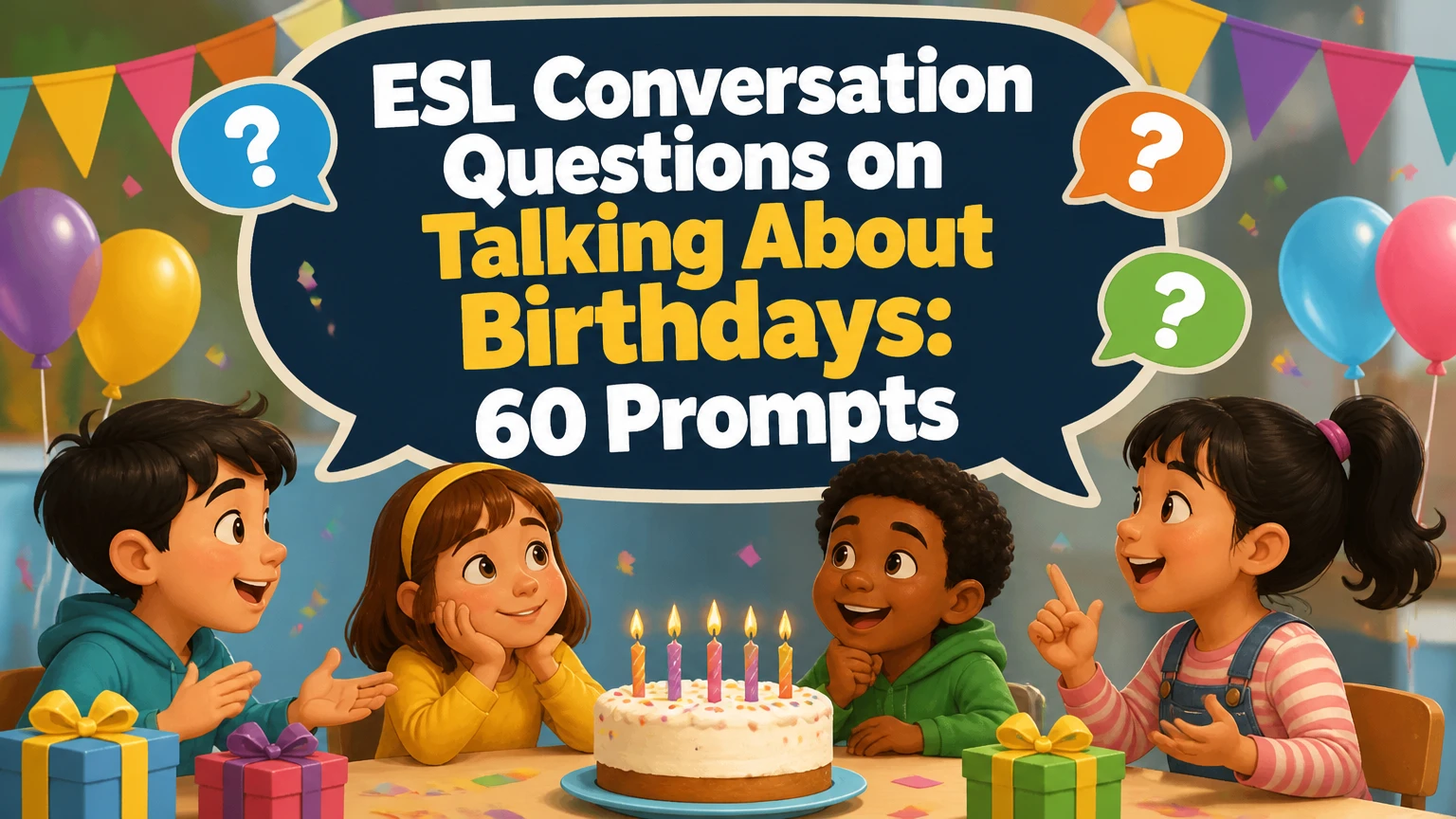
ESL conversation questions on talking about birthdays help learners practise dates, personal experiences, preferences, cultural traditions, future plans, and polite follow-up questions. The strongest lesson moves from concrete A1-A2 prompts to reflective B1-B2 discussion and C1-C2 analysis, while protecting students’ privacy and giving every learner a reason to speak.
Key Facts at a Glance
A 45-60-minute birthday lesson works best with a warm-up, scaffolded questions, production task, and delayed correction.
A1-A2 learners need concrete prompts using present tense, dates, numbers, and familiar vocabulary.
B1-B2 learners can discuss memories, traditions, preferences, hypothetical celebrations, and aging.
C1-C2 learners can analyse commercialization, social media, generational attitudes, and birthday anxiety.
A two-follow-up-question rule prevents students from treating the worksheet as an interrogation.
Students should be allowed to pass, invent a birthday, or discuss a fictional person when the topic feels private.
What Makes Birthday Questions Effective in ESL?
Birthday questions are effective because they combine familiar personal content with several useful language functions: describing routines, narrating past events, expressing preferences, making plans, comparing cultures, and giving reasons. The topic also produces natural vocabulary such as birthday party, birthday cake, make a wish, blow out the candles, receive a gift, and throw a party.
A birthday lesson should not assume that every learner celebrates birthdays in the same way. Some students may follow religious traditions, avoid birthday celebrations, have difficult family experiences, or simply prefer not to disclose their date of birth. Offer alternatives before discussion begins.
The teacher’s main objective is extended interaction, not completion of every prompt. A useful classroom target is at least 70% student talking time, measured by observing whether learners are speaking, listening, asking follow-ups, and negotiating meaning while the teacher monitors quietly.
Which Birthday Vocabulary Should Students Learn?
Students usually need 10-15 birthday expressions before discussion becomes fluent. Teach phrases in short chunks rather than isolated words, because chunks reduce hesitation and improve grammatical accuracy.
| Expression | Meaning | Example sentence |
|---|---|---|
| birthday party | social event for a birthday | I had a small birthday party at home. |
| birthday cake | cake served at a birthday | We ordered a chocolate birthday cake. |
| make a wish | silently hope for something | She closed her eyes to make a wish. |
| blow out the candles | extinguish candles by blowing | The child blew out eight candles. |
| receive a gift | get a present | I received a book from my cousin. |
| unwrap a present | remove gift wrapping | He unwrapped the present slowly. |
| throw a party | organize a party | They are throwing a party next Saturday. |
| milestone birthday | birthday marking an important age | Eighteen is a milestone birthday in many countries. |
| birthday blues | sadness or anxiety around a birthday | She gets the birthday blues when she feels isolated. |
| get together | meet socially | We got together for dinner. |
Pronunciation deserves brief attention. Birthday contains the voiced dental fricative /ð/, while thirteen and thirty differ in stress and vowel quality. Have students repeat meaningful phrases such as “My birthday is on Thursday” rather than practising single sounds without context.
Which Sentence Frames Support A1-A2 Learners?
A1-A2 learners benefit from frames that make the grammar visible:
- My birthday is on ___.
- I usually celebrate by ___.
- My favorite birthday food is ___ because ___.
- Last year, I ___.
- I would like to receive ___.
- In my family, we usually ___.
- What about you?
- Why do you like that?
These frames support accuracy without forcing identical answers. Remove the frames gradually after students complete one successful round.
What Are the Best A1-A2 Birthday Conversation Questions?
A1-A2 birthday questions should focus on dates, routines, people, food, gifts, and simple preferences. Students can answer in one or two sentences at first, but the teacher should quickly add “Why?” or “Who with?” to move beyond isolated words.
- When is your birthday?
- What month is your birthday in?
- What do you usually do on your birthday?
- Do you have a birthday party?
- Who do you celebrate with?
- What food do you eat?
- What kind of cake do you like?
- What is your favorite birthday drink?
- Do you receive cards?
- What is a good birthday gift?
- What gift would you like this year?
- Do you like surprises?
- What colors do you use for decorations?
- Do you take photos at a birthday party?
- What is one birthday tradition in your family?
- Do you prefer a party at home or in a restaurant?
- What do children do at birthday parties?
- What song do people sing at birthdays?
- Do you give gifts to your friends?
- What was your best birthday food?
A useful beginner information-gap activity gives Student A a fictional birthday calendar and Student B a list of people, dates, and party plans. Students ask questions to complete missing information, so the exchange has a genuine purpose.
What Are Good B1-B2 Birthday Discussion Questions?
B1-B2 questions require past narration, explanations, comparisons, and hypothetical language. Ask learners to include a time marker, a reason, and one specific detail in each answer.
- How did you celebrate your last birthday?
- What is your earliest birthday memory?
- What was the most memorable birthday you have had?
- Have you ever had a disappointing birthday?
- Do you prefer a large party or a small gathering?
- What makes a birthday celebration successful?
- Which birthday traditions are common in your country?
- Which traditions are changing?
- How do children and adults celebrate differently?
- What is the best birthday gift you have received?
- What is the most thoughtful gift you have given?
- Is an expensive gift better than a personal gift?
- How has social media changed birthday celebrations?
- Do people feel pressure to post birthday photos?
- Should friends always remember someone’s birthday?
- How do you celebrate when you are away from family?
- If you had an unlimited budget, what would you organize?
- If you could celebrate any birthday again, which would you choose?
- How do you feel about getting older?
- Should employers celebrate workers’ birthdays?
- What birthday customs should visitors understand in your culture?
- How do people politely decline a birthday invitation?
- Is it acceptable to ask someone’s age?
- What would make a birthday celebration environmentally responsible?
For narrative practice, require a beginning, turning point, and outcome. For example, students can explain where the celebration happened, what unexpected event occurred, and how the guests responded.
Which Advanced Questions Create Deeper Discussion?
C1-C2 birthday questions work best when they involve claims that students can challenge. Give groups a position card, such as “Birthdays are mainly commercial events,” then require evidence, a concession, and a conclusion.
- To what extent do birthdays become less important in adulthood?
- Why do milestone ages matter more than ordinary birthdays?
- How do cultural and religious beliefs shape birthday customs?
- Should a person’s age be treated as private information?
- How does the birthday industry influence social expectations?
- Does social media make celebrations more meaningful or more performative?
- Why might a person experience birthday blues?
- Are birthday blues caused more by aging, loneliness, comparison, or unmet expectations?
- How do parents’ birthday traditions differ from those of younger adults?
- Should schools avoid birthday celebrations to protect inclusion?
- Are milestone birthdays useful social rituals or arbitrary numbers?
- Does a large birthday party demonstrate friendship?
- How should people respond when a friend forgets their birthday?
- Can public birthday rituals reinforce inequality?
- Should workplaces organize compulsory birthday celebrations?
- Is giving money more practical but less meaningful than giving a gift?
- How might climate concerns change birthday parties?
- What does a society’s treatment of older adults reveal about its values?
- Are birthdays a celebration of identity, survival, relationships, or consumption?
- Should parents post photos of children’s birthday parties online?
A strong advanced follow-up is “What evidence would change your mind?” It moves the exchange from personal opinion toward reasoning and makes discussion skills visible.
How Should a Teacher Run a 60-Minute Birthday Lesson?
A 60-minute birthday lesson should contain four phases: 10 minutes of vocabulary and activation, 25 minutes of scaffolded discussion, 15 minutes of role-play, and 10 minutes of delayed correction. The largest block belongs to student interaction, while teacher explanations remain short and targeted.
| Time | Phase | Teacher action | Student output |
|---|---|---|---|
| 0-5 minutes | Anonymous warm-up | Display four celebration options | Vote and explain one choice |
| 5-10 minutes | Vocabulary | Teach 10-15 lexical chunks | Pronounce and complete frames |
| 10-20 minutes | First discussion | Assign six levelled prompts | Give 30-60-second answers |
| 20-35 minutes | Follow-up rounds | Enforce two follow-up questions | Listen and respond naturally |
| 35-50 minutes | Role-play | Give planning constraints | Negotiate a birthday plan |
| 50-60 minutes | Feedback | Board anonymous errors | Correct, repeat, and self-assess |
Before class, prepare question cards, a timer, a fictional birthday calendar, role-play constraints, and an exit ticket. For a 20-student class, groups of two or three usually create more speaking opportunities than a single whole-class discussion.
How Can Teachers Prevent a Question-Checklist Conversation?
Teachers can prevent checklist conversations by requiring two spontaneous follow-up questions before partners select a new prompt. Follow-ups must connect to the answer, such as “Who was there?”, “What happened next?”, “Why did you choose that?”, or “Would you do it again?”
Award one point when a learner asks a relevant follow-up and another when the learner accurately refers to the partner’s answer. This changes the goal from finishing 10 questions to maintaining a conversation.
Which Classroom Activity Fits Each Teaching Situation?
The best activity depends on class size, proficiency, and the desired language outcome. Speed dating maximizes repetition, seminars support abstract reasoning, and role-play creates a practical reason to negotiate.
| Activity | Class size | Rotation or duration | Main language target | Main risk |
|---|---|---|---|---|
| Speed dating | 8-30 students | 3-4 minutes per partner | Fluency and repetition | Repetitive answers |
| Pair interview | 2-20 students | 12-15 minutes | Listening and follow-ups | Unequal participation |
| Socratic seminar | 6-16 students | 20-30 minutes | Argument and turn-taking | Dominant speakers |
| Surprise-party role-play | 4-24 students | 15-20 minutes | Negotiation and planning | Off-topic discussion |
| Gallery walk | 10-30 students | 4 stations, 4 minutes each | Short presentations | Noise and rushed feedback |
| One-to-one itinerary task | 1 learner and tutor | 15-25 minutes | Functional speaking | Limited peer interaction |
Speed dating suits A1-B2 learners who need repeated practice with changing partners. A Socratic seminar suits C1-C2 learners who can sustain a claim and respond to disagreement. Role-play is the strongest mixed-ability option when each participant receives a distinct responsibility.
How Can Students Give Longer Birthday Answers?
The PREP framework helps students extend answers: Point, Reason, Example, Point. A learner answering “Do you like large parties?” might say, “I prefer small parties. They feel more personal. Last year, I invited four friends and we cooked together. For that reason, small gatherings suit me better.”
| PREP stage | Useful prompt | Example |
|---|---|---|
| Point | What is your answer? | I prefer a small party. |
| Reason | Why? | It feels more personal. |
| Example | Can you give a detail? | We cooked together last year. |
| Point | What is your final view? | Small gatherings suit me better. |
For lower levels, use Point, Reason, Example only. For advanced learners, add a counterargument: “Some people prefer large parties because they enjoy meeting many people, but…”
What Role-Plays Work for Birthday Conversation Practice?
Birthday role-plays work when each student has information, preferences, or constraints that others do not have. A shared script produces reading aloud; unequal information produces conversation.
Surprise Party Planning
Assign four roles: organizer, guest of honor’s close friend, budget manager, and venue adviser. Set a budget of $150, a guest limit of eight, a Saturday deadline, and one dietary restriction. The group must decide the location, food, gift, invitation method, and backup plan.
Workplace Birthday Etiquette
Assign an employee, manager, remote colleague, and human-resources representative. The group must plan a $20 shared gift without pressuring anyone to contribute, disclose private information, or attend outside working hours.
Dream Birthday With a Fixed Budget
Give pairs one of four budgets: $25, $100, $500, or $2,000. Students plan food, transport, guests, activities, and a gift, then explain which compromise was necessary.
The teacher should assess negotiation phrases, not extravagance. Useful language includes “Could we compromise?”, “I see your point, but…”, “What if we reduced the guest list?”, and “That option fits the budget.”
How Should Birthday Lessons Handle Culture and Privacy?
Birthday lessons should offer choice because birthdays are not universal in practice, even though the topic is widely recognizable. Students can discuss a fictional character, a national tradition, a public holiday, or a general preference instead of revealing their own date or family history.
Avoid presenting one custom as the normal model. In some communities, birthdays emphasize family meals; in others, religious observance, public milestones, or age-specific ceremonies may matter more. Ask “What happens in some families or communities?” before asking “What happens in your family?”
Use these privacy-safe alternatives:
- Describe a fictional person’s birthday.
- Compare two invented celebrations.
- Discuss a famous character’s milestone birthday.
- Explain a tradition without identifying personal participation.
- Choose “pass” without giving a reason.
The teacher should also avoid requiring students to state their age. Asking “Which milestone ages are important in your society?” creates the same language practice without requesting personal data.
What Are the Common Grammar and Pronunciation Problems?
Birthday conversations commonly expose errors with prepositions, past-tense verbs, countable nouns, and age expressions. Delayed correction is usually less disruptive than interrupting a fluent personal story.
| Common error | Correct form | Teaching contrast |
|---|---|---|
| My birthday is in May 12. | My birthday is on May 12. | in + month, on + date |
| I celebrated at last year. | I celebrated last year. | no preposition with last year |
| I have 25 years old. | I am 25 years old. | be + age |
| I received many present. | I received many presents. | plural count noun |
| We make a party. | We have or throw a party. | natural collocation |
| She buyed a cake. | She bought a cake. | irregular past tense |
| He invited me in his party. | He invited me to his party. | invite someone to |
| I am agree with that. | I agree with that. | agree is a verb |
During correction, write three to five anonymous examples on the board. Students first identify the problem, then repair it in pairs, and finally repeat the corrected sentence with a new personal or fictional detail.
How Do Online Tutors Adapt Birthday Conversation Questions?
Online tutors should use shorter rounds, visible prompts, and shared digital notes. In a 30-minute one-to-one lesson, spend five minutes activating vocabulary, 12 minutes on levelled questions, eight minutes on a planning task, and five minutes on feedback.
Use a shared document with three columns: partner answer, follow-up question, and useful phrase. The learner must type one keyword while listening, then ask a question based on that keyword. This prevents passive listening during video calls.
For camera-shy learners, use an avatar or fictional birthday profile. For learners with limited connectivity, send a printable question card and use the phone for the speaking stage.
How Can Birthday Topics Work in Business English?
Business English birthday lessons should focus on professional etiquette, inclusion, scheduling, and workplace communication rather than childhood parties. Learners can practise inviting colleagues, declining politely, organizing a shared gift, and deciding whether a celebration belongs during working hours.
Useful prompts include:
- Should workplace birthday celebrations be optional?
- How can a manager avoid pressuring employees to contribute money?
- Is a group card appropriate for a remote team?
- How should a colleague respond to a birthday invitation they cannot accept?
- Should workplace celebrations include everyone or only close teammates?
- What is an appropriate budget for a shared office gift?
- How can a team respect employees who do not celebrate birthdays?
- Is announcing an employee’s age ever appropriate?
A practical task is to write a 60-word invitation and a 30-word polite refusal. Students then role-play the exchange using formal and neutral registers.
How Should Teachers Assess Birthday Speaking?
Teachers can assess birthday speaking with four criteria scored from 1 to 4: comprehensibility, interaction, language control, and development. A score of 3 means the learner communicates clearly, responds to a partner, uses mostly accurate target language, and adds relevant supporting detail.
| Criterion | 1 point | 2 points | 3 points | 4 points |
|---|---|---|---|---|
| Comprehensibility | Often unclear | Meaning usually recoverable | Clear with minor strain | Clear and natural |
| Interaction | Gives isolated replies | Answers and occasional questions | Follows up appropriately | Sustains and develops exchange |
| Language control | Frequent breakdowns | Basic forms partly accurate | Mostly accurate target forms | Flexible, accurate range |
| Development | One-word answers | Some added detail | Reasons and examples | Detailed, organized responses |
Use an exit ticket with three tasks: write one past-tense sentence, one future sentence, and one follow-up question. The exit ticket identifies whether students can transfer the spoken language into controlled written production.
What Should Teachers Do When Students Become Silent?
Silence usually results from excessive difficulty, insufficient planning time, privacy concerns, or a partner who does not reciprocate. Reduce the cognitive load first, then increase the challenge.
| Problem | Immediate fix | Follow-up adjustment |
|---|---|---|
| One-word answers | Give a sentence frame | Require one reason |
| Student refuses personal topic | Offer a fictional profile | Normalize passing |
| Partner dominates | Use timed turns | Give listening roles |
| Learners forget vocabulary | Provide five-word support card | Recycle phrases next round |
| Discussion ends quickly | Add “What happened next?” | Require two follow-ups |
| Tenses become confused | Display past and future anchors | Separate question rounds |
A useful board display is “Last year, I…”, “Usually, I…”, and “Next year, I hope to…”. Time anchors make tense choice visible and reduce random switching.
How Long Should a Birthday Conversation Lesson Be?
A complete birthday conversation lesson typically takes 45-60 minutes, while a focused speaking activity takes 15-25 minutes. A 45-minute lesson can omit the extended seminar, and a 90-minute class can add writing, presentations, and peer assessment.
| Lesson length | Vocabulary | Discussion | Production | Feedback |
|---|---|---|---|---|
| 20 minutes | 3 minutes | 10 minutes | 5 minutes | 2 minutes |
| 45 minutes | 8 minutes | 20 minutes | 10 minutes | 7 minutes |
| 60 minutes | 10 minutes | 25 minutes | 15 minutes | 10 minutes |
| 90 minutes | 15 minutes | 30 minutes | 25 minutes | 20 minutes |
The topic becomes repetitive when every question asks for a personal memory. Alternate personal, fictional, cultural, planning, and evaluative prompts.
Frequently Asked Questions
What is a good birthday question for a shy ESL student?
A low-pressure question with a choice is usually best: “Would you prefer a quiet dinner or a large party, and why?” The learner can answer from preference rather than disclose personal history. A picture sequence, sentence frame, or fictional character gives additional preparation time.
How do you ask someone about their birthday politely?
Ask “When is your birthday?” in ordinary friendly conversation, but recognize that the date may be private. If asking about age, use a conditional phrase such as “If you do not mind me asking, how old are you?” In class, “Which birthday traditions are common where you live?” is less intrusive.
What is the difference between birthday and anniversary?
A birthday marks the date a person was born, while an anniversary marks the yearly return of another event, such as a wedding, company founding, or historical event. Learners often confuse the terms because both use dates and yearly celebrations, but they describe different events.
How can students practise birthday vocabulary at home?
Students can record a 60-second fictional birthday plan using five target expressions, listen again, and replace two repeated words. They can also write six questions, answer three aloud, and ask a friend or language partner two follow-ups. Re-recording after feedback provides measurable fluency practice.
Should birthday questions be used with children?
Birthday questions suit children when prompts remain concrete, optional, and age-appropriate. Use cake, games, invitations, decorations, and wishes for younger learners, but avoid requiring disclosure of an exact birth date, family income, gifts, or personal circumstances.
The Bottom Line
ESL conversation questions on talking about birthdays are most effective when teachers sequence them from concrete description to personal narrative, cultural comparison, and critical discussion. Combine levelled prompts with vocabulary frames, two follow-ups, role-play constraints, privacy-safe alternatives, and delayed correction, then assess interaction as well as grammatical accuracy.