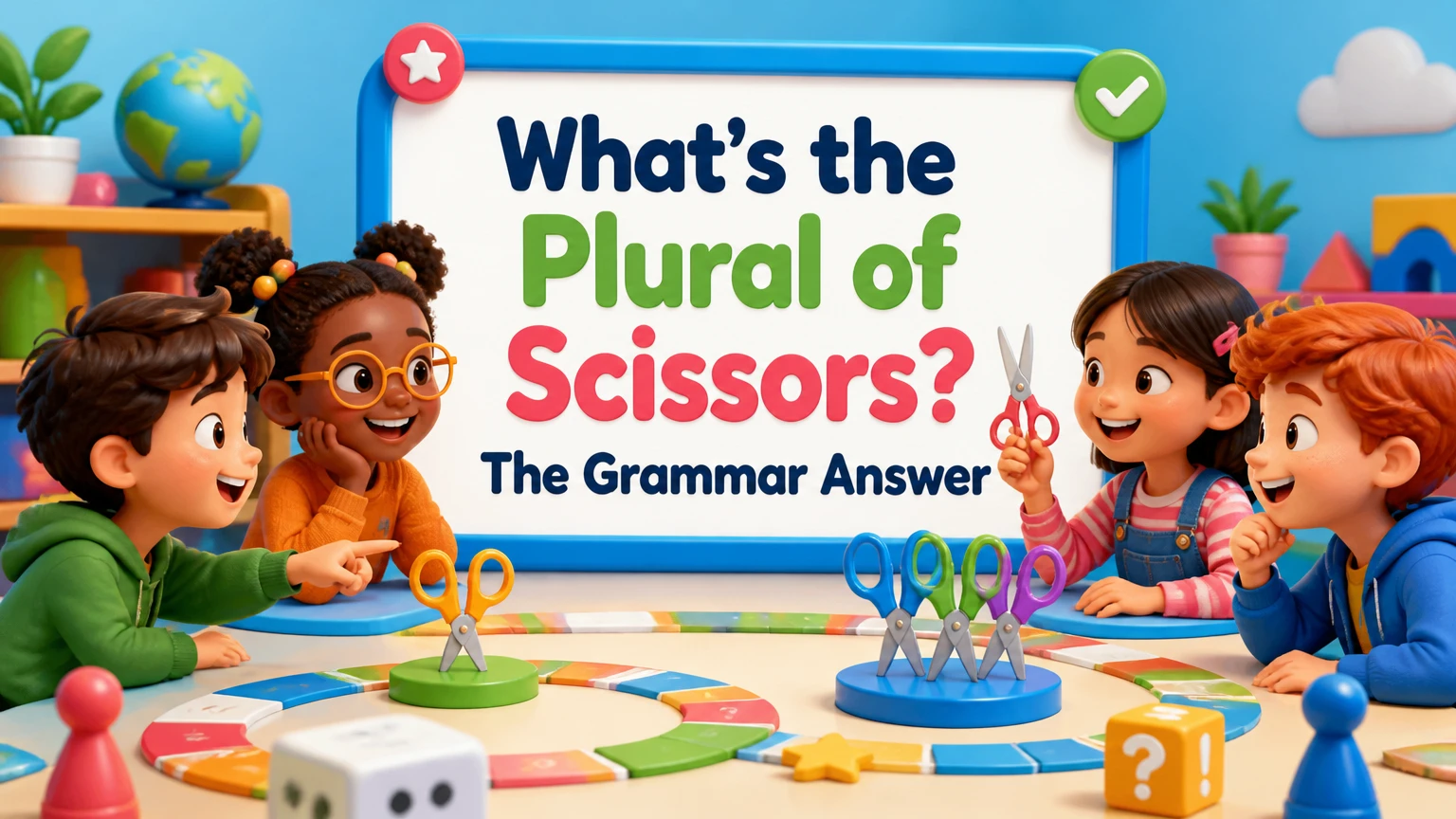
The plural of scissors is still scissors because scissors is a plurale tantum noun, a noun normally used only in the plural form. For one tool, write a pair of scissors; for more than one tool, write two pairs of scissors. Use a plural verb: The scissors are sharp.
Key facts
Scissors normally has the same form for one tool and multiple tools.
A pair of scissors means one complete cutting tool.
Pairs of scissors means two or more complete tools.
The standard verb with scissors is plural: These scissors are blunt.
Scissor is usually a verb or modifier, not the ordinary singular noun.
Scissors’ is the possessive form when the noun itself owns something.
What Is the Plural of Scissors?
The standard answer is scissors. English does not normally form a second plural such as scissorses, and standard English does not usually use scissor as the singular name for one cutting tool.
The practical counting pattern is one pair of scissors, two pairs of scissors, or several pairs of scissors. The word pair supplies the countable singular or plural noun, while scissors identifies the tool inside that pair.
| Meaning | Standard expression | Example |
|---|---|---|
| One tool | a pair of scissors | I bought a pair of scissors. |
| Two tools | two pairs of scissors | The classroom has two pairs of scissors. |
| Several tools | several pairs of scissors | Several pairs of scissors need cleaning. |
| Unspecified number | some scissors | Please bring some scissors. |
| One tool with a demonstrative | these scissors | These scissors cut fabric cleanly. |
The supplied overview is correct about the central rule, but the rule needs one qualification: scissors is not morphologically plural in the same way that books or chairs are. It belongs to a group of nouns whose ordinary forms are plural because the objects historically or conceptually consist of paired parts.
Why Is Scissors Treated as a Plural Noun?
Scissors is treated as a plural noun because the tool has two matching blades joined at a central pivot, a structure historically understood as a pair. English also uses plural grammar for nouns such as trousers, shorts, binoculars, and pliers, although the reason and historical development differ by word.
The grammatical category is called plurale tantum, Latin for “plural only.” A plurale tantum noun normally lacks a commonly used singular counterpart. The noun scissors therefore combines with are, were, have, and do, rather than is, was, has, and does when the noun is the subject.
Examples include:
- The scissors are on the desk.
- Those scissors were expensive.
- These scissors have stainless-steel blades.
- The scissors do not cut paper cleanly.
The physical design helps explain the language, but grammar does not require a speaker to inspect the object. A single pair of scissors remains grammatically plural because the conventional noun is scissors.
Is “Scissors” Singular or Plural?
Scissors is grammatically plural in standard everyday English, even when it refers to one tool. The phrase a pair of scissors is grammatically singular because the head noun pair is singular, so the verb changes when the phrase becomes the subject.
Compare these sentences:
| Subject | Correct verb | Example |
|---|---|---|
| scissors | are | The scissors are clean. |
| a pair of scissors | is | A pair of scissors is missing. |
| two pairs of scissors | are | Two pairs of scissors are missing. |
| this pair of scissors | is | This pair of scissors is blunt. |
| these scissors | are | These scissors are blunt. |
The noun inside a prepositional phrase does not control agreement. In A pair of scissors is missing, scissors follows of, so the singular head noun pair controls the verb.
Do You Say “Scissors Is” or “Scissors Are”?
Use “scissors are” when scissors is the subject. The sentence The scissors are sharp is standard; The scissors is sharp is normally incorrect in edited English.
Plural agreement applies even when the sentence describes one physical tool:
- The scissors are beside the sewing machine.
- My scissors were in the drawer.
- This scissors has a comfortable handle. Incorrect in standard everyday usage.
- This pair of scissors has a comfortable handle. Correct.
- Where are the scissors?
- The scissors have become dull.
A common mistake occurs when writers see one object and instinctively choose a singular verb. Physical quantity and grammatical number are separate systems. One tool can be referred to by a plural-form noun, just as one pair of trousers can be described with are.
What Happens With Auxiliary Verbs?
Auxiliary verbs follow the same agreement pattern. Use are, were, have, and do with scissors:
- The scissors are not suitable for cardboard.
- The scissors were being sharpened.
- These scissors have been cleaned.
- Why do the scissors keep sticking?
Use singular auxiliaries when pair is the head noun:
- A pair of scissors is being sharpened.
- That pair of scissors has been cleaned.
- Why does this pair of scissors keep sticking?
Why Do We Say “A Pair of Scissors”?
We say “a pair of scissors” because pair provides a singular countable unit for a noun conventionally used in plural form. The expression identifies one complete tool without forcing the nonstandard singular noun scissor.
The same construction works for many objects made of two joined or associated parts:
- a pair of trousers
- a pair of pliers
- a pair of binoculars
- a pair of tweezers
- a pair of spectacles
The construction is useful when a sentence needs an article or an exact number. English generally does not allow a scissors in ordinary standard prose, because a normally introduces a singular count noun and scissors is plural-form.
Use these patterns:
- A pair of scissors is on the table.
- One pair of scissors costs $12.
- Two pairs of scissors are in the kit.
- Three pairs of scissors were distributed to the students.
- A new pair of fabric scissors was needed for the project.
What Is the Plural of “A Pair of Scissors”?
The plural is pairs of scissors. With a number, write two pairs of scissors, four pairs of scissors, or twenty pairs of scissors, not two pair of scissors in standard formal English.
| Quantity | Correct form | Agreement |
|---|---|---|
| 1 | one pair of scissors | is |
| 2 | two pairs of scissors | are |
| 4 | four pairs of scissors | are |
| 12 | twelve pairs of scissors | are |
| Unknown | several pairs of scissors | are |
In informal speech, some regional varieties use two pair in limited contexts, especially with clothing and tools. Formal writing, schoolwork, business communication, and edited publishing should use the regular plural pairs.
Can You Say “A Scissor”?
Do not use “a scissor” as the ordinary singular name for one cutting tool. In standard contemporary English, choose a pair of scissors instead.
The noun scissor does exist, but its common functions are different:
- Verb: The two runners’ legs began to scissor.
- Verb: The machine uses blades that scissor through plastic.
- Modifier: The patient was placed in a scissor position.
- Technical noun: A scissor lift raises a platform vertically.
Technical industries may use singular scissor in compounds such as scissor lift, scissor jack, or scissor mechanism. That use does not make a scissor the normal singular form of the handheld stationery or sewing tool.
| Word or phrase | Function | Standard example |
|---|---|---|
| scissors | plural-form noun | The scissors are clean. |
| a pair of scissors | singular noun phrase | A pair of scissors is missing. |
| scissor | verb | The blades scissor through the material. |
| scissor lift | compound noun | The scissor lift reaches 10 metres. |
| scissor cut | technical or descriptive modifier | The machine uses a scissor cut. |
A specialist dictionary may record uncommon noun uses, and regional speech can differ. Those exceptions do not change the safest general rule for learners: write a pair of scissors.
How Do You Use Scissors in a Sentence?
Use scissors with a plural verb when the word appears alone, and use pair with singular or plural agreement when you count the tools. The correct form depends on the grammatical head of the sentence, not on whether the reader sees one object or several.
Subject Examples
- The scissors are beside the printer.
- These scissors cut through denim.
- My scissors were sharpened yesterday.
- The scissors have blue handles.
- Two pairs of scissors are available.
- A pair of scissors is required for the activity.
Object Examples
The object position does not create a singular verb issue:
- Please pass me the scissors.
- I used a pair of scissors to cut the label.
- The teacher gave each group two pairs of scissors.
- Keep these scissors away from small children.
Questions and Negatives
- Where are the scissors?
- Are the scissors sharp enough?
- The scissors are not designed for wire.
- How many pairs of scissors are in the drawer?
- Is a pair of scissors included in the kit?
The phrase how many scissors can sound ambiguous because scissors names the tool but does not clearly signal whether the speaker means individual tools or pairs. How many pairs of scissors is more precise when counting.
How Do You Make “Scissors” Possessive?
Use “scissors’” when the plural-form noun scissors owns or relates to something, and use “pair of scissors’” when the counted phrase is the possessor. The apostrophe follows the final s in the ordinary plural-form noun.
Examples:
- The scissors’ blades are rusty.
- The scissors’ handles are cracked.
- The pair of scissors’ handle is loose.
- The two pairs of scissors’ blades need oiling.
Writers often choose a clearer of phrase in formal prose:
- The blades of the scissors are rusty.
- The handle of the pair of scissors is loose.
The possessive form can become difficult to read when several nouns are stacked together. Use scissors’ for a direct, short relationship, but use of the scissors when the sentence contains multiple possessors or technical details.
How Do You Pronounce “Scissors”?
Scissors is usually pronounced /ˈsɪzərz/, approximately “SIZ-erz,” with two syllables. The spelling contains silent letters: the initial c and the second s do not receive separate consonant sounds in the usual pronunciation.
| Item | Pronunciation guidance | Example |
|---|---|---|
| scissors | SIZ-erz | The scissors are sharp. |
| scissor | SIZ-er | The blades scissor together. |
| pair | pair | A pair of scissors. |
| pairs | pairz | Two pairs of scissors. |
The final sound in scissors is a voiced z sound, matching the ending in offers or answers, not an extra pronounced syllable such as “sciss-or-es.” Regional accents alter vowel quality, but the two-syllable structure remains broadly recognizable in American and British English.
Is Scissors Used the Same Way in British and American English?
British and American English both commonly use “scissors,” “a pair of scissors,” and plural agreement with “scissors.” Differences in this construction are minor compared with differences in vocabulary, punctuation, or pronunciation elsewhere.
Examples accepted in both major varieties include:
- The scissors are on the desk.
- I need a pair of scissors.
- She bought two pairs of scissors.
- These scissors are for fabric.
Some regional varieties may omit the plural ending in expressions such as two pair, but edited British and American writing normally uses two pairs. School assignments, product instructions, and professional documents should follow the regular form unless a quotation or dialect representation requires otherwise.
What Is the Difference Between Scissors, Shears, and Snips?
Scissors, shears, and snips all describe cutting tools, but the words differ by design, size, and customary use. Scissors is the broad everyday term, while shears often identifies larger or specialized scissors and snips commonly identifies compact cutting tools.
| Term | Typical length or design | Common material | Example |
|---|---|---|---|
| scissors | 10-25 cm, two pivoted blades | Paper, fabric, hair | school scissors |
| shears | 20-35 cm, long or heavy blades | Fabric, hedges, metal | dressmaking shears |
| snips | 10-20 cm, short reinforced blades | Wire, sheet metal, packaging | aviation snips |
| secateurs | 18-25 cm, bypass or anvil blades | Green wood, stems | garden secateurs |
Usage is not perfectly fixed. A manufacturer may call a compact tool shears, while a user may call large fabric shears scissors. The grammar of shears resembles scissors: The shears are sharp, a pair of shears, and two pairs of shears.
Are Scissors and Shears Counted the Same Way?
Both terms are commonly counted with “a pair of,” especially when referring to one complete handheld tool. Write a pair of shears, two pairs of shears, a pair of scissors, and two pairs of scissors.
The practical difference is semantic rather than grammatical. Hairdressing scissors may be small and precise, while tailoring shears may have long blades and an offset handle. The count construction remains the same.
What Common Mistakes Should You Avoid?
The main errors are using “scissor” as the ordinary singular noun, pairing scissors with a singular verb, and writing “two pair” in formal English. Each error can be corrected by identifying whether the sentence refers to the tool, one pair, or multiple pairs.
- Incorrect: I need a scissors.
Correct: I need a pair of scissors. - Incorrect: The scissors is on the desk.
Correct: The scissors are on the desk. - Incorrect: Two pair of scissors were supplied.
Correct: Two pairs of scissors were supplied. - Incorrect: This scissors has blunt blades.
Correct: This pair of scissors has blunt blades. - Ambiguous: How many scissors did you buy?
Clearer: How many pairs of scissors did you buy? - Incorrect possessive: The scissors’s blade is damaged.
Correct: The scissors’ blade is damaged, or the blade of the scissors is damaged.
A useful editing test is to replace scissors with pair of scissors. If the sentence needs a singular article or singular verb, the replacement usually reveals the correct construction.
When Should You Use “A Pair of Scissors” Instead of “Scissors”?
Use “a pair of scissors” when the sentence requires a singular count, an indefinite article, or singular agreement. Use scissors alone when the tool is already identifiable, when the quantity is irrelevant, or when a demonstrative such as these supplies the reference.
| Writing situation | Preferred wording | Reason |
|---|---|---|
| Buying one tool | I bought a pair of scissors. | The quantity is one. |
| Giving an instruction | Use scissors to cut the card. | The exact pair is unimportant. |
| Identifying a tool | These scissors are blunt. | The demonstrative identifies it. |
| Describing a requirement | Bring a pair of scissors. | One complete tool is required. |
| Counting classroom supplies | The class has six pairs of scissors. | Multiple complete tools are counted. |
| Referring to a known tool | Put the scissors away. | The listener knows which tool. |
In instructions, the bare plural can function generically: Cut the thread with scissors. The sentence does not claim that multiple tools are required. It names the tool category in the same way that Write with a pencil names an instrument without discussing its grammatical number.
What Does the Grammar Rule Mean for Formal Writing?
Formal writing should use “scissors are” for the bare noun and “a pair of scissors is” when one tool must be treated as a singular unit. This pattern is clear, conventional, and suitable for academic, workplace, instructional, and editorial contexts.
Recommended formal examples:
- The scissors are stored in a locked cabinet.
- Each student must bring a pair of scissors.
- A pair of scissors is included with the craft materials.
- The two pairs of scissors are different sizes.
- The blades of the scissors require professional sharpening.
Avoid relying on colloquial forms when precision matters. A scissors, the scissors is, and two pair of scissors may appear in informal speech or regional usage, but they are poor choices for standard edited prose.
A practical rule of thumb is simple: if scissors appears by itself as the subject, use a plural verb; if pair appears as the head noun, match the verb to pair.
Frequently Asked Questions
Is “Scissors” Always Plural?
In standard everyday English, scissors is normally plural in form and takes plural agreement. The word can refer to one tool, but writers usually say a pair of scissors when they need a singular count. Rare technical or regional uses do not replace the ordinary standard pattern.
Can I Say “These Scissors” for One Pair?
Yes. These scissors can refer to one complete pair of scissors because demonstratives do not always encode the number of physical tools in the same way that count nouns do. The verb remains plural: These scissors are mine. For maximum counting clarity, write this pair of scissors is mine.
What Is the Correct Phrase for Children’s Scissors?
The standard phrase is a pair of children’s scissors or children’s scissors, depending on whether the quantity matters. Write This pair of children’s scissors is safe for the activity when referring to one tool, and The children’s scissors are in the supply box when using the bare noun.
Is “Scissors” Countable or Uncountable?
Scissors is a plural-form count noun that is counted through “pair,” rather than through a singular form such as “scissor.” Write one pair of scissors, three pairs of scissors, or several pairs of scissors. Do not treat scissors like a mass noun in formal writing.
What Is the Singular of “Scissors” in a Dictionary?
The ordinary singular equivalent is a pair of scissors, not usually a scissor. Dictionaries may list scissor as a verb, a technical modifier, or a specialized noun, but those entries do not establish a scissor as the normal term for one handheld cutting tool.
Should I Write “The Scissors’ Handle” or “The Handle of the Scissors”?
Both are grammatically possible. The scissors’ handle uses a plural-form possessive, while the handle of the scissors uses an of-construction. The second version is often clearer in technical instructions, especially when the sentence already contains several possessive nouns.
The Bottom Line
The answer to whats the plural of scissors is that scissors already has the standard plural-only form. Say a pair of scissors for one tool, pairs of scissors for multiple tools, and use plural agreement with the bare noun: The scissors are sharp. In formal writing, avoid a scissor and the scissors is.