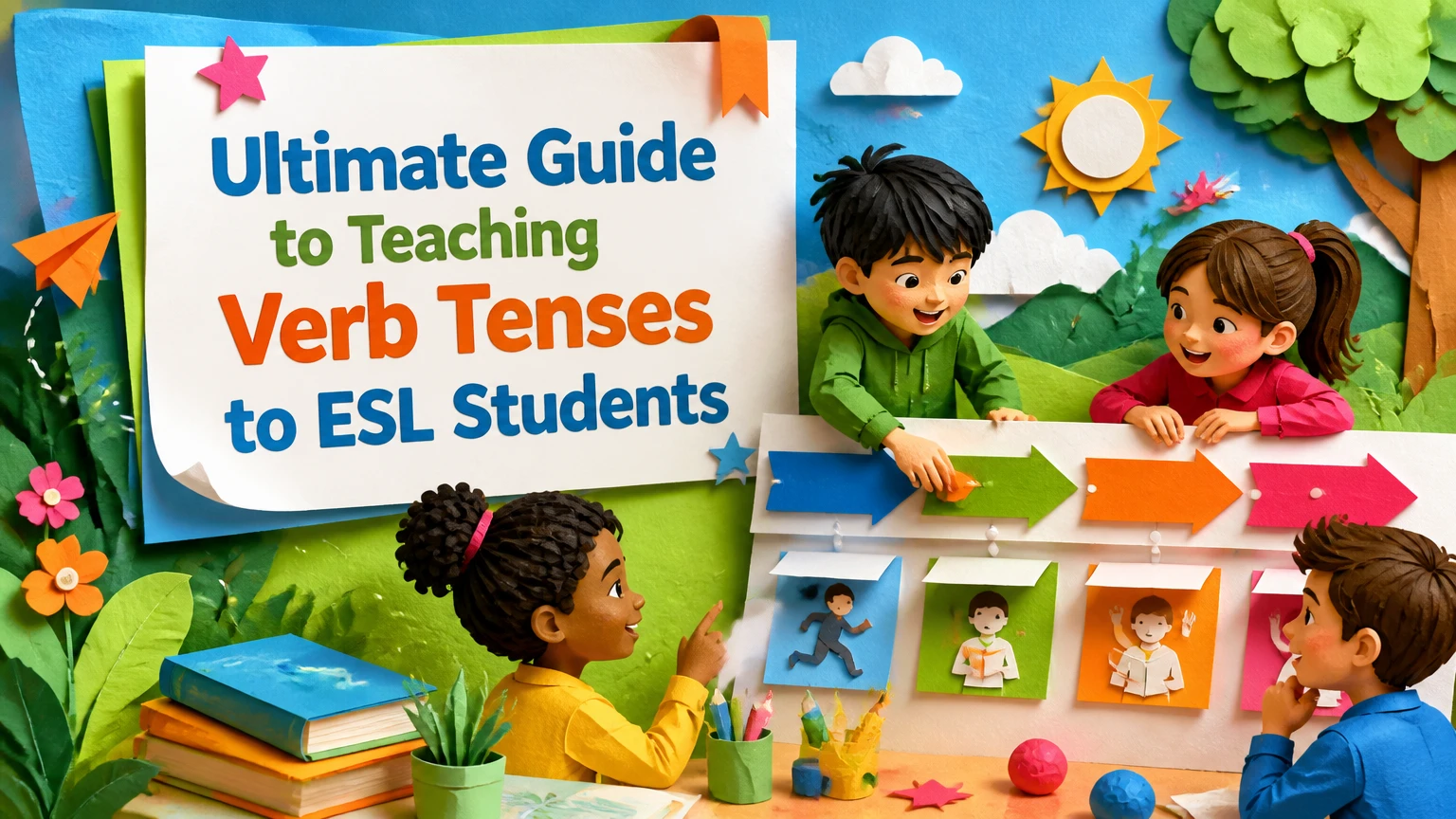
Teaching verb tenses to ESL students works best when learners connect time, aspect, form, and communicative purpose instead of memorizing isolated formulas. The most reliable sequence teaches a small contrast in context, checks meaning with timelines and concept questions, practices accuracy, and then requires purposeful communication.
Key Facts
English teaching traditionally presents 12 tense-aspect combinations, formed from three time references and four aspect patterns.
Present simple, present continuous, and past simple usually provide the most useful beginner foundation.
A tense lesson should establish meaning before formula, because accurate form without understood meaning produces fragile performance.
Present perfect normally connects a prior event to a present reference point, while past simple places an event inside finished past time.
A practical single-tense lesson commonly takes 40-60 minutes, followed by spaced review over several weeks.
Learners improve faster when teachers assess meaning, auxiliary verbs, endings, pronunciation, and use separately.
What Are English Verb Tenses?
English verb tenses are grammatical choices that locate an event in relation to a reference time, while aspect shows whether the speaker presents the event as complete, ongoing, repeated, or connected to another point. In classroom terms, tense answers “when?” and aspect answers “how does the speaker view the event?”
The familiar “12 tenses” model combines three time references with four aspect patterns. Technically, English has present and past verb forms, while future meaning is usually expressed through modal or semi-modal constructions such as will, be going to, and the present continuous. That distinction matters for advanced teachers, but the 12-part framework remains useful for organizing instruction.
| Teaching category | Core structure | Main viewpoint | Example |
|---|---|---|---|
| Simple | Base, past form, or modal + base | State, habit, fact, or completed event | She teaches English |
| Continuous | Be + verb-ing | Temporary or ongoing activity | She is teaching now |
| Perfect | Have + past participle | Earlier event linked to a reference point | She has taught here since 2020 |
| Perfect continuous | Have + been + verb-ing | Duration leading to a reference point | She has been teaching all morning |
Teachers should present the framework as a meaning system, not twelve unrelated boxes. Students need to understand why I lived in Seoul and I have lived in Seoul create different time relationships.
How Do the 12 Tense-Aspect Forms Work?
The 12-form system becomes manageable when each form receives a timeline function, a high-frequency context, and one carefully selected example. Teachers should not give beginners the complete table as a memorization assignment; use it as a planning reference and introduce forms according to communicative need.
| Form | Structure | Typical function | Example |
|---|---|---|---|
| Present simple | Base, third-person -s | Habit, state, fact | Omar works in Cairo |
| Present continuous | am/is/are + -ing | Current or temporary activity | Omar is working tonight |
| Present perfect | have/has + participle | Past event with present relevance | Omar has finished the report |
| Present perfect continuous | have/has been + -ing | Duration until now | Omar has been working since six |
| Past simple | Past form | Finished event in finished time | Omar finished it yesterday |
| Past continuous | was/were + -ing | Background activity at a past time | Omar was working at eight |
| Past perfect | had + participle | Earlier past event | Omar had left before noon |
| Past perfect continuous | had been + -ing | Duration before a past point | Omar had been waiting for an hour |
| Future with will | will + base | Prediction, decision, promise | Omar will call later |
| Be going to | am/is/are going to + base | Intention or evidence-based prediction | Omar is going to apply |
| Future continuous | will be + -ing | Activity in progress at a future time | Omar will be travelling at noon |
| Future perfect | will have + participle | Completion before a future point | Omar will have arrived by six |
| Future perfect continuous | will have been + -ing | Duration up to a future point | Omar will have been travelling for six hours |
The table contains 13 rows because will and be going to are both high-value future constructions, although many syllabi place them under one broad “future simple” category. Present the distinction explicitly rather than implying that English has one mandatory future inflection.
Why should meaning come before form?
Meaning must come before form because students can reproduce an auxiliary pattern while choosing the wrong time relationship. Show a situation, mark the reference point, and ask learners to interpret the speaker’s viewpoint before displaying the formula.
For example, draw a line from 2018 to today and write Mina has lived here since 2018. Ask whether Mina lives here now, whether she lived here in 2019, and whether the sentence names a finished time. Students then see why Mina lived here in 2018 has a different boundary.
Use three layers:
- Meaning: event location, duration, completion, or connection.
- Form: auxiliary, subject agreement, main verb, and participle.
- Use: the reason a speaker selects the form in that situation.
This order also helps teachers diagnose the error. A student may understand the time relationship but lack the past participle, or know the formula but misunderstand a finished time expression.
How Should Teachers Sequence Tenses?
Teachers should sequence tense instruction by communicative usefulness, conceptual contrast, and learner readiness rather than by completing all 12 forms in a fixed calendar. A practical beginner pathway starts with present simple, present continuous, and past simple, then adds future plans, present perfect, and narrative contrasts.
| Learner stage | Priority forms | Communicative outcome | Typical review period |
|---|---|---|---|
| A1 | Present simple, be, present continuous | Introduce routines and current actions | Every lesson for 2-3 weeks |
| A2 | Past simple, future plans, countable time phrases | Describe experiences and arrangements | 3-4 weeks |
| B1 | Present perfect, past continuous, basic past perfect | Discuss experience and narrate events | 4-6 weeks |
| B2 | Perfect contrasts, future continuous, future perfect | Explain deadlines, duration, and predictions | 4-8 weeks |
| C1-C2 | Aspect choice, hypothetical time, passive combinations | Control register and nuanced sequencing | Ongoing writing and speaking review |
A form is ready for instruction when students have a reason to use it. A class planning a holiday can use going to, present continuous, and will more meaningfully than a disconnected future-tense worksheet.
Which forms should beginners learn first?
Beginners should first learn forms that support identity, routine, immediate surroundings, and recent completed events. Present simple supplies high-frequency statements, present continuous supports classroom actions, and past simple unlocks personal narratives.
Do not delay past simple indefinitely. Learners often need it to say what happened yesterday, even when their present-tense accuracy is incomplete. Teach a small set of regular verbs alongside frequent irregular verbs such as go/went, have/had, eat/ate, see/saw, and be/was-were.
How Do You Teach One Tense?
A complete tense lesson usually takes 45-60 minutes and follows a meaning-form-use sequence: contextual presentation, guided accuracy practice, and communicative production. The factor that most determines success is the quality of the contrast, because students remember a form more reliably when they must choose it against a competing form.
Before the lesson
| Item | Typical requirement | Teacher decision |
|---|---|---|
| Time | 45-60 minutes | Add 10 minutes for assessment |
| Materials | 1 timeline, 8-12 prompts, 1 short text | Use images for lower levels |
| Group size | 6-18 learners | Pair work needs assigned roles |
| Target language | 1 form plus 1 contrast | Avoid teaching four forms together |
| Prerequisite | Subject pronouns and main verb meaning | Preteach irregular participles |
Step 1: Create a meaningful situation
Use a short story, image sequence, schedule, or personal information gap. For present perfect, show a project board with completed tasks and ask what the team has finished. For past simple, provide a dated weekend itinerary.
Keep the first context to 6-8 sentences. Underline the target examples, but do not name the tense immediately.
Success checkpoint: Students can identify whether the event is current, finished, or connected to now.
Common mistake: Choosing a context that contains too many competing forms.
Step 2: Check meaning with timelines and CCQs
Draw the event and reference point before writing the formula. Ask questions that require a short, unambiguous answer.
For Leila has worked here since 2021, ask:
- Does Leila work here now? Yes.
- Did she work here in 2022? Yes.
- Is 2021 a finished period in this sentence? No.
- Can the speaker name a completed event yesterday with this sentence? Usually no.
CCQs should test meaning, not grammar vocabulary. “Is this present perfect?” checks recognition of a label, while “Is the action finished now?” checks interpretation.
Success checkpoint: At least 80% of learners answer the CCQs correctly without seeing the rule.
Common mistake: Asking “Do you understand?” and treating silence as comprehension.
Step 3: Display the form
Write positive, negative, and question structures side by side. Mark the auxiliary and main verb in different colors.
| Sentence type | Present perfect example | Form |
|---|---|---|
| Positive | She has finished | subject + has/have + participle |
| Negative | She has not finished | subject + has/have + not + participle |
| Yes/no question | Has she finished? | has/have + subject + participle |
| Wh-question | What has she finished? | wh-word + has/have + subject + participle |
Include contractions in speech practice, such as she’s finished and hasn’t finished. Explain that the main verb does not take past tense after has, did, or will: Did he go?, not Did he went?
Success checkpoint: Learners produce the auxiliary and main verb in the correct order.
Common mistake: Teaching affirmative form while postponing questions and negatives for weeks.
Step 4: Practice with controlled variation
Begin with substitution and information selection, then move to sentence transformation. Use 8-12 items rather than 30 nearly identical blanks.
Effective tasks include:
- timeline-to-sentence matching;
- affirmative-to-negative transformations;
- error correction with one deliberate error;
- verb-card sentence building;
- pair questions using different time markers.
Controlled practice should expose form errors quickly. It should not consume the entire lesson.
Success checkpoint: Learners reach about 80-90% accuracy before freer speaking.
Common mistake: Correcting every pronunciation error while ignoring the tense decision itself.
Step 5: Require purposeful production
Give students a reason to exchange information. A project update requires has completed, has not started, and will finish. A detective story requires past simple, past continuous, and past perfect.
Use delayed correction during a fluency task. Record four or five anonymous examples, classify them as meaning, form, pronunciation, or word-choice errors, and ask the class to repair them after the activity.
Success checkpoint: Each learner uses the target form at least four times with an intelligible purpose.
Common mistake: Calling a worksheet with personal names “communication” when no information gap exists.
How Do Timelines Make Meaning Visible?
Timelines make tense meaning visible by separating event time from speech time and reference time. The most useful classroom timeline marks three points: when the event occurs, the moment of speaking, and any comparison deadline.
Use consistent symbols:
- X: a completed event;
- line: an ongoing duration;
- NOW: the speaking point;
- vertical bar: a deadline or reference point.
For past perfect, place two X marks before NOW and label the earlier event with had. For future perfect, place an X before a future deadline, then write will have plus the participle. For perfect continuous forms, draw a line ending at the reference point and label the duration.
Timelines are less effective for pragmatic choices such as politeness, prediction strength, or social distance. A timeline can show will and going to at the same future point, but a dialogue is needed to show that going to commonly expresses an existing intention or visible evidence.
Which Teaching Model Works Best?
No single model works for every ESL class. PPP provides clear scaffolding for a new form, task-based teaching creates stronger communicative need, contrastive teaching clarifies difficult choices, and lexical chunks improve fluent retrieval when students already understand the underlying pattern.
| Method | Best learner profile | Main strength | Main limitation |
|---|---|---|---|
| PPP | A1-B1, unfamiliar structure | Clear progression from explanation to use | Can produce unnatural drills |
| Task-based lesson | B1-C2, functional goals | Creates genuine communication | Learners may avoid the target form |
| Contrastive lesson | B1-C2, tense confusion | Makes boundaries explicit | Too abstract for early beginners |
| Lexical chunks | A2-C2, speaking fluency | Speeds retrieval of common phrases | Limits novel sentence construction |
| Guided discovery | B1-C2, analytical groups | Builds noticing and self-correction | Requires carefully designed examples |
The strongest practical approach is hybrid: present a short context, guide learners to infer meaning, practice the form, and finish with a task that makes the target choice necessary. PPP is a lesson sequence, not a complete teaching philosophy.
How Do You Teach the Most Difficult Contrasts?
The most difficult tense contrasts become teachable when students compare time anchors, reference points, and speaker viewpoint rather than memorize lists of signal words. Present perfect versus past simple deserves special treatment because both can describe a prior event.
Present perfect versus past simple
Use the past simple for an event inside a finished time box: I visited Kyoto in 2019. Use the present perfect when the period remains open or the result, experience, or duration connects to now: I have visited Kyoto three times.
| Situation | Preferred form | Example | Time status |
|---|---|---|---|
| Finished dated event | Past simple | I met Ana yesterday | Closed |
| Life experience | Present perfect | I have met Ana before | Open relevance |
| Current duration | Present perfect | I have known Ana since 2020 | Continues now |
| Sequence of past events | Past simple | Ana arrived and called me | Finished narrative |
| Earlier event before past event | Past perfect | Ana had left before I arrived | Past reference point |
The common error I have gone to London last year combines an open-time form with a finished time anchor. Ask students to put last year inside a closed box, then rebuild the sentence with went.
British Council teaching materials commonly explain present perfect as a connection between past and present, while the past simple identifies a finished past time. Usage differs in some varieties of English, especially with words such as just, but the time-reference principle remains a dependable classroom starting point.
Stative verbs and continuous forms
Stative verbs usually describe conditions rather than deliberate, bounded activities, so learners generally use them in simple forms: I know the answer, She owns a car, and They believe him. Common groups include knowledge, possession, preference, emotion, and perception.
The rule is not absolute. Meaning can change the grammar:
- I think you are right expresses an opinion.
- I am thinking about the problem describes an active process.
- She has a new car expresses possession.
- She is having lunch describes an activity.
Teach the contrast through paired contexts rather than a banned-word list. Students need to see why I’m loving this course appears in advertising and informal speech even though traditional rules classify love as stative.
Third-person singular -s
Third-person -s is a small sound with a large communication burden because learners must select the subject, remember agreement, and pronounce the ending during real-time speech. Teach the three pronunciations: /s/ in works, /z/ in plays, and /ɪz/ in watches.
Use a visible subject card, a verb card, and an “S” token. During a one-minute routine interview, partners listen only for third-person subjects and place a token whenever the ending is heard. This isolates the target without interrupting every sentence.
Which Activities Build Accuracy and Fluency?
Accuracy activities should force a grammatical decision, while fluency activities should give learners a reason to communicate information that naturally requires the target tense. Mixing both activity types in one lesson prevents students from becoming accurate only on worksheets or fluent only through avoidance.
| Activity | Primary skill | Target contrast | Typical duration |
|---|---|---|---|
| Timeline sort | Meaning | Past simple and present perfect | 8 minutes |
| Information-gap interview | Form plus meaning | Present simple and continuous | 10 minutes |
| Project status meeting | Functional fluency | Present perfect and future | 12 minutes |
| Story reconstruction | Narrative sequencing | Past simple, continuous, perfect | 15 minutes |
| Error auction | Metalinguistic noticing | Mixed tense accuracy | 10 minutes |
| Personal journal exchange | Extended production | Recent and past experience | 15 minutes |
Use retrieval spacing instead of one intensive tense day. Revisit a target after one day, one week, and two to three weeks, changing the context each time. The British Council’s English teaching resources also emphasize contextualized practice and communicative use rather than grammar explanation alone.
How Does the First Language Affect Errors?
A learner’s first language affects tense errors through transfer, but L1 categories do not predict individual performance perfectly. Mandarin-speaking learners may rely heavily on context and aspect particles, Arabic-speaking learners may struggle with auxiliary and agreement systems, and Japanese-speaking learners may need extra support with English time anchoring and articles alongside tense.
| L1 background | Frequent English difficulty | Useful response |
|---|---|---|
| Mandarin | Omitting auxiliaries or past marking | Rehearse complete auxiliary frames |
| Japanese | Selecting English time forms from context | Require explicit timeline choices |
| Arabic | Third-person agreement and auxiliary order | Use subject-auxiliary substitution drills |
| Spanish | Present perfect and past simple boundary | Contrast regional and classroom examples |
| Korean | Articles plus tense in narrative | Separate tense correction from noun-phrase correction |
Avoid telling learners that their language “has no tenses,” which is often inaccurate and can sound dismissive. Ask what their language marks through verb changes, particles, adverbs, or context. Then compare one meaningful pair at a time.
How Should Lessons Change by Learner?
Learner age, proficiency, purpose, and available processing time should determine the lesson design. Children benefit from movement and repeated routines, academic learners need genre-specific tense choices, and workplace learners need status, scheduling, reporting, and negotiation tasks.
| Learner group | Useful context | Priority forms | Avoid |
|---|---|---|---|
| Young learners | Classroom actions and picture stories | Present simple, continuous, past simple | Long terminology lectures |
| General adults | Routines, travel, experiences | Present, past, present perfect, future | Isolated conjugation tables |
| IELTS or TOEFL | Data description and argument | Past, present perfect, future, past perfect | Teaching tense as a score guarantee |
| Business professionals | Project updates and deadlines | Present perfect, future, past simple | Childish flashcard contexts |
| Advanced writers | Research claims and chronology | Perfect forms, passive voice, hedging | Treating all errors as basic mistakes |
For children, say “action now” before introducing present continuous. For business learners, contrast We completed phase one with We have completed phase one: the first reports a finished event, while the second foregrounds the current project status.
How Should Teachers Measure Progress?
Tense mastery should be measured across interpretation, controlled form, guided interaction, and spontaneous production. A student who scores 90% on a fill-in exercise may still omit auxiliaries in conversation, so one test format cannot represent usable competence.
Use a four-part mini-assessment:
- Meaning selection: choose between two forms for six illustrated situations.
- Form completion: produce six affirmative, negative, and question sentences.
- Guided exchange: complete a two-minute information gap.
- Independent task: tell a story or explain a plan for three minutes.
A practical rubric scores each category from 0 to 2:
| Criterion | 0 points | 1 point | 2 points |
|---|---|---|---|
| Time meaning | Usually unclear | Meaning clear with prompts | Meaning consistently clear |
| Auxiliary and verb form | Frequent breakdown | Occasional errors | Mostly accurate |
| Agreement and pronunciation | Often obscures meaning | Errors remain intelligible | Endings usually controlled |
| Contextual choice | Avoids target | Uses target with support | Selects target independently |
Set mastery at 7 of 8 for a familiar context, then test transfer in a new context. Do not advance because a worksheet is complete. Advance when learners can choose and produce the form under modest speaking pressure.
What Are the Most Persistent Errors?
Persistent tense errors usually result from an unresolved meaning contrast, missing retrieval practice, or excessive correction during communication. Teachers should classify the cause before selecting a remedy.
- Wrong time choice: Rebuild the timeline and compare two sentences.
- Missing auxiliary: Use color-coded sentence frames and substitution drills.
- Wrong participle: Create a small personal irregular-verb bank, not a 100-word list.
- Dropped -s: Practice subject selection and pronunciation separately.
- Overuse of continuous: Contrast states with bounded activities.
- Past perfect everywhere: Require two past events before allowing had.
- Confusion between will and going to: Use intention, evidence, and spontaneous decision scenarios.
One expert rule of thumb is to correct the highest-value error first. If missing -s does not affect comprehension but a wrong past-perfect sequence changes the story, address the chronology before the ending.
Another counterintuitive rule is to reduce explanation when errors persist. More terminology often increases cognitive load; two contrasting examples, one timeline, and repeated retrieval can produce better results than another ten-minute lecture.
What Should Teachers Avoid?
Teachers should avoid presenting all 12 forms in one unit, treating time-marker words as automatic rules, and correcting every tense error during a fluency task. These practices create test performance without flexible communicative control.
Time markers are clues, not guarantees. When I was young strongly favors past simple for a finished period, but I have lived here for ten years uses a duration phrase with a present connection. Similarly, today can occur with either form depending on whether the day remains open in the speaker’s context.
Tense teaching is also not a substitute for vocabulary, discourse, pronunciation, or interactional practice. A learner may choose the correct form yet fail to communicate because the verb is unknown, the sentence is poorly organized, or the listener cannot hear the auxiliary.
FAQ
How many English tenses should ESL students learn?
ESL students can usefully study the traditional 12 tense-aspect combinations, but they do not need equal instructional time for each one. Beginners should prioritize present simple, present continuous, and past simple; intermediate learners usually add present perfect, narrative past forms, and practical future constructions before advanced perfect-continuous contrasts.
How long does it take to teach all the tenses?
Teaching an initial tense system typically requires several months of distributed lessons, not one unit. A 45-60 minute lesson can introduce one form or contrast, but reliable independent use generally requires at least three later retrieval sessions in new speaking and writing contexts.
Should teachers teach grammar rules or conversation first?
Teachers should combine both. A short rule explanation can clarify form, but conversation supplies the communicative reason to choose that form. Begin with meaning, provide controlled practice, and finish with a task where avoiding the target structure prevents students from exchanging complete information.
Are English future tenses actually tenses?
English has present and past morphological forms, while future time is commonly expressed through will, be going to, present continuous, and present simple schedules. The traditional 12-tense framework is therefore a useful pedagogical classification of tense and aspect, not a claim that English has 12 distinct verb inflections.
What is the best way to teach verb tenses online?
Online teachers can use shared timelines, polls, chat transformations, breakout-room information gaps, and recorded delayed correction. Keep each screen focused on one contrast, require every learner to produce an answer, and use a short individual speaking check because silent video participation can conceal misunderstanding.
Should tense errors be corrected immediately?
Correct immediately when the error blocks meaning, concerns the lesson’s controlled target, or appears during a pronunciation drill. During fluency work, delayed correction usually protects communication and reveals recurring patterns more accurately, allowing the teacher to address several learners with one focused repair stage.
The Bottom Line
The ultimate guide to teaching verb tenses to ESL students begins with time and aspect, not memorized labels. Sequence high-use forms, show reference points visually, check meaning with targeted questions, practice auxiliary and verb form separately, and recycle every tense through purposeful communication. A 12-form chart organizes the curriculum, but repeated choices in meaningful contexts create lasting control.