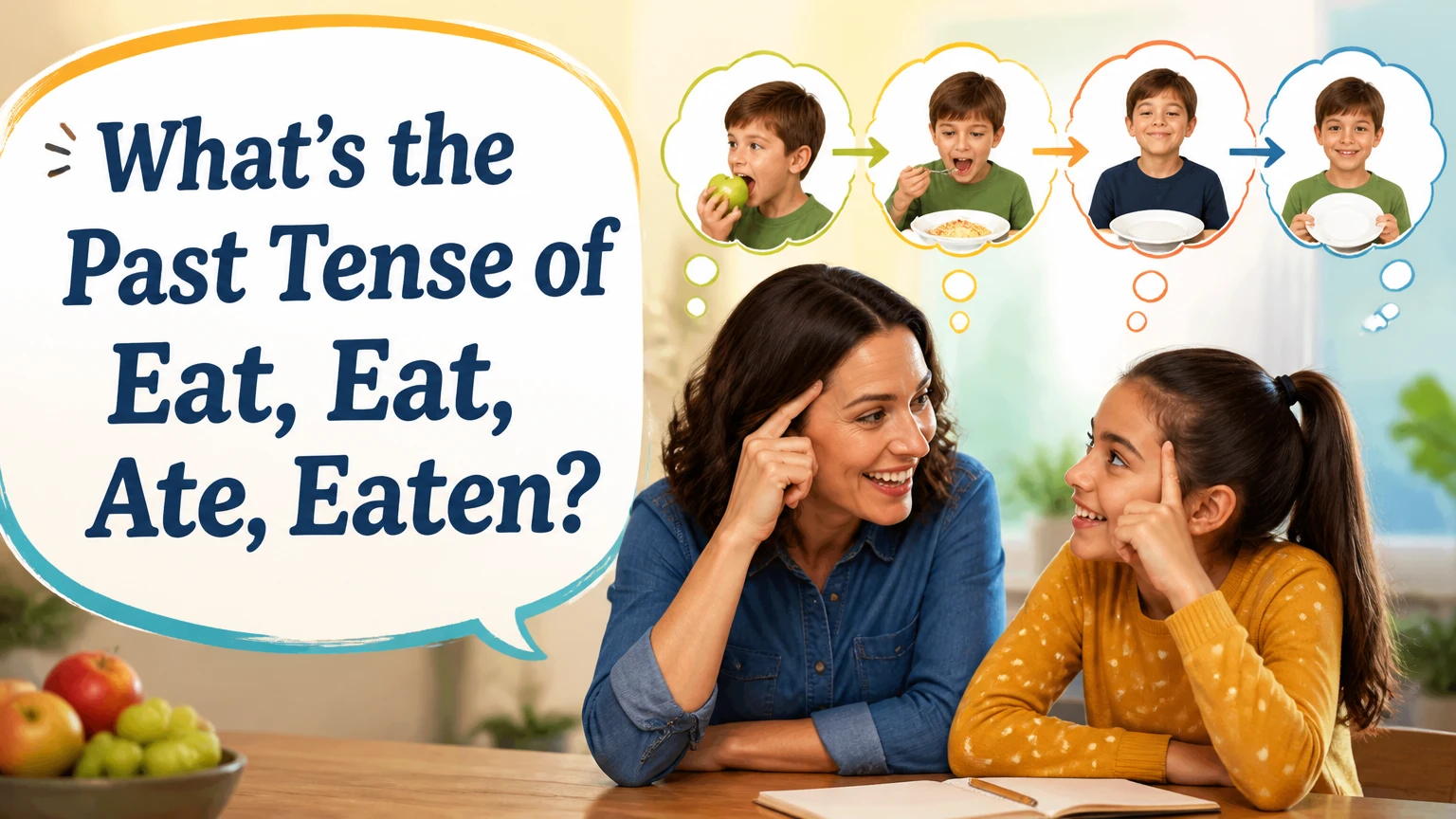
The past tense of eat is ate, while eaten is the past participle. Use ate as the main verb for a completed past action, as in “I ate breakfast at 8.” Use eaten after an auxiliary such as have, has, had, or be, as in “She has eaten breakfast.”
Key Facts at a Glance
- Eat is the base form of the irregular verb.
- Ate is the simple past form of eat.
- Eaten is the past participle of eat.
- “I ate lunch” is correct because ate works as a standalone past-tense verb.
- “I have eaten lunch” is correct because eaten follows the auxiliary have.
- After did, use eat, not ate, because did already marks the past tense.
What Is the Past Tense of Eat?
The simple past tense of eat is ate. English speakers use ate for an action that began and finished in the past, usually with a stated or understood past time.
Examples include:
- I ate an orange yesterday.
- Marcus ate before the meeting.
- We ate at a restaurant last night.
- The dog ate the entire biscuit.
- She ate too quickly.
The word eaten is not the simple past form. Eaten is the past participle, so it normally combines with a helping verb. The contrast is simple: “They ate dinner” uses the simple past, while “They have eaten dinner” uses the present perfect.
The phrase eat, ate, eaten is therefore the standard verb-form sequence. The first form is the base, the second is the simple past, and the third is the past participle.
What Are the Forms of Eat?
The principal forms of eat are eat, eats, eating, ate, and eaten. The correct form depends on the subject, tense, and auxiliary verb.
| Verb form | Grammatical function | Example |
|---|---|---|
| eat | Base form, present plural, infinitive | They eat rice daily. |
| eats | Present third-person singular | Lina eats fruit daily. |
| eating | Present or past participle in continuous forms | He is eating now. |
| ate | Simple past | He ate at noon. |
| eaten | Past participle | He has eaten already. |
The base form appears after modal verbs and the auxiliary did. Consequently, standard English uses “can eat,” “will eat,” and “did eat,” not “can ate,” “will ate,” or “did ate.”
The third-person singular present form is eats, not eat, when the subject is he, she, or a singular noun. That agreement rule disappears in the simple past: “She ate” and “They ate” use the same past form.
When Should You Use Ate?
Use ate when the sentence has a completed past action and no auxiliary requires a participle. Ate can function as the only verb in an affirmative simple-past statement.
Common patterns include:
- Subject + ate + object: “I ate a sandwich.”
- Subject + ate + time expression: “We ate at six.”
- Subject + did not + eat: “We did not eat at six.”
- Did + subject + eat?: “Did you eat at six?”
The simple past often appears with yesterday, last night, two hours ago, in 2022, or a specific event in a completed period. The time expression is not mandatory, but the speaker presents the action as finished.
| Situation | Correct sentence | Why it works |
|---|---|---|
| Completed meal yesterday | I ate breakfast yesterday. | Ate is the main past verb. |
| Completed action at a known time | Sara ate at noon. | The action belongs to a finished past point. |
| Past narrative sequence | He opened the box and ate the cake. | Both coordinated verbs are simple past. |
| Past action with a named year | They ate there in 2019. | The time period is complete. |
A common learner error is choosing eaten because the action happened in the past. Tense depends on the entire verb construction, not on whether the event occurred earlier. “I eaten lunch” is incorrect in standard English because eaten lacks a suitable auxiliary.
When Should You Use Eaten?
Use eaten as the past participle after forms of have or be, or after another auxiliary construction that requires a participle. Eaten cannot normally carry simple past tense by itself.
Examples with have include:
- I have eaten lunch.
- She has eaten the last apple.
- They had eaten before the bus arrived.
- By 9 p.m., we will have eaten dinner.
Examples with be include:
- The cake was eaten by the children.
- All the food has been eaten.
- The apples were eaten before the picnic began.
The auxiliary supplies grammatical information such as tense, aspect, or voice. In “She has eaten,” has marks present perfect, while eaten identifies the completed action. In “The cake was eaten,” was helps form the passive voice.
How Does Eaten Work With Have?
Eaten follows have, has, or had in perfect constructions. The choice among those auxiliaries depends on the subject and the relationship between the eating event and another time.
| Construction | Formula | Example | Main meaning |
|---|---|---|---|
| Present perfect | have/has + eaten | She has eaten. | Past action connected to now |
| Past perfect | had + eaten | She had eaten before class. | Earlier than another past event |
| Future perfect | will have + eaten | She will have eaten by noon. | Finished before a future deadline |
| Modal perfect | should have + eaten | She should have eaten first. | Past advice, expectation, or judgment |
Present perfect usually avoids a finished-time expression such as yesterday in standard usage. “I have eaten yesterday” is generally replaced by “I ate yesterday,” because yesterday identifies a completed past period.
Past perfect needs a past reference point or context. “They had eaten” is grammatically possible, but “They had eaten before the film started” makes the sequence explicit.
Can Eaten Be Used With Be?
Eaten combines with be in passive constructions, where the grammatical subject receives the action. “The sandwich was eaten” focuses on the sandwich, while “Jordan ate the sandwich” focuses on Jordan.
| Voice | Sentence | Focus |
|---|---|---|
| Active simple past | Maya ate the cake. | Maya, the eater |
| Passive simple past | The cake was eaten by Maya. | The cake, the affected object |
| Active present perfect | Maya has eaten the cake. | Maya and the completed action |
| Passive present perfect | The cake has been eaten by Maya. | The cake and its current state |
Passive voice is useful when the person who ate is unknown, irrelevant, or obvious from context. “The leftovers were eaten overnight” does not identify the eater because the food matters more than the person.
Passive constructions can become unnecessarily long when the active subject is available and important. “The entire pizza was eaten by Tom” is grammatical, but “Tom ate the entire pizza” is more direct in most everyday writing.
Why Is Eat an Irregular Verb?
Eat is irregular because its past forms do not use the regular -ed ending. Instead, the vowel changes across the historical verb pattern: eat, ate, and eaten.
This internal vowel alternation is commonly called ablaut, a pattern inherited through the history of Germanic languages. Modern learners do not need historical linguistics to form the verb correctly, but the pattern explains why “eated” is not standard English.
Other irregular verbs show related vowel changes:
| Base form | Simple past | Past participle | Example |
|---|---|---|---|
| eat | ate | eaten | She ate and has eaten. |
| fall | fell | fallen | He fell and has fallen before. |
| give | gave | given | I gave it and have given advice. |
| take | took | taken | They took it and have taken notes. |
| write | wrote | written | She wrote it and has written often. |
The comparison is a memory aid, not a complete rule. Some irregular verbs follow different patterns, such as go, went, gone and buy, bought, bought. Memorizing the complete triad remains more reliable than predicting every form from spelling.
What Is the Difference Between Ate and Eaten?
Ate is a finite simple-past verb that can stand alone, whereas eaten is a past participle that normally requires an auxiliary. The two forms refer to related events, but they do not occupy the same grammatical position.
| Feature | Ate | Eaten |
|---|---|---|
| Form type | Simple past | Past participle |
| Works alone as main verb | Yes | Usually no |
| Common auxiliary | None required | have, has, had, be |
| Example | We ate early. | We have eaten early. |
| Typical time relationship | Completed past event | Perfect or passive construction |
The sentence “I ate” is complete when the listener knows what food or meal is understood. The sentence “I eaten” is incomplete in standard English because the construction needs an auxiliary, such as “I have eaten.”
A useful substitution test is to inspect the word immediately before the verb:
- After did, choose eat: “Did you eat?”
- After have, has, or had, choose eaten: “Have you eaten?”
- Without an auxiliary in a completed past statement, choose ate: “I ate.”
Why Do We Say Did You Eat Instead of Did You Ate?
We say “Did you eat?” because the auxiliary did already marks the past tense, so the main verb returns to its base form. Standard English does not normally mark the same past tense twice with did + ate.
The same rule applies to negatives:
- Correct: I did not eat breakfast.
- Incorrect: I did not ate breakfast.
- Correct: She didn’t eat the leftovers.
- Incorrect: She didn’t ate the leftovers.
The underlying structure is:
did + subject + base verb
The auxiliary changes for emphasis or question formation, while the lexical verb remains eat. In an emphatic statement, “I did eat breakfast” is also correct. The word did carries the past marking, and eat remains unchanged.
| Sentence purpose | Correct form | Incorrect form |
|---|---|---|
| Yes-or-no question | Did you eat? | Did you ate? |
| Negative statement | We did not eat. | We did not ate. |
| Emphasis | I did eat it. | I did ate it. |
| Wh-question | What did she eat? | What did she ate? |
This rule applies to regular verbs as well. English uses “Did you walk?” rather than “Did you walked?” The irregular form makes the error more noticeable, but the auxiliary principle is general.
When Do You Use Eating Instead?
Use eating for continuous or progressive constructions that present the action as ongoing, temporary, or in progress. Eating is the -ing form, not the simple past or past participle.
Examples include:
- I am eating now.
- She was eating when the phone rang.
- They have been eating since noon.
- We will be eating at eight.
| Tense or aspect | Formula | Example |
|---|---|---|
| Present continuous | am/is/are + eating | He is eating now. |
| Past continuous | was/were + eating | He was eating at seven. |
| Present perfect continuous | have/has been + eating | He has been eating for an hour. |
| Future continuous | will be + eating | He will be eating at eight. |
The distinction between ate and was eating concerns viewpoint. “I ate dinner at seven” presents the meal as completed. “I was eating dinner at seven” presents the action as in progress at that time, perhaps when another event occurred.
The verb eat can also describe repeated behavior in a temporary period: “During the training camp, the athletes were eating five meals a day.” The continuous form emphasizes the temporary arrangement rather than one completed meal.
How Do Eat Out and Eat Up Change?
Phrasal verbs built with eat change the main verb in the same way as the standalone verb. The particles remain in place: eat out becomes ate out and eaten out, while eat up becomes ate up and eaten up.
| Base phrasal verb | Simple past | Past participle construction | Example |
|---|---|---|---|
| eat out | ate out | have eaten out | We ate out Friday. |
| eat up | ate up | has eaten up | She has eaten up the soup. |
| eat away at | ate away at | had eaten away at | Rust ate away at the metal. |
| eat into | ate into | has eaten into | Inflation has eaten into savings. |
Examples:
- We ate out after the concert.
- We have eaten out three times this week.
- The children ate up all the fruit.
- The children had eaten up the snacks before dinner.
- Rising costs have eaten into the budget.
The particle can affect meaning substantially. Eat out usually means dine at a restaurant, eat up means consume completely, and eat into often means reduce a resource or amount. The irregular forms remain unchanged across these meanings.
How Is Ate Pronounced?
In widely used standard varieties of English, ate is commonly pronounced like eight, with the vowel sound represented in the International Phonetic Alphabet as /eɪt/. Some regional British and Irish varieties use a pronunciation closer to et, /ɛt/.
The spelling does not change with pronunciation. Standard written English uses ate in both cases, so pronunciation variation should not be confused with a separate verb form.
| Word | Common pronunciation | Meaning |
|---|---|---|
| ate | /eɪt/ | Simple past of eat |
| eight | /eɪt/ | Number 8 |
| eat | /iːt/ | Base form |
| eaten | /ˈiːtən/ | Past participle |
The final consonant is important. Ate ends with /t/, while eat also ends with /t/ but has a different vowel. Eaten normally has two syllables, although rapid speech may reduce the second vowel.
For spelling practice, connect the homophones ate and eight in memory, but do not use eight in writing when you mean the past tense of eating.
What Should You Do When a Sentence Sounds Wrong?
Check the auxiliary first, then identify whether the sentence describes a completed event, an ongoing action, or a perfect or passive construction. This procedure resolves most errors involving eat, ate, and eaten in under a minute.
Use the following diagnostic sequence:
- Find the time or auxiliary verb. Look for did, have, has, had, was, were, or been.
- Choose the required verb form. Use eat after did or a modal; use eaten after perfect auxiliaries; use ate for a standalone simple past.
- Check the meaning. Decide whether the action is completed, ongoing, earlier than another event, or expressed passively.
- Read the whole sentence aloud. Listen for duplicate past marking such as “did ate” or a missing auxiliary such as “have ate.”
- Test the time expression. Use simple past with finished periods such as yesterday; use present perfect when the time is unfinished or relevant now.
| Common error | Correct version | Diagnostic reason |
|---|---|---|
| I have ate lunch. | I have eaten lunch. | Have requires the participle. |
| Did you ate lunch? | Did you eat lunch? | Did requires the base form. |
| She has eat already. | She has eaten already. | Present perfect needs has + eaten. |
| We eaten at noon. | We ate at noon. | No auxiliary is present. |
| He was ate dinner. | He was eating dinner. | Was plus an ongoing action takes -ing. |
| The meal was ate. | The meal was eaten. | Passive voice takes the past participle. |
One counterintuitive rule deserves emphasis: a sentence can refer to the past without using ate. “I have eaten” refers to a completed action, but the present perfect connects that action to the present. The label “past action” does not automatically determine the verb form.
How Can English Learners Remember Eat, Ate, Eaten?
Memorize eat, ate, eaten as a three-part sequence, then practice each form inside a complete construction. Isolated lists help recall, but auxiliary-based sentences reveal whether the learner understands the grammar.
A compact practice set is:
- Every day, I eat breakfast.
- Yesterday, I ate breakfast.
- I have eaten breakfast already.
- I was eating breakfast when you called.
- Did you eat breakfast?
- The breakfast was eaten by the guests.
The strongest learning contrast pairs one meaning with one structure. Repeat the sequence with different subjects, because present agreement changes only the third-person singular form:
- I eat.
- She eats.
- We ate.
- She ate.
- They have eaten.
- He has eaten.
A practical rule of thumb is to memorize the auxiliary partnerships rather than the past forms alone:
- did + eat
- have/has/had + eaten
- was/were + eating
- was/were + eaten
That approach prevents the two most frequent errors, did ate and have ate, because it stores the verb as part of a grammatical pattern.
Are Ate and Eaten Interchangeable?
Ate and eaten are not interchangeable in standard English because they perform different grammatical jobs. Replace ate with eaten only when the sentence also contains the auxiliary structure required by the past participle.
Compare these pairs:
- “I ate the pear.”
“I have eaten the pear.” - “They ate before us.”
“They had eaten before us.” - “The cat ate the fish.”
“The fish was eaten by the cat.”
The first sentence in each pair uses a finite simple-past verb. The second uses either perfect aspect or passive voice. Although the underlying event is similar, the grammar changes the relationship between the event, the speaker’s reference time, and the sentence’s focus.
The adjective eaten can also appear in expressions such as “half-eaten sandwich.” In that position, eaten describes the sandwich’s condition rather than forming a complete verb phrase. The participial form still relates to the same verb, but an auxiliary is not necessary when the word functions adjectivally.
The Bottom Line
The answer to “whats the past tense of eat eat ate eaten” is ate. The complete irregular-verb sequence is eat, ate, eaten: use eat as the base form, ate for a standalone completed past action, and eaten after have, has, had, or forms of be.
Remember the four most useful patterns:
- “I eat lunch every day.”
- “I ate lunch yesterday.”
- “I have eaten lunch.”
- “Did you eat lunch?”
The form eaten is never the ordinary simple past by itself, and ate does not follow did, have, has, or had. That distinction resolves nearly every basic question about the past tense of eat.
Frequently Asked Questions
Is “I eaten” ever correct?
“I eaten” is not correct as a complete standard-English verb phrase because eaten needs an auxiliary. Say “I ate” for the simple past, “I have eaten” for the present perfect, or “I was eating” for an action in progress. In informal dialects, grammar may differ, but formal writing follows the auxiliary rule.
Is “I had ate” grammatically correct?
“I had ate” is incorrect in standard English. The past perfect requires had + past participle, so the correct sentence is “I had eaten before the guests arrived.” Use ate without had, as in “I ate before the guests arrived,” when the past perfect relationship does not need emphasis.
What is the past tense of “eat” in a question?
The past-tense question form is “Did you eat?”, not “Did you ate?” The auxiliary did carries the past tense, so the main verb uses its base form, eat. The same pattern applies to questions such as “What did she eat?” and “When did they eat?”
Can “eaten” describe a noun?
Yes. Eaten can function as a participial adjective in phrases such as “a half-eaten sandwich” or “an already-eaten apple.” In “The sandwich was eaten,” eaten forms a passive verb phrase. In “a half-eaten sandwich,” eaten describes the sandwich’s condition.
What is the difference between “I ate” and “I have eaten”?
“I ate” uses the simple past and usually presents a completed event in a finished past time. “I have eaten” uses the present perfect and connects the completed event with the present, often to explain a current condition such as not needing more food. The choice depends on time reference and context.
How do you pronounce “ate”?
In many standard English varieties, ate is pronounced like eight, /eɪt/. Some regional British and Irish accents use a pronunciation closer to et, /ɛt/. Both pronunciations refer to the same written past-tense form, ate, and the spelling does not change.