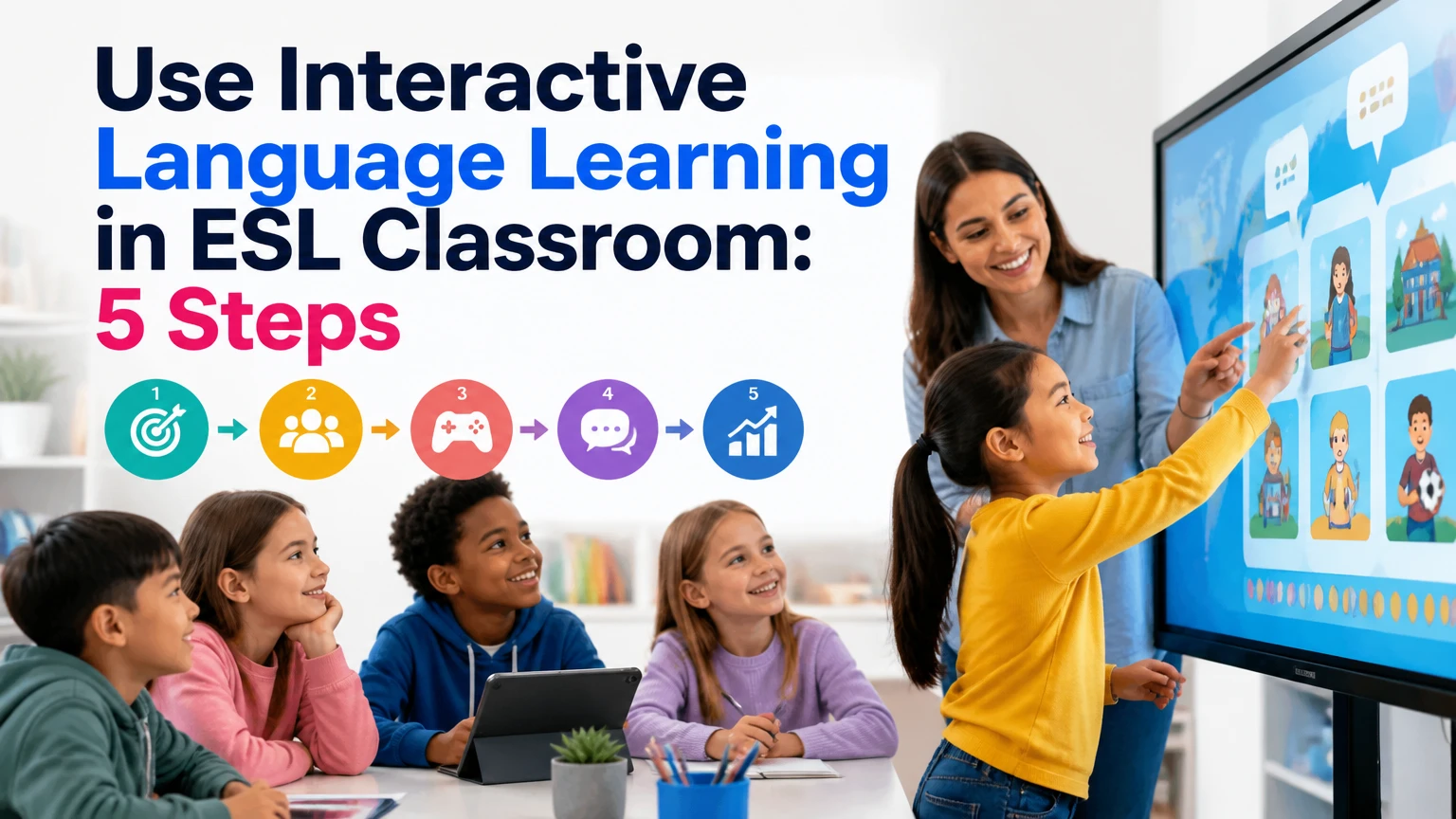
Interactive language learning in an ESL classroom is a student-centered approach in which learners use English to exchange information, solve problems, perform tasks, and respond to peers, teachers, or digital tools. Effective interaction combines a clear language objective, structured communication, comprehensible support, student output, and feedback rather than relying on unplanned conversation.
Key facts at a glance
Allocate approximately 40%-60% of a lesson to structured student interaction, adjusted for level, class size, and lesson purpose.
A workable low-tech activity can cost $0-$50 per classroom and take 1-2 weeks to establish.
Effective tasks require an outcome, a time limit, defined roles, and language support such as sentence frames.
Pair and group work creates learning value only when every learner must exchange information or produce language.
Delayed correction protects fluency during communication and gives the teacher evidence for focused accuracy work.
Technology is useful when it increases meaningful practice, feedback, access, or participation; paper is often more efficient for simple tasks.
What Does Interactive Language Learning Mean in ESL?
Interactive language learning means students actively use English with a communicative purpose instead of mainly listening to explanations or completing isolated drills. Learners negotiate meaning, ask for clarification, compare ideas, produce spoken or written language, and receive responses that change what they do next.
Interaction is not synonymous with movement, games, or screens. A noisy game can produce little language, while a quiet information-gap worksheet can generate sustained negotiation. The decisive feature is reciprocal language use: one learner needs another learner’s information, interpretation, decision, or response.
A strong interactive activity contains five components:
- A target outcome: Students complete a route, reach a decision, solve a mystery, or produce a recommendation.
- A language target: The lesson may focus on requests, past-tense narration, conditionals, pronunciation, or academic discussion.
- An information or opinion gap: Partners do not begin with identical knowledge.
- A participation structure: Roles, turns, reporting duties, or written evidence prevent one learner from carrying the task.
- A feedback cycle: Students revise meaning, language, pronunciation, or a final product.
Teacher-led instruction still has a place. A short explanation, model, pronunciation demonstration, or vocabulary preview can make interaction more successful. The problem is prolonged teacher talk without a requirement for students to use the language.
Why Does Interaction Improve English Learning?
Interactive ESL learning works because learners receive understandable language, notice gaps in their own language, negotiate meaning, and produce English for a real communicative outcome. The Interaction Hypothesis associated with Michael Long emphasizes negotiation during communication, while Merrill Swain’s Output Hypothesis explains why producing language can push learners to process grammar more precisely.
Krashen’s input framework is commonly summarized as comprehensible input slightly beyond a learner’s current level, often written as “i+1.” The formula is a useful planning shorthand, not a precise classroom measurement. Teachers make input accessible through images, gestures, examples, slower delivery, familiar context, and peer clarification.
Interaction adds pressure to understand and be understood. When a student says, “She go yesterday,” a partner may ask, “She went where?” The learner then has a reason to notice both meaning and form. Teachers should not manufacture confusion through deliberately obscure instructions; productive difficulty comes from a solvable communication gap.
Output also reveals what students cannot yet control. A learner may recognize would have in a reading exercise but avoid it while negotiating a travel problem. Speaking and writing expose that gap, allowing the teacher to plan the next mini-lesson.
What should the teacher measure?
Measure language use, not volume alone. Useful indicators include:
| Indicator | Typical classroom target | Collection method | Instructional use |
|---|---|---|---|
| Student talking time | 40%-60% of lesson time | Teacher timer or observation sample | Reduce explanations or enlarge pair work |
| Target-form use | 5-10 meaningful uses per learner | Checklist during task | Reteach or extend the language target |
| Participation distribution | Each learner speaks in every round | Role and turn tracker | Reassign roles or reduce group size |
| Negotiation moves | 2-4 clarification requests per pair | Student tally card | Add repair phrases and model examples |
| Final task completion | 80% of groups reach outcome | Product or report review | Simplify instructions or increase scaffolding |
These are practitioner targets, not universal research thresholds. A pronunciation lesson may require shorter exchanges, while a debate may require longer uninterrupted turns.
How Do You Plan an Interactive ESL Lesson?
Plan an interactive ESL lesson around one communicative outcome, one language target, and one observable success condition. A 50-minute lesson typically works well with 5 minutes of activation, 8 minutes of input and modeling, 20-25 minutes of interaction, 7 minutes of reporting, and 5-10 minutes of feedback.
Before you start
| Planning item | Typical specification | Low-tech option | Technology option |
|---|---|---|---|
| Class duration | 45-60 minutes | Printed task cards | Shared digital prompt |
| Group size | Pairs or groups of 3-4 | Desks in clusters | Breakout rooms |
| Preparation time | 15-40 minutes | One card set per group | One tested activity link |
| Material cost | $0-$50 initially | Paper, board, markers | Free or freemium platform |
| Backup requirement | One offline version | Duplicate cards | Downloaded prompts and timer |
Write the outcome as a completed action: “Students will agree on a three-day itinerary and justify two choices.” Avoid targets such as “Students will discuss travel,” because the instruction does not define a finish point.
Select language that supports the outcome. For the itinerary task, students might use We could, I would rather, That might be difficult because, and What do you suggest? Prepare a short vocabulary bank, but do not prewrite every sentence. Learners need support without losing ownership of the exchange.
What Are the Five Steps for an Interactive ESL Lesson?
The five-step cycle is target setup, scaffold and model, active execution, monitoring, and structured debrief. Teachers can run the cycle in 25-40 minutes, with the teacher gradually transferring control from explanation to student communication.
Step 1: Define the target and groupings
Choose the outcome, language function, proficiency demand, group size, and time limit before class begins. Pair beginners with supportive peers when possible, but avoid permanently labeling students by ability because flexible grouping creates more interaction patterns.
Give each learner a reason to speak. In an information-gap map task, Student A has locations and Student B has street names. Neither learner can finish alone.
Checkpoint: Students can explain what they must produce at the end.
Common mistake: Choosing a topic without a communication gap.
Step 2: Scaffold and model the task
Provide 3-6 sentence starters, essential vocabulary, visual examples, and repair phrases such as “Could you say that again?” or “Do you mean…?” Model one complete exchange with a student, including a misunderstanding and a clarification request.
Keep modeling under 5 minutes for most activities. Excessive explanation consumes the time students need to practice.
Checkpoint: Two students can demonstrate the first turn without teacher prompting.
Common mistake: Giving written instructions that contain more language than the task requires.
Step 3: Run the active task
Set a visible timer, assign roles, and require a tangible result. A seven-minute decision task might require each group to rank four options, record two reasons, and prepare one spokesperson.
Use rounds when participation is uneven. For example, every student speaks for 30 seconds, asks one follow-up question, and then passes the turn.
Checkpoint: Every learner produces the target language at least once during the first two minutes.
Common mistake: Allowing groups to finish early without an extension task.
Step 4: Monitor without interrupting fluency
Circulate, listen, and record patterns rather than correcting every error. Track target-language use, communication breakdowns, pronunciation problems, and participation imbalance on a simple grid.
Interrupt only when communication has stopped, instructions are misunderstood, safety is involved, or a repeated error blocks the task. Immediate correction has a place in controlled pronunciation or form practice, but constant interruption damages conversational momentum.
Checkpoint: Your notes contain three to five teachable patterns, not a transcript of every mistake.
Common mistake: Staying with the loudest group while quieter pairs receive no support.
Step 5: Debrief and correct selectively
Bring the class back to the outcome, not merely to whether students enjoyed the activity. Ask groups to report one decision, one disagreement, or one phrase that helped them communicate.
Write three to five anonymous errors on the board. Ask students to identify the problem, propose a correction, and use the revised form in a new sentence. This delayed correction preserves fluency while connecting accuracy work to language students actually attempted.
Checkpoint: Students leave with a corrected form and a second opportunity to use it.
Common mistake: Turning the debrief into a teacher lecture.
Which Interactive ESL Activities Work Best?
Information-gap tasks are usually the strongest starting point because missing information creates a natural reason to speak. Role-plays, collaborative problem solving, games, and digital response systems work well when the language demand and outcome are explicit.
| Activity | Group and time | Language target | Required output |
|---|---|---|---|
| Split map | Pairs, 8-12 minutes | Directions and prepositions | Completed route with two corrections |
| Restaurant role-play | Groups of 3, 10-15 minutes | Requests, offers, count nouns | Order and customer resolution |
| Ranking challenge | Groups of 4, 12-18 minutes | Comparatives and justification | Ranked list with three reasons |
| Find someone who | Pairs, 8-10 minutes | Present perfect questions | Completed survey and summary |
| Problem-solving meeting | Groups of 4, 15-20 minutes | Modals and conditionals | Agreed action plan |
| Picture reconstruction | Pairs, 6-10 minutes | Descriptive language | Recreated image or written description |
How can beginners participate?
Beginners need visual context, predictable turns, controlled vocabulary, and permission to rehearse before public speaking. Use objects, pictures, gestures, bilingual glossaries where appropriate, and sentence frames such as “I see ___,” “Please repeat,” and “I choose ___ because ___.”
Begin with pairs rather than groups of four. A beginner may produce more English in six short pair exchanges than in one large-group discussion where proficient speakers dominate. Increase complexity by adding choices, reasons, and follow-up questions, not by removing all support at once.
How should teachers adapt activities for advanced learners?
Advanced learners need ambiguity, competing evidence, audience awareness, and language precision. Replace simple opinion prompts with tasks requiring qualification, rebuttal, synthesis, or negotiation.
For example, students can evaluate two workplace policies using evidence cards, challenge unsupported claims, and deliver a recommendation. Require discourse markers such as however, provided that, the evidence suggests, and a possible limitation is.
Which Technology Should You Use?
Use technology when it provides a measurable advantage over paper, such as rapid response collection, asynchronous speaking practice, accessible multimedia, or repeated interaction with a patient practice partner. Kahoot!, Quizlet Live, Blooket, and Padlet fit different purposes, while AI conversation tools and virtual reality require more oversight and infrastructure.
| Technology or method | Typical cost | Best use | Main limitation |
|---|---|---|---|
| Printed cards and board tasks | $0-$50 per classroom | Information gaps and role-play | Manual preparation and checking |
| Kahoot! | Free tier, paid plans often $5-$10 monthly per teacher | Fast formative review | Speed can outweigh language depth |
| Quizlet Live | Free tier, paid features vary | Vocabulary retrieval and team review | Limited spontaneous conversation |
| Padlet | Free tier, paid plans vary | Shared writing and multimodal responses | Device access and moderation |
| AI voice practice | Typically $0-$60 per learner annually | Private repetition and pronunciation rehearsal | Accuracy, privacy, and subscription changes |
| VR classroom platforms | Commonly $15-$60 per learner annually | Immersive scenario practice | Hardware, Wi-Fi, motion, and licensing |
Prices are typical planning ranges, not fixed quotations. Software pricing changes by country, institution size, plan, and billing period, so teachers should verify current terms before budgeting.
AI tools can generate patient practice, but automated pronunciation or grammar scores are not authoritative assessments. Accents, background noise, multilingual speech patterns, and unfamiliar vocabulary can affect results. Do not upload identifiable student recordings without institutional approval, clear consent, and a documented retention policy.
When is paper better than technology?
Paper is better when the goal is simple information exchange, when devices are unreliable, or when screen use would distract from eye contact and spontaneous speech. A printed split-map task creates genuine negotiation without login delays, battery failure, or platform distraction.
A useful practitioner rule is simple: keep the analog version if the digital tool does not increase practice opportunities, feedback quality, accessibility, or teacher visibility.
How Much Time and Money Does Implementation Require?
A low-tech interactive ESL system usually takes 1-2 weeks to establish routines and costs $0-$50 for reusable cards, printing, markers, and storage. A technology-supported system commonly takes 2-4 weeks because teachers must test accounts, devices, accessibility, data handling, and backup procedures.
| Implementation level | Setup time | Typical initial cost | Suitable classroom |
|---|---|---|---|
| No-tech | 1-3 lessons | $0-$15 | Any class with paper and board access |
| Low-tech | 1-2 weeks | $15-$50 | Conversation, grammar, and mixed-level classes |
| Freemium digital | 1-3 weeks | $0-$120 annually | Classes with reliable student devices |
| AI speaking practice | 2-4 weeks | $15-$60 per learner annually | Adult, blended, or homework practice |
| VR ecosystem | 3-6 weeks | $15-$60 per learner annually plus hardware | Well-funded language labs |
For a 50-minute class, reserve approximately 20-30 minutes for structured interaction, 5-8 minutes for reporting, and 5-10 minutes for feedback. Beginners may need more modeling; advanced learners can sustain longer task cycles with less teacher support.
How Do You Compare Low-Tech, Gamified, and AI Activities?
Low-tech collaborative tasks generally provide the strongest communication value per dollar, gamified systems provide fast formative data, and AI or VR provides additional repetition and privacy. No category is universally best because each solves a different instructional problem.
| Criterion | Low-tech collaboration | Gamified response system | AI or VR practice |
|---|---|---|---|
| Setup cost | $0-$50 per classroom | $0-$120 annually | $15-$60 per learner annually |
| Main practice | Peer negotiation | Recognition and retrieval | Repeated speaking or simulation |
| Feedback speed | Teacher or peer, 1-10 minutes | Automatic, under 1 minute | Automatic, variable accuracy |
| Device requirement | None | One device per learner or team | Compatible device, headset for VR |
| Best class size | 2-30 learners | 5-40 learners | 1-25 active users |
| Primary risk | Unequal participation | Speed-focused guessing | Privacy and technical failure |
Low-tech wins when the objective is spontaneous exchange. Gamification wins for a five-minute vocabulary check. AI wins when learners need repeated, low-stakes rehearsal beyond class time, provided that human review remains part of the learning process.
How Do You Assess Interactive Speaking?
Assess interactive speaking with a short analytic rubric that separates intelligibility, task completion, interaction, language control, and fluency. A student can make grammar errors yet complete a communicative task effectively, so a single overall impression gives weak diagnostic information.
| Criterion | 1 point | 2 points | 3 points | 4 points |
|---|---|---|---|---|
| Task completion | Missing outcome | Partial outcome | Complete outcome | Complete and extended outcome |
| Interaction | Rarely responds | Responds with prompts | Initiates and responds | Repairs and extends exchange |
| Intelligibility | Often unclear | Usually understood | Clear with minor issues | Clear across longer turns |
| Language control | Frequent blocking errors | Basic control | Generally accurate | Flexible and precise |
| Fluency | Long frequent pauses | Short prepared turns | Sustained familiar speech | Sustained spontaneous speech |
Use the rubric during a 2-3 minute performance or collect a recording with consent. Assess one or two criteria per lesson rather than grading every feature. Students can also complete a reflection: “Which clarification phrase did I use?” and “Which sentence did I improve after feedback?”
What Problems Occur in Interactive ESL Classes?
The most common problems are vague tasks, dominant speakers, silence, excessive correction, unequal proficiency, and technology failure. Each problem requires a structural fix rather than a louder instruction.
| Failure mode | Likely cause | Immediate fix | Prevention |
|---|---|---|---|
| Students stop after 30 seconds | No outcome or information gap | Add ranking, evidence, or missing data | Write a finished product |
| One student dominates | No turn structure | Use timed turns and rotating roles | Assign facilitator and reporter |
| Beginners remain silent | Excessive linguistic load | Add frames, rehearsal, and visuals | Preteach repair phrases |
| Students use their first language | Task is too difficult or low-value | Reduce vocabulary demand and clarify purpose | Pair support with a visible English goal |
| Grammar correction stops speech | Teacher interrupts too often | Record errors for delayed feedback | Correct only blocking or target errors |
| Digital activity fails | Untested platform or weak Wi-Fi | Switch to printed prompts | Test every device and prepare offline materials |
Interactive work is not suitable for every moment. It is a poor choice when students first need a concise explanation, when assessment conditions require individual silent work, or when the task demands vocabulary they have never encountered. Interaction should follow enough preparation to make communication possible.
How do you manage large classes?
Use fixed stations, numbered groups, visible role cards, and short reporting formats. In a class of 40, eight groups of five can rotate through four stations, while the teacher monitors two stations per round and collects one product from each group.
Use peer observers to track a single behavior, such as clarification requests, rather than asking students to evaluate everything. Keep noise purposeful by assigning a voice-level expectation and a visible countdown.
How do you teach mixed-level classes?
Keep the outcome shared but vary the support and extension. A developing learner may complete a route using sentence frames, while an advanced learner must add alternatives, justify choices, or reformulate a partner’s statement.
Avoid giving advanced students the role of permanent translator or teacher. Give every learner a language challenge and rotate roles so support flows in both directions.
How do you teach online ESL classes?
Online interaction works best in pairs or groups of three with a shared document, visible task card, timer, and reporting requirement. Visit breakout rooms according to a rotation plan, and provide a text-chat alternative for learners affected by bandwidth, hearing, anxiety, or microphone problems.
Never assume that a breakout room creates participation. Require a recorded decision, collaborative text, voice note, or short report so the teacher can verify task completion.
The Bottom Line
Use interactive language learning in an ESL classroom by designing a real communication gap, modeling the exchange, requiring every learner to produce English, monitoring without constant interruption, and correcting selected patterns afterward. Start with a $0-$50 low-tech lesson, devote 20-30 minutes to structured interaction, and add technology only when it improves practice or feedback.
The strongest activity is not the most entertaining tool. It is the task in which students need one another’s language to reach a specific outcome. Build that condition first, then adjust grouping, scaffolding, assessment, and technology around it.
FAQ
Is interactive language learning suitable for complete beginners?
Yes. Complete beginners can participate when activities use pictures, gestures, repeated routines, limited vocabulary, sentence frames, and pair rehearsal. Begin with recognition and controlled choices, then add short questions and reasons. Beginners need more structure, not less interaction, because predictable exchanges create safe opportunities for early output.
How many students should be in an ESL interaction group?
Pairs are best for maximizing individual speaking time, while groups of three or four support role-play, problem solving, and reporting. Groups above four often reduce individual output unless the teacher assigns turns and roles. For large classes, use several small groups rather than one full-class conversation.
Should ESL teachers correct every speaking error?
No. Correct errors that block meaning, represent the lesson target, or occur repeatedly across the class. Record other errors and address them during delayed feedback. Immediate correction remains appropriate for focused pronunciation or accuracy drills, but correcting every mistake during a fluency task can reduce risk-taking and speech length.
Can interactive activities replace grammar instruction?
Interactive activities should complement grammar instruction, not eliminate it. Students often need a short explanation, model, or controlled practice before using a form in communication. A productive sequence is brief form instruction, meaningful task use, monitoring, delayed correction, and a second attempt using the revised form.
How can teachers make shy students speak?
Use pairs, private rehearsal, predictable turn lengths, role cards, and low-stakes reporting before whole-class performance. Give shy learners preparation time and a defined contribution, such as asking one question or reporting one group decision. Avoid forcing immediate public performance as the first interaction.
What is the best free interactive ESL tool?
No single free tool is best for every objective. Printed information-gap cards are often the strongest free option for speaking because they require no accounts or devices. Kahoot! and Quizlet can support rapid retrieval, while Padlet can collect short written responses when students have reliable internet access.