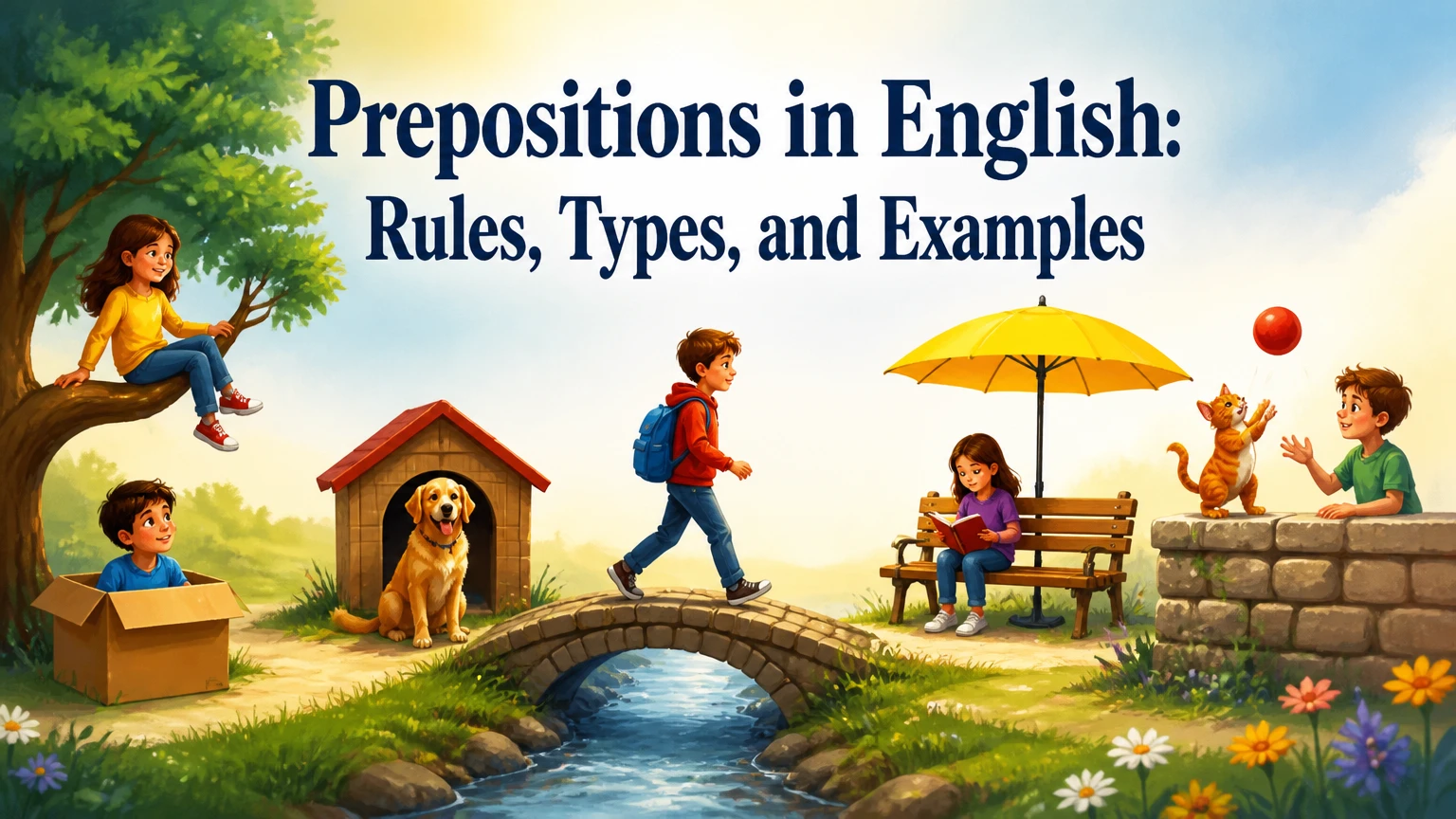
Prepositions in English are words or multi-word units that connect a noun phrase to another part of a sentence and express relationships such as time, place, direction, method, cause, or possession. In a sentence such as “The keys are on the table,” on links the keys to the table and forms the prepositional phrase on the table.
Key Facts at a Glance
A preposition normally comes before a noun phrase, pronoun, or gerund clause called its object.
A prepositional phrase can modify a noun, verb, adjective, adverb, or an entire clause.
In generally describes an enclosed space or broad period, on a surface or day, and at a point or exact time.
English prepositions include simple forms such as by and under, and multi-word forms such as in front of and because of.
Preposition choice depends on meaning, grammar, collocation, and established usage, not on a single universal spatial rule.
English has roughly 70-150 commonly recognized prepositions, depending on whether grammar experts count particles and fixed phrases.
What Are Prepositions in English?
Prepositions in English establish a relationship between an object and another word, phrase, or clause. The relationship may be physical, as in “under the bridge,” or abstract, as in “interested in science.” The preposition itself usually carries less meaning than the complete phrase.
A preposition is followed by an object:
preposition + optional modifier + noun phrase
- at + the station
- under + a large wooden desk
- with + her
- about + solving the problem
The object may also be a pronoun or an -ing form. English therefore permits “for them,” “without him,” and “by working carefully.” A full clause can follow some prepositions, usually through a noun-like structure: “They argued about what the contract required.”
Prepositions are function words. They appear frequently because English uses them to mark relationships that other languages may express through word endings or word order. The Oxford English Corpus and frequency lists based on large English datasets consistently place words such as of, to, in, for, on, with, at, and by among the most common English words.
How Do Prepositional Phrases Work?
A prepositional phrase contains a preposition and its object, with optional modifiers between them. The phrase can answer questions such as where, when, how, why, or which one.
Consider the sentence: “The researcher placed the samples in a refrigerated cabinet.”
- The researcher is the subject.
- placed is the verb.
- the samples is the direct object.
- in a refrigerated cabinet is a prepositional phrase.
- a refrigerated cabinet is the object of in.
Prepositional phrases are not normally complete sentences because they lack an independent subject and finite verb. “After the meeting” is a phrase, while “After the meeting ended” is a dependent clause.
What Can a Prepositional Phrase Modify?
A prepositional phrase can modify a noun, verb, adjective, adverb, or clause. Its position often reveals its function.
| Function | Example | What the phrase modifies |
|---|---|---|
| Noun modifier | The report on renewable energy arrived. | report |
| Verb modifier | The team worked through the night. | worked |
| Adjective complement | She is proud of her result. | proud |
| Adverb modifier | He stood directly behind me. | stood |
| Clause modifier | After lunch, the class resumed. | whole clause |
A misplaced phrase can create ambiguity. “She served sandwiches to the children on paper plates” may mean the children were on paper plates or the sandwiches were. Move the phrase closer to its intended noun: “She served the children sandwiches on paper plates.”
What Are the Main Types of English Prepositions?
The main functional types express time, place, movement, agency, instrument, cause, possession, comparison, and exception. Structural classifications include simple prepositions, compound prepositions, and complex prepositional expressions.
| Type | Common examples | Core meaning | Example |
|---|---|---|---|
| Time | at, on, in, since, during | When an event occurs | The exam starts at nine. |
| Place | in, on, at, under, behind | Where something exists | The files are in the cabinet. |
| Movement | to, into, onto, through, across | Path or destination | They walked through the tunnel. |
| Agent | by | Performer in passive voice | The mural was painted by Ana. |
| Instrument | with, by | Tool or method | He opened it with a key. |
| Cause | because of, from, through | Reason or source | The match stopped because of rain. |
| Possession | of, with | Relationship or ownership | The roof of the building leaked. |
| Comparison | like, unlike, than | Similarity or contrast | She runs faster than I do. |
| Exception | except, besides, apart from | Inclusion or exclusion | Everyone came except Luis. |
Simple Prepositions
Simple prepositions consist of one word. Frequent examples include about, above, across, after, against, along, among, around, as, at, before, behind, below, beneath, beside, between, beyond, by, despite, down, during, except, for, from, in, inside, into, near, of, off, on, onto, over, past, since, through, throughout, till, to, toward, under, until, up, upon, with, within, without, and via.
Compound and Complex Prepositions
Multi-word prepositions function as units, although grammar references classify them differently. Examples include according to, because of, by means of, in addition to, in front of, in spite of, instead of, next to, on behalf of, owing to, prior to, and with regard to.
Some expressions resemble prepositions but can also function as adverbs or particles. In “The plane flew over the city,” over is a preposition because it has the object the city. In “The plane flew over,” over has no object and functions as an adverbial particle.
Which Prepositions Express Time?
Use at for an exact clock time or conventional point, on for a day or date, and in for a month, year, season, or longer period. The choice reflects the scale of the time expression.
| Preposition | Typical time expression | Example | Important contrast |
|---|---|---|---|
| At | exact time, meal, night | at 6:30, at noon | at night, but in the morning |
| On | day or date | on Friday, on May 12 | on Friday morning |
| In | month, year, season, period | in July, in 2027 | in two weeks means after that period |
| For | duration | for three hours | No starting point is implied |
| Since | starting point | since 2020 | Continues to the present in perfect constructions |
| During | within an event or period | during the lecture | Focuses on when something happens |
| By | deadline | by Friday | Means no later than Friday |
| Until | endpoint | until Friday | Continues up to Friday |
“By Friday” means the action must be complete no later than Friday. “Until Friday” means the action continues up to Friday. This distinction prevents a common deadline error: “Submit the form by Friday” differs from “The office is closed until Friday.”
Holidays and Parts of the Day
Use on when a holiday is treated as a particular day: “on Christmas Day” and “on New Year’s Day.” Use at in fixed expressions such as “at Christmas” when referring to the holiday period, and use in for broader parts of the day: “in the afternoon.”
English varies by region. American English commonly uses “on the weekend,” while British English frequently uses “at the weekend.” Both forms are standard within their respective varieties.
Which Prepositions Express Place?
Use in for an enclosed area or geographic region, on for a surface or line, and at for a point, address, activity, or general location. The intended perspective determines the choice.
| Relationship | Preferred preposition | Example | Meaning |
|---|---|---|---|
| Enclosure | in | in the drawer | Inside boundaries |
| Geographic area | in | in Canada | Within a country or city |
| Surface | on | on the shelf | Touching or supported by a surface |
| Line or page | on | on page 14 | Located along a flat reference |
| Point | at | at the entrance | Specific position |
| Address | at | at 22 King Street | Exact location |
| Proximity | near, beside | near the station | Close to a reference point |
| Vertical position | above, below, under | under the bridge | Relative height or covering |
Transport illustrates viewpoint rather than a rigid physical rule. Speakers usually say “in a car” because a car is treated as an enclosed individual vehicle, but “on a bus,” “on a train,” and “on a plane” because passengers are considered to board a shared service. “In the bus” is possible when emphasizing physical interior space, especially in contrast with outside.
How Do Prepositions Show Movement?
Movement prepositions describe a destination, entry, surface contact, route, crossing, or direction. To marks a destination, while into emphasizes movement from outside to inside and onto emphasizes movement toward a surface.
| Preposition | Movement relationship | Example | Static counterpart |
|---|---|---|---|
| to | destination | Walk to the gate. | at the gate |
| into | movement inside | She went into the room. | in the room |
| onto | movement to a surface | The cat jumped onto the bed. | on the bed |
| through | entry and exit within a space | We drove through the tunnel. | inside the tunnel |
| across | from one side to another | They ran across the field. | on the field |
| along | following a line or route | Walk along the river. | beside the river |
| toward | direction without guaranteed arrival | He moved toward the door. | near the door |
| past | beyond a reference point | Drive past the library. | beyond the library |
Do not add to before inside, outside, upstairs, downtown, or home when those words already function as adverbs: “She went inside,” “They drove downtown,” and “I went home.” Use to with a noun phrase: “She went to the interior of the building.”
What Is the Difference Between By and With?
By identifies an agent, route, or method, while with usually identifies a physical instrument, accompanying person, or characteristic. In passive voice, by answers “who performed the action?” and with answers “what tool was used?”
- The novel was written by Toni Morrison.
- The technician repaired the circuit with a soldering iron.
- We travelled by train.
- She arrived with her colleague.
- The parcel was sent by courier.
- He cut the cable with scissors.
The distinction can change meaning. “The window was broken by Alex” assigns responsibility to Alex. “The window was broken with a hammer” identifies the instrument without identifying the person.
How Many Prepositions Are There in English?
English has no universally agreed total number of prepositions. A practical learner’s inventory contains roughly 70-150 forms, because dictionaries and grammars disagree about whether to count particles, participles, and fixed multi-word expressions.
The number changes according to the classification system:
- A narrow grammar may count only dedicated words such as in, at, and under.
- A broad grammar may include concerning, regarding, following, and including.
- A phrase-based inventory may count in front of and because of as complex prepositions.
- A syntactic analysis may classify some of those expressions as ordinary phrases rather than single prepositions.
Learners should prioritize frequency over the total. The 20 most useful forms cover a large share of everyday relationships, while advanced accuracy depends more on collocations such as responsible for and similar to than on memorizing rare forms.
When Do Words Require Dependent Prepositions?
Dependent prepositions are conventional combinations in which a verb, adjective, or noun typically selects a particular preposition. The relationship is grammatical and lexical, so translating directly from another language often produces errors.
| Head word | Correct preposition | Example | Common error |
|---|---|---|---|
| depend | on | It depends on cost. | depend of |
| interested | in | She is interested in law. | interested on |
| good | at | He is good at chess. | good in |
| afraid | of | They are afraid of failure. | afraid from |
| responsible | for | Maya is responsible for safety. | responsible of |
| comply | with | Firms must comply with the rule. | comply to |
| belong | to | This account belongs to Omar. | belongs for |
| focus | on | The lesson focuses on syntax. | focuses in |
| similar | to | The designs are similar to ours. | similar with |
| capable | of | The device is capable of recording audio. | capable to |
A reliable method is to learn the complete chunk rather than the head word alone. Store depend on the result, apply for a position, and apologize to someone for something as reusable patterns.
Phrasal verbs create a related difficulty. In “turn off the light,” off is a particle, not a preposition, because it does not take an object. In “walk off the stage,” off is a preposition because the stage is its object. The same word can therefore have different grammatical roles.
When Is No Preposition Needed?
English omits a preposition before a direct object after certain verbs, destinations, and time expressions. Adding one can make the sentence ungrammatical or change its meaning.
- “We discussed the proposal,” not “discussed about the proposal.”
- “She entered the laboratory,” not “entered into the laboratory,” when enter means go inside.
- “They reached the station,” not “reached to the station.”
- “I called him,” not “called to him,” unless the meaning is shouted or summoned.
- “He went home,” not “went to home.”
- “We met last Tuesday,” not “met on last Tuesday.”
- “The course lasts two months,” not “lasts for two months” in every formal style, although for is acceptable in many varieties.
Some verbs legitimately take a preposition with a different construction. “They discussed the issue” and “They talked about the issue” are both correct because discuss and talk have different patterns.
In, On, and At: Which One Should You Choose?
Choose in for an enclosure or broad period, on for a surface, day, or date, and at for a precise point, time, address, or activity. The familiar wide-to-narrow mnemonic helps, but collocation and context override the mnemonic.
| Context | In | On | At |
|---|---|---|---|
| Time scale | in 2030 | on Tuesday | at 4:15 |
| Geographic scale | in Brazil | on the coast | at the border |
| Physical location | in the box | on the lid | at the corner |
| Transport | in a car | on a bus | at the airport |
| Institution | in school, inside | on campus | at school, general activity |
| Communication | in a photograph | on television | at a meeting |
| Address reference | in London | on Main Street | at 15 Main Street |
“On the coast” treats the coast as a line or surface. “In the coastal region” treats it as an area. “At the coast” usually identifies a location near or at the coastline. These choices are perspective-sensitive, not contradictions.
Special Cases With In, On, and At
Fixed phrases must be learned individually:
- in bed, but on the bed
- in a picture, but on television
- at work, but in the workplace
- on the internet, but in an online forum
- at the end, but in the middle
- on a street, but in a neighborhood
- at the beginning of a book, but on page five
The word following the preposition does not always determine the answer. Meaning does.
How Do You Choose the Correct Preposition?
Choose a preposition by identifying the relationship first, then checking whether the head word imposes a fixed collocation. A five-step editing method resolves most everyday uncertainty.
- Identify the object. Locate the noun phrase linked to the rest of the sentence.
- Name the relationship. Decide whether the phrase expresses time, place, destination, instrument, cause, possession, or another meaning.
- Check the scale or path. For time and place, distinguish a point, surface, enclosure, period, route, or endpoint.
- Test the collocation. Check combinations such as married to, depend on, different from, or reason for in a reliable dictionary.
- Read the complete sentence aloud. Remove unnecessary prepositions and inspect whether the phrase sits beside the word it modifies.
A visual rule works for basic examples: imagine in as a container, on as contact with a surface, and at as a location point. Do not apply that image mechanically to idioms, institutions, transport, or abstract expressions.
What Are the Most Common Preposition Errors?
The most common errors involve dependent prepositions, unnecessary additions, confused time markers, and direct translation from another language. Error correction should target the complete phrase, not merely replace an isolated word.
| Incorrect form | Correct form | Reason |
|---|---|---|
| It depends of the weather. | It depends on the weather. | Depend on is the standard collocation. |
| She arrived in time at 8:00. | She arrived on time at 8:00. | On time means at the scheduled time. |
| We arrived on time to stop the leak. | We arrived in time to stop the leak. | In time means before it became too late. |
| He entered into the room. | He entered the room. | Enter already expresses movement inside. |
| She is married with a doctor. | She is married to a doctor. | Standard adjective pattern: married to. |
| I have lived here since three years. | I have lived here for three years. | For introduces duration. |
| Wait here during two hours. | Wait here for two hours. | During introduces an event or period. |
| This differs than the original. | This differs from the original. | Differ from is the safest formal pattern. |
In Time Versus On Time
On time means punctual according to a schedule. In time means early enough for an event or deadline.
- “The train arrived on time at 9:00.”
- “The firefighters arrived in time to contain the fire.”
- “Submit the application by Friday.”
- “The office remains open until Friday.”
The distinction is semantic rather than stylistic. Substituting one expression for the other can change whether the sentence describes punctuality or successful prevention of delay.
Can You End a Sentence With a Preposition?
Ending a sentence with a preposition is grammatical in ordinary modern English when the preposition belongs to a verb, adjective, or question structure. Formal writing may use a fronted preposition or a more concise rewrite, but forced rearrangement can sound unnatural.
- Natural: “Who are you speaking to?”
- Formal: “To whom are you speaking?”
- Natural: “That is the policy we agreed on.”
- Formal: “That is the policy on which we agreed.”
The claim that a sentence must never end with a preposition comes from older prescriptive traditions rather than a general rule of present-day English. Use the formal version when a publication, examination, or institutional style guide specifically requires it. Otherwise, prioritize clarity and natural syntax.
How Long Does It Take to Learn Prepositions?
A beginner can learn core time and place patterns in 2-4 weeks, while dependable control of dependent prepositions and phrasal verbs usually requires 3-6 months of repeated exposure. Advanced editing of idiomatic and formal usage may take one to two years.
| Learner stage | Typical timeframe | Main target | Suitable practice |
|---|---|---|---|
| A1-A2 | 2-4 weeks | in, on, at, to, from, under | Picture descriptions and daily schedules |
| B1-B2 | 3-6 months | Collocations and movement | Sentence transformation and reading |
| C1-C2 | 1-2 years | Register, idioms, edge cases | Editing academic and professional prose |
| Intensive tutoring | 8-12 weeks | Personal error patterns | 1-2 lessons weekly plus homework |
These are typical learning ranges, not guarantees. An English learner who speaks daily and records recurring mistakes may progress faster than a learner who memorizes isolated lists without producing sentences.
Grammar apps commonly cost about $10-$30 per month, workbooks about $15-$45, and individual tutoring about $15-$50 per hour in many international markets. Local prices vary substantially, so cost should not be treated as a measure of instructional quality.
How Should Writers Use Prepositions in Formal English?
Formal writing should use precise prepositions, avoid unnecessary phrase chains, and place modifiers close to the words they describe. Prepositions are not inherently weak, but several consecutive prepositional phrases can obscure the main action.
Dense version: “The implementation of the review of the records by the department resulted in a reduction of errors.”
Clearer version: “The department reviewed the records, reducing errors.”
The rewrite does not eliminate every preposition. It changes an abstract noun chain into an active verb and preserves the causal relationship. Technical writing may need prepositional phrases for precision, especially in specifications, legal conditions, and location descriptions.
A useful practitioner rule is to inspect any sentence containing four or more consecutive prepositional phrases. The sentence may be correct, yet splitting it or replacing one noun with a verb often improves processing speed and reduces ambiguity.
FAQ About English Prepositions
What Is the Difference Between a Preposition and a Conjunction?
A preposition introduces a noun phrase, pronoun, or gerund phrase, as in “before the test” or “before leaving.” A conjunction introduces a clause containing a subject and verb, as in “before the test began.” Some words, including after, before, and since, can perform both roles depending on what follows.
Should I Say Between or Among?
Use between for separate, identifiable relationships, including relationships involving more than two entities: “The agreement is between the four departments.” Use among for an undefined group or general distribution: “She found support among colleagues.” The traditional rule that between applies only to two items is too narrow.
What Is the Difference Between To and Toward?
To usually marks a destination or endpoint: “They walked to the station.” Toward marks direction without guaranteeing arrival: “They walked toward the station.” American English commonly uses toward, while British English also frequently uses towards.
Is “At the Weekend” Correct?
“At the weekend” is standard in British English, while “on the weekend” is standard in American English. “Over the weekend” works broadly when describing an event occurring during that period. Choose one form consistently within the variety of English you are writing.
Can a Preposition Be Followed by a Verb?
A preposition can be followed by an -ing form, because the form functions as a gerund: “She succeeded by practicing.” A base verb usually requires to as an infinitive marker, not a preposition: “She wants to practice.” The distinction matters because prepositions take noun-like complements.
What Is the Fastest Way to Improve Preposition Accuracy?
Record complete phrases rather than individual prepositions, read examples from reputable dictionaries, and maintain an error log containing the original sentence and corrected pattern. Practice ten high-frequency chunks daily, such as interested in, apply for, arrive at, and responsible for, then use each in a new sentence.
The Bottom Line
Prepositions in English connect words and phrases by expressing relationships of time, place, movement, agency, instrument, cause, possession, and comparison. Start with the core contrasts of in, on, at, to, into, by, and with, then build accuracy through dependent-preposition collocations and complete sentence patterns. When a choice remains uncertain, identify the intended relationship, check the head word’s collocation, and remove any preposition the verb does not require.