
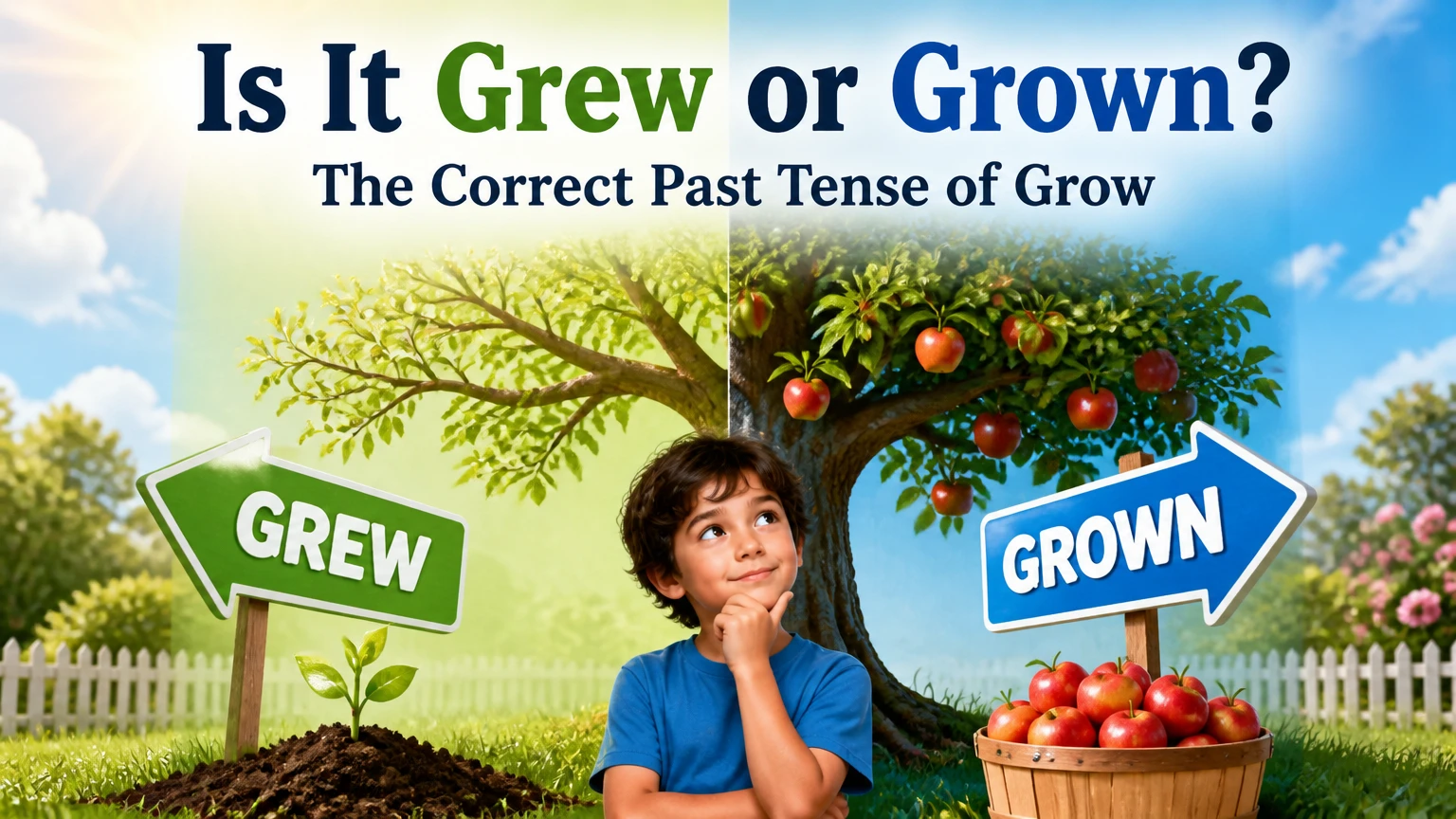
The correct past tense of grow is grew, while grown is the past participle. Use grew alone for a completed past action, as in “The tree grew quickly.” Use grown after an auxiliary verb such as has, have, had, or be, as in “The tree has grown quickly” or “The tree was grown from a seed.”
Key Facts at a Glance
Grow is the base form of an irregular English verb.
Grew is the simple past tense: “The child grew rapidly.”
Grown is the past participle: “The child has grown rapidly.”
Grown can also function as an adjective: “The child is fully grown.”
Growed is not the standard past-tense form in modern formal English.
After did, use grow, not grew: “Did the plant grow?”
What Are the Three Forms of Grow?
The principal forms of the verb grow are grow, grew, and grown. These forms express different grammatical roles, so “grew” and “grown” are not interchangeable versions of the same past tense.
| Verb form | Grammatical name | Typical construction | Example |
|---|---|---|---|
| grow | Base form | I grow, to grow, can grow | “Plants grow toward light.” |
| grew | Simple past | Subject + grew | “The plant grew overnight.” |
| grown | Past participle | has grown, had grown, was grown | “The plant has grown taller.” |
| growing | Present participle | is growing, growing plants | “The plant is growing.” |
| grows | Third-person singular present | he grows, it grows | “The tree grows rapidly.” |
The vowel change from grow to grew to grown identifies an irregular verb. English does not add -ed to create these forms, so growed is not the standard form used in edited writing.
Is Grew the Simple Past Tense?
Yes. Grew is the simple past tense of grow, and it normally describes an event or condition located entirely in the past. The form does not need has, have, had, or another auxiliary verb.
Examples include:
- “The company grew by 18% in 2024.”
- “My children grew up in Chicago.”
- “The seedlings grew three inches last week.”
- “The audience grew larger after the announcement.”
- “She grew tired during the journey.”
The simple past often appears with a finished-time expression such as yesterday, last year, in 2019, or during the summer. A finished time is not mandatory, however. “The tree grew quickly” is grammatical even without a stated date.
Is Grown a Past Tense?
Grown is not the simple past tense. Grown is the past participle of grow, and it usually needs an auxiliary verb to function as part of a verb phrase.
| Construction | Auxiliary | Example | Meaning |
|---|---|---|---|
| Present perfect | has or have | “Sales have grown.” | Past growth connected to now |
| Past perfect | had | “Sales had grown before the merger.” | Growth before another past event |
| Future perfect | will have | “Sales will have grown by June.” | Growth completed by a future point |
| Passive voice | is, are, was, were | “The wheat was grown locally.” | Subject receives the growing action |
| Adjective | be or noun position | “A fully grown tree blocked the road.” | Describes maturity or development |
A sentence such as “The business grown rapidly” is incomplete in standard English. Correct versions include “The business grew rapidly” and “The business has grown rapidly.”
When Should You Use Grew?
Use grew when the sentence presents growth as a completed past event, especially when the time period is finished. The sentence pattern is usually subject + grew + complement, without a perfect-tense auxiliary.
“Revenue grew by $2 million in the third quarter” reports a completed result for a defined reporting period. “The child grew six centimeters last year” similarly places the change inside a finished period.
| Situation | Correct sentence | Why grew works |
|---|---|---|
| Finished year | “The farm grew larger in 2020.” | The time is complete |
| Finished project | “The audience grew during the campaign.” | The event is narrated as past |
| Historical narrative | “The settlement grew around the river.” | The story moves through past events |
| Measured result | “Revenue grew 12% in Q3.” | Q3 is a defined past period |
| Physical development | “The plant grew two feet.” | The completed change is foregrounded |
Grew also works when the speaker simply chooses a past narrative perspective. “She grew quiet and left the room” does not require a precise date because the sequence itself establishes the past.
Can Grew Follow Did?
No. After did, use the base form grow, because did already carries the past tense. The same rule applies in questions and negative statements.
- Correct: “Did the plant grow?”
- Incorrect: “Did the plant grew?”
- Correct: “The plant did not grow.”
- Incorrect: “The plant did not grew.”
- Correct: “Why did the market grow so quickly?”
The construction did grow is possible when the speaker adds emphasis: “The market did grow, despite the forecasts.” The verb remains grow, not grew.
When Should You Use Grown?
Use grown after has, have, or had when the sentence uses a perfect tense. Use grown after a form of be when the sentence is passive, or use it as an adjective describing maturity or development.
The present perfect, “The population has grown,” connects earlier growth with the present situation. The simple past, “The population grew,” reports the past event without making that present connection grammatically explicit.
| Meaning | Correct form | Example |
|---|---|---|
| Present result | has grown | “The city has grown considerably.” |
| Multiple subjects | have grown | “The seedlings have grown tall.” |
| Earlier past result | had grown | “The weeds had grown before we arrived.” |
| Passive cultivation | was grown | “The coffee was grown in Colombia.” |
| Maturity adjective | fully grown | “The puppy is fully grown.” |
A useful diagnostic is to inspect the word before the verb. If the sentence contains has, have, or had, choose grown, not grew. If the sentence contains no auxiliary and describes a completed past event, grew is usually correct.
Can Grown Stand Alone?
Usually, no. Grown cannot normally serve as the only finite verb in a standard sentence because the past participle does not carry tense by itself.
- Incorrect: “The children grown so fast.”
- Correct: “The children grew so fast.”
- Correct: “The children have grown so fast.”
- Correct: “The children are fully grown.”
One apparent exception occurs when grown is an adjective, as in “a grown woman” or “fully grown plants.” In those examples, grown describes a noun rather than functioning as the sole past-tense verb.
What Is the Difference Between Grew and Grown?
The central difference is grammatical function: grew is a finite simple-past verb, while grown is a participle used with an auxiliary or as an adjective. Time meaning matters, but the presence or absence of an auxiliary is the faster test.
| Sentence | Form | Grammatical role | Correct? |
|---|---|---|---|
| “The company grew in 2023.” | grew | Simple past | Yes |
| “The company has grown since 2023.” | grown | Present perfect | Yes |
| “The company had grown before the sale.” | grown | Past perfect | Yes |
| “The company was grown by investors.” | grown | Passive voice | Grammatically possible, context-dependent |
| “The company grown in 2023.” | grown | Unsupported participle | No |
| “The company has grew since 2023.” | grew | Wrong form after has | No |
The practical choice is therefore not based only on whether the action happened in the past. Both forms can describe past growth. The sentence structure determines the correct form.
Grew or Has Grown for Business Writing?
Use grew for a completed reporting period and has grown when the growth continues into, or matters in, the present. Financial writing commonly uses both forms because reporting periods and current trends require different grammatical perspectives.
- “Revenue grew 9% in fiscal year 2023.”
- “Revenue has grown 9% since the new product launched.”
- “The customer base grew by 40,000 accounts in Q2.”
- “The customer base has grown steadily over the past three years.”
The phrase year over year can take either form depending on the sentence. “Revenue grew year over year in Q4” reports a completed comparison. “Revenue has grown year over year since 2021” describes a trend that reaches the present.
Grew or Had Grown for Storytelling?
Use grew to narrate a past event directly, and use had grown when the growth occurred before another past event. The past perfect creates an earlier point in a past timeline.
- “The vines grew across the wall.”
- “The vines had grown across the wall before the workers removed them.”
- “The boy grew anxious as the storm approached.”
- “The boy had grown anxious before anyone noticed.”
A common editing mistake is using had grown merely because the sentence sounds formal. Past perfect is useful when two past times must be ordered. If no earlier-versus-later relationship needs clarification, simple past is usually cleaner.
How Do You Choose the Correct Form in Five Seconds?
Choose grew when the sentence has a past subject and no auxiliary controlling the verb. Choose grown when has, have, had, or a form of be requires a past participle, or when grown operates as an adjective.
Use this five-step test:
- Find the subject and main verb.
- Check for has, have, or had. If present, use grown.
- Check for is, are, was, or were. Use grown if the construction is passive or adjectival.
- Check for did. After did, use grow.
- If no auxiliary appears and the event is past, use grew.
The test handles most ordinary sentences:
- “The market ___ last year.” Answer: grew.
- “The market has ___ since January.” Answer: grown.
- “The market did not ___.” Answer: grow.
- “The vegetables were ___ locally.” Answer: grown.
- “The teenager is fully ___.” Answer: grown.
What Does Grown Mean in Passive Sentences?
In passive sentences, grown means that someone cultivated or produced the subject, while the producer may appear after by. The construction uses a form of be plus the past participle grown.
- “The tomatoes were grown in a greenhouse.”
- “The rice is grown in flooded fields.”
- “The coffee was grown by a small cooperative.”
- “These flowers are grown for export.”
Passive voice is especially common for crops, food, and manufactured biological products. “The farmer grew the tomatoes” is active because the farmer performs the action. “The tomatoes were grown by the farmer” is passive because the tomatoes become the grammatical subject.
The phrase homegrown is a related adjective, not a replacement for every use of grown. “Homegrown talent joined the team” describes talent developed locally. “The talent has grown” uses the perfect-tense verb phrase.
Can Grown Be an Adjective?
Yes. Grown functions as an adjective when it describes maturity, size, or development rather than forming a perfect or passive verb phrase.
Common expressions include:
- fully grown
- grown adult
- grown man
- grown woman
- homegrown produce
- grown plants
- overgrown garden
Compare these sentences:
| Sentence | Role of grown | Interpretation |
|---|---|---|
| “The dog has grown.” | Past participle | The dog has developed |
| “The dog is grown.” | Adjective or stative complement | The dog is mature |
| “The dog was grown by a breeder.” | Passive participle | The breeder raised it |
| “A grown dog needs exercise.” | Adjective | The dog is mature |
| “The garden is overgrown.” | Related adjective | Vegetation has become excessive |
“Fully grown” is often more natural than “grown” alone when describing physical maturity. “The oak is fully grown” identifies a mature condition, whereas “The oak has grown” focuses on development over time.
What Are the Most Common Errors?
The three most frequent errors are growed, has grew, and an unsupported grown. Each error comes from applying a regular-verb pattern or confusing the simple past with the past participle.
| Incorrect sentence | Correct sentence | Rule |
|---|---|---|
| “The plant growed quickly.” | “The plant grew quickly.” | Grow is irregular |
| “The plant has grew quickly.” | “The plant has grown quickly.” | Use the participle after has |
| “The plant grown quickly.” | “The plant grew quickly.” | Use simple past without an auxiliary |
| “Did the plant grew?” | “Did the plant grow?” | Did carries past tense |
| “The plants have grew tall.” | “The plants have grown tall.” | Have requires the participle |
| “The child had grow up.” | “The child had grown up.” | The phrasal verb keeps the participle |
Is Growed Ever Correct?
Growed is not the standard past-tense form of grow in formal modern English. Children may produce growed while learning English, and writers may use it intentionally to represent child speech, dialect, or a humorous voice.
For standard writing, use:
- “The plant grew.”
- “The plant has grown.”
- “The plants had grown.”
- “The plants are grown indoors.”
The same irregular pattern appears in related historical forms: know, knew, known and throw, threw, thrown. English learners often expect growed because many regular verbs form the past with -ed, but irregular verbs must be memorized as principal forms.
How Do Grow, Grow Up, Grew Up, and Grown Up Differ?
Grow describes development, increase, or cultivation. Grow up describes becoming an adult or developing from childhood, while grew up is its simple past and grown up is its participle or adjective.
| Expression | Form | Example | Meaning |
|---|---|---|---|
| grow | Base verb | “Children grow quickly.” | Develop or increase |
| grew | Simple past | “She grew in confidence.” | Developed in the past |
| grow up | Base phrasal verb | “Children grow up.” | Become adults |
| grew up | Simple past phrasal verb | “He grew up in Boston.” | Spent childhood there |
| grown up | Participle or adjective | “She has grown up.” | Has become mature |
| grown-up | Adjective or noun | “That is a grown-up decision.” | Adult or mature |
The spelling can change with function. Grown up is normally written as two words after an auxiliary, as in “He has grown up.” Grown-up is commonly hyphenated before a noun or used as a noun, as in “a grown-up conversation.”
Which Form Fits These Real Situations?
The correct form depends on the sentence’s time frame, auxiliary verb, and intended meaning. The following examples cover common contexts where writers hesitate between grew and grown.
| Context | Best sentence | Reason |
|---|---|---|
| School report | “The student grew more confident.” | Direct past development |
| Current family observation | “The student has grown more confident.” | Change reaches the present |
| Gardening | “The beans grew rapidly in July.” | Finished month |
| Gardening result | “The beans have grown rapidly.” | Current visible result |
| Manufacturing | “The crops were grown organically.” | Passive cultivation |
| Biography | “She grew up in Nairobi.” | Completed childhood history |
| Ongoing trend | “The community has grown since 2010.” | Development continues to now |
| Earlier past event | “The community had grown before the railway arrived.” | Growth preceded another past event |
A useful practitioner rule is to decide whether the sentence answers what happened then or what has become true now. The first question usually favors grew. The second usually favors has grown.
What Should You Remember About Grew and Grown?
Remember that grew is the simple past of grow, while grown is the past participle. Use “The business grew last year,” but use “The business has grown since last year.” After did, return to the base form: “Did the business grow?”
The most reliable correction method is structural, not semantic. Locate the auxiliary first, then select the form that the auxiliary requires. That approach prevents both “has grew” and the incomplete “grown” construction.
Is it grew or grown, what’s the correct past tense of grow? The answer is grew for simple past and grown for perfect tenses, passive voice, or adjective use.
FAQ
Is “The company has grew” ever correct?
No. “Has” requires the past participle, so the standard sentence is “The company has grown.” “The company grew” is also correct, but it uses simple past and removes the auxiliary. The form grew cannot follow has, have, or had in standard English.
Is “The kids grown so fast” grammatical?
Not as a complete standard sentence. Use “The kids grew so fast” for simple past, or “The kids have grown so fast” when their growth connects with the present. “Grown” can appear without those auxiliaries only when it acts as an adjective, such as “The kids are grown.”
Should I write “grew up” or “grown up”?
Write grew up for simple past: “I grew up in Denver.” Write grown up after an auxiliary: “I have grown up,” or as an adjective: “She is a grown-up.” The choice follows the same simple-past and past-participle distinction as grew and grown.
Is “the business has grown year over year” correct?
Yes. “Has grown” is correct when the business’s development extends to the present or describes an ongoing trend. For a completed reporting period, write “The business grew year over year in 2024.” Both sentences are grammatical, but their time perspectives differ.
What is the past tense of “grow” in British English?
British and American English both use grew as the simple past and grown as the past participle. Regional pronunciation may vary, but the standard principal parts remain grow, grew, grown in both major varieties of English.
Can “grown” describe a person?
Yes. Grown can describe an adult or mature person, especially in phrases such as “a grown man,” “a grown woman,” and “a fully grown adult.” In “She has grown,” however, grown is a past participle that describes development rather than simply labeling her as mature.


