
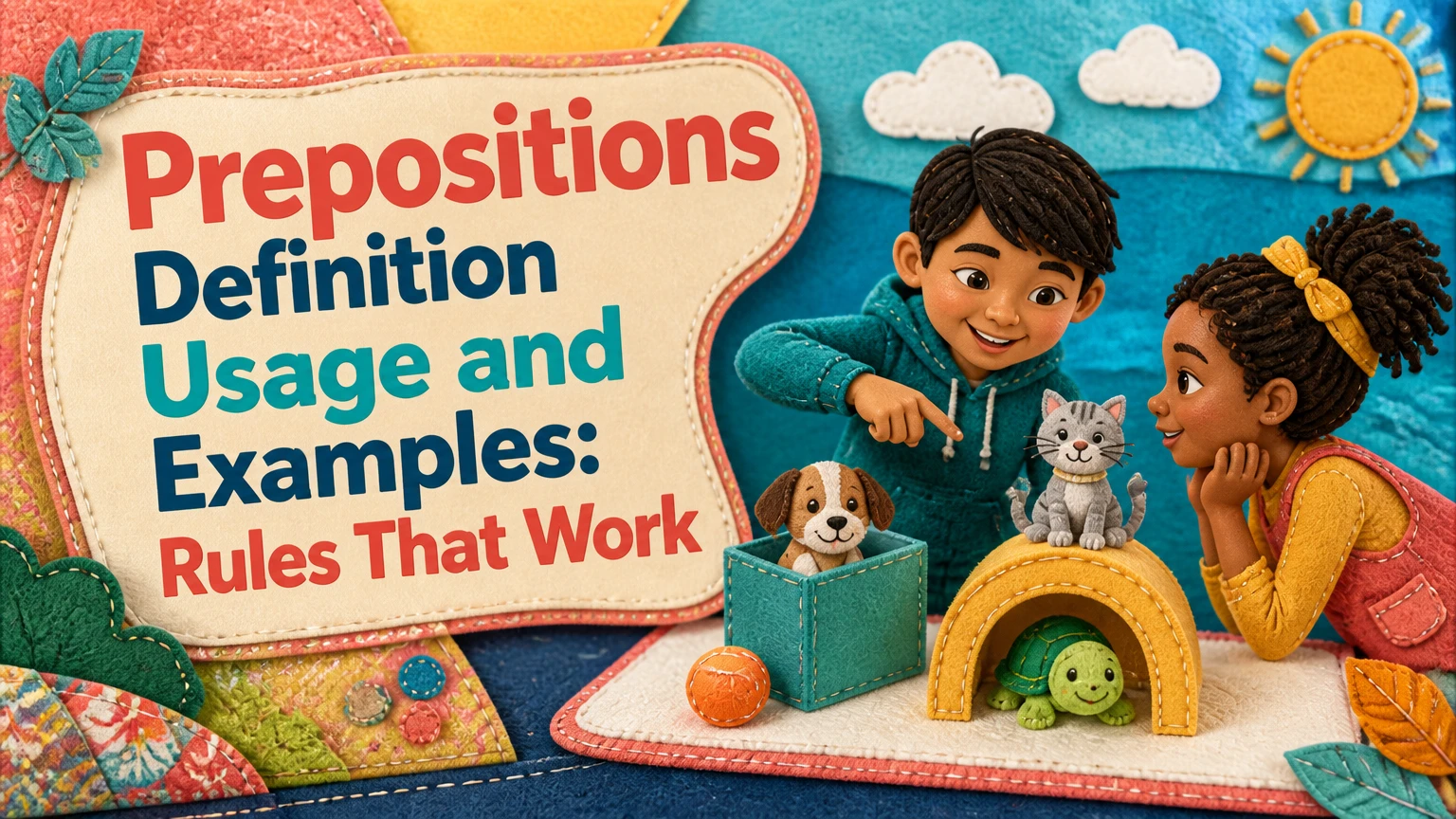
A preposition is a word or group of words that links a noun phrase or pronoun to another part of a sentence, expressing relationships such as time, place, direction, cause, possession, or method. In “The keys are under the cushion,” under introduces the cushion, and the complete phrase under the cushion modifies are by identifying location.
Key Facts at a Glance
- A preposition normally introduces an object, such as a noun phrase, pronoun, or gerund.
- A prepositional phrase consists of a preposition plus its complement: after lunch, with her, or in the red box.
- At usually identifies a point, on a surface or day, and in an enclosure or extended period.
- To marks a destination, while into emphasizes movement inside and onto emphasizes movement to a surface.
- A sentence may end with a preposition when that construction is natural, as in “Who did you speak to?”
- Preposition choice is often idiomatic, so learners should study combinations such as interested in and responsible for.
What Is a Preposition?
A preposition expresses a relationship between a complement and another element, called the headword. The complement is most often a noun phrase, pronoun, or -ing form.
Examples include:
- The meeting starts at noon.
At expresses time. - Maria placed the file on the desk.
On expresses surface location. - They traveled through Canada.
Through expresses movement within or across an area. - He succeeded because of careful planning.
Because of expresses cause. - This letter is from the director.
From expresses source.
Traditional grammar often calls the noun or pronoun after a preposition its object. Modern grammatical descriptions may call it a complement, because some prepositions take clauses or -ing forms as well.
What Is the Formula for a Prepositional Phrase?
The basic structure is:
Headword + preposition + complement = relationship expressed by a prepositional phrase
| Sentence | Preposition | Complement | Function |
|---|---|---|---|
| The cat slept under the bed. | under | the bed | Adverbial location |
| A letter from Ana arrived. | from | Ana | Adjectival source |
| We talked about leaving. | about | leaving | Topic |
| She is proud of her work. | of | her work | Adjective complement |
| Before the train leaves, call me. | before | the train leaves | Clause relationship |
A prepositional phrase can modify a verb, noun, adjective, or entire clause. In “The report on climate policy was published,” on climate policy modifies report. In “The report was published in June,” in June modifies was published.
A preposition cannot normally complete its intended relational meaning without a complement. However, a preposition may appear without an immediately following object when the object is understood, as in “She went inside.” In that sentence, inside functions as an adverb rather than introducing an expressed noun phrase.
How Do Prepositions Work in a Sentence?
Prepositions work by narrowing the relationship between a headword and its complement. The same preposition can express different meanings according to the noun it introduces and the verb or adjective it follows.
Consider on:
- The cup is on the table. Surface location.
- The show is on Monday. Calendar time.
- The machine is on. Here on is an adjective or adverb-like complement, not a conventional preposition with an expressed object.
- She depends on her team. A verb-dependent relationship.
Prepositions also form fixed patterns. English speakers say interested in, good at, afraid of, belong to, and listen to. Replacing the preposition with a literal translation from another language often produces an error even when the general meaning remains understandable.
How Can You Identify a Prepositional Phrase?
Use three tests:
- Find a word that introduces a relationship.
- Ask whether it has a noun phrase, pronoun, gerund, or clause as its complement.
- Check whether the whole group modifies a noun, verb, adjective, or clause.
In “The researcher worked with three assistants in the laboratory,” with three assistants identifies association or accompaniment, while in the laboratory identifies location. Both phrases add information to worked.
A useful diagnostic is movement. “In the laboratory, the researcher worked with three assistants” remains grammatical because the prepositional phrase can move without changing its core relationship.
What Are the Main Types of Prepositions?
Prepositions can be classified by their form and by the relationship they express. Form-based categories describe structure; meaning-based categories describe function.
| Type | Structure | Examples | Typical register |
|---|---|---|---|
| Simple | One word | at, by, for, from | All registers |
| Complex | Two or more words | because of, in front of | General and formal |
| Compound | Single lexical unit | inside, beneath, without | All registers |
| Participial | Verb-derived form | during, regarding, including | Formal and general |
| Paired expression | Fixed combination | out of, next to, according to | General and formal |
The boundaries are not identical in every grammar reference. For example, during historically relates to a participle, but contemporary speakers generally process it as an ordinary preposition.
Simple Prepositions
Simple prepositions contain one word, including about, above, across, after, against, among, around, before, behind, below, beside, between, beyond, during, except, for, from, in, inside, near, of, off, on, over, through, toward, under, until, with, within, without, and by.
Examples:
- The trail runs through the forest.
- The children waited behind the gate.
- We stayed until Friday.
- She solved the problem without assistance.
Complex Prepositions
Complex prepositions act as units even though they contain multiple words:
- in front of
- next to
- because of
- in addition to
- according to
- in spite of
- with regard to
- by means of
A complex preposition normally takes a noun phrase or pronoun after its final word: because of the storm, not because of alone.
Participial Prepositions
Words ending in -ing or -ed may function as prepositions when they introduce a complement:
- Regarding your application, the committee will respond next week.
- Including tax, the order costs $84.
- During the interview, the candidate discussed research methods.
- Provided that the data are verified, the results may be published.
Not every -ing word is a preposition. In “The child is running,” running is part of the verb. In “Running through the park, the child waved,” running through the park is a nonfinite clause, not simply a prepositional phrase.
How Do In, On, and At Differ?
In usually presents an enclosure or an extended period, on presents contact with a surface or a particular day, and at presents a point in space or time. These are useful default patterns, but idioms and transport expressions create exceptions.
| Preposition | Time examples | Place examples | Additional pattern |
|---|---|---|---|
| at | at 6:30, at noon, at night | at the station, at 14 King Street | at work, at school |
| on | on Tuesday, on July 4, on the weekend | on the wall, on the road | on a bus, on television |
| in | in 2027, in April, in winter | in the box, in London, in a car | in bed, in a photograph |
For time, at identifies a precise point, on identifies a day or date, and in identifies a month, year, season, century, or period. For place, at treats a location as a point or activity site, on emphasizes a surface or route, and in emphasizes boundaries or an enclosed area.
The distinction can change with meaning. Someone may be at the hospital as a patient or visitor, while a doctor may work in the hospital because the building is treated as an interior space.
How Do To, Into, and Onto Differ?
To identifies a destination, into identifies movement from outside to inside, and onto identifies movement toward a surface. The distinction concerns the path and endpoint, not merely the final location.
| Expression | Core meaning | Example | Contrast |
|---|---|---|---|
| to the room | Destination | Walk to the room. | Arrival is emphasized |
| into the room | Entry | Walk into the room. | Crossing the boundary is emphasized |
| onto the platform | Movement to a surface | Step onto the platform. | Surface contact is emphasized |
| toward the room | Direction only | Move toward the room. | Arrival is not guaranteed |
| from the room | Source | Come from the room. | Movement begins there |
Compare “She ran to the pool” with “She ran into the pool.” The first sentence identifies the destination; the second states that she entered the water. Onto is often literal, but it can also describe a change of position, as in “The bird flew onto the roof.”
How Do By and With Differ?
By commonly identifies an agent, route, deadline, or method, while with commonly identifies a tool, accompaniment, or characteristic. In passive voice, by names who performed the action.
- The novel was written by Toni Morrison. Agent.
- The parcel arrived by courier. Method or means.
- Finish the form by Friday. Deadline.
- She opened the package with scissors. Instrument.
- He traveled with his sister. Accompaniment.
- The room was filled with smoke. Content or characteristic.
The agent-instrument distinction is especially important in passive constructions. “The window was broken by a stone” identifies the apparent cause or agent, while “The window was broken with a stone” presents the stone as the instrument used by someone.
How Should Writers Use Prepositions of Time, Place, and Direction?
Writers should select a preposition according to the relationship they intend, then verify whether the surrounding word requires an idiomatic pairing. Meaning comes first, but collocation determines many abstract uses.
| Relationship | Common prepositions | Example | Meaning |
|---|---|---|---|
| Time | at, on, in, during, since, until | since 2020 | Starting point continuing now |
| Place | in, at, on, under, beside | under the bridge | Spatial position |
| Direction | to, into, toward, across, through | across the river | Path or destination |
| Cause | because of, from, through | because of rain | Reason |
| Possession or relation | of, to, with | the cover of the book | Connection |
| Method or agency | by, with, via | via email | Means or instrument |
| Contrast | despite, against, unlike | despite the delay | Opposition |
Some prepositions are polysemous, meaning their interpretation depends heavily on context. From can express origin in “a letter from Madrid,” cause in “suffering from exhaustion,” or material in “a table made from recycled wood.”
Why Do Dependent Prepositions Matter?
Dependent prepositions are prepositions selected by particular verbs, adjectives, and nouns. English grammar treats these combinations as collocations, so a learner must usually memorize the complete pattern rather than derive it from physical logic.
| Headword | Correct preposition | Example | Frequent error |
|---|---|---|---|
| depend | on | depend on evidence | depend of evidence |
| interested | in | interested in music | interested on music |
| responsible | for | responsible for safety | responsible of safety |
| similar | to | similar to the original | similar with the original |
| accused | of | accused of fraud | accused for fraud |
| capable | of | capable of solving it | capable to solve it |
| listen | to | listen to the podcast | listen the podcast |
| discuss | no preposition | discuss the proposal | discuss about the proposal |
The correct pattern may vary by meaning. “Agree with a person” differs from “agree to a proposal” and “agree on a subject.” A reliable learner dictionary, such as the Oxford Advanced Learner’s Dictionary or Cambridge Dictionary, lists these patterns with example sentences.
Can You End a Sentence With a Preposition?
Yes, English permits a sentence to end with a preposition when the construction is clear and natural. The rule forbidding final prepositions is a prescriptive tradition influenced by Latin grammar, not a general requirement of modern English.
- Natural: Who are you speaking to?
- Formal alternative: To whom are you speaking?
- Natural: That is the issue we need to deal with.
- Formal alternative: That is the issue with which we need to deal.
The formal versions are grammatical but often sound stiff. In business, academic, and public-facing writing, the best choice depends on audience and sentence rhythm. Do not move a preposition merely to obey a blanket rule.
What Are Common Preposition Errors?
Most errors arise from unnecessary words, incorrect collocations, confused movement terms, or a mismatch between the preposition and the intended relationship.
Redundant Prepositions
Delete a preposition when the verb already contains the relationship:
- Incorrect in standard edited English: Where is the library at?
- Preferred: Where is the library?
- Wordy: Return back to the office.
- Preferred: Return to the office.
- Wordy: Combine together the results.
- Preferred: Combine the results.
Some forms are established in particular dialects. “Where are you at?” is common in informal speech in several English varieties, but edited writing usually omits at.
Discuss and Talk
Discuss takes a direct object, while talk commonly takes about or to:
- The committee discussed the budget.
- The committee talked about the budget.
- I talked to the manager.
The incorrect form “discussed about the budget” combines two different verb patterns.
Comprise and Compose
A whole comprises its parts, while a whole is composed of its parts:
- The team comprises five researchers.
- The team is composed of five researchers.
The form “comprises of” remains common in usage, but many edited style guides recommend avoiding it.
Different From and Different Than
Different from is the safest choice in formal international English: “The revised method is different from the original.” Different than is established, especially in American English before a clause, as in “The outcome was different than we expected.” Register and regional audience should guide the choice.
How Should Professionals Edit Prepositional Phrases?
Professional writers should retain a prepositional phrase when it adds necessary meaning and shorten it when it merely inflates a sentence. Concision improves scanability, but deleting a preposition can also remove a real relationship.
| Wordier expression | Concise alternative | Meaning preserved |
|---|---|---|
| in order to reduce costs | to reduce costs | Purpose |
| at this point in time | now | Time |
| with regard to your request | about your request | Topic |
| in the event that prices rise | if prices rise | Condition |
| due to the fact that | because | Cause |
| a number of factors | several factors | Quantity, when exact count is unknown |
Do not replace every complex preposition automatically. “In front of the building” is more precise than “before the building” when physical position is intended, and “because of” may be clearer than a shorter but ambiguous alternative.
A useful editing rule is to ask whether the phrase answers a necessary question: where, when, why, how, toward what, or in relation to whom. If it answers none, test deletion.
What Is the Difference Between a Preposition and an Adverb?
A preposition introduces a complement, while an adverb does not. The same word can belong to either category depending on whether a noun phrase follows it.
- Preposition: The plane flew over the city.
- Adverb: The plane flew over.
- Preposition: She went inside the house.
- Adverb: She went inside.
- Preposition: He looked around the room.
- Adverb: He looked around.
Particle verbs create another complication. In “Turn off the light,” off is a verb particle; in “The light is off,” off functions as an adjective; in “The bird flew off the roof,” off introduces a source or surface relationship.
How Do Pronouns Work After Prepositions?
Standard English uses object pronouns after prepositions: me, him, her, us, them, and whom. Use I, he, she, we, they, and who when the pronoun is a subject.
- Correct: The gift is from Sarah and me.
- Correct: The manager spoke with him and her.
- Formal: To whom should I send the invoice?
- Informal: Who should I send the invoice to?
The common test “between you and I” is traditionally corrected to “between you and me” because both pronouns follow the preposition between. Actual usage varies, but object forms remain the standard choice in edited prose.
Do Prepositions Change Across English Varieties?
Yes. Core meanings remain widely shared, but idioms, transport expressions, and regional collocations differ across American, British, Canadian, Australian, and other English varieties.
Examples include:
- British English commonly uses at the weekend; American English commonly uses on the weekend.
- British English often uses in hospital; American English commonly uses in the hospital.
- American English commonly uses on a team; some varieties also use in a team.
- Speakers may say different from, different than, or occasionally different to, depending on region and register.
No single variety supplies every correct answer. Choose a consistent style for the audience, and preserve a speaker’s regional form when quoting dialogue.
How Can English Learners Practice Prepositions?
Learners improve faster by studying prepositions in complete collocations than by memorizing isolated lists. A practical routine requires about 10-15 minutes per day and focuses on retrieval, contrast, and correction.
- Record the full phrase: apply for a job, not merely for.
- Add one original sentence: Nadia applied for a research grant.
- Contrast a near neighbor: arrive at the station, but arrive in London.
- Review the phrase after one day, three days, and seven days.
- Notice the pattern in reliable reading, then copy its grammatical frame.
- Ask a teacher or writing tool to identify the exact collocation, not just mark the sentence wrong.
Keep a correction log with four columns: headword, correct preposition, original error, and new example. Typical progress is noticeable after 2-4 weeks of daily practice, while high-frequency idiomatic patterns may require several months of repeated exposure. These are practical learning ranges, not universal mastery deadlines.
FAQ
Is “to” always a preposition?
No. To is a preposition before a noun phrase, as in “We went to the market,” but it is an infinitive marker before a base verb, as in “We want to leave.” The following word identifies the difference: a noun phrase follows the preposition, while a base-form verb follows the infinitive marker.
How many prepositions are there in English?
English has no universally agreed fixed number of prepositions. Dictionaries list core items, marginal items, and multiword expressions differently, while new or specialized combinations can develop through usage. Learning the most frequent forms and their collocations is more useful than memorizing a disputed total.
Is “because” a preposition?
Because is usually a conjunction when it introduces a clause, as in “We left because it was raining.” Because of is a complex preposition when it introduces a noun phrase, as in “We left because of the rain.” The complement type distinguishes the two constructions.
Should I use “in” or “on” a website?
Use on for a website, webpage, platform, or online service: “The instructions are on the website.” Use in for content contained within a page or digital space when the enclosure matters: “The error appears in the article.” Established digital collocations generally favor on.
What preposition follows “arrive”?
Use arrive at for a specific point or smaller location, such as “arrive at the airport,” and arrive in for a city, country, or larger area, such as “arrive in Paris.” Use arrive home without a preposition: “They arrived home at midnight.”
Is “between” used only for two things?
No. Between traditionally describes separate relationships among two or more clearly identified people or things: “Negotiations continued between the four countries.” Among emphasizes an undifferentiated group: “She shared the documents among the participants.” The choice depends on relationship structure, not a strict numerical rule.
The Bottom Line
Prepositions express relationships involving time, place, direction, cause, agency, method, possession, and association. The most reliable method for understanding prepositions definition usage and examples is to analyze the complement, identify the intended relationship, and learn abstract patterns as complete collocations. Use at, on, and in as spatial and temporal defaults, distinguish to, into, and onto by movement, and edit only the prepositional phrases that add no necessary meaning.


