
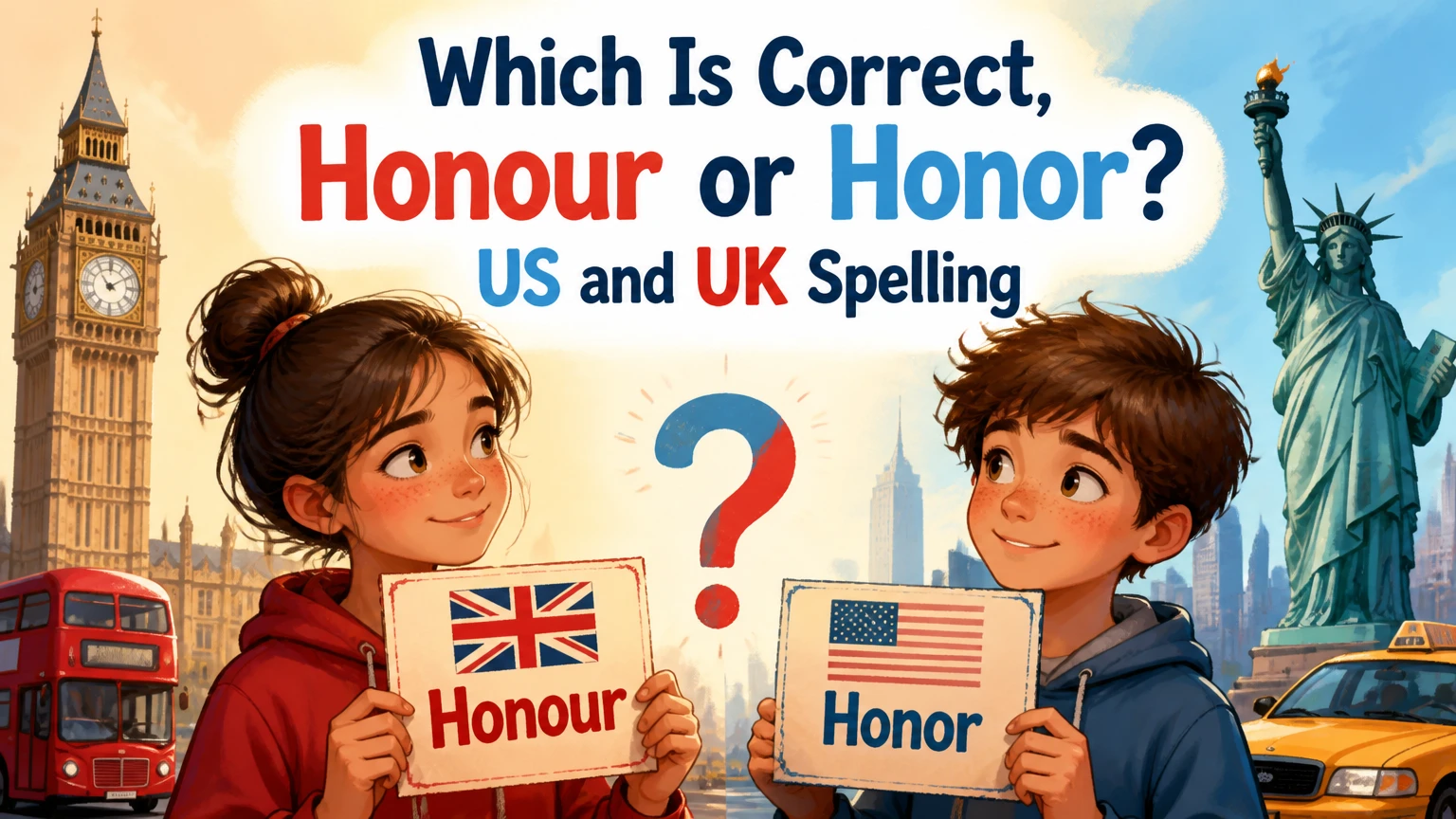
Both honour and honor are correct English spellings with the same meaning. Honor is the standard form in American English, while honour is preferred in British English and is widely used in Australian, New Zealand, and many Commonwealth contexts. Choose the form required by your audience or style guide, then use it consistently.
Key Facts at a Glance
Honor is the usual spelling in American English.
Honour is the usual spelling in British English.
Canadian English generally prefers honour, although honor appears frequently.
The noun and verb have the same meaning in both forms.
Honorary, honorific, and honorarium normally keep no “u” in either variety.
A proper name, official title, quotation, or institutional name may preserve its original spelling.
Is Honour or Honor Correct?
Honour and honor are regional spelling variants, not different words. Both can mean high respect, a privilege, a distinction, or the act of fulfilling a promise or obligation. The correct choice depends mainly on the English variety used by the document, publication, institution, or intended readers.
Examples include:
- “It was an honor to meet the president.”
- “It was an honour to meet the president.”
- “The company agreed to honor the warranty.”
- “The company agreed to honour the warranty.”
- “She received the highest honors.”
- “She received the highest honours.”
The spelling does not change pronunciation or core meaning. Both forms are pronounced approximately ON-er, although pronunciation can vary slightly by accent.
A document is not automatically wrong because it uses the less familiar regional form. A US reader may expect honor, whereas a UK reader may expect honour. Editorial correctness includes audience fit, so regional consistency matters more than choosing one spelling for every English-speaking market.
What does honor or honour mean?
Honor or honour means respect, esteem, a mark of distinction, or compliance with an obligation. The word functions primarily as a noun and verb, and context determines which sense applies.
| Function | Meaning | American example | British example |
|---|---|---|---|
| Noun | Respect or esteem | He acted with honor. | He acted with honour. |
| Noun | Distinction or privilege | It was an honor to speak. | It was an honour to speak. |
| Noun | Award or recognition | Military honors were awarded. | Military honours were awarded. |
| Verb | Show respect | We honor the volunteers. | We honour the volunteers. |
| Verb | Fulfill a commitment | The bank will honor the cheque. | The bank will honour the cheque. |
The word can also appear in fixed expressions. Honor among thieves, on your honor, and in honor of are common American forms; British writing uses the corresponding honour spellings.
Why Do Honor and Honour Have Different Spellings?
The difference developed through English spelling history and was reinforced by American dictionary conventions. The word entered English through Anglo-French and ultimately derives from Latin honor, with historical spellings varying across time and place.
Noah Webster’s dictionaries helped establish many American preferences for shorter spellings in the early nineteenth century. Webster supported changes such as color instead of colour, center instead of centre, and honor instead of honour. The spelling difference therefore reflects standardization, not a difference in meaning or pronunciation.
British English retained the “u” in many words influenced by French spelling. American English removed it in a group of words, particularly those ending in -our. The pattern is broad but not perfectly predictable, because English spelling contains older exceptions and later borrowings.
| Word family | American English | British English | Meaning |
|---|---|---|---|
| Main word | honor | honour | Respect or distinction |
| Colour family | color | colour | Hue |
| Neighbour family | neighbor | neighbour | Person living nearby |
| Labour family | labor | labour | Work |
| Favour family | favor | favour | Preference or support |
| Behaviour family | behavior | behaviour | Conduct |
The historical explanation does not mean every American spelling is a simplification, or that every British spelling preserves an older form. English standards developed through dictionaries, schools, publishers, government institutions, and local usage over several centuries.
Which Spelling Does Each Country Use?
American English uses honor, while British English uses honour; other countries follow local institutions and publishing conventions rather than one universal Commonwealth rule. Country is a strong starting point, but a specific employer, university, newspaper, or government style guide can override the general tendency.
| Region or variety | Usual spelling | Common derivative | Practical note |
|---|---|---|---|
| United States | honor | honorable | Used by US publishers and federal institutions |
| United Kingdom | honour | honourable | Used by most UK publishers |
| Canada | honour | honourable | Canadian style commonly retains the “u” |
| Australia | honour | honourable | Australian government and academic writing usually use it |
| New Zealand | honour | honourable | British-derived spelling is generally preferred |
| India | honour | honourable | Institutional usage often follows British conventions |
| International business | Depends on audience | Depends on locale | Brand and style guides determine consistency |
“Usually” is more accurate than “exclusively.” American companies may use honour in a brand name, and British organizations may preserve Honor in a product or personal name. Proper nouns do not need to be converted to match the surrounding prose.
Does Canada use honor or honour?
Canadian English generally prefers honour, but honor is also established in Canadian usage. Canadian English developed under both British and American influence, so newspapers, universities, public agencies, and businesses may not make identical choices.
A Canadian document should follow its institution’s style guide. The Canadian Style guide from the Translation Bureau has traditionally supported many British-derived spellings, while individual publications can adopt their own house rules. Canadian legal and governmental contexts also vary by jurisdiction and by the official name of an institution.
For Canadian readers, honour is usually the safer default when no style guide is available. A Canadian writer targeting a US publication should switch to honor if the publisher requires American spelling.
Is honour British spelling?
Honour is the standard British spelling, and honor is the standard American spelling. UK publications commonly write honourable, honours, and honoured, while US publications generally write honorable, honors, and honored.
British spelling does not guarantee that every related word contains a “u.” The related forms honorary, honorific, and honorarium normally appear without one in both British and American English.
What Are the Correct Derivatives?
Most derivatives follow the regional spelling of the root, but several Latin-derived forms retain honor without a “u” in both major standards. Writers should check the complete word rather than add or remove a letter mechanically.
| Meaning or use | American English | British or Commonwealth English | Usage note |
|---|---|---|---|
| Adjective meaning deserving respect | honorable | honourable | Regional root spelling |
| Past tense of the verb | honored | honoured | Doubled consonant differs too |
| Present participle | honoring | honouring | British form retains “u” |
| Plural awards or distinctions | honors | honours | Education and ceremonies |
| Person receiving an award | honoree | honouree or honoree | Honouree is less common |
| Ceremonial payment | honorarium | honorarium | Same spelling in both varieties |
| Relating to an honorary position | honorary | honorary | No “u” in standard usage |
| Relating to titles | honorific | honorific | No “u” in standard usage |
Is it honorary or honourary?
The standard spelling is honorary in both American and British English. The form honourary is generally treated as a misspelling in professional writing, even in documents that otherwise use honour.
Examples:
- She received an honorary doctorate.
- He was appointed an honorary fellow.
- The university awarded an honorary degree.
The reason is historical rather than purely visual. Honorary comes from Latin-derived honorarius and entered English without the spelling pattern that produced honour. A British document can therefore correctly contain both honour and honorary.
Is honorarium spelled with a “u”?
Honorarium is normally spelled without a “u” in American and British English. An honorarium is a payment given for a service, usually when the payment is not a standard salary or fee.
Correct examples include:
- The guest lecturer received an honorarium.
- The conference paid each speaker a small honorarium.
- The charity offered an honorarium for the workshop.
The plural is usually honorariums in general English, although honoraria also appears in formal or academic writing. The choice depends on the publication’s preferred treatment of Latin plurals.
How Do Titles and Formal Names Work?
Formal titles should follow the jurisdiction, institution, or official source that uses them. A UK government title is generally The Honourable, while a US title is generally The Honorable.
| Context | Typical US form | Typical UK or Commonwealth form | Decision rule |
|---|---|---|---|
| Government title | The Honorable Jane Smith | The Honourable Jane Smith | Follow the official jurisdiction |
| Court reference | Hon. Robert Jones | The Hon. Robert Jones | Check court style |
| Award ceremony | An honor bestowed on her | An honour bestowed on her | Match document variety |
| Organization name | National Honor Society | Local institutional spelling | Preserve official name |
| Quotation | “It was an honour,” | “It was an honor,” | Preserve the speaker’s wording |
The title The Honorable is associated with US governmental and judicial usage. The Honourable is used for many officials in the UK, Canada, Australia, New Zealand, and other countries, although exact eligibility and capitalization rules differ.
A proper name is an exception to normal copyediting. If a Canadian organization is officially called the Order of Honour, do not silently change it to Order of Honor for an American audience. Explain the name only if readers could reasonably misunderstand it.
Are Honors and Honours Degrees the Same?
Honors degree and honours degree describe related academic distinctions, but the exact structure differs by country and university. American institutions often use honors for an enhanced undergraduate program or designation, while UK, Australian, and some other systems use honours as part of the degree classification or program name.
| Education context | Usual spelling | Typical meaning | Important variation |
|---|---|---|---|
| US honors program | honors | Enriched undergraduate coursework | Requirements vary by college |
| US Latin honors | honors | Cum laude distinctions | Award thresholds differ |
| UK honours degree | honours | Standard bachelor’s degree category | Classification may be first, 2:1, 2:2, or third |
| Australian honours year | honours | Advanced research or specialist year | Often follows a bachelor’s degree |
| Canadian university | honors or honours | Institution-specific program | Calendar and faculty rules control |
The spelling alone does not tell you the academic level. A US honors program may involve special seminars and a thesis, while a UK honours degree can refer to the normal bachelor’s degree pathway rather than an optional elite program.
Use the institution’s exact name on applications, transcripts, résumés, and credential evaluations. Do not convert Bachelor of Science with Honours into Bachelor of Science with Honors when reproducing an official qualification.
Should One Document Use Honor or Honour?
One document should normally use one regional spelling system throughout, unless it reproduces proper names, quotations, or source text. Consistency helps readers identify the intended language variety and prevents editorial errors such as mixing honor, honourable, and honored without a reason.
A US document would normally use:
The organization honored three volunteers and presented them with civic honors.
A UK document would normally use:
The organisation honoured three volunteers and presented them with civic honours.
The regional pattern extends beyond this word. A document that uses colour, centre, and organise should usually use honour. A document that uses color, center, and organize should usually use honor.
Mixed spelling is acceptable in controlled situations:
- A quotation retains the original wording.
- A registered organization name is reproduced exactly.
- A product name uses its trademark spelling.
- A page serves different localized versions.
- A linguistic article intentionally compares variants.
What should a global website use?
A global website should use localized spelling where practical, rather than treating American English as a universal default. A site with separate en-US, en-GB, en-CA, and en-AU versions can display honor or honour according to the selected locale.
For a single English version, choose the audience with the highest commercial, legal, or editorial priority. A UK law firm should use honour even if many software tools default to US English. A US software company should use honor in its interface unless a regional localization requires otherwise.
Search engines generally understand both spellings as equivalent for ordinary meaning. Localization still affects trust, spelling-checking, user expectations, and institutional accuracy. Regional spelling is a user-experience decision, not merely a keyword decision.
How Do You Fix the Wrong Spelling in Software?
Set the document or application language to the intended English variety, then run a consistency search for the full word family. Changing the language dictionary corrects future flags, but it does not reliably repair every existing variant in a long document.
Use this workflow:
- Identify the target variety, such as US, UK, Canadian, or Australian English.
- Set the proofing language in Microsoft Word or Google Docs.
- Search for both honor and honour.
- Search related forms such as honored, honoured, honorable, and honourable.
- Check official names and quotations before replacing anything.
- Review page templates, navigation labels, metadata, and downloadable files.
- For websites, confirm that the locale code and visible copy agree.
A US spellchecker may flag honour even though the word is correct in British English. That warning identifies a dictionary mismatch, not an objective spelling error.
For software interfaces, store translations in locale files rather than hard-coding one form into every component. For example, an en-US resource can contain Honor Roll, while an en-GB resource contains Honour Roll. Developers should also check pluralization, capitalization, and official product names.
What Common Mistakes Should You Avoid?
The most common mistake is mixing regional forms without an editorial reason. The second is applying the “u” rule to derivatives that standard English spells honorary, honorific, and honorarium.
| Mistake | Incorrect or risky pattern | Better form | Reason |
|---|---|---|---|
| Mixed root forms | honor and honour in one article | Choose one system | Preserves editorial consistency |
| Wrong derivative | honourary doctorate | honorary doctorate | Standard form in both varieties |
| Wrong payment spelling | honourarium | honorarium | Latin-derived exception |
| Altered proper name | Changing an official title | Preserve source spelling | Names are not ordinary prose |
| US title in UK context | The Honorable MP | The Honourable MP | Jurisdiction controls title style |
| Automatic replacement | Replacing all “honour” strings | Review matches individually | Quotations and names may differ |
One counterintuitive rule matters especially in British editing: retaining the “u” does not mean adding it to every word historically related to honour. Honorary and honorarium are accepted without it, so a blanket find-and-replace operation can create new errors.
Another practical rule concerns capitalization. Honor and honour are lowercase common nouns, but official titles may capitalize Honorable or Honourable according to the relevant style guide. Capitalization and regional spelling are separate editorial decisions.
Which Version Should You Choose?
Choose honor for a US audience, honour for a UK or Commonwealth audience, and the institution’s own spelling for formal names and qualifications. If the audience is international and no stronger regional requirement exists, select one house style and document it in the publication’s style guide.
| Writer or document | Recommended default | Verification source | Main risk |
|---|---|---|---|
| US business website | honor | Company style guide | Inconsistent localization |
| UK academic essay | honour | University guide | Using US derivatives |
| Canadian public document | honour | Agency style guide | Assuming all institutions match |
| Australian résumé | honour | Employer or university guide | Altering qualification names |
| International product UI | Locale-specific | Translation files | Hard-coded spelling |
| Legal correspondence | Jurisdiction-specific | Court or regulator | Incorrect official title |
A US student applying to a UK university should reproduce the institution’s degree name exactly. A UK writer submitting to an American journal should follow the journal’s style sheet, even if the writer normally uses honour.
The strongest editorial rule is simple: audience first, official names second, consistency throughout. Do not select honor merely because it appears more often in global software, and do not select honour merely because it is historically older.
Frequently Asked Questions
Does honor mean something different from honour?
No. Honor and honour have the same core meanings: respect, esteem, distinction, privilege, or fulfillment of an obligation. Their difference is regional spelling. Context can create different meanings, such as an award versus a promise, but the spelling does not create that distinction.
Is the plural honors or honours?
Both honors and honours are correct. Use honors in American English and honours in British, Australian, New Zealand, and many Canadian contexts. Preserve the institution’s official wording for names such as Honors College or Honours College.
Is it honored or honoured?
Honored is the usual American form, while honoured is the usual British and Commonwealth form. The same regional pattern applies to honoring and honouring. Use the spelling that matches the document’s wider system.
Is The Honorable or The Honourable correct?
Both are correct in the right jurisdiction. The Honorable is the common US form, while The Honourable is widely used for officials in the UK and Commonwealth. Confirm the officeholder’s official title before addressing formal correspondence.
Can a British writer use honor?
Yes. A British writer can use honor when quoting an American source, reproducing a US organization’s name, following an American publisher’s style guide, or writing for a US audience. It is not inherently incorrect, but it may be inconsistent with general British prose.
How do you pronounce honor and honour?
Both forms are usually pronounced approximately ON-er. The written “u” in honour does not normally add a syllable. Accent, stress, and vowel quality can vary between speakers, but the two spellings are not normally distinguished in pronunciation.
The Bottom Line
Which is correct, honour or honor? Both are correct. Use honor in American English, honour in British and most Commonwealth English, and follow the exact spelling of official names, titles, and academic qualifications. Remember that honorary, honorific, and honorarium normally keep no “u” in either variety. Consistency and audience fit determine the best choice.


