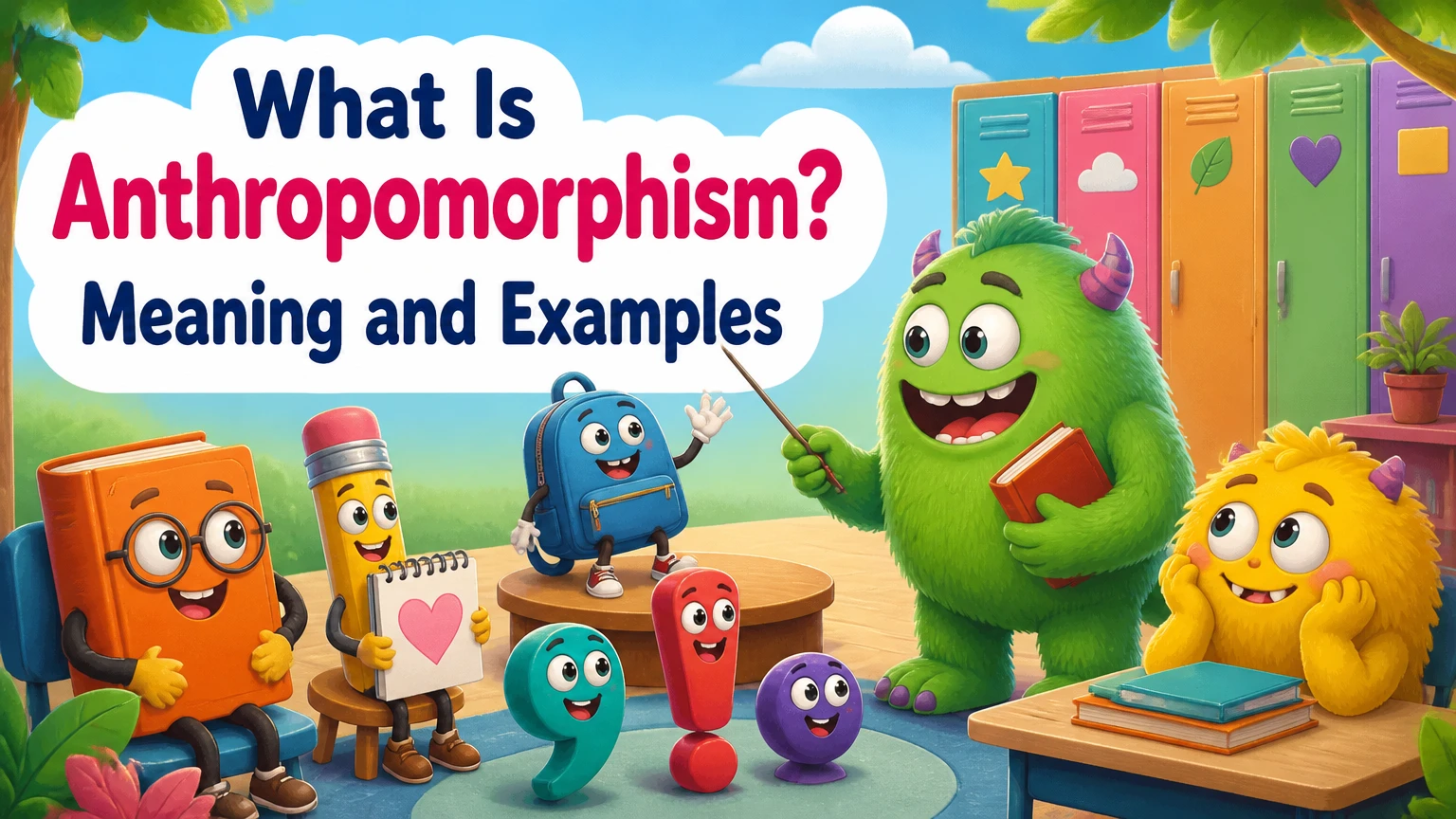
Anthropomorphism is the attribution of human traits, emotions, intentions, appearance, or behavior to a non-human entity. People anthropomorphize animals, objects, forces of nature, software, fictional characters, deities, and abstract ideas, as in saying that a dog feels guilty or that a computer is being stubborn.
Key Facts at a Glance
- Anthropomorphism means treating a non-human entity as human in appearance, behavior, emotion, or intention.
- The word comes from the Greek anthropos, meaning “human,” and morphe, meaning “form.”
- Anthropomorphism can be literal in fiction, design, or religion, and metaphorical in ordinary speech.
- People often anthropomorphize because human motives provide a fast way to interpret uncertain events.
- Anthropomorphism is useful for storytelling and interface design but can produce scientific errors or misplaced trust in AI.
- Personification is usually a figure of speech, while anthropomorphic characters behave as though they possess human agency.
What Does Anthropomorphism Mean?
Anthropomorphism means assigning human characteristics to something that is not human. The characteristic may be physical, such as a car with a face; behavioral, such as software that “understands” a request; emotional, such as a cat being called jealous; or intentional, such as a storm being described as angry.
The term derives from the Greek words anthropos (“human”) and morphe (“form”). Anthropomorphism appears in ordinary conversation, children’s stories, animation, advertising, religious imagery, mythology, robotics, and artificial intelligence. Its presence does not automatically mean that the speaker literally believes the non-human entity has a human mind.
The distinction between literal and figurative use matters. In Toy Story, toys literally speak and make decisions within the story world. In “the wind whispered,” the wind receives a human action only as poetic imagery. Both examples use human qualities, but they create different expectations about agency and consciousness.
What Is the Simplest Example?
A simple example of anthropomorphism is saying, “My alarm clock is angry because it keeps ringing.” An alarm clock has no demonstrated anger, but the sentence gives an inanimate object a human emotion and an implied motive.
Other everyday examples include:
- “The flowers are happy in the sunlight.”
- “The old house is tired.”
- “My laptop refuses to cooperate.”
- “The ocean swallowed the boat.”
- “The dog knows he did something wrong.”
- “The printer hates me.”
- “The clouds are following us.”
The examples differ in strength. “The printer hates me” is usually humorous shorthand for repeated malfunction. “The dog feels moral guilt” makes a more substantial claim about an animal’s internal state.
How Does Anthropomorphism Work Psychologically?
Anthropomorphism helps people explain unfamiliar, unpredictable, or socially important entities by applying familiar knowledge about human minds. Epley, Waytz, and Cacioppo’s 2007 Three-Factor Theory identifies elicited agent knowledge, effectance motivation, and sociality motivation as major influences on this tendency.
Elicited Agent Knowledge
Human behavior is the most accessible model people have for interpreting agency. When a phone stops responding, a person may say that the phone is “confused” because confusion provides a familiar explanation for an unexpected result.
This shortcut can be efficient. Human language contains rich concepts for goals, attention, frustration, cooperation, and refusal. Applying those concepts to a machine or animal lets a person form a quick prediction, even when the prediction is not biologically or technically accurate.
Effectance Motivation
Effectance motivation is the desire to understand, predict, and control the environment. A person who treats a car as “temperamental” may feel that the vehicle has a pattern that can be recognized, even when the actual cause is fuel quality, battery voltage, or a sensor fault.
Anthropomorphic explanations can therefore reduce uncertainty. They become harmful when emotional labels replace diagnosis. Calling a malfunctioning computer “lazy” does not identify corrupted files, overheating, or network failure.
Sociality Motivation
Sociality motivation is the desire for connection and interaction. People who feel isolated may respond more strongly to human-like pets, digital assistants, robots, or conversational systems.
A 2007 review by Epley and colleagues describes anthropomorphism as a variable psychological process rather than a fixed personality trait. The tendency increases or decreases according to the entity’s cues, the person’s social context, and the need to explain what happens next.
Does a Human-Like Face Cause Anthropomorphism?
Human-like visual cues increase anthropomorphic interpretation, but they are not required. Eyes, a face, upright posture, names, voices, turn-taking, and first-person language can all suggest human agency.
A robot with two camera lenses may appear watchful. A navigation app that says “I found a faster route” may appear capable of intention. A plain software error can also be anthropomorphized when a user is frustrated. The cue and the situation work together.
What Are the Main Types of Anthropomorphism?
The main types are physical, behavioral, emotional, cognitive, and religious or symbolic anthropomorphism. A single character or product can combine several types, such as a talking animal that wears clothes, expresses fear, and pursues a personal goal.
| Type | Human attribute added | Specific example | Common context |
|---|---|---|---|
| Physical | Face, limbs, posture, clothing | Mickey Mouse walks upright and wears gloves | Animation and illustration |
| Behavioral | Speech, cooperation, refusal, tool use | A chatbot says, “I understand” | Software and robotics |
| Emotional | Guilt, jealousy, pride, spite | A cat is called petty after knocking over a cup | Pets and everyday speech |
| Cognitive | Beliefs, plans, reasoning, memory | A fictional car chooses its destination | Film and literature |
| Religious or symbolic | Human body, motives, judgment | Zeus displays anger and desire | Mythology and religion |
| Functional | Social role or personality | A brand mascot acts as a friendly guide | Marketing and service design |
Physical and Visual Anthropomorphism
Physical anthropomorphism gives a non-human form human anatomy or visual signals. Common features include eyes, mouths, hands, upright movement, clothing, eyebrows, and recognizable facial expressions.
Cars often receive visual anthropomorphic treatment through headlights and grilles that resemble eyes and mouths. Pixar’s Luxo Jr. uses a desk lamp’s movement and posture to communicate curiosity without giving the lamp a human body. Stylized forms often avoid the discomfort caused by nearly realistic human replicas.
Behavioral and Functional Anthropomorphism
Behavioral anthropomorphism occurs when a non-human entity performs actions associated with human agency. A robotic vacuum that changes direction may appear “stubborn,” while a voice assistant that apologizes may appear socially aware.
Functional anthropomorphism is common in interface design because human conversational patterns reduce learning effort. Labels such as “Ask,” “Remember,” and “Help me choose” are easy to understand. Designers must still state what the system actually does, because conversational fluency does not prove comprehension.
Emotional and Cognitive Anthropomorphism
Emotional anthropomorphism assigns feelings to animals, objects, nature, or software. Cognitive anthropomorphism goes further by assigning beliefs, motives, plans, or moral judgments.
The claim that a dog “feels guilty” after chewing a shoe is a common example. The dog may instead be responding to a person’s posture, tone, or facial expression. The visible behavior is real; the human interpretation of its cause may be wrong.
Religious and Mythological Anthropomorphism
Religious and mythological anthropomorphism represents gods, death, time, nature, or cosmic forces with human bodies and motives. Zeus is portrayed with human emotions and desires, while Father Time is commonly shown as an old man carrying a clock or scythe.
These representations make abstract forces easier to narrate and remember. They should be interpreted within their cultural and theological context rather than treated as interchangeable examples of fictional character design.
Where Is Anthropomorphism Used?
Anthropomorphism is used in literature, animation, branding, product design, education, religion, robotics, and conversational AI. The practical value comes from making unfamiliar systems easier to recognize, remember, or emotionally approach.
| Domain | Anthropomorphic technique | Named example | Primary benefit | Main risk |
|---|---|---|---|---|
| Literature | Human speech and motives | George Orwell’s Animal Farm | Allegorical critique | Oversimplifying real animals |
| Animation | Human posture and dialogue | Zootopia | Character empathy | Stereotyping groups through animals |
| Branding | Mascot personality | GEICO Gecko | Message recall | Personality overshadowing product facts |
| UX design | Warm language and motion | Duolingo’s owl mascot | Reduced interface anxiety | Manipulative engagement |
| Robotics | Face, voice, social response | SoftBank Pepper | Easier interaction | Overestimating competence |
| AI | First-person conversational output | ChatGPT-style assistants | Natural task interaction | Mistaking fluency for feeling |
Anthropomorphism in Literature and Storytelling
Writers use anthropomorphism to give readers access to ideas through characters. A speaking animal can represent political groups, social classes, human virtues, or personal conflicts without directly naming them.
The technique works best when the human trait supports the story’s purpose. A cautious tortoise communicates persistence through behavior, while a “wise” owl relies on a culturally familiar association. Writers should avoid presenting animal traits as scientifically accurate unless the story clearly signals fantasy or allegory.
Anthropomorphism in Branding
Brands use mascots and human-like voices to make abstract products more memorable. Insurance, finance, cybersecurity, and enterprise software often have difficulty conveying warmth because their services are intangible, so a character can provide a recognizable social identity.
Anthropomorphic branding is not a substitute for evidence. A friendly mascot may increase attention, but product reliability, price, privacy, and customer support determine whether trust survives. A mascot should express a defined brand attribute, such as reassurance or competence, rather than an unfocused personality.
Anthropomorphism in Artificial Intelligence
AI systems use anthropomorphic cues through names, avatars, first-person pronouns, typing indicators, emotional language, and conversational turn-taking. These cues can make complex tools easier to operate, but they do not establish consciousness, emotion, intention, or independent understanding.
A language model generates outputs from learned statistical patterns and the instructions, context, and system design surrounding it. When an assistant says “I understand,” the phrase can function as a conversational signal without proving subjective understanding. Users should verify medical, legal, financial, and safety-critical claims independently.
What Is the Difference Between Anthropomorphism and Personification?
Anthropomorphism usually presents a non-human entity as having human form, behavior, or agency, while personification generally uses human qualities as a metaphor or literary description. The difference is practical: anthropomorphic characters act within a human-like role, whereas personification may exist only in a sentence.
| Concept | Direction of attribution | Example | Literal within context? | Typical use |
|---|---|---|---|---|
| Anthropomorphism | Non-human to human | A talking fox builds a house | Often yes | Fiction and design |
| Personification | Object or idea described as human | “Justice is blind” | Usually no | Poetry and rhetoric |
| Zoomorphism | Human or object to animal | A person is described as wolf-like | Usually figurative | Art and literature |
| Animism | Nature treated as spiritually alive | A river has a guardian spirit | Cultural or religious | Religion and worldview |
| Analogy | Similarity used to explain function | “The brain is like a computer” | No | Education and science |
“ The wind whispered” is personification because the wind is described with a human action. A wind character that speaks, remembers, and makes choices is anthropomorphic within the story.
How Can You Identify Anthropomorphism?
Identify anthropomorphism by checking whether a non-human entity receives a human body, human action, human emotion, human thought, or human moral intention. Replace the human label with an observable description to test whether the sentence contains interpretation rather than evidence.
Use this five-question checklist:
- Does the entity have human anatomy, clothing, or facial expression?
- Does the entity speak, plan, negotiate, apologize, or refuse?
- Does the sentence assign a human emotion such as jealousy or shame?
- Does the sentence claim a human motive, such as revenge or kindness?
- Would a measurable description produce a different explanation?
For example, replace “the dog felt guilty” with “the dog lowered its head, avoided eye contact, and moved away after the owner raised their voice.” The second sentence records behavior without claiming a human moral emotion.
Is Anthropomorphism Good or Bad?
Anthropomorphism is useful when it improves communication, memory, empathy, or story structure, and harmful when it causes inaccurate predictions about biology, technology, or responsibility. Its value depends on the domain and on whether the human-like interpretation is clearly signaled.
| Situation | Likely benefit | Likely harm | Practical choice |
|---|---|---|---|
| Children’s fiction | Makes characters memorable | Creates false biology lessons | Label fantasy clearly |
| Pet training | Encourages attachment | Misreads fear as guilt | Use species-specific behavior |
| Software onboarding | Reduces unfamiliarity | Hides system limits | Pair warmth with disclosures |
| Safety-critical AI | Makes interaction easier | Encourages overtrust | Use capability labels |
| Branding | Improves recognition | Distracts from product quality | Tie personality to evidence |
| Scientific writing | Makes prose accessible | Implies unsupported agency | Use measurable descriptions |
When Does Anthropomorphism Become a Scientific Error?
Anthropomorphism becomes a scientific error when an assumed human motive replaces observable evidence or a testable biological explanation. Calling a predator “cruel,” for example, adds moral intention to behavior that may be explained by feeding, territorial defense, or reproductive competition.
Animal behavior researchers can describe what an animal did, the conditions under which it did it, and the outcome that followed. They should avoid treating a human emotional label as proof of the animal’s internal experience unless the study provides evidence for that conclusion.
The same rule applies to plants, weather, and ecosystems. A forest does not “want” to recover after a fire in the same sense that a person wants a goal, although ecological processes can produce directional change.
What Is the Uncanny Valley?
The uncanny valley is the drop in comfort that can occur when a robot, avatar, or animated character looks almost human but displays small unnatural differences. Mismatched eye movement, facial timing, skin texture, voice quality, or body motion can produce discomfort rather than familiarity.
Stylization is often the safer design strategy. A simple animated face establishes a clear fictional category, while a realistic face with rigid expressions creates conflicting signals. Designers should test whether human likeness improves task completion, not assume that greater realism improves trust.
Can Anthropomorphism Make People Trust AI Too Much?
Anthropomorphism can make people overestimate an AI system’s empathy, memory, judgment, or independent agency. First-person language and emotionally responsive phrasing may encourage users to treat generated text as advice from a social partner rather than output from an engineered system.
Responsible interfaces should disclose the system’s limits near consequential actions. Product teams can use labels such as “generated response,” provide source links, show uncertainty where appropriate, and require confirmation before external actions. Warm interaction is compatible with transparency, but warmth must not imply consciousness or authority.
How Should Writers and Designers Use Anthropomorphism?
Writers should select one dominant human trait and express it through consistent action, while designers should use the minimum human cues needed for comprehension. The best choice depends on whether the goal is emotional identification, rapid recognition, instruction, or literal simulation.
A Practical Design Framework
- Name the goal. Decide whether the human-like cue should create empathy, reduce anxiety, explain function, or support recall.
- Choose the attribute. Select a specific quality such as patience, curiosity, caution, or speed.
- Set the boundary. State what the entity does not feel, know, or control.
- Match realism to context. Use stylized forms for fictional characters and restrained cues for safety-critical tools.
- Test interpretation. Ask users what the entity can do and why it acted.
- Remove misleading cues. Eliminate expressions that imply unsupported emotion, memory, or intent.
A practitioner rule is to test interpretation, not preference. Users may say that a smiling assistant feels friendly, yet still infer that it has personal beliefs or reliable judgment. Those inferences create a product risk if the system cannot support them.
Anthropomorphism Examples by Category
| Example | Entity | Human quality | Classification | Interpretation |
|---|---|---|---|---|
| “The printer is refusing to work” | Printer | Intentional refusal | Everyday speech | Metaphorical shorthand |
| Talking fox in a fable | Fox | Speech and reasoning | Fictional anthropomorphism | Literal within the story |
| “The angry sea destroyed boats” | Sea | Emotion and intention | Personification | Figurative description |
| A chatbot says “I can help” | Software | Social agency | Interface anthropomorphism | Functional, not proof of feeling |
| Zeus arguing with other gods | Deity | Desire and anger | Religious mythology | Human-shaped divinity |
| A car with eye-like headlights | Car | Facial appearance | Visual anthropomorphism | Design cue |
| “The plant is thirsty” | Plant | Bodily need | Everyday anthropomorphism | May simplify watering needs |
| A dog avoids its owner after punishment | Dog | Shame or guilt | Emotional attribution | Requires behavioral caution |
The strongest examples reveal the boundary between appearance and agency. A car with headlights resembling eyes looks human-like, but a fictional car that makes plans has behavioral and cognitive anthropomorphism as well.
Frequently Asked Questions
Is anthropomorphism always intentional?
No. Anthropomorphism is often an automatic interpretation rather than a deliberate creative decision. A person may call a malfunctioning device “stubborn” while knowing that the device has no feelings. Writers, illustrators, and marketers use the technique deliberately, but everyday speakers often produce it unconsciously.
Why do people anthropomorphize animals?
People anthropomorphize animals because animals move, communicate, respond to attention, and form relationships with humans. Sociality motivation makes pets especially likely targets. However, recognizing an animal as a social partner does not prove that the animal experiences human concepts such as moral guilt, spite, or deliberate revenge.
Is giving an object a face anthropomorphism?
Yes. Giving an object eyes, a mouth, human posture, or a facial expression is physical or visual anthropomorphism. The design becomes stronger when the facial cue communicates a specific function, such as a battery indicator that looks tired, rather than adding a face without a clear interaction purpose.
What is anthropomorphism in psychology?
In psychology, anthropomorphism is the attribution of human-like mental states or behavior to non-human agents. Epley, Waytz, and Cacioppo’s Three-Factor Theory links the tendency to accessible human knowledge, the need to predict and control events, and the desire for social connection.
Can nature be anthropomorphized?
Yes. Statements such as “the river is angry” or “the storm is taking revenge” give nature human emotion or intention. Such language can be poetic, religious, or conversational. It becomes misleading when it replaces meteorological, geological, or ecological explanations for a real event.
What is the main risk of anthropomorphism?
The main risk is confusing a useful human analogy with evidence that a non-human entity has human thoughts or feelings. That confusion can distort animal training, scientific writing, product design, and AI use. The safest practice is to separate observable behavior from the inferred motive behind it.
The Bottom Line
What is anthropomorphism meaning examples becomes clear when the concept is separated into human appearance, behavior, emotion, cognition, and intention assigned to non-human entities. A talking animal, a “stubborn” computer, a smiling car, and a storm described as angry all use human qualities, but they differ in literalness and purpose.
Anthropomorphism supports storytelling, branding, education, and approachable interfaces. It should not substitute for biological evidence, technical diagnosis, or disclosure of AI limitations. Use the human analogy when it clarifies a function or experience, then state where the analogy ends.