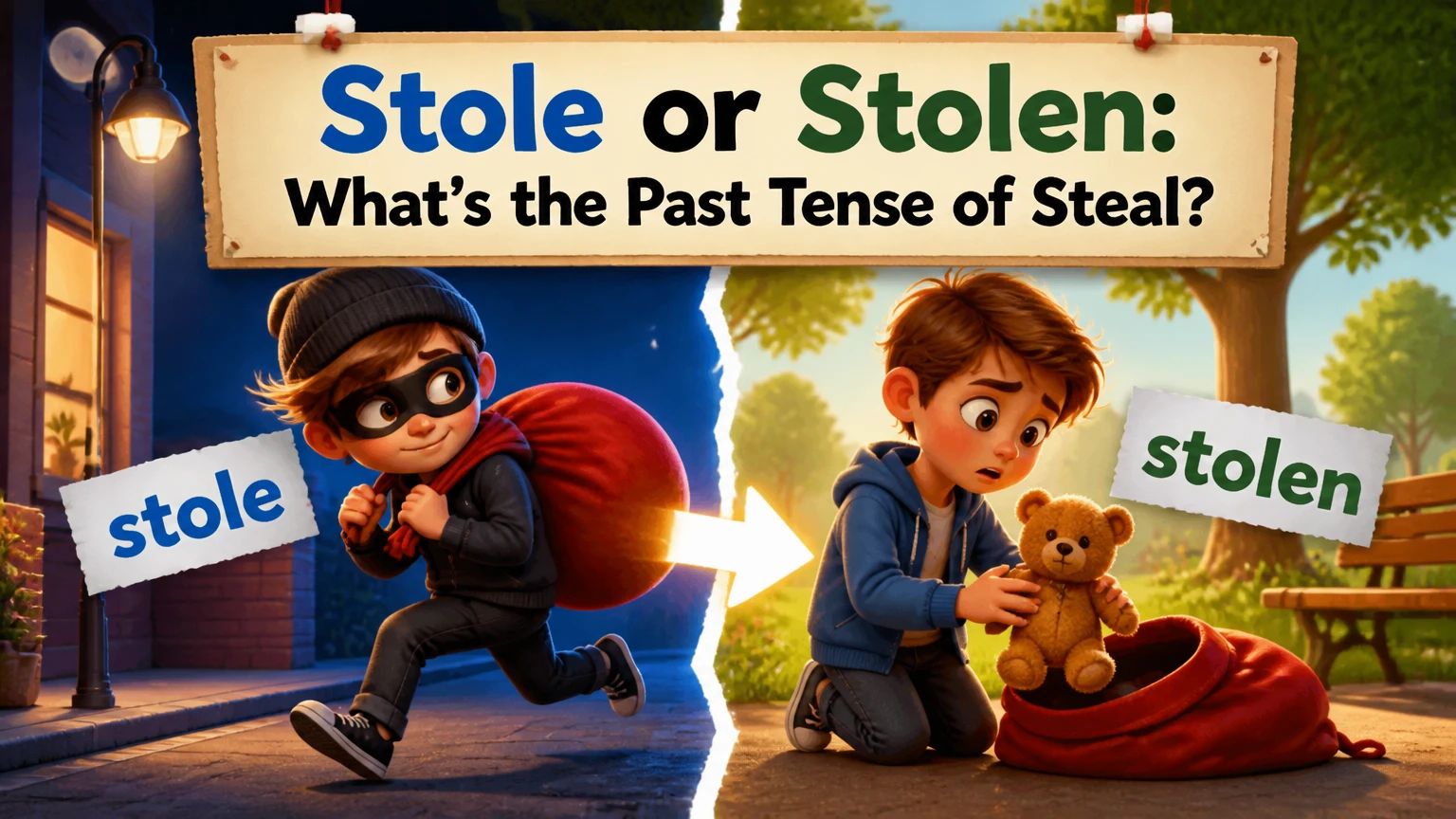
The past tense of steal is stole. Stolen is the past participle, used with auxiliary verbs such as has, have, had, be, and been, or as an adjective before a noun. Write “She stole my phone,” but “She has stolen my phone” and “My phone was stolen.”
Key Facts at a Glance
Steal is the base form of the irregular verb.
Stole is the simple past tense: “He stole the painting.”
Stolen is the past participle: “He has stolen the painting.”
Passive sentences use a form of be plus stolen: “The painting was stolen.”
Stolen can describe a noun: “The police recovered the stolen painting.”
“He stolen it,” “he has stole it,” and “it was stole” are standard-English errors.
What Is the Past Tense of Steal?
Stole is the simple past tense of steal. Use stole when one subject completed the stealing in the past and the sentence does not require a perfect or passive construction.
Examples include:
- The burglar stole three watches.
- Maya stole a glance at the timetable.
- Someone stole my bicycle last night.
- The dog stole a sandwich from the table.
The verb changes internally rather than taking the regular -ed ending. English therefore uses the irregular sequence steal, stole, stolen, similar to break, broke, broken and choose, chose, chosen.
| Verb form | Grammatical name | Example | Typical function |
|---|---|---|---|
| steal | Base form | They may steal the documents. | Present, infinitive, modal constructions |
| steals | Third-person singular present | He steals wallets. | Present habit or repeated action |
| stole | Simple past | He stole a wallet. | Completed past action |
| stolen | Past participle | He has stolen a wallet. | Perfect, passive, or adjective use |
| stealing | Present participle | He is stealing a wallet. | Progressive construction |
Is Stolen a Past Tense?
Stolen is not the simple past tense of steal; stolen is the past participle. A past participle generally needs an auxiliary verb, although it can also function adjectivally in phrases such as “stolen goods.”
The distinction matters because English tense and verb form are related but not identical. Stole independently expresses a past event. Stolen contributes meaning to a larger verb phrase:
- Simple past: The thief stole the ring.
- Present perfect: The thief has stolen the ring.
- Past perfect: The thief had stolen the ring.
- Passive: The ring was stolen.
- Adjective: The police found the stolen ring.
A useful precision rule is this: stole can stand as the main verb by itself, while stolen normally cannot. “They stole it” is complete. “They stolen it” is incomplete and incorrect in standard English.
When Should You Use Stole?
Use stole for a completed past action when the subject directly performed the stealing. The sentence normally places stole after the subject and does not place have, has, had, or a form of be before it.
Simple past examples
| Sentence | Subject | Object | Time reference |
|---|---|---|---|
| The suspect stole the laptop. | The suspect | the laptop | Unspecified past |
| Liam stole my seat yesterday. | Liam | my seat | Yesterday |
| The fox stole the eggs at dawn. | The fox | the eggs | At dawn |
| Someone stole the tickets before noon. | Someone | the tickets | Before noon |
The simple past works with definite past-time expressions such as yesterday, last week, in 2022, and an hour ago. It also works when the time is understood from the surrounding narrative:
I left my coat in the café. When I returned, someone had stolen my wallet.
In that example, had stolen appears because the theft happened before another past event, returned. If the order does not need emphasis, ordinary narrative English may use stole:
I returned to the café and discovered that someone stole my wallet.
The first version is more explicit about sequence. The second is common in informal storytelling, though style and regional preference may influence the choice.
When Should You Use Stolen?
Use stolen after an auxiliary verb in perfect or passive constructions, or before a noun as a descriptive participle. The correct auxiliary depends on the meaning: has, have, and had form perfect constructions, while forms of be form passive constructions.
Perfect-tense patterns
| Pattern | Example | Meaning |
|---|---|---|
| has + stolen | She has stolen the keys. | Past action connected to the present |
| have + stolen | They have stolen the files. | Past action involving a plural subject |
| had + stolen | He had stolen the files before police arrived. | Earlier action in past time |
| will have + stolen | The thief will have stolen the car by dawn. | Completed action before a future point |
The perfect auxiliary carries tense. In has stolen, has marks present perfect time, while stolen supplies the participle form. In had stolen, had marks past perfect time.
Correct and incorrect forms
| Incorrect sentence | Correct sentence | Reason |
|---|---|---|
| He has stole my phone. | He has stolen my phone. | Perfect tense requires the participle |
| They had stole the money. | They had stolen the money. | Past perfect requires had + stolen |
| I have stole nothing. | I have stolen nothing. | Have cannot take the simple past form |
| She will have stole it. | She will have stolen it. | Future perfect requires have + stolen |
Is It “Was Stole” or “Was Stolen”?
The standard form is “was stolen,” not “was stole.” Passive voice requires a form of be followed by the past participle, so the pattern is was/were + stolen.
Compare the focus of each sentence:
- Active: The thief stole my car.
- Passive: My car was stolen by the thief.
The active sentence foregrounds the person who performed the action. The passive sentence foregrounds the car, which may be more relevant in an insurance claim or police report.
| Subject focus | Correct construction | Example |
|---|---|---|
| Actor | Subject + stole + object | The thief stole the car. |
| Singular object | Object + was stolen | The car was stolen. |
| Plural objects | Objects + were stolen | The cars were stolen. |
| Perfect passive | has/had been stolen | The car had been stolen. |
The most common passive error is treating stole as though it were a past participle:
- Incorrect: The bicycle was stole.
- Correct: The bicycle was stolen.
- Correct: The bicycle had been stolen.
“Was stolen” and “had been stolen” are not interchangeable in every context. Was stolen describes a past passive event. Had been stolen places that event before another past reference point:
The car had been stolen before the owner reported it missing.
Can Stolen Be an Adjective?
Stolen can function as an adjective when it describes a noun rather than completing a verb phrase. Words such as stolen property, stolen goods, and stolen identity identify a condition or category associated with theft.
Examples:
- The officer catalogued the stolen property.
- The shop refused to sell stolen goods.
- The company investigated a stolen identity.
- The museum returned a stolen artifact.
The adjective test is simple: if stolen appears directly before a noun and describes that noun, it is functioning adjectivally.
However, a noun phrase can contain both an adjective-like participle and a passive verb:
The stolen painting was recovered.
Here, stolen describes painting, while was recovered is the main passive verb. The sentence does not mean that stolen is the finite verb.
| Use of “stolen” | Example | Role |
|---|---|---|
| Perfect active | She has stolen the ring. | Past participle |
| Passive | The ring was stolen. | Past participle |
| Adjective before noun | The stolen ring was insured. | Descriptive modifier |
| Complement after linking verb | The ring is stolen property. | Adjectival description |
Stole Versus Stolen: Which Word Is Correct?
Choose stole when the subject performed a completed past action; choose stolen when an auxiliary requires a past participle or when the word describes a noun. The choice depends on sentence structure, not merely on whether the event happened in the past.
| Question to ask | Choose | Example |
|---|---|---|
| Did the subject directly perform a completed past action? | stole | The guard stole the documents. |
| Does the sentence contain has, have, or had? | stolen | The guard has stolen the documents. |
| Does the sentence contain was, were, is, or are for passive voice? | stolen | The documents were stolen. |
| Does the word describe a noun? | stolen | The stolen documents were recovered. |
| Does a modal come directly before the verb? | steal | The guard may steal the documents. |
| Does “did” already mark the past? | steal | Did the guard steal the documents? |
The final two rows prevent related errors. After did, use the base form steal, not stole: “Did she steal it?” After a modal such as might, could, or should, also use the base form: “They might steal it.”
How Do You Decide Between Stole and Stolen?
Identify the auxiliary verb and the sentence voice before choosing the form. Use this four-step process:
- Find the main verb. Locate the action involving theft.
- Check the word before it. Look for has, have, had, is, are, was, were, be, or been.
- Identify the voice. If the subject performs the action, the sentence may be active; if the subject receives the action, use passive structure.
- Apply the form rule. Use stole for simple past active sentences and stolen after the relevant auxiliary.
Examples:
- No auxiliary: “The thief stole the watch.”
- Present perfect: “The thief has stolen the watch.”
- Past perfect: “The thief had stolen the watch.”
- Passive: “The watch was stolen.”
- Adjective: “The stolen watch was found.”
A compact decision tree
| Sentence condition | Verb form | Model sentence |
|---|---|---|
| Completed action, active voice | stole | Ana stole the necklace. |
| Present connection, active voice | has/have stolen | Ana has stolen the necklace. |
| Earlier past action | had stolen | Ana had stolen the necklace. |
| Passive event | was/were stolen | The necklace was stolen. |
| Noun description | stolen | The stolen necklace was recovered. |
What Are the Most Common Errors?
Most mistakes occur when writers use a past participle without an auxiliary or use the simple past after an auxiliary. Correcting the auxiliary pattern usually resolves the problem immediately.
1. “He stolen my bike”
This sentence lacks the auxiliary required by stolen.
- Incorrect: He stolen my bike.
- Simple past correction: He stole my bike.
- Present-perfect correction: He has stolen my bike.
2. “My car was stole”
Passive voice requires the participle.
- Incorrect: My car was stole.
- Correct: My car was stolen.
3. “They have stole the money”
The auxiliary have requires the participle.
- Incorrect: They have stole the money.
- Correct: They have stolen the money.
4. “The painting had stole from the gallery”
This sentence needs both passive voice and past perfect structure.
- Incorrect: The painting had stole from the gallery.
- Correct: The painting had been stolen from the gallery.
The word been is necessary because the painting received the action. The pattern is had + been + stolen.
5. “Did she stole it?”
The auxiliary did already carries the past tense.
- Incorrect: Did she stole it?
- Correct: Did she steal it?
The same rule applies to negatives:
- Incorrect: She did not stole it.
- Correct: She did not steal it.
Is “Got Stolen” Correct?
“Got stolen” is grammatically possible, but “was stolen” is usually more formal and more suitable for careful writing. The construction get + past participle is an informal passive that often emphasizes an event affecting the subject.
Examples:
- My phone got stolen on the train.
- My phone was stolen on the train.
- His account got hacked overnight.
- His account was compromised overnight.
“Got stolen” is common in conversation, especially in American and British English, but official reports usually prefer was stolen. The informal form can also suggest an unfortunate event or personal involvement:
I got my wallet stolen at the festival.
Many editors would revise that sentence to:
My wallet was stolen at the festival.
The revision is more concise and places the stolen object in the grammatical subject position.
How Do Related Verb Forms Work?
The complete standard paradigm is steal, steals, stole, stolen, and stealing. Each form appears in a different grammatical environment, so replacing one with another can change or break the sentence.
| Meaning | Correct form | Example |
|---|---|---|
| Present habit, I/you/we/they | steal | They steal expensive equipment. |
| Present habit, he/she/it | steals | She steals food from the counter. |
| Simple past | stole | She stole food yesterday. |
| Perfect construction | stolen | She has stolen food before. |
| Progressive construction | stealing | She is stealing food now. |
| Infinitive or modal | steal | She wants to steal it. |
| Negative with did | steal | She did not steal it. |
The form after to, do, does, did, and modal verbs remains the base form:
- They wanted to steal the files.
- Does he steal from customers?
- Did he steal the files?
- He might steal them.
A frequent misconception is that every verb connected to a past event must itself appear in a past form. Auxiliary verbs determine the construction, and the main verb must match that construction.
Which Form Fits Common Situations?
Everyday narratives usually use stole, while reports about missing objects often use was stolen or has been stolen. The best choice depends on whether the writer wants to emphasize the actor, the completed event, or the present result.
| Situation | Best form | Example |
|---|---|---|
| Storytelling about yesterday | stole | The fox stole the bread yesterday. |
| Missing property discovered now | has been stolen | My passport has been stolen. |
| Police report describing an event | was stolen | The vehicle was stolen at 2:15 a.m. |
| Earlier event in a past narrative | had stolen | The suspect had stolen the keys earlier. |
| Property category | stolen | Officers recovered stolen vehicles. |
| Question about a past act | steal after did | Who did steal the files? |
| Ordinary question | stole | Who stole the files? |
The present perfect, has been stolen, often fits a recent discovery whose consequences remain current. The simple past, was stolen, fits a report that supplies a finished time, such as last night at 11 p.m.
What Is the Fastest Way to Remember the Difference?
Remember the sequence “steal, stole, stolen” and attach “stolen” to an auxiliary. The mnemonic is: stole stands alone, stolen needs help.
Use these formulas:
- Subject + stole + object
- Subject + has/have/had + stolen + object
- Object + was/were + stolen
- The + stolen + noun
Examples:
- Jordan stole the tablet.
- Jordan has stolen the tablet.
- The tablet was stolen.
- The stolen tablet was recovered.
The rule is useful, but it has one important qualification: stolen does not always need an auxiliary when it is an adjective. “Stolen property” is a noun phrase, not a complete verb phrase. That distinction explains why “the stolen car” is correct while “he stolen the car” is not.
FAQ
Is “stole” the past tense or past participle of steal?
Stole is the simple past tense of steal, not the past participle. The past participle is stolen. Use stole in “The child stole the cookie,” and use stolen in “The child has stolen the cookie” or “The cookie was stolen.”
Is it “has stole” or “has stolen”?
The correct form is has stolen. The auxiliary has requires the past participle, so “She has stolen my pen” is grammatical, while “She has stole my pen” is not standard English.
Is it “have stole” or “have stolen”?
The correct form is have stolen. Use have with I, you, we, and they: “They have stolen the documents.” The simple past form stole does not follow have.
Is “was stole” ever correct?
Was stole is not correct in standard English. Passive voice requires the past participle, so write was stolen: “The bicycle was stolen.” The form stole can appear without was: “Someone stole the bicycle.”
Can “stolen” describe a person?
Stolen normally describes property, identity, data, or other things taken unlawfully, not the person who committed the theft. Standard examples include “stolen goods,” “stolen identity,” and “stolen artwork.” For a person, use thief, robber, or a phrase such as “the person who stole it.”
What is the past tense of “steal from”?
The past tense remains stole, followed by from: “Someone stole money from the drawer.” The participle form is stolen from: “Money has been stolen from the drawer” or “The drawer was emptied after money was stolen from it.”
The Bottom Line
The answer to stole or stolen whats the past tense of steal is stole. Use stole as the simple past in “The thief stole my wallet,” and use stolen after an auxiliary or as an adjective in “The thief has stolen my wallet,” “My wallet was stolen,” and “the stolen wallet.”