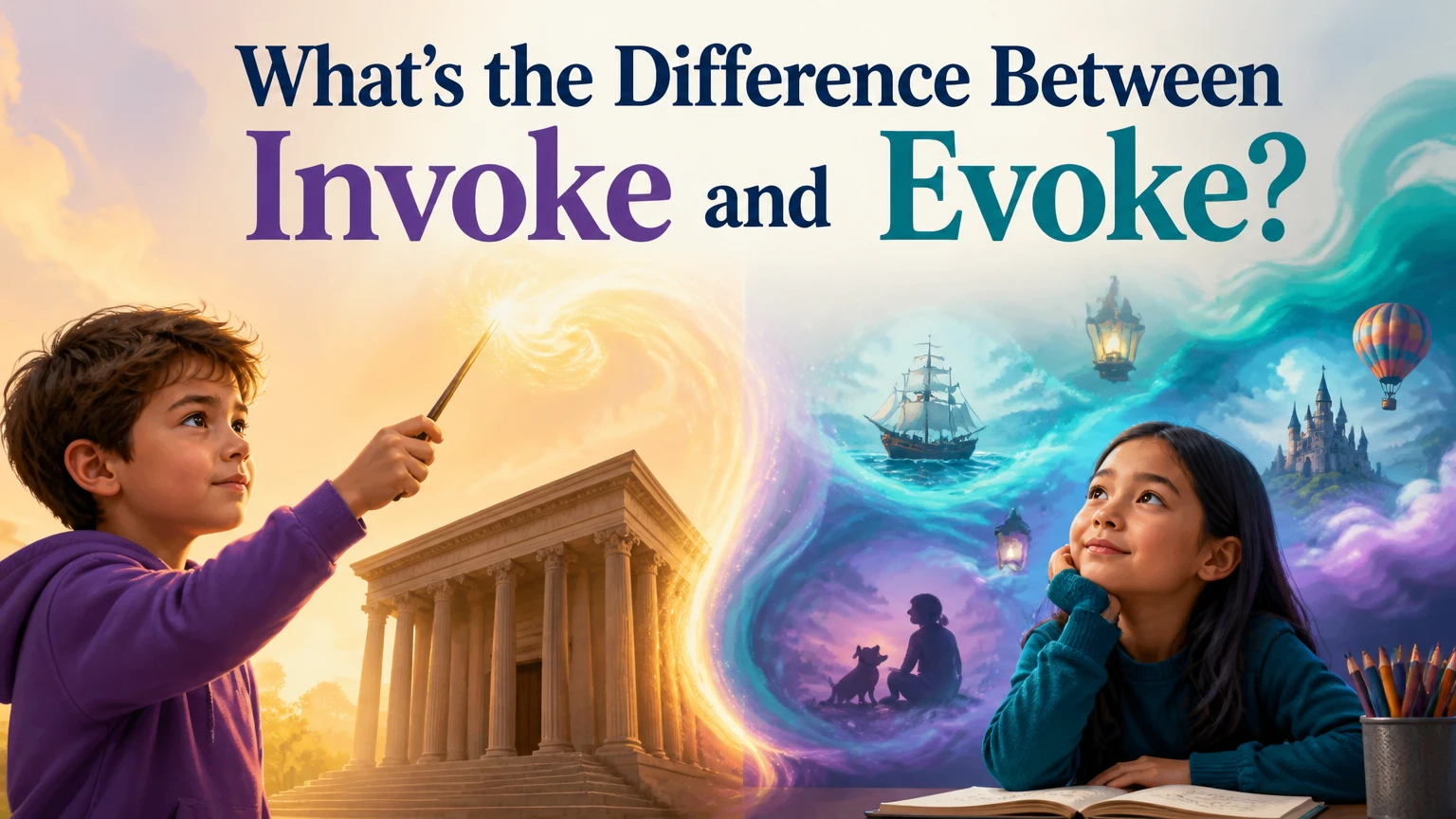
The difference between invoke and evoke is the kind of “calling” involved. Invoke means deliberately calling upon an authority, rule, power, person, or technical mechanism to produce an action or justify a position; evoke means causing a memory, feeling, image, or response to arise in someone’s mind. Invoke usually has an external, actionable target, while evoke produces an internal, associative response.
Key Facts at a Glance
Invoke means to appeal to, activate, or formally use something.
Evoke means to bring a memory, emotion, image, or atmosphere to mind.
A person can intentionally evoke a feeling, so “unintentional” is not part of the essential definition.
Lawyers invoke rights and statutes; writers evoke memories and emotions.
Programmers invoke functions, methods, APIs, and remote procedures.
A smell usually evokes a memory, while a legal privilege is invoked.
What Does Invoke Mean?
Invoke means to call upon something deliberately, especially an authority, law, principle, right, deity, procedure, or software operation. The verb indicates that an agent actively uses or appeals to a resource that can affect a decision, rule, process, or result.
A defendant may invoke the Fifth Amendment. A government may invoke an emergency statute. A religious person may invoke a deity for protection. A program may invoke a function. In each case, the subject performs an intentional act toward a defined target.
The word often carries formal or technical register. Everyday speakers can invoke a name, rule, or argument, but “invoke” is more deliberate than simply “mention.” Mentioning a company policy describes the policy; invoking the policy uses it to support or trigger a specific outcome.
Common grammatical patterns for invoke
| Pattern | Example | Intended function |
|---|---|---|
| invoke + right | “She invoked her right to counsel.” | Formally claim protection |
| invoke + law | “The agency invoked Section 230.” | Apply legal authority |
| invoke + principle | “The ruling invoked proportionality.” | Use a governing idea |
| invoke + deity | “The prayer invoked divine protection.” | Call upon spiritual power |
| invoke + function | “The program invoked calculateTax().” |
Execute code |
| invoke + memory | “The image invoked an old memory.” | Trigger a response, often less idiomatic than “evoked” |
The last row illustrates an important boundary. Invoke can sometimes mean call forth, including a memory or image, but modern usage strongly favors evoke for emotional and imaginative responses. Invoke remains the safer choice when the object is an authority, mechanism, rule, or formal power.
What Does Evoke Mean?
Evoke means to bring a feeling, memory, image, idea, or atmosphere into conscious awareness. The stimulus may be a smell, sound, color, phrase, landscape, photograph, or piece of music, and the response may be emotional rather than physical.
A familiar song evokes childhood. A novelist evokes winter through sensory detail. A museum exhibit evokes sadness without explicitly instructing visitors to feel sad. A package design may evoke luxury through typography, color, and material texture.
Evocation is associative. The stimulus does not normally command an external system. Instead, it activates a mental or emotional connection in a person.
Can evoke describe an intentional action?
Yes. Evoke does not mean accidental. An author can intentionally evoke suspense, and a brand can intentionally evoke trust. The crucial distinction is not whether the sender planned the effect. The distinction is that the sender brings about an internal response through suggestion, association, or representation rather than formally activating an authority or mechanism.
A useful sentence is: “The director intentionally evoked nostalgia through 1980s music.” The director’s choice was deliberate, but the audience’s precise emotional response remained partly subjective.
Invoke vs. Evoke: The Core Difference
Invoke activates or appeals to something; evoke brings something to mind. Invoke normally points toward an authority, rule, power, or executable mechanism, whereas evoke normally points toward a feeling, memory, image, mood, or mental association.
| Decision factor | Invoke | Evoke |
|---|---|---|
| Basic action | Appeal to or activate | Bring to mind |
| Typical object | Right, law, function, deity | Memory, emotion, image |
| Direction | Agent acts on a resource | Stimulus prompts a response |
| Outcome | Rule applied or process executed | Feeling or idea becomes present |
| Typical register | Legal, technical, formal | Literary, artistic, psychological |
| Degree of control | Usually explicit and bounded | Often indirect and variable |
| Example | “Invoke the warranty clause.” | “Evoke a sense of calm.” |
The distinction is a practical tendency, not an absolute grammatical law. English has overlapping historical meanings, and writers sometimes use invoke figuratively for memories or emotions. Nevertheless, readers usually expect evoke when the sentence describes imaginative or emotional impact.
How Do Invoke and Evoke Work Mechanically?
Invocation uses an explicit call that targets a recognized authority or mechanism; evocation uses a stimulus that activates an association in a person’s mind. The first process normally has a defined command or appeal, while the second depends on perception, memory, culture, and personal experience.
The invocation process
- A need or condition appears. A defendant faces questioning, or an application receives an event.
- An agent makes an explicit appeal or call. The defendant claims a right, or code calls a function.
- A valid target is identified. The target may be a statute, privilege, API endpoint, method, or religious power.
- Rules or permissions are checked. A court considers legal applicability; software checks arguments and access.
- The target produces an effect. The proceeding pauses, the function returns a value, or the rule changes the available options.
Invocation can fail. A person may invoke a law that does not apply, and a program may invoke a function with invalid parameters.
The evocation process
- A stimulus is presented. The stimulus may be scent, sound, language, imagery, or design.
- The person perceives the stimulus. Vision, hearing, smell, or reading supplies the initial input.
- Associations become active. Personal memories and cultural meanings shape interpretation.
- A mental or emotional response emerges. The person experiences nostalgia, fear, calm, recognition, or another state.
- The response may influence behavior. A remembered holiday may prompt conversation, or a tense scene may encourage continued reading.
Evocation also has failure conditions. A symbol may have no meaning for a particular audience, and an intended mood may be replaced by confusion or an opposing reaction.
Where Is Invoke Used?
Invoke is most natural when a person or system deliberately applies authority, protection, procedure, or executable functionality. Legal writing and software documentation use the word especially often, but religion, politics, debate, and formal argument also rely on it.
Law and government
Legal subjects invoke rights, privileges, statutes, clauses, precedents, and jurisdiction. The object is a formal source of authority or protection.
- “The witness invoked the privilege against self-incrimination.”
- “The agency invoked its emergency powers.”
- “The agreement invokes the laws of the State of New York.”
- “The defense invoked precedent from the Supreme Court.”
The Fifth Amendment example needs a small qualification. A person may invoke the privilege against self-incrimination in an appropriate setting, but saying only “I invoke the Fifth” does not automatically resolve every legal question. Whether the privilege applies depends on the proceeding, the question, and applicable law.
Treaties can also be invoked. A government may invoke a treaty provision to justify diplomatic action. However, invoking a clause is not identical to proving that every required condition has been satisfied.
Religion and ritual
Religious language uses invoke for deliberate appeals to a deity, saint, spirit, blessing, or sacred authority.
- “The priest invoked Saint Brigid during the ceremony.”
- “The petition invokes God’s mercy.”
- “The ritual invoked protection for the travelers.”
Here, invoke does not necessarily imply that the requested result will occur. It describes the act of calling upon the power.
Politics, debate, and formal writing
Speakers invoke history, national identity, fairness, tradition, or public safety to support an argument.
- “The minister invoked national security to defend the measure.”
- “The editorial invoked the principle of equal treatment.”
- “The campaign invoked memories of economic hardship.”
In political prose, invoke can signal either legitimate reasoning or rhetorical use. The verb itself does not decide whether the appeal is persuasive or manipulative.
Where Is Evoke Used?
Evoke is most natural when a person, artwork, environment, or sensory cue produces a mental, emotional, or imaginative response. Literature, film, advertising, design, music, psychology, and ordinary conversation provide its main contexts.
Literature and visual art
Writers evoke scenes through selected details rather than direct explanation.
- “The description evoked a deserted railway station.”
- “The blue lighting evoked isolation.”
- “The poem evokes the uncertainty of adolescence.”
- “The film’s score evoked dread before the door opened.”
A writer can evoke an image without naming it directly. “Wet wool, coal smoke, and a dim platform” may evoke a train station more effectively than the sentence “The scene was like a train station.”
Marketing and design
Brands intentionally evoke associations such as reliability, nostalgia, calm, or exclusivity. The result depends on audience interpretation, so marketers cannot guarantee one exact emotion.
| Stimulus | Common intended association | Possible audience response | Example context |
|---|---|---|---|
| Serif type and cream paper | Heritage | Trust or old-fashioned style | Boutique food label |
| Slow piano and soft light | Calm | Comfort or sadness | Wellness advertisement |
| Familiar childhood packaging | Nostalgia | Warmth or distrust | Limited-edition product |
| High contrast and angular type | Energy | Excitement or aggression | Sports campaign |
| Cedar, leather, and amber scent | Luxury | Sophistication or discomfort | Retail showroom |
The practitioner’s rule is simple: design can evoke a response, but it cannot command a uniform response. Personal history, age, culture, and context change the meaning of the cue.
Psychology and memory
Smells and songs can evoke unusually vivid autobiographical memories. The phenomenon is often discussed in relation to the “Proust phenomenon,” named after Marcel Proust’s literary account of a taste triggering recollection. The term describes a research topic, not a guarantee that every sensory cue will produce a detailed flashback.
“Evoked” also appears in technical psychology, as in “evoked potential,” where a measurable neural response follows a stimulus. That scientific use still concerns a response brought forth, although the response is measured rather than merely described emotionally.
How Are the Words Used in Software?
Software invokes code or services; software interfaces may evoke feelings or associations. A function call, method execution, API request, remote procedure call, or AWS Lambda execution is an invocation because a defined mechanism receives an explicit trigger.
| Technical object | Correct verb | Example | Result |
|---|---|---|---|
| JavaScript function | invoke | renderPage() is invoked |
The function executes |
| REST endpoint | invoke or call | The client invokes POST /orders |
The server processes a request |
| AWS Lambda function | invoke | Amazon EventBridge invokes Lambda | A function instance runs |
| RPC method | invoke | The client invokes getUser() |
A remote result returns |
| User interface style | evoke | Rounded cards evoke familiarity | Users perceive an association |
| Notification sound | evoke | The sound evokes urgency | Users experience a reaction |
Technical documentation often uses call as the plain-language alternative to invoke. “The event calls the cleanup routine” and “the event invokes the cleanup routine” are both acceptable, although invoke sounds more formal and emphasizes execution.
Do not write that an event “evokes” a script unless you are using metaphorical language. A script does not become an emotion or memory. The event triggers execution.
Is Invoke Always Intentional, and Is Evoke Always Unintentional?
Invoke normally describes deliberate action, while evoke can describe either deliberate or unintended effects. The difference is not intention alone: invoke targets a power or mechanism, and evoke produces a mental, emotional, or imaginative response.
| Sentence | Best choice | Reason |
|---|---|---|
| “The lawyer ___ the privilege.” | invoked | A formal right was claimed |
| “The photograph ___ memories.” | evoked | A mental response arose |
| “The designer ___ nostalgia.” | evoked | The design created an association |
| “The application ___ the payment API.” | invoked | Code executed a service |
| “The speech ___ the constitution.” | invoked | A formal authority supported an argument |
| “The speech ___ anger.” | evoked | An emotional response arose |
The common simplification “invoke is intentional and evoke is accidental” produces errors. An author may deliberately evoke grief, and a smell may unexpectedly evoke a memory. Intent affects the circumstances, not the basic meaning of the verbs.
What Is the Difference Between Invoke and Evoke in a Sentence?
Choose invoke when the object is something you actively claim, apply, or execute; choose evoke when the object is something you bring into someone’s awareness or emotional experience. Identify the object first, then ask whether the sentence describes activation or association.
Use this ten-second editing test:
- Underline the object after the verb.
- Ask whether the object is a right, law, authority, procedure, function, or service.
- If yes, choose invoke.
- Ask whether the object is a memory, image, feeling, mood, or atmosphere.
- If yes, choose evoke.
- If neither category fits, test related verbs such as cite, elicit, summon, or convene.
Sentence repair examples
| Incorrect or weak sentence | Better sentence | Explanation |
|---|---|---|
| “The scent invoked childhood memories.” | “The scent evoked childhood memories.” | Memory is an association |
| “The attorney evoked the client’s right to silence.” | “The attorney invoked the client’s right to silence.” | A right is formally claimed |
| “The button evoked the login function.” | “The button invoked the login function.” | The button triggered code |
| “The novel invoked a feeling of loss.” | “The novel evoked a feeling of loss.” | The novel prompted emotion |
| “The policy evoked emergency powers.” | “The policy invoked emergency powers.” | A formal power was applied |
| “The speech invoked fear in the audience.” | “The speech evoked fear in the audience.” | Fear is an emotional response |
What Words Are Commonly Confused With Invoke and Evoke?
Invoke and evoke are not interchangeable with elicit, elude, allude, summon, or convoke. Each neighboring verb describes a different relationship between an agent, an object, and a result.
| Word | Core meaning | Typical object | Example |
|---|---|---|---|
| invoke | Appeal to or activate | Law, right, function | “Invoke the exception.” |
| evoke | Bring to mind | Feeling, memory, image | “Evoke a sense of place.” |
| elicit | Draw out a response | Answer, reaction, information | “The question elicited a laugh.” |
| summon | Call someone or something to appear | Person, courage, energy | “Summon the witness.” |
| allude | Refer indirectly | Idea, event, text | “The poem alludes to Homer.” |
| convoke | Call people together formally | Assembly, council, meeting | “The president convoked the council.” |
| cite | Refer to as evidence or authority | Case, source, rule | “Cite the decision.” |
Evoke versus elicit creates the most frequent secondary confusion. A photograph evokes a memory, while a question elicits an answer. Both involve bringing something forth, but evoke emphasizes association and elicit emphasizes extracting a response.
Invoke versus summon also differs by object. A court summons a witness through formal process; a developer invokes a function. A person may “summon courage,” but “invoke courage” sounds unusual unless the context is deliberately elevated or rhetorical.
What Are the Main Edge Cases?
The boundary becomes flexible when formal language is used metaphorically, but the surrounding object still determines the clearest choice. Invoke may take an abstract idea, and evoke may describe a measurable response, yet standard collocations remain the safest guide.
Invoke with abstract concepts
Writers commonly say that someone invokes justice, tradition, history, or morality. These objects are not always legal authorities, but the speaker actively appeals to them as reasons or principles.
- “The court invoked fairness in interpreting the contract.”
- “The speaker invoked tradition to oppose the change.”
- “The report invoked public safety as its justification.”
Evoke with concrete images
Evoke does not require an emotion. A description can evoke a place, person, visual scene, sound, or era.
- “The architecture evokes a Mediterranean village.”
- “The logo evokes a mountain peak.”
- “The melody evokes early cinema.”
When invoke sounds overly formal
In casual contexts, use, mention, or call may be clearer.
- Formal: “The technician invoked the diagnostic protocol.”
- Plain: “The technician used the diagnostic protocol.”
Invoke is appropriate when the formal mechanism matters. It is unnecessary when the sentence only means “used.”
When evoke sounds too weak
If an action directly causes a system or person to perform a defined operation, use trigger, activate, cause, or invoke.
- Weak: “The webhook evoked a refund.”
- Precise: “The webhook triggered the refund workflow.”
- Technical: “The service invoked the refund API.”
What Are the Most Common Mistakes?
The most common error is choosing a verb from the shared idea of “calling” rather than from the object being called. Rights, rules, and code are invoked; memories, feelings, images, and atmospheres are evoked.
| Mistake | Why it fails | Reliable correction |
|---|---|---|
| “Evoked the Fifth Amendment” | A constitutional protection is claimed | “Invoked the Fifth Amendment” |
| “Invoked memories of school” | Memories are brought to mind | “Evoked memories of school” |
| “The listener evoked the API” | An API is executed or requested | “The client invoked the API” |
| “The painting invoked serenity” | Serenity is an emotional response | “The painting evoked serenity” |
| “The judge evoked the statute” | The judge applied or relied on it | “The judge invoked the statute” |
| “The question invoked an answer” | An answer is drawn out | “The question elicited an answer” |
A second mistake is treating emotional effects as fully controllable. A campaign may be designed to evoke trust, but audience testing should verify whether it actually does so. A cue can evoke nostalgia for one demographic and confusion for another.
A third mistake is using invoke merely to sound authoritative. Technical and legal prose benefits from precision, not formality. If “used” or “called” communicates the action without losing meaning, those alternatives may be better.
Which Word Should You Choose?
Choose invoke for a deliberate appeal or execution, and choose evoke for a mental or emotional response. Legal professionals should invoke rights, developers should invoke functions, and writers or designers should evoke feelings, memories, images, and atmospheres.
Choose invoke when:
- A person claims a constitutional or contractual right.
- A court, agency, or agreement applies a rule.
- A speaker appeals to a principle or authority.
- A program executes a function or method.
- A service sends a formal request to an API.
- A ritual calls upon a deity or sacred power.
Choose evoke when:
- A smell brings back a memory.
- A poem creates a mental image.
- A photograph produces nostalgia.
- A film score creates tension.
- A color scheme suggests calm or luxury.
- A place recalls a historical period or personal experience.
Expert insight: object-first editing beats synonym substitution
Experienced editors do not begin by asking which word sounds more sophisticated. They identify the object and its relationship to the verb. “Invoke a statute” and “evoke a memory” are stable pairings because each verb matches the type of object, not because the sentences happen to involve intention.
Expert insight: direct causation changes the verb
If the result is an executable event, use invoke, call, activate, or trigger. If the result is an interpretation or feeling, use evoke, suggest, elicit, or imply. This distinction prevents a common category error in product, UX, and software writing.
Expert insight: evoke allows a planned input but not a guaranteed output
A novelist controls words, not the reader’s exact emotional state. That asymmetry explains why “intentionally evoked” is perfectly logical, while “the advertisement invoked trust” usually sounds wrong unless trust is treated as a formal authority or named mechanism.
FAQ
Can a person invoke an emotion?
A person can invoke an emotion in figurative or poetic language, but evoke an emotion is the standard modern expression. Invoke suggests an appeal to authority or activation of a mechanism, while evoke describes causing an emotional response through words, actions, images, or circumstances.
Can a smell invoke a memory?
A smell can technically be described as invoking a memory, especially in older, formal, or figurative prose. Evoking a memory is more idiomatic because the smell stimulates an association rather than formally calling upon an authority or executable process.
Is it correct to say “invoke your imagination”?
Yes, but the phrase is less common than “evoke an image” or “stimulate your imagination.” Invoke your imagination presents imagination as a resource the reader must deliberately call upon; evoke an image describes the writer’s act of bringing a mental picture into the reader’s mind.
What is the noun form of invoke?
The noun form of invoke is invocation. An invocation can mean a formal appeal, a prayer, or the execution of a function or procedure in computing. The noun form of evoke is evocation, which means the production or appearance of a memory, feeling, image, or response.
Are invoke and summon synonyms?
Invoke and summon overlap when both mean calling upon something, but they usually take different objects. People summon a witness or summon courage; people invoke a right, law, deity, principle, or software function. Summon often suggests bringing something or someone into presence, while invoke emphasizes appeal or activation.
What is the easiest way to remember the difference?
Remember invoke equals invoke authority or action, while evoke equals emotional or mental effect. If the sentence concerns a law, right, rule, function, or formal power, choose invoke. If it concerns a memory, feeling, image, mood, or atmosphere, choose evoke.
The Bottom Line
The answer to what’s the difference between invoke and evoke is based on the object and the kind of result. Invoke means deliberately appeal to or activate an authority, rule, power, procedure, or technical mechanism. Evoke means bring a feeling, memory, image, or atmosphere into someone’s mind. Lawyers invoke rights, programs invoke functions, and art evokes emotion. Use that object-first test, and the correct verb becomes clear in most sentences.