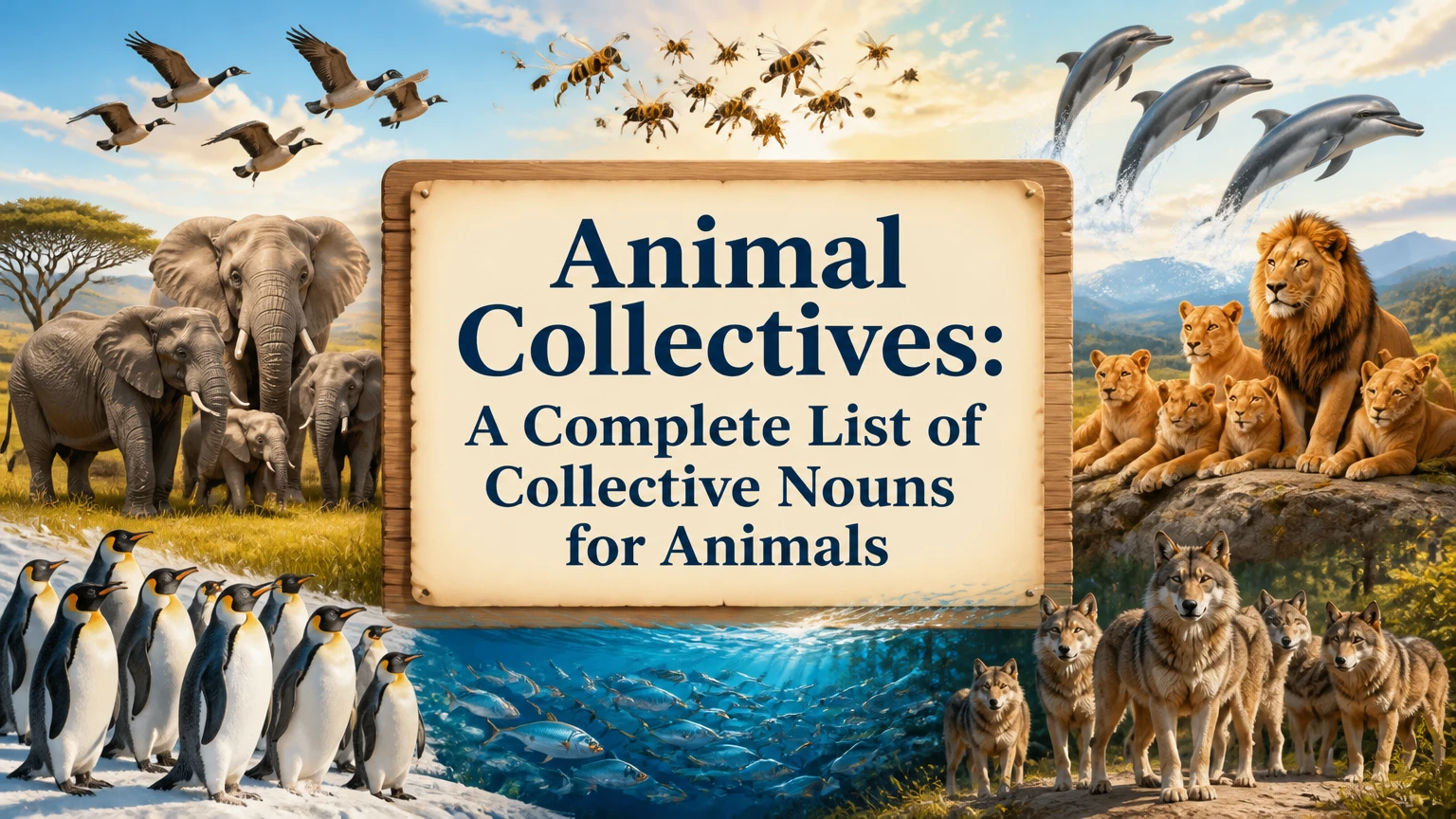
Animal collectives are nouns used for groups of particular animals, such as a pride of lions, a murder of crows, or a gaggle of geese. Many are traditional terms of venery associated with medieval hunting vocabulary, while others describe observable behavior, appearance, habitat, or sound. They are linguistic conventions, not scientific classifications.
Key Facts at a Glance
- A pride is a traditional collective noun for lions, while group, population, and pride are not interchangeable in every scientific context.
- A gaggle describes geese on the ground; a skein commonly describes geese flying in formation.
- Collective nouns vary in reliability: some are common modern usage, while others are rare, playful, or supported mainly by word lists.
- A collective noun usually describes the animals as a unit, but animal behavior and location can change the most suitable term.
- Scientific writing normally prefers group, flock, herd, colony, population, school, or cohort.
- “Terms of venery” originally referred to specialized hunting vocabulary, although many popular animal group names were added or popularized later.
What Are Animal Collective Nouns?
Animal collective nouns are conventional words that identify groups of animals. The word pride in “a pride of lions” names the group through a traditional association with social dominance, whereas tower in “a tower of giraffes” evokes the animals’ height and clustered appearance.
These expressions describe language, not zoological rank. A “murder of crows” is not a biological unit, and a “parliament of owls” does not indicate a defined number, age structure, or social organization. Zoologists may study a crow population or an owl assemblage without using the traditional term.
The phrase term of venery comes from historical hunting language. The 1486 Book of Saint Albans, traditionally associated with Juliana Berners, is a famous early printed source for lists of collective expressions. Researchers caution that later compilations often repeated, embellished, or invented terms, so an attractive phrase is not automatically medieval or universally established.
How reliable are animal group names?
Reliability depends on frequency, historical evidence, and modern usage. Flock of birds, herd of cattle, colony of ants, and pod of dolphins are ordinary, widely understood expressions. Murder of crows, parliament of owls, and dazzle of zebras are recognizable traditional terms, but their use is more literary than scientific.
Rare entries deserve a label rather than false certainty. Dictionaries, regional usage, and specialist references do not always agree, particularly for exotic animals, insects, and terms that circulated through trivia books rather than everyday speech.
Complete List of Mammal Collective Nouns
The table below separates familiar terms from alternatives and explains the context in which each expression works best.
| Animal | Traditional collective noun | Common alternative or context |
|---|---|---|
| Apes | Shrewdness | Troop, especially for social groups |
| Baboons | Troop | Congress, occasionally recorded |
| Badgers | Cete | Colony |
| Bears | Sloth | Sleuth, group |
| Buffalo | Obstinacy | Herd |
| Cats | Clowder | Glaring; kindle for kittens |
| Cattle | Herd | Drove, especially when moved |
| Dogs | Pack | Kennel, for housed dogs |
| Donkeys | Pace | Drove |
| Elephants | Herd | Parade, literary usage |
| Ferrets | Business | Fesnyng, rare |
| Foxes | Skulk | Leash |
| Giraffes | Tower | Journey |
| Gorillas | Troop | Band |
| Hippopotamuses | Bloat | Pod |
| Hyenas | Cackle | Clan |
| Kangaroos | Mob | Troop |
| Leopards | Leap | — |
| Lions | Pride | Troop, especially in neutral description |
| Monkeys | Troop | Barrel, informal or playful |
| Moles | Labor | — |
| Otters | Romp | Raft in water; family |
| Rabbits | Colony | Warren, for a population living in burrows |
| Rhinoceroses | Crash | Herd |
| Seals | Colony | Herd, rookery at breeding sites |
| Tigers | Ambush | Streak, rare |
| Whales | Pod | Gam or school |
| Wolves | Pack | Route, rare |
| Zebras | Zeal | Dazzle |
What are the most familiar mammal terms?
The most established everyday expressions include a pride of lions, a pack of wolves, a herd of elephants, a troop of monkeys, a colony of rabbits, and a pod of whales. These terms communicate quickly because readers encounter them in journalism, documentaries, fiction, and children’s education.
Some terms are memorable but less dependable. An obstinacy of buffalo, a labor of moles, and a business of ferrets are traditional entries, yet a neutral sentence such as “researchers observed a group of ferrets” is clearer for most audiences.
Complete List of Bird Collective Nouns
Bird terminology often changes with behavior or location. A group resting on land may have one label, while the same species in flight receives another.
| Bird | Collective noun | Situation or alternative |
|---|---|---|
| Albatrosses | Rookery | Flock |
| Crows | Murder | Parcel |
| Ducks | Raft | Paddling on water; flock in flight |
| Eagles | Convocation | Congregation |
| Flamingos | Flamboyance | Stand |
| Geese | Gaggle | Skein or wedge in flight |
| Herons | Sedge | Siege |
| Larks | Exaltation | Flock |
| Magpies | Tiding | Murder, in some lists |
| Nightingales | Watch | — |
| Owls | Parliament | Stare |
| Parrots | Pandemonium | Company |
| Peacocks | Muster | Ostentation |
| Penguins | Colony | Waddle on land; raft in water |
| Ravens | Unkindness | Conspiracy |
| Starlings | Murmuration | Flock |
| Swans | Bevy | Lamentation; wedge in flight |
| Turkeys | Rafter | Flock |
| Vultures | Kettle | Committee |
| Woodpeckers | Descent | — |
A murmuration of starlings is especially precise when the birds perform coordinated aerial movement. The term describes the visible phenomenon, not every group of starlings. A flock feeding in a field remains a flock in ordinary description.
Why do geese and swans have multiple terms?
Geese are commonly called a gaggle on land and a skein when flying in formation. A wedge also describes the V-shaped arrangement of flying geese. Swans may form a bevy on the water, a lamentation in poetic usage, or a wedge in flight.
These distinctions are useful but not mandatory. A wildlife report can accurately say “42 geese flew overhead,” because the numerical description is more informative than the venery term.
Reptile, Amphibian, Fish, and Marine Collectives
Marine and cold-blooded animal terms are particularly variable. Some expressions are common, while others appear mainly in specialist dictionaries or popular lists.
| Animal | Collective noun | Usage note |
|---|---|---|
| Barracudas | Battery | Traditional term |
| Cobras | Quiver | Evokes movement |
| Crocodiles | Bask | Usually animals resting together |
| Eels | Swarm | Bed, especially on the seafloor |
| Fish | School | Coordinated swimming; shoal is broader |
| Frogs | Army | Knot, traditional alternative |
| Jellyfish | Smack | Bloom, especially a large concentration |
| Sharks | Shiver | School, a neutral alternative |
| Toads | Knot | Common traditional term |
| Turtles | Bale | Nest or group, depending on context |
| Vipers | Generation | Rare traditional term |
| Dolphins | Pod | Herd, less specific |
| Seals | Colony | Rookery at a breeding site |
| Walruses | Herd | Colony |
| Clams | Bed | Usually a dense seabed aggregation |
| Oysters | Bed | Reef when describing a developed habitat |
| Crabs | Cast | Consortium, in some references |
| Lobsters | Risk | Rare and literary |
A bask of crocodiles means crocodiles gathered while basking, usually on a bank or sandbar. A float may describe crocodiles in water, but “group of crocodiles” is safer when the animals’ behavior is unknown.
A school of fish generally implies coordinated movement, while shoal can refer to fish gathered together whether or not they swim in synchronized formation. Marine biologists may specify species, density, depth, and transect location instead of using either traditional expression.
Insect and Invertebrate Collective Nouns
Insect group names frequently describe abundance rather than social structure. A colony of ants has a different biological meaning from a swarm of locusts.
| Animal | Collective noun | Common alternative or note |
|---|---|---|
| Ants | Colony | Army, when moving or attacking |
| Bees | Swarm | Colony refers to the social unit |
| Butterflies | Kaleidoscope | Swarm |
| Caterpillars | Army | Group |
| Cockroaches | Intrusion | — |
| Flies | Swarm | Business, rare |
| Grasshoppers | Cloud | Swarm |
| Locusts | Plague | Swarm |
| Mosquitoes | Swarm | Cloud |
| Spiders | Cluster | Clutter, rare |
| Wasps | Nest | Swarm when airborne |
| Worms | Bed | Bunch, informal |
| Snails | Rout | Escargatoire, rare |
| Crickets | Orchestra | Collective, mainly playful |
| Ladybirds | Loveliness | Cluster |
Is a swarm the same as a colony?
A swarm is a moving or airborne concentration, while a colony is a persistent social unit or living community. Bees illustrate the difference: a swarm may contain a queen and many workers temporarily leaving a hive, whereas the colony includes the established hive system.
The distinction matters in biology, pest management, and conservation. Calling an ant colony a swarm emphasizes movement and may misrepresent the situation; calling airborne locusts a colony ignores their migratory behavior.
Why Do These Names Exist?
Animal collective nouns usually arise from five overlapping sources.
Sound and vocal behavior
A cackle of hyenas, murmuration of starlings, and pandemonium of parrots connect the name with sound or perceived disorder. These terms are mnemonic devices, not acoustic measurements.
Shape and visual arrangement
A tower of giraffes, dazzle of zebras, kettle of vultures, and raft of penguins refer to height, stripes, circling flight, or floating bodies. Visual terms are often the easiest for children and creative writers to remember.
Behavior and temperament
A shrewdness of apes, pride of lions, obstinacy of buffalo, and unkindness of ravens assign human qualities to animals. Such expressions reveal cultural attitudes more than objective animal psychology.
Habitat and physical position
A bed of oysters, bask of crocodiles, raft of otters, and warren of rabbits connect the noun to a surface, shelter, or activity. Habitat-based terms are often more informative than purely decorative ones.
Medieval allegory and later invention
Medieval hunting culture encouraged specialized vocabulary as a marker of education and social status. Later writers, editors, and trivia compilers expanded the catalogue, sometimes presenting recent or uncertain terms as ancient facts.
Are Collective Nouns Scientifically Accurate?
Traditional animal collectives are linguistically accurate when used as recognized expressions, but they are not scientific classifications. A pride does not have a fixed population size, a murder does not identify a particular crow species, and a colony can mean different things across ants, penguins, seals, and bacteria.
| Communication setting | Preferred wording | Reason |
|---|---|---|
| Literary fiction | A murder of crows | Creates atmosphere and cultural association |
| Primary education | A pride of lions | Memorable vocabulary example |
| Wildlife journalism | A pod of dolphins | Familiar and concise |
| Field research | A group of 18 dolphins | Gives count and observable facts |
| Population biology | A breeding colony of penguins | Identifies social and reproductive context |
| Veterinary records | Cohort of 12 ferrets | Neutral, searchable, operational |
| Statistical dataset | Population or sample | Supports reproducible analysis |
| Historical text analysis | Term of venery | Preserves period-specific language |
A practical rule is simple: use the traditional noun when imagery or vocabulary is the point, and use a neutral or quantified noun when measurement, diagnosis, law, or reproducibility is the point.
How Should Collective Nouns Agree With Verbs?
In American English, a collective noun is often treated as singular when the group acts as one unit: “A pride of lions is resting.” When the writer emphasizes individual members, plural agreement is also possible in varieties of English, especially British English: “The pride are dispersing across the reserve.”
The safest construction for formal writing is to avoid ambiguity by naming the animals directly. “The 12 lions were resting” identifies both number and subject without requiring a dialect decision.
| Sentence | Assessment | Better context |
|---|---|---|
| A pride of lions is resting. | Singular collective agreement | Group treated as one unit |
| The pride are separating. | Plural agreement | British usage or individual actions |
| A gaggle of geese crossed the road. | Singular agreement | Standard narrative prose |
| The geese crossed the road. | Neutral | Reports and general writing |
| A colony of penguins contains 600 adults. | Singular agreement | Scientific description |
| Six hundred adult penguins occupied the site. | More precise | Research and conservation |
The AI Overview’s claim that collective nouns are always grammatically singular is too broad. Agreement depends on dialect, meaning, and whether the group acts collectively or as separate members.
Which Terms Change With Context?
Context changes the best expression when an animal’s activity creates a recognizable form or social condition.
- Geese: gaggle on land, skein or wedge in flight.
- Penguins: waddle on land, raft in water, colony as a breeding community.
- Otters: romp in general, raft when floating together.
- Ducks: raft on water, flock in flight.
- Crocodiles: bask when resting together, float when in water.
- Ants: colony as a social unit, army during coordinated movement.
- Bees: colony for the hive society, swarm for a temporary airborne mass.
- Fish: school during coordinated swimming, shoal for a broader gathering.
- Seals: colony generally, rookery at a breeding site.
- Whales: pod for a social group, school in some traditional references.
The noun should describe an observed condition rather than decorate an unrelated sentence. Writing “a raft of penguins waddled across the ice” creates a factual mismatch because raft refers to floating birds.
Why Do Animal Collective Lists Disagree?
Animal collective lists disagree because English has no governing authority that approves every group noun. Some expressions are documented in historical sources, some are regional, some are modern coinages, and others survive because list-makers copied them from one another.
Four tests help evaluate a doubtful term:
- Check dictionary evidence. Oxford English Dictionary, Merriam-Webster, Collins, and regional dictionaries may identify whether a term is established or rare.
- Check historical attribution. A phrase linked to the Book of Saint Albans may still have uncertain authorship or later editorial expansion.
- Check current frequency. Newspapers, books, wildlife organizations, and corpus databases reveal whether people actually use the expression.
- Check semantic fit. A word that describes flight, water, breeding, or movement should not be applied in every setting.
Terms such as murder of crows, parliament of owls, and unkindness of ravens are culturally established, but their popularity does not prove that medieval observers used them continuously or universally.
Traditional Venery or Scientific Terminology?
Traditional terms are best for memorability and atmosphere. Scientific terminology is best for precision, indexing, measurement, and international communication.
| Criterion | Venery term | Scientific or neutral term |
|---|---|---|
| Main purpose | Imagery and cultural expression | Measurement and classification |
| Example | A dazzle of zebras | A herd of zebras |
| Fixed group size | None | Number can be stated |
| Biological status | Convention | Defined study category |
| Searchability | Variable | Usually high |
| Best setting | Fiction, teaching, trivia | Research, medicine, policy |
| Main risk | Obscurity or exaggeration | Less vivid prose |
A wildlife educator might introduce “a murmuration of starlings” and then explain coordinated flight. A conservation report should record the number of birds, location, date, and behavior rather than rely on the poetic noun alone.
What should researchers write instead?
Researchers should use population, sample, cohort, herd, flock, colony, pod, or aggregation according to the study design. The chosen term should identify the relevant biological unit and, where necessary, include count, location, age, sex, and observation period.
For example, “a breeding colony of 2,400 Adélie penguins was surveyed on Ross Island in November 2024” is more reproducible than “a waddle of penguins was observed.” The traditional term is not wrong in a field note, but it does not carry enough scientific information.
Common Mistakes and How to Fix Them
Treating every list entry as equally authentic
Problem: A rare term is presented as universal fact.
Fix: Label terms as common, traditional, rare, literary, or context-specific.
Confusing a species with a broad category
Problem: “A herd of cats” or “a school of whales” is used without explaining the distinction.
Fix: Identify whether the expression applies to a species, family, behavior, or general category.
Ignoring location and behavior
Problem: A raft of penguins is described walking on ice.
Fix: Use waddle on land and raft in water.
Assuming singular agreement is mandatory
Problem: Every collective noun is forced to take a singular verb.
Fix: Follow the variety of English and intended meaning, or state the animals and number directly.
Using poetic terms in technical reports
Problem: “A business of ferrets” appears in a laboratory record.
Fix: Use “ferret cohort,” “group of ferrets,” or a numbered sample.
Claiming false medieval origins
Problem: A popular internet list is treated as direct evidence from 1486.
Fix: Distinguish documented historical usage from later compilation and modern popularization.
How Can Writers Use Animal Collectives Well?
Writers should choose a collective noun that adds information beyond the animal name. A murder of crows establishes a darker cultural mood, while a murmuration of starlings suggests coordinated aerial movement; “a group of birds” does neither.
Use one distinctive term at a time, then anchor it with a concrete verb or setting. “A skein of geese crossed the October sky” works because skein and crossed the sky reinforce one another. “A skein of geese fed beside the pond” is less natural because the birds are not flying.
For children’s writing, pair unfamiliar words with definitions. For historical fiction, verify period fit. For contemporary journalism, prefer familiar expressions unless the term contributes genuine precision or imagery.
Frequently Asked Questions
What is the collective noun for a group of animals?
The general collective noun is group, but the traditional term depends on the animal. Common examples include herd of elephants, flock of birds, pack of wolves, colony of ants, pod of dolphins, school of fish, and pride of lions. No single special noun applies to every species.
What is the rarest animal collective noun?
No objectively verified “rarest” term exists because rarity depends on region, corpus, and reference source. Expressions such as an intrusion of cockroaches, a labor of moles, a fesnyng of ferrets, and a generation of vipers are uncommon in modern general English and are best treated as rare or literary.
What is a group of crows called?
A group of crows is traditionally called a murder. Parcel is another recorded term, although it is much less familiar. In scientific or formal writing, use a group of crows, a flock of crows, or a precise count because “murder” supplies cultural imagery rather than biological information.
What is a group of fish called?
A group of fish is commonly called a school when the fish move in coordinated formation. Shoal is broader and can describe fish gathered together without synchronized movement. Scientific reports should provide species, number or density, location, depth, and observation date when those details matter.
Are animal collective nouns capitalized?
Animal collective nouns are normally lowercase: a pride of lions, a parliament of owls, and a colony of ants. Capitalization applies only at the beginning of a sentence or within a proper name. The animal name is also lowercase unless it contains a proper geographic or taxonomic name.
Are animal collective nouns universal across English?
Animal collective nouns are not fully universal across English varieties. Dictionaries, regions, historical periods, and specialist communities may prefer different expressions, while British English may use plural agreement for a collective group more readily than American English. Use a familiar neutral term when the audience or context is international.
Conclusion
Animal collectives are traditional language patterns, not fixed zoological categories. The complete list of collective nouns for animals includes familiar terms such as pride, murder, gaggle, school, colony, and pod, alongside rare expressions whose historical status or modern frequency varies. Choose the term that matches the species, behavior, setting, audience, and purpose. For vivid writing, use venery terms selectively; for research and reporting, provide neutral terminology, counts, and observable facts.