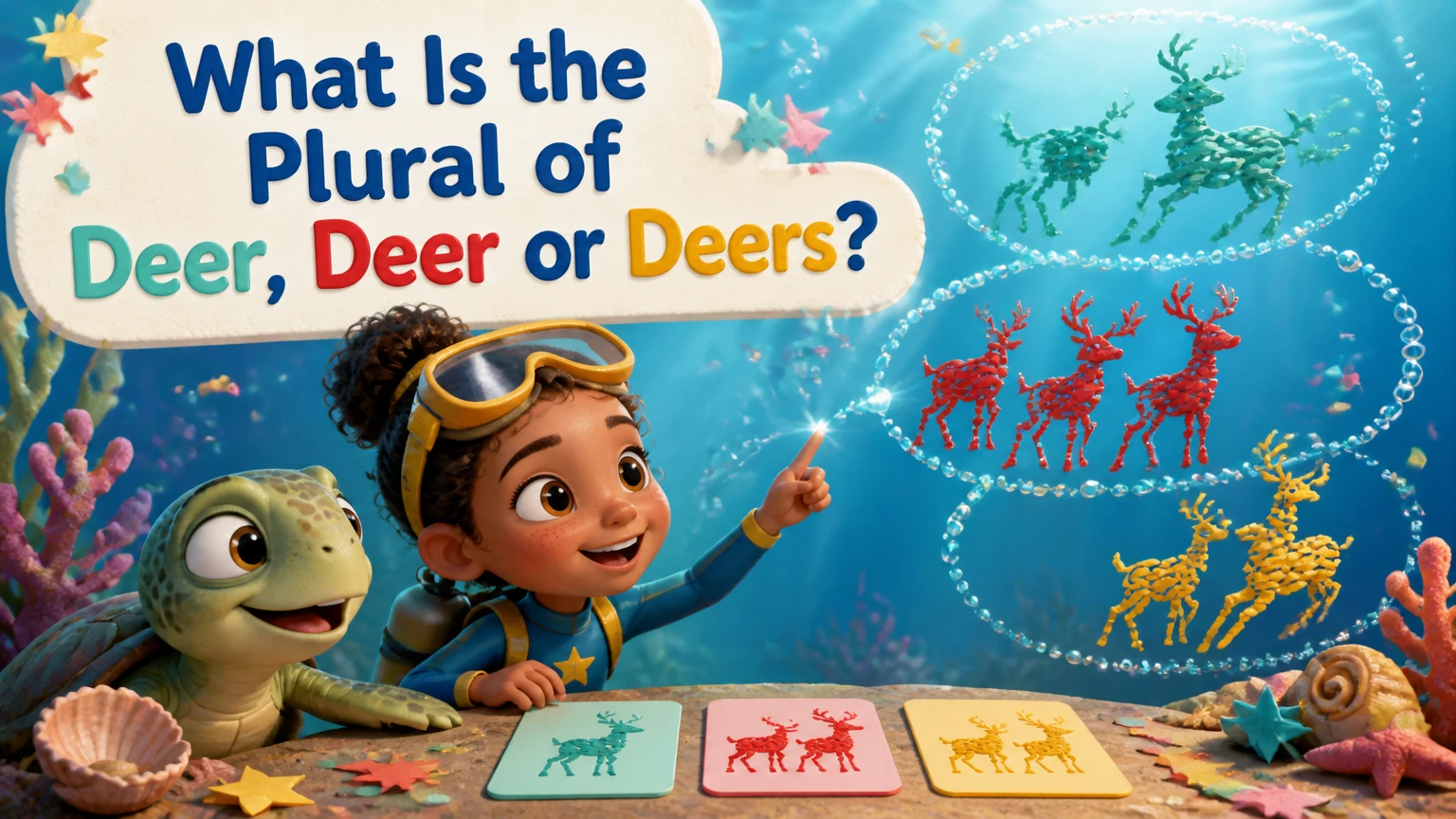
The plural of deer is deer: one deer, two deer, or 500 deer. Deers is not the normal plural in standard English and usually sounds incorrect; when writers mean several species, deer species or species of deer is clearer and more widely accepted.
Key Facts at a Glance
- Deer is both the singular and standard plural form: “one deer” and “six deer.”
- The unchanged plural is called a zero plural or invariant plural.
- Deers is rare and generally unsuitable for everyday, academic, business, and school writing.
- Use deer species when referring to several biological species, not “deers” by default.
- The plural possessive is deer’s, because the plural noun deer does not end in s.
- A group of deer is commonly called a herd, although “group,” “population,” and “aggregation” may fit scientific contexts better.
What Is the Plural of Deer?
The standard plural of deer is deer, with no added ending. English uses the same noun form after singular and plural determiners, so the correct expressions are “a deer,” “one deer,” “several deer,” “many deer,” and “a herd of deer.”
The surrounding words show the number. The article a identifies one animal, while numerals and quantifiers identify more than one:
- “I saw one deer beside the road.”
- “I saw four deer beside the road.”
- “Several deer were grazing.”
- “That deer was standing near the fence.”
The agreement changes even though the noun does not. Use was and is with singular deer, but were and are with plural deer.
Merriam-Webster lists deer as the plural of deer, and major learner dictionaries give the same standard rule. The form is not an abbreviation, a mistake, or an informal shortcut. It is an established English plural pattern.
Why Does Deer Have a Zero Plural?
Deer has a zero plural because historical English preserved a noun pattern in which number was expressed by context rather than a changed ending. The term zero plural describes a noun whose singular and plural forms are identical, such as “sheep” and “moose.”
Modern English has several plural systems:
| Noun | Singular | Standard plural | Plural pattern |
|---|---|---|---|
| deer | 1 deer | 2 deer | zero plural |
| sheep | 1 sheep | 2 sheep | zero plural |
| moose | 1 moose | 2 moose | zero plural |
| horse | 1 horse | 2 horses | regular -s plural |
| child | 1 child | 2 children | irregular plural |
The historical reason does not change the modern recommendation. Writers should choose deer because current standard usage, dictionaries, edited publications, and native-speaker convention support it.
A useful diagnostic is substitution. If “two deer” sounds natural in the sentence, adding -s is unnecessary. The same test works for “two sheep” and “two moose,” but not for “two horses.”
Is “Deers” Correct English?
“Deers” is not the ordinary plural of the animal deer. Some dictionaries and specialist texts record occasional uses of deers for separate kinds or species, but that limited usage does not make “deers” the preferred plural for multiple individual animals.
The AI Overview’s central advice is correct, but its scientific exception needs precision. A biologist comparing species might encounter deers in older, translated, or highly specialized writing. However, contemporary scientific English normally favors explicit phrases such as:
- “several deer species”
- “species of deer”
- “members of the deer family”
- “different cervid species”
- “North American cervids”
The sentence “The deers of North America exhibit diverse migratory patterns” is therefore a poor general recommendation. It may be interpretable, but “North American deer species exhibit diverse migratory patterns” is clearer and more idiomatic.
| Intended meaning | Recommended wording | Avoid in ordinary writing |
|---|---|---|
| Three individual animals | three deer | three deers |
| Animals from multiple species | deer from three species | three deers |
| Several biological species | three deer species | three deers |
| The entire taxonomic family | members of Cervidae | the deers of Cervidae |
| A wildlife population | a deer population | a deer’s population, unless possessive |
When Might “Deers” Appear?
Deers may appear when a writer treats separate varieties or species as distinct countable categories. That use is uncommon, inconsistent, and often replaced by deer species in edited English.
A specialist should not select deers merely because several species are present. The wording must intentionally contrast categories, and even then, a more explicit noun phrase usually communicates the distinction better. Scientific precision comes from naming the categories, not from adding an unfamiliar plural ending.
For students, job applicants, journalists, and general writers, the safe rule is simple: use deer for multiple animals and deer species for multiple species.
How Do You Choose Between Deer and Deers?
Use deer unless the sentence specifically contrasts separate species as categories, and even that specialized meaning is usually better expressed with deer species.
Follow this decision process:
- Count individual animals.
Write deer: “The survey recorded 27 deer.” - Refer to animals from different species.
Still write deer: “The reserve contains deer from several regions.” - Compare biological species as named categories.
Write deer species, species of deer, or cervid species: “The study compares four deer species.” - Check the audience.
In a school essay or public report, use deer or deer species. A rare specialist form can distract readers and invite correction.
The most reliable editing rule is to replace every occurrence of deers with deer or deer species, then select the phrase that preserves the intended meaning.
What Do You Call a Group of Deer?
A group of deer is commonly called a herd of deer. “Group of deer” is also correct, while wildlife researchers may choose “population,” “aggregation,” or “local population” when describing a defined biological unit.
| Expression | Meaning | Example context | Precision |
|---|---|---|---|
| herd of deer | visible social group | “A herd of deer crossed the trail.” | everyday |
| group of deer | neutral collection | “The group moved into the meadow.” | general |
| deer population | animals in a defined area | “The deer population declined.” | ecological |
| deer aggregation | animals gathered together | “The aggregation formed near food.” | technical |
| deer species | separate biological kinds | “The region supports five deer species.” | taxonomic |
Collective nouns do not change the plural of the noun itself. The phrase remains a herd of deer, not “a herd of deers.” In American English, a collective noun such as “herd” often takes a singular verb when treated as one unit: “The herd was moving.” The noun phrase “deer” takes plural agreement when it directly functions as the subject: “The deer were moving.”
How Do You Write Deer’s and the Plural Possessive?
The possessive form is deer’s for both one deer and multiple deer because the noun has the same singular and plural spelling and the plural does not end in s.
| Meaning | Correct form | Example |
|---|---|---|
| one deer owns an antler | deer’s | “The deer’s antler was damaged.” |
| several deer own antlers collectively | deer’s | “The deer’s antlers were measured.” |
| several named deer own something separately | deer’s or each deer’s | “Each deer’s tag was checked.” |
| a rare plural form ending in s | deers’ | Grammatically possible only if “deers” is deliberately used |
The sentence context identifies whether deer’s refers to one or many animals. “The deer’s antlers were visible” could describe one unusually antlered animal or several animals treated collectively, although “the deer’s antlers” is often clearer when the group is already established.
Do not write deers antlers without an apostrophe. The apostrophe marks possession, not plurality. Do not automatically write deers’ merely because the sentence refers to multiple deer, because standard plural deer does not end in s.
Which Form Should You Choose in Formal Writing?
Choose deer in formal writing whenever the sentence counts or describes individual animals. Choose deer species when the sentence compares taxonomic categories. This rule works for essays, reports, news articles, conservation plans, captions, and professional correspondence.
| Writing situation | Preferred form | Example |
|---|---|---|
| school assignment | deer | “Researchers observed eight deer.” |
| wildlife news | deer | “The deer were relocated.” |
| conservation report | deer population | “The deer population increased.” |
| zoology paper | deer species | “The analysis compares six deer species.” |
| public signage | deer | “Watch for deer.” |
| fiction and dialogue | deer | “There were two deer in the clearing.” |
A formal register does not require unusual vocabulary. Cervid is useful when the discussion includes deer, elk, moose, or related members of the family Cervidae, but it is not a replacement for the ordinary plural in every sentence.
What Does Cervid Mean?
Cervid means a member of the deer family, Cervidae. The term includes animals such as white-tailed deer, mule deer, elk, moose, reindeer, and red deer, depending on the taxonomic classification being used.
“Cervid” and “deer” are not always interchangeable in a technical passage. A sentence about the family may require cervids, the regular plural of cervid: “The park supports several cervid populations.” A sentence about the animals commonly called deer should use deer.
Which Animal Plurals Work Like Deer?
Several animal nouns retain one spelling in singular and plural, but the pattern is not universal. The correct form depends on the individual noun, not on a general rule that all animal names behave alike.
| Singular animal | Standard plural | Example | Common error |
|---|---|---|---|
| deer | deer | “Seven deer were nearby.” | deers |
| sheep | sheep | “The sheep were in the field.” | sheeps |
| moose | moose | “Two moose crossed the road.” | mooses |
| bison | bison or bison | “The bison moved north.” | bisons, in formal wildlife prose |
| fish | fish or fishes | “We caught five fish.” | assuming fishes is always wrong |
| elk | elk | “Several elk were grazing.” | elks |
Fish differs from deer because fishes can be standard when referring to multiple species or kinds of fish. “Fish” is usually used for multiple individual fish, while “fishes” has a recognized species-level use. That distinction does not automatically transfer to deer and deers.
The word elks may occur in some varieties and contexts, but elk is the standard wildlife plural in North American usage. Dictionary treatment and regional convention matter.
What Are the Most Common Deer Plural Mistakes?
The most common mistake is adding -s after a number. The second is using singular verb agreement because the noun’s spelling looks singular. The third is confusing a possessive apostrophe with a plural ending.
Mistake 1: Adding -s After a Number
Incorrect: “We saw five deers near the road.”
Correct: “We saw five deer near the road.”
Numbers already identify plurality. The noun remains unchanged.
Mistake 2: Using Singular Verb Agreement
Incorrect: “The deer was moving through the forest,” when the sentence describes several animals.
Correct: “The deer were moving through the forest.”
The noun’s appearance does not determine the verb. Meaning and quantity do.
Mistake 3: Writing the Wrong Possessive
Incorrect: “The deers antlers were measured.”
Correct: “The deer’s antlers were measured.”
The apostrophe belongs before the s in the standard construction because deer is a plural noun that does not end in s.
Mistake 4: Using “Deers” for Different Species
Weak: “The museum displays examples of five deers.”
Better: “The museum displays five deer species.”
Also correct: “The museum displays specimens from five species of deer.”
Naming the taxonomic unit removes ambiguity more effectively than using a rare plural.
How Does Deer Work in Real Sentences?
The form deer can function as singular or plural, so determiners, verbs, numerals, and context carry the grammatical information.
| Number | Determiner or modifier | Verb | Example |
|---|---|---|---|
| singular | a | was | “A deer was standing near the gate.” |
| singular | one | has | “One deer has a tracking collar.” |
| plural | two | were | “Two deer were crossing the path.” |
| plural | several | have | “Several deer have entered the field.” |
| plural | many | are | “Many deer are active at dusk.” |
| plural | no | were | “No deer were visible.” |
The same principle applies to questions and negatives:
- “How many deer did you see?”
- “Did the deer cross the stream?”
- “We did not see any deer.”
- “There were fewer deer near the road this year.”
Deer can also modify another noun without changing form: deer habitat, deer tracks, deer management, and deer population. These compounds do not use deers.
What Is the History of the Word Deer?
The modern word deer developed from Old English dēor, a word that originally had the broader sense of an animal or wild creature. Over time, its meaning narrowed toward the animal group now associated with the family Cervidae.
Historical origin explains why the word has an unusual modern pattern, but it does not establish a rule for every related noun. English inherited and reshaped several plural systems, including vowel changes in “mouse” and “mice,” endings in “horse” and “horses,” and unchanged forms such as “deer” and “sheep.”
The unchanged spelling also creates a useful semantic contrast:
- “The deer is young.” One animal.
- “The deer are young.” More than one animal.
- “The deer species is widespread.” One species category.
- “The deer species are widespread.” Several species categories.
Verb agreement and nearby nouns provide the necessary number information.
Can “Deers” Be Used in Scientific Writing?
Scientists can encounter deers in specialist literature, but scientific writing should normally use deer species, species of deer, or cervids instead. The clearer term identifies whether the writer means individual animals, species, genera, or the family Cervidae.
Taxonomy has several levels, and confusing them creates inaccurate prose:
| Biological level | Preferred wording | Example |
|---|---|---|
| individual | deer | “Three deer were captured.” |
| local group | deer population | “The deer population was monitored.” |
| species category | deer species | “Four deer species occur there.” |
| family | cervids or members of Cervidae | “Cervids have distinctive antlers.” |
| genus | named genus | “The genus Odocoileus includes…” |
The limitation matters in peer-reviewed work. Deers does not reliably tell readers whether the writer means several animals, species, genera, or regional types. A phrase such as “four deer species” carries the intended taxonomic meaning immediately and reduces editorial ambiguity.
How Should You Refer to Different Kinds of Deer?
Use different deer species or different species of deer when the categories are biologically distinct. Use types, varieties, or named common species only when the classification actually warrants those terms.
Examples include:
- “The study compares white-tailed deer and mule deer.”
- “The reserve protects three deer species.”
- “The region contains several species of deer.”
- “The researchers examined two populations of the same deer species.”
- “The report distinguishes native deer from introduced deer.”
A population is not the same as a species. Two deer populations may belong to one species, while one geographic region may contain several species. The noun phrase should match the scientific claim.
The Bottom Line
The answer to what is the plural of deer deer or deers is deer. Write “one deer,” “two deer,” “many deer,” and “a herd of deer.” Avoid deers in normal English, including schoolwork and most scientific writing. When discussing separate biological categories, write deer species, species of deer, or cervids for greater precision.
Frequently Asked Questions
Is “two deer” grammatically correct?
Yes. Two deer is the standard, fully grammatical plural phrase. The noun deer remains unchanged after numerals, so “two deers” is not the normal form. The same zero-plural pattern appears in “two sheep” and “two moose,” although each animal noun has its own usage conventions.
Is “deer” singular or plural?
Deer can be singular or plural. “That deer is injured” is singular, while “Those deer are injured” is plural. Articles, demonstratives, numerals, quantifiers, and verb agreement reveal the intended number because the noun itself has identical singular and plural forms.
Is “a deer” correct?
Yes. A deer refers to one animal. The indefinite article a forces a singular interpretation, so the verb should also be singular: “A deer was standing by the fence.” For more than one animal, use a number or plural quantifier, as in “several deer were standing by the fence.”
Is the plural possessive “deer’s” or “deers’”?
The standard plural possessive is deer’s, because the plural noun deer does not end in s. Write “the deer’s habitat” when one or more deer are treated as the possessor in context. Deers’ would only follow the rare, deliberate use of deers as a plural category.
What is the plural of a deer species?
The clearest phrase is deer species or species of deer. For example, “The country contains six deer species.” Avoid using “deers” as a shortcut for species unless a specialist source deliberately defines and uses that form.
Is “deer” countable or uncountable?
Deer is countable when referring to individual animals: “one deer,” “three deer,” and “many deer.” It can also appear in broader ecological phrases such as “deer habitat” or “deer management,” where it functions as a noun modifier rather than as a directly counted noun.