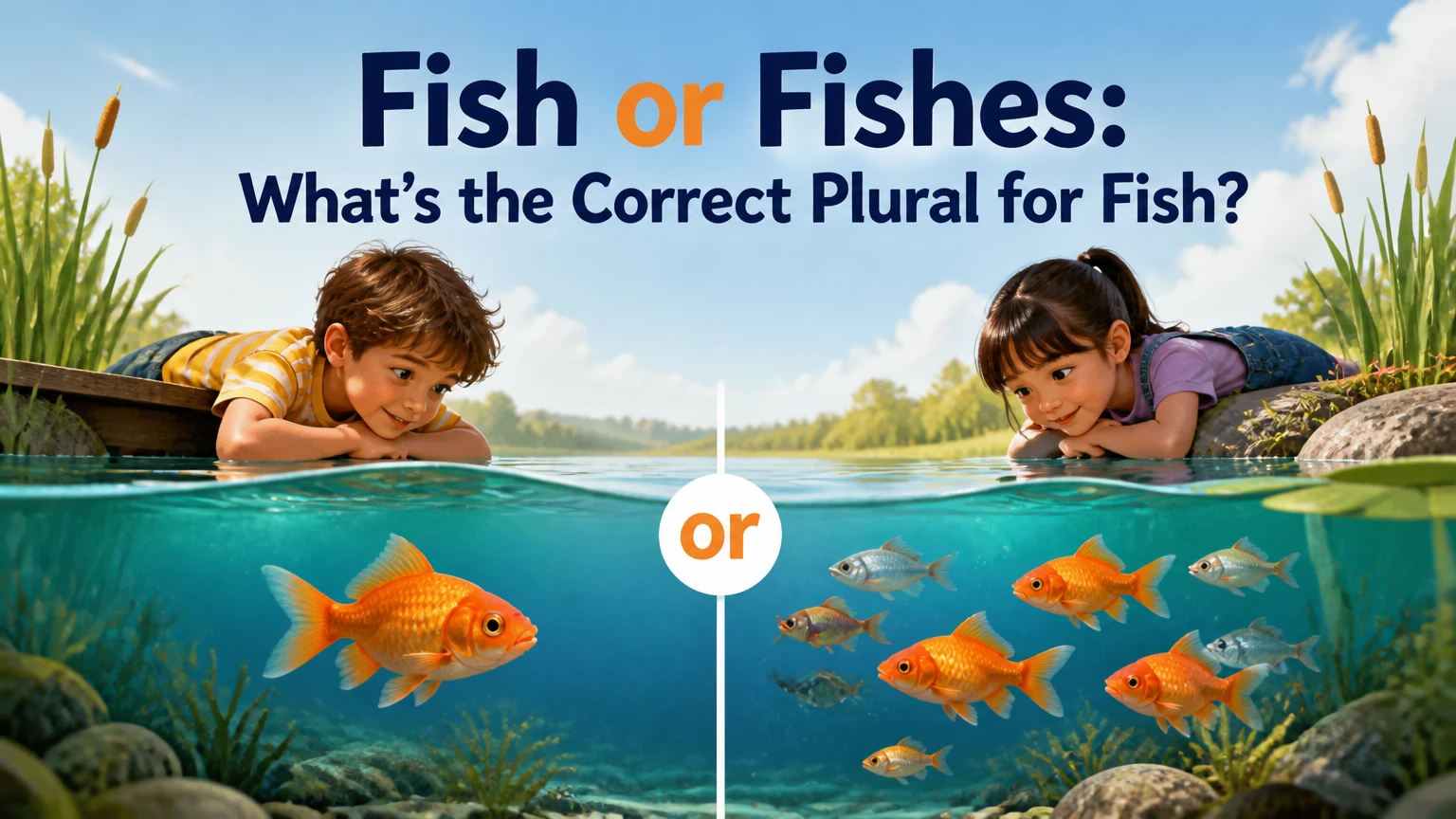
Both fish and fishes are correct plural forms of fish. Use fish for multiple individual animals in ordinary English, including when the species is unknown or irrelevant; use fishes when emphasizing multiple species or taxonomic groups, especially in biology. The distinction is about meaning and context, not simply the number of animals.
Key facts
Fish is the usual plural for more than one individual fish.
Fishes is a marked plural that emphasizes different species, kinds, or taxonomic groups.
“Three fish” can describe three animals from one species or several species.
“Three fishes” can emphasize that the three animals represent three kinds, but it sounds technical in everyday speech.
Fish used as food is commonly a mass noun: “We bought fish,” not usually “We bought fishes.”
The fixed idiom is sleeping with the fishes, even though ordinary conversation usually uses fish.
Which Is Correct, Fish or Fishes?
Fish is the correct default plural, while fishes is correct when the sentence needs to emphasize species diversity. A shopper, angler, teacher, or aquarium visitor will normally say “six fish.” A zoologist cataloging species may write “the fishes of the western Pacific,” where the plural highlights a collection of distinct kinds.
The simple same-species versus different-species rule is useful, but it is not absolute. English speakers routinely use fish for animals from different species when the species distinction does not matter: “The pond contains fish,” “We saw fish and turtles,” and “The market sells fresh fish.” Conversely, fishes can refer to multiple representatives of one broad group when a scientific author is discussing forms or lineages.
| Sentence | Form | Meaning | Naturalness |
|---|---|---|---|
| “I caught five fish.” | fish | Five individual animals | Very natural |
| “The reef contains many fish.” | fish | Aquatic animals generally | Very natural |
| “The survey identified seven fishes.” | fishes | Seven species or taxonomic units | Technical |
| “The museum displays the fishes of the Atlantic.” | fishes | Diverse Atlantic fish groups | Formal and natural |
| “The restaurant serves three fishes.” | fishes | Usually intended as three fish dishes or species | Often awkward |
| “We bought fish for dinner.” | fish | Fish as food or a food substance | Natural |
For most general writing, choose fish. Choose fishes when replacing it with “species of fish” would preserve the intended meaning.
What Is the Grammar Difference Between Fish and Fishes?
Fish is an irregular zero plural, meaning its singular and ordinary plural forms are identical. Fishes is a regular plural ending in -es, but the extra ending carries a special semantic emphasis. The singular noun is “one fish,” and the ordinary plural is “two fish,” not “two fishs.”
English has several nouns whose plural does not visibly change. “One sheep” becomes “two sheep,” and “one deer” becomes “two deer.” Fish follows the same pattern in its most common use. The noun does not need a plural ending because the numeral, determiner, or verb already supplies number information.
- Singular: “A fish is in the tank.”
- Ordinary plural: “Several fish are in the tank.”
- Species-focused plural: “Several fishes are represented in the collection.”
The verb still agrees with the grammatical number. “The fish is swimming” describes one animal, while “The fish are swimming” describes multiple animals. Context, determiners, and verb agreement identify the number.
| Noun phrase | Number | Example | Interpretation |
|---|---|---|---|
| one fish | Singular | “One fish is missing.” | One individual |
| two fish | Plural | “Two fish are missing.” | Two individuals |
| several fish | Plural | “Several fish were tagged.” | Multiple individuals |
| a species of fish | Singular | “This species of fish is native.” | One species |
| several fishes | Plural | “Several fishes were compared.” | Multiple species or groups |
| three kinds of fish | Plural concept | “Three kinds of fish live there.” | Unambiguous species diversity |
Can Fish Refer to Different Species?
Yes, fish can refer to individuals from different species when the sentence treats them simply as aquatic animals. The word fish does not guarantee that every animal belongs to one species, so “fish means one species and fishes means several species” is a helpful shortcut rather than a complete grammar rule.
Imagine an aquarium containing a guppy, a goldfish, and an angelfish. “There are three fish in the aquarium” is ordinary, correct English. The speaker is counting animals. “There are three fishes in the aquarium” is also possible, but it draws attention to the three kinds and may sound unnecessarily formal unless the setting is taxonomic.
The contrast becomes clearer when the object of the sentence changes:
- Count individuals: “Researchers tagged 120 fish.”
- Count species: “Researchers recorded 18 fishes.”
- Avoid ambiguity: “Researchers recorded 120 fish representing 18 species.”
The third version is often best in reports because it states both measurements. A biological survey may need the number of individuals, the number of species, or both. The nouns fish and fishes alone cannot always communicate that distinction precisely.
Why the Species Rule Is Not Absolute
Scientific writers do not use fishes mechanically every time more than one species appears. Many research papers use fish as a broad taxonomic or ecological category, particularly in phrases such as “fish behavior,” “fish populations,” “fish habitat,” and “fish diversity.” The choice depends on the author’s intended unit of analysis.
Use fish when the focus is biomass, individuals, harvest, behavior, or habitat. Use fishes when the focus is a set of species, regional diversity, classification, or comparative anatomy. In technical writing, a precise noun phrase such as “fish species,” “individual fish,” or “taxa” is often clearer than either plural alone.
When Is Fishes Preferred?
Fishes is preferred when a writer wants readers to notice multiple species, lineages, or taxonomic groups. The form appears most naturally in zoology, ichthyology, museum catalogs, biodiversity surveys, and formal descriptions of regional fauna.
Examples include:
- “The fishes of the Amazon basin include hundreds of species.”
- “The guide compares the feeding structures of reef fishes.”
- “The collection contains fishes from four oceanic regions.”
- “Native fishes declined after the introduction of the predator.”
- “The study examined fishes occupying separate depth zones.”
In each sentence, fishes frames the subject as a diverse set rather than a pile of individual animals. The noun is especially useful when the surrounding words already signal classification, such as species, fauna, assemblage, lineage, native, or a geographic region.
However, fishes is not automatically more scientific or more accurate. “The researchers counted 500 fishes” may be less precise than “The researchers counted 500 fish from 12 species,” because the first wording leaves the measurement unclear. Scientific style rewards explicit units.
| Writing purpose | Recommended wording | Reason |
|---|---|---|
| Count captured animals | “240 fish” | Counts individuals |
| Count species | “12 fish species” | Names the unit directly |
| Describe regional diversity | “The fishes of Lake Tanganyika” | Frames a diverse fauna |
| Measure total mass | “800 kilograms of fish” | Uses a mass noun |
| Compare animals across taxa | “Representative fishes were dissected” | Species-group focus |
| Write for children | “Many colorful fish live there” | Natural general English |
How Do You Choose the Right Form?
Choose the correct plural by identifying whether the sentence counts individuals, refers to food, or contrasts species. Apply the following three-question test before finalizing the sentence.
- Are you counting individual animals?
Use fish: “The fisherman released four fish.” - Are you discussing fish as food or material?
Use fish as a mass noun: “The recipe requires 500 grams of fish.” - Are you deliberately grouping or comparing species?
Use fishes, or choose the clearer phrase fish species: “The survey compares fishes from three river systems.”
If the answer to the third question is uncertain, fish is normally safer in general English. If a reader could misunderstand the unit, add a measurement word. “The lake contains 20 fish species” identifies biodiversity, while “The lake contains 20 fish” identifies individual animals.
A Fast Editing Method
Replace the plural with a more explicit phrase and see what the sentence means:
- Replace fish with “individual fish.” If the meaning remains correct, use fish.
- Replace fishes with “fish species” or “different kinds of fish.” If that replacement preserves the meaning, fishes may be justified.
- If neither replacement works, the sentence may need a different noun, such as specimens, taxa, stocks, or dishes.
This test prevents a common problem: using fishes merely because several species appear in the background. Species diversity must be the sentence’s communicative focus, not an incidental fact.
How Does Fish Work in Food and Culinary Writing?
Fish is normally the correct form for food, whether the meal contains one species or several. In culinary English, fish commonly functions as a mass noun, like meat, rice, or seafood, so menus usually say “grilled fish,” “fish tacos,” and “fresh fish.”
Examples:
- “The market sells fresh fish.”
- “The buffet offers salmon, cod, and fish curry.”
- “We ordered two fish dishes.”
- “The chef prepared three types of fish.”
- “The restaurant sources fish from local boats.”
“Three fishes” can be grammatical when a writer means three species or three prepared fish varieties, but it is rarely the natural menu wording. A restaurant would usually write “three fish options,” “three kinds of fish,” or “three fish dishes.”
Countability changes with meaning. “We bought three fish” counts whole animals or portions treated as individual units. “We bought fish” describes food without specifying individual units. “We ordered three fishes” sounds unusual because the intended objects are generally dishes, fillets, or species.
| Culinary meaning | Natural expression | Less natural expression |
|---|---|---|
| Food generally | “Fresh fish” | “Fresh fishes” |
| Three menu items | “Three fish dishes” | “Three fishes” |
| Three whole animals | “Three fish” | “Three fishes” |
| Several species in a market | “Several fish species” | “Several fishes,” in a casual menu |
| A prepared portion | “A piece of fish” | “A fish,” unless it is a whole animal |
| Total food weight | “2 kilograms of fish” | “2 kilograms of fishes” |
Which Form Fits Aquarium and Fishing Examples?
Use fish for ordinary aquarium, angling, and wildlife sentences; use fishes only when the sentence intentionally compares species. The ordinary forms “two fish in the tank” and “I caught six fish” are idiomatic regardless of whether the animals belong to one species or several.
Consider these situations:
- One species, several individuals: “The pond contains 30 koi fish.”
- Several species, casual observation: “The aquarium has 30 fish.”
- Several species, scientific inventory: “The aquarium’s fishes represent 12 families.”
- Angling quantity: “She caught five fish.”
- Species identification: “She caught five fish representing four species.”
- Conservation survey: “Native fishes disappeared from the upper stream.”
The phrase fish species often outperforms fishes because it separates the category from the individual. A visitor may see “three fish,” while a curator may record “three species represented by three fish specimens.” Those statements describe different facts.
What About Goldfish, Starfish, and Shellfish?
Compound nouns usually retain the same plural logic as fish. “Two goldfish,” “several starfish,” and “many shellfish” are standard ordinary plurals. The forms “goldfishes” and “starfishes” may occur when discussing multiple species or taxonomic groups, but they are not the normal choices for counting individuals.
- “The child has two goldfish.”
- “The tide pool contains several starfish.”
- “The survey documents starfish species from the Pacific.”
- “The industry harvests shellfish.”
- “The database lists several shellfishes” is possible in specialized classification, but “shellfish species” is clearer.
A compound’s established usage matters. Some words ending in -fish refer to animals that are not biologically fish, such as jellyfish and cuttlefish. Their plurals still follow conventional English usage, not a universal biological rule.
What Does “Sleeping With the Fishes” Mean?
“Sleeping with the fishes” is a fixed idiom meaning that someone has been killed, usually by drowning or disposal in water. The idiom uses fishes because the expression became established as a set phrase, not because ordinary speakers must use fishes for every group of fish.
The expression is strongly associated with organized-crime fiction and the 1972 film The Godfather, although the phrase has earlier popular usage. Writers should preserve the idiom exactly: “He threatened to send the traitor to sleep with the fishes.” Replacing it with “sleeping with the fish” removes the familiar idiomatic form.
Fixed expressions can preserve older, regional, or specialized wording. Grammar advice should distinguish an idiom from productive everyday usage. The existence of fishes in this phrase does not make it the normal plural for a casual sentence such as “Look at those fishes.”
What Are the Most Common Mistakes?
The most common error is treating fishes as either always wrong or always required for multiple species. Both conclusions ignore context. Writers should choose the form that identifies the intended unit, then replace an ambiguous plural with “fish species” or “individual fish” when precision matters.
| Mistake | Problem | Better revision |
|---|---|---|
| “I saw two fishes at the aquarium.” | Technical plural in casual counting | “I saw two fish at the aquarium.” |
| “The lake has 14 fish.” | Could mean animals or species | “The lake has 14 fish species.” |
| “The restaurant serves many fishes.” | Food is treated as a mass noun | “The restaurant serves many kinds of fish.” |
| “Fish is swimming near the pier.” | Singular verb with plural meaning | “Fish are swimming near the pier.” |
| “Fishes are always wrong.” | Ignores scientific usage | “Fishes is formal but correct for species groups.” |
| “All different species are fishes.” | Overstates the distinction | “Fish can refer to different species when diversity is not the focus.” |
Expert Rule: Count the Unit, Not the Animal
A biological sentence may contain several valid counts. “The net caught 100 fish from five species” reports individuals and biodiversity separately. Using fishes alone would not communicate both figures and could obscure the research result.
Expert Rule: Formality Is Not the Same as Accuracy
Fishes can sound more technical without adding useful information. In a school report, “The river supports 22 fish species” is usually clearer than “The river supports 22 fishes,” because the phrase names the measured category directly.
Expert Rule: Modifiers Often Resolve the Problem
Words such as species, individuals, specimens, kinds, and stocks provide more precision than plural morphology alone. “Four fish specimens from two species” is clearer than either “four fish” or “four fishes” when a laboratory inventory is involved.
What Alternatives Avoid Ambiguity?
Use a compound phrase when the reader needs to know whether the sentence refers to individuals, species, specimens, or food. The best alternative depends on the noun’s role in the sentence.
| Intended meaning | Precise alternative | Example |
|---|---|---|
| Individual animals | individual fish | “The researchers measured 40 individual fish.” |
| Biological diversity | fish species | “The reef contains 85 fish species.” |
| Museum or laboratory objects | fish specimens | “The cabinet holds 300 fish specimens.” |
| Broad categories | kinds of fish | “The store sells six kinds of fish.” |
| Food varieties | types of fish | “The menu lists four types of fish.” |
| Ecological populations | fish populations | “Three fish populations use the inlet.” |
| Taxonomic groups | fish taxa | “The analysis included nine fish taxa.” |
These alternatives also help writers avoid an unsupported claim about species. A sentence that says “The aquarium contains 12 fishes” may imply 12 species, but the writer may only know that it contains 12 animals. “The aquarium contains 12 fish” accurately preserves the known fact.
Fish Versus Fishes: Practical Decision Table
| Context | Use | Example | Confidence |
|---|---|---|---|
| Casual conversation | fish | “Look at those fish.” | Standard |
| Sport fishing | fish | “He caught seven fish.” | Standard |
| Aquarium count | fish | “The tank has eight fish.” | Standard |
| Fish as food | fish | “We ate fish for dinner.” | Standard |
| General ecology | fish | “Fish need suitable habitat.” | Standard |
| Species inventory | fishes or fish species | “The fishes of the reef vary by depth.” | Formal |
| Museum catalog | fishes or fish species | “The exhibit presents fishes of the Indian Ocean.” | Formal |
| Taxonomic comparison | fishes | “The study compares fishes with different jaw structures.” | Specialized |
| Exact biodiversity count | fish species | “The survey found 19 fish species.” | Clearest |
| Idiom | fishes | “He was sleeping with the fishes.” | Fixed phrase |
FAQ
Is “fish” singular and plural?
Yes. Fish is singular in “one fish is swimming” and plural in “two fish are swimming.” The surrounding determiner and verb reveal the number. Fishes is an additional plural form used mainly when the sentence emphasizes multiple species, kinds, or taxonomic groups.
Is “fishes” grammatically wrong?
No. Fishes is grammatically correct, but it is less common and more specialized than fish. Use fishes when species diversity matters, particularly in biology or museum writing. In casual conversation, fish almost always sounds more natural.
Can I say “two fishes”?
Yes, but the phrase normally emphasizes two different kinds or species, and it may sound technical. “Two fish” is the ordinary expression for two individual animals. “Two fish species” is clearer when the writer specifically means two species rather than two specimens.
What is the plural of fish species?
The standard phrase is fish species, both for one species category and for multiple species: “one fish species” and “20 fish species.” Writers sometimes use fish species because fish functions attributively before species. “Fishes species” is not standard.
Should I use “fish” or “fishes” in a biology essay?
Use fish for individuals, populations, biomass, behavior, and habitat. Use fishes when discussing a collection of species or taxonomic diversity. When the measurement must be unmistakable, write “individual fish,” “fish species,” or “fish specimens” instead.
Does “fish” take a singular or plural verb?
The verb depends on whether fish is singular or plural. Write “The fish is injured” for one animal and “The fish are injured” for several animals. With fishes, use a plural verb: “The fishes are distributed across several habitats.”
The Bottom Line
Fish or fishes, what’s the correct plural for fish? Both are correct. Choose fish for ordinary plural use, counting animals, fishing, aquariums, and food. Choose fishes when formal writing emphasizes different species or taxonomic groups. When the distinction matters scientifically, the clearest wording is often “individual fish” or “fish species,” not a forced choice between the two plurals.