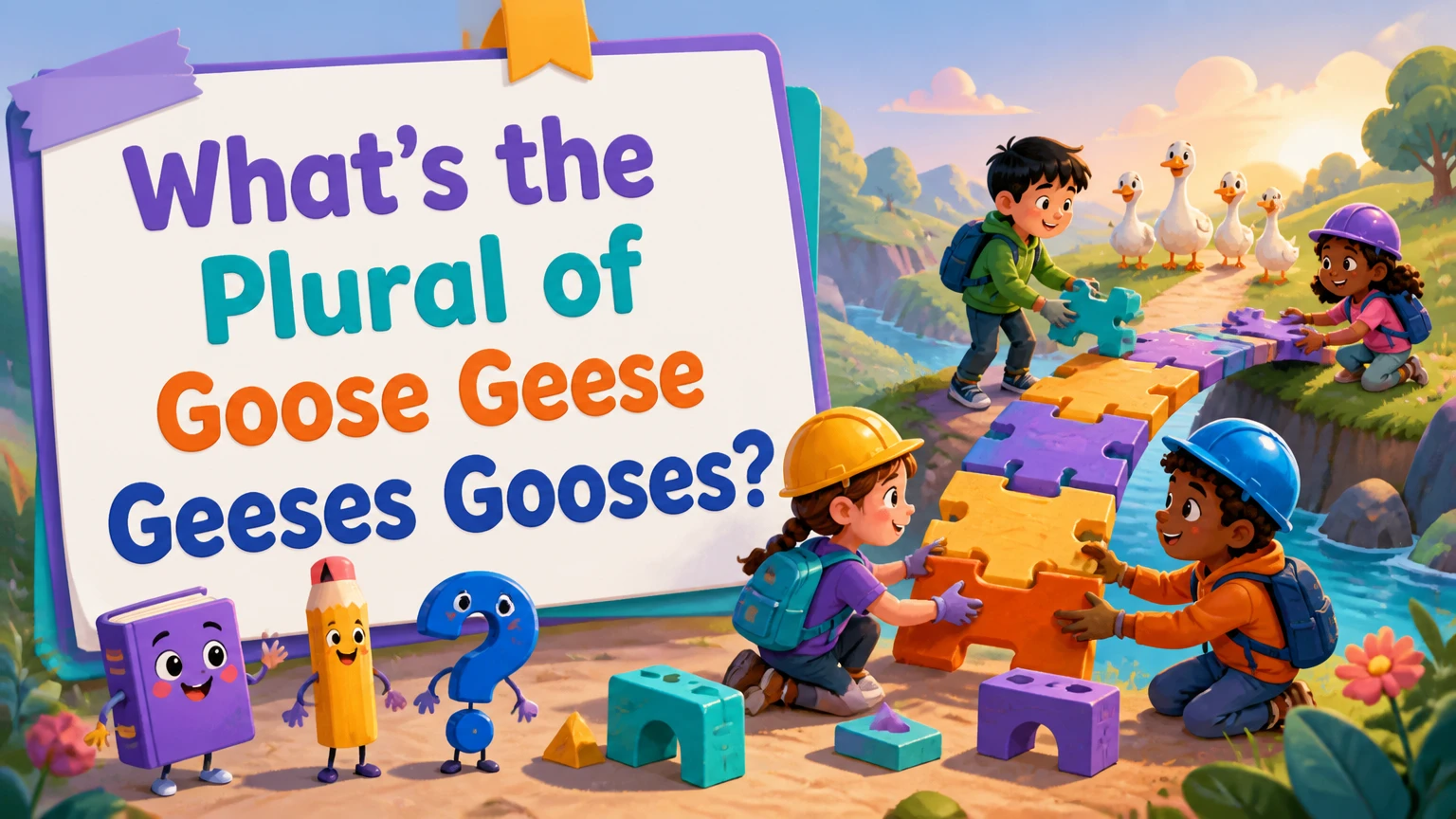
The plural of goose is geese when referring to two or more birds. Gooses is not the standard English plural noun, although gooses is a valid third-person singular verb form of goose. Geeses is not standard English and should not be used as a plural.
Key Facts at a Glance
- Goose means one bird; geese means two or more birds.
- Geese is pronounced with a long “ee” sound, like fees.
- Gooses is incorrect as the ordinary plural noun for the birds.
- Gooses can be correct as a verb: “The mechanic gooses the engine.”
- Geeses is not the standard plural of either goose or geese.
- The plural geese developed through an old Germanic vowel change rather than a modern rule for creating new plurals.
What Is the Plural of Goose?
The plural of goose is geese. Use goose for one bird and geese for more than one: “A goose crossed the path” and “Six geese crossed the path.”
The word geese applies to several waterfowl species in the family Anatidae, including Canada geese, greylag geese, and domestic geese. In ordinary English, the number of birds does not change the form after two: “two geese,” “twenty geese,” and “a flock of geese.”
| Meaning | Singular form | Plural form | Example |
|---|---|---|---|
| One bird | goose | Not applicable | “A goose is near the pond.” |
| More than one bird | Not applicable | geese | “Four geese are near the pond.” |
| A group of birds | goose | geese | “The geese flew south.” |
| Possession by one bird | goose’s | Not applicable | “The goose’s wing is injured.” |
| Possession by several birds | Not applicable | geese’s | “The geese’s nesting area is protected.” |
Is Geese Always Correct?
Geese is correct whenever the noun means multiple birds. The word remains geese after exact numbers, indefinite quantities, and expressions such as many, several, and a flock of.
Examples include:
- “The farmer counted 18 geese.”
- “Several geese gathered beside the lake.”
- “The geese are migrating.”
- “A flock of geese landed on the field.”
The only common complication is grammatical number in the surrounding sentence. A singular subject takes a singular verb: “The goose is loud.” A plural subject takes a plural verb: “The geese are loud.”
Why Does Goose Become Geese?
Goose becomes geese because Old English used a Germanic vowel change to mark the plural, and the original plural ending later disappeared. The modern word preserves the changed vowel even though speakers no longer create new plurals through the same process.
Old English had forms related to gōs for singular and gēs for plural. The plural vowel moved forward under the influence of an earlier suffix. Linguists commonly describe this historical process as i-mutation or umlaut.
The modern plural is therefore an inherited form, not a rule that English speakers freely apply to every noun. A learner cannot reliably produce new plurals by changing oo to ee. English borrowed or created many words after this pattern stopped operating productively.
Is This an Unmutated Plural?
No. Calling geese an “unmutated plural” is inaccurate if the term means that the internal vowel stayed unchanged. Geese is historically a mutated or umlaut plural, because the vowel changed under the influence of an earlier sound.
The ending disappeared over time, but the vowel alteration remained. Modern speakers memorize the pair as an irregular plural rather than actively applying Old English phonology.
How Do You Pronounce Goose and Geese?
Goose is pronounced /ɡuːs/, rhyming with moose and loose. Geese is pronounced /ɡiːs/, rhyming with piece and peace. The spelling changes both the vowel and the pronunciation.
| Word | IPA pronunciation | Rhymes with | Number |
|---|---|---|---|
| goose | /ɡuːs/ | moose, loose | Singular |
| geese | /ɡiːs/ | piece, peace | Plural |
| gooses, verb | /ˈɡuːsɪz/ | uses, chooses | Third-person singular |
| geeses | No standard pronunciation | No standard use | Nonstandard form |
The final sound also differs. Goose ends in /s/, while geese ends in /s/ as well, but the vowel distinguishes the words. The plural is not pronounced “goose-es.”
Goose Versus Geese: Which Form Fits?
Use goose for one bird and geese for more than one. The choice depends on number, not species, size, sex, or whether the birds are wild or domesticated.
| Sentence | Correct form | Reason |
|---|---|---|
| “A ___ is standing by the gate.” | goose | One bird is described. |
| “Three ___ are standing by the gate.” | geese | The number is greater than one. |
| “Those ___ damaged the garden.” | geese | Those requires a plural noun. |
| “That ___ damaged the garden.” | goose | That identifies one bird. |
| “The flock contains twelve ___.” | geese | The flock contains multiple birds. |
| “The farmer bought one ___.” | goose | One requires a singular noun. |
A common error is selecting goose because each animal is individually a goose. Grammar counts the members collectively in the sentence, so “five geese” is correct even though every individual bird is a goose.
Is Gooses Ever Correct?
Gooses is correct as a verb, not as the ordinary plural noun for birds. The verb to goose can mean to poke or prod someone, stimulate activity, or increase power or speed, depending on context.
Examples:
- “She gooses him whenever he falls asleep.”
- “The new discount gooses weekend sales.”
- “The driver gooses the engine.”
- “The coach’s speech goosed the team’s energy.”
As a verb, gooses is the third-person singular present form:
| Verb form | Example |
|---|---|
| Base form: goose | “They goose the engine.” |
| Third-person singular: gooses | “He gooses the engine.” |
| Past tense: goosed | “She goosed the motor.” |
| Present participle: goosing | “They are goosing demand.” |
| Noun meaning a poke | “He gave me a goose.” |
The verb often has an informal tone. In professional writing, choose a more precise alternative such as increase, stimulate, accelerate, or prod when the context requires neutral language.
Can Gooses Mean Several Birds?
In standard English, gooses should not mean several birds. A speaker might use it jokingly, in child speech, or as deliberate nonstandard dialogue, but edited writing should use geese.
The form can appear in historical texts, local speech, or language-learning mistakes. Its presence in a sentence does not automatically make it a recognized plural noun.
Why Is Geeses Incorrect?
Geeses is incorrect in standard English because it combines the irregular plural geese with an additional plural ending. English does not normally pluralize geese by adding -s or -es.
The mistake usually comes from treating geese as though it were a singular noun. A learner may reason that if one bird is a geese, several must be geeses. The actual singular-plural relationship is:
one goose → two or more geese
Not:
one geese → two or more geeses
The same error would produce forms such as feet-s or mice-s. Those forms fail because feet and mice are already plural.
Why Is Moose Not Meese?
The plural of moose is usually moose, not meese. English speakers sometimes expect moose to follow goose, but the two words have different histories and entered English through different language pathways.
Goose is an inherited Germanic word with an Old English plural related to gēs. Moose entered English from an Algonquian language, commonly identified in historical dictionaries as an Indigenous North American source. Its plural is generally unchanged: one moose, two moose.
| Singular | Standard plural | Word history or pattern | Example |
|---|---|---|---|
| goose | geese | Inherited Germanic vowel change | “Two geese crossed the road.” |
| moose | moose | Borrowed noun with unchanged plural | “Two moose entered the valley.” |
| sheep | sheep | Inherited zero plural | “A flock of sheep grazed.” |
| deer | deer | Inherited zero plural | “Several deer appeared.” |
| mouse | mice | Inherited Germanic vowel change | “The mice hid indoors.” |
| ox | oxen | Older Germanic plural suffix | “The oxen pulled the cart.” |
English plural patterns depend on a word’s history, not only on its spelling. Similar-looking words do not necessarily share grammatical behavior.
Which Irregular Plurals Resemble Geese?
Several common English nouns preserve historical Germanic vowel changes, but each plural must be learned as an individual word pair. The pattern is useful for memory, not a fully reliable modern rule.
| Singular | Plural | Internal change | Example |
|---|---|---|---|
| foot | feet | oo to ee | “Her feet were cold.” |
| tooth | teeth | oo to ee | “The child lost two teeth.” |
| mouse | mice | ou to i | “Mice entered the shed.” |
| louse | lice | ou to i | “The treatment removed lice.” |
| man | men | a to e | “Several men waited outside.” |
| woman | women | first vowel change | “The women organized the event.” |
| blood | bleed | Related historical alternation | Not a regular plural pair |
The last row is not a plural pair. It illustrates why historical vowel alternation should not be mistaken for a productive present-day plural rule. Modern English speakers do not form plurals by changing arbitrary internal vowels.
Which Form Should You Use in Formal Writing?
Use geese for multiple birds in academic, professional, journalistic, and everyday edited writing. Use goose for one bird, and use gooses only when it clearly functions as a verb.
A practical editing test is to place a number before the word:
- If the sentence means one bird, write one goose.
- If the sentence means multiple birds, write two geese.
- If the word describes an action performed by someone or something, check whether gooses is the verb.
- If the sentence uses geeses as a bird plural, replace it with geese.
| Intended meaning | Recommended wording | Avoid |
|---|---|---|
| One bird | “a goose” | “a geese” |
| Multiple birds | “several geese” | “several gooses” |
| An engine accelerates | “He gooses the engine.” | “He geeses the engine.” |
| A child makes an error | “Look at those gooses.” in dialogue only | Using it in formal narration |
| Multiple moose | “three moose” | “three meese” |
The strongest rule is semantic: identify whether the word names birds or describes an action. The spelling gooses has a legitimate grammatical role, but that role is verbal.
Can Writers Use Gooses or Geeses Deliberately?
Writers can use gooses or geeses deliberately in dialogue, comedy, advertising, dialect representation, or a child’s speech, but the surrounding context should signal that the nonstandard form is intentional. Standard narration should retain geese unless the author is reproducing a specific linguistic feature.
A child might say, “Look at the gooses,” because regular -s pluralization is a common language-learning strategy. A character might say “geeses” after incorrectly treating geese as singular. These forms can reveal age, education, community identity, or comic intent.
The limitation matters. A nonstandard plural should not be labeled a dialect feature without evidence from the particular speech community. Some communities use irregular local forms, while others simply regard gooses and geeses as mistakes.
How Do Possessives Work With Goose and Geese?
The singular possessive is goose’s, while the plural possessive is geese’s because geese does not end in the letter s. The apostrophe rule follows spelling, not pronunciation.
| Meaning | Correct form | Example |
|---|---|---|
| One goose owns a nest | goose’s | “The goose’s nest is hidden.” |
| Several geese own a nesting area | geese’s | “The geese’s nesting area is fenced.” |
| More than one ordinary noun ending in s | geese is irregular | Not “geeses’” |
| A phrase describing a group | flock of geese | “The flock of geese moved east.” |
Writers sometimes create geeses’ by assuming every plural possessive needs an apostrophe after a final s. That form is not standard because the correct plural is geese, not geeses.
Common Mistakes and How to Fix Them
Mistake 1: Writing “two gooses”
Replace two gooses with two geese. The number two requires a plural noun, and geese is the established plural.
Mistake 2: Writing “one geese”
Replace one geese with one goose. The number one requires the singular form.
Mistake 3: Writing “geeses”
Ask whether the intended meaning is one bird or several. Choose goose for one and geese for several.
Mistake 4: Treating gooses as always wrong
Check the sentence’s verb. “The comedian gooses the audience” is grammatical because gooses describes an action.
Mistake 5: Writing “meese”
Use moose for both singular and plural in standard English: “one moose,” “two moose.”
Mistake 6: Pronouncing geese as “goose-es”
Pronounce geese with one syllable, /ɡiːs/. The plural does not contain a separate final syllable.
FAQ
What Is the Plural of a Male Goose?
The plural of gander, the usual term for a male goose, is ganders. The word goose can also refer generally to the species, while gander specifically identifies a male bird.
What Is a Group of Geese Called?
A group of geese is commonly called a gaggle when the birds are on land. A group in flight may be called a skein, especially when the birds fly in a V-shaped formation.
Is “A Flock of Geese” Grammatically Correct?
Yes. A flock of geese is grammatical because flock is the singular collective noun and geese identifies the birds in that flock. “The flock is moving” treats the group as one unit; “the geese are moving” emphasizes individual birds.
Does the Plural of Goose Change in British and American English?
No meaningful standard difference exists between British and American English for this plural. Both varieties use goose for one bird and geese for multiple birds. Local dialects or humorous speech may produce alternatives, but edited English uses the same forms.
Is “Goose” an Uncountable Noun?
No. Goose is a countable noun, so speakers can say “one goose,” “two geese,” or “many geese.” The related meat meaning can sometimes behave like a food substance in context, but the bird noun remains countable.
What Is the Plural of Goose Egg?
The plural of goose egg is goose eggs. In this compound, goose functions as a noun modifier, while egg carries the plural ending: “The basket contains six goose eggs.”
The Bottom Line
The answer to whats the plural of goose geese geeses gooses is geese. Write one goose and two or more geese. Do not use gooses as the plural noun, although gooses is valid as a verb, and do not use geeses in standard English.