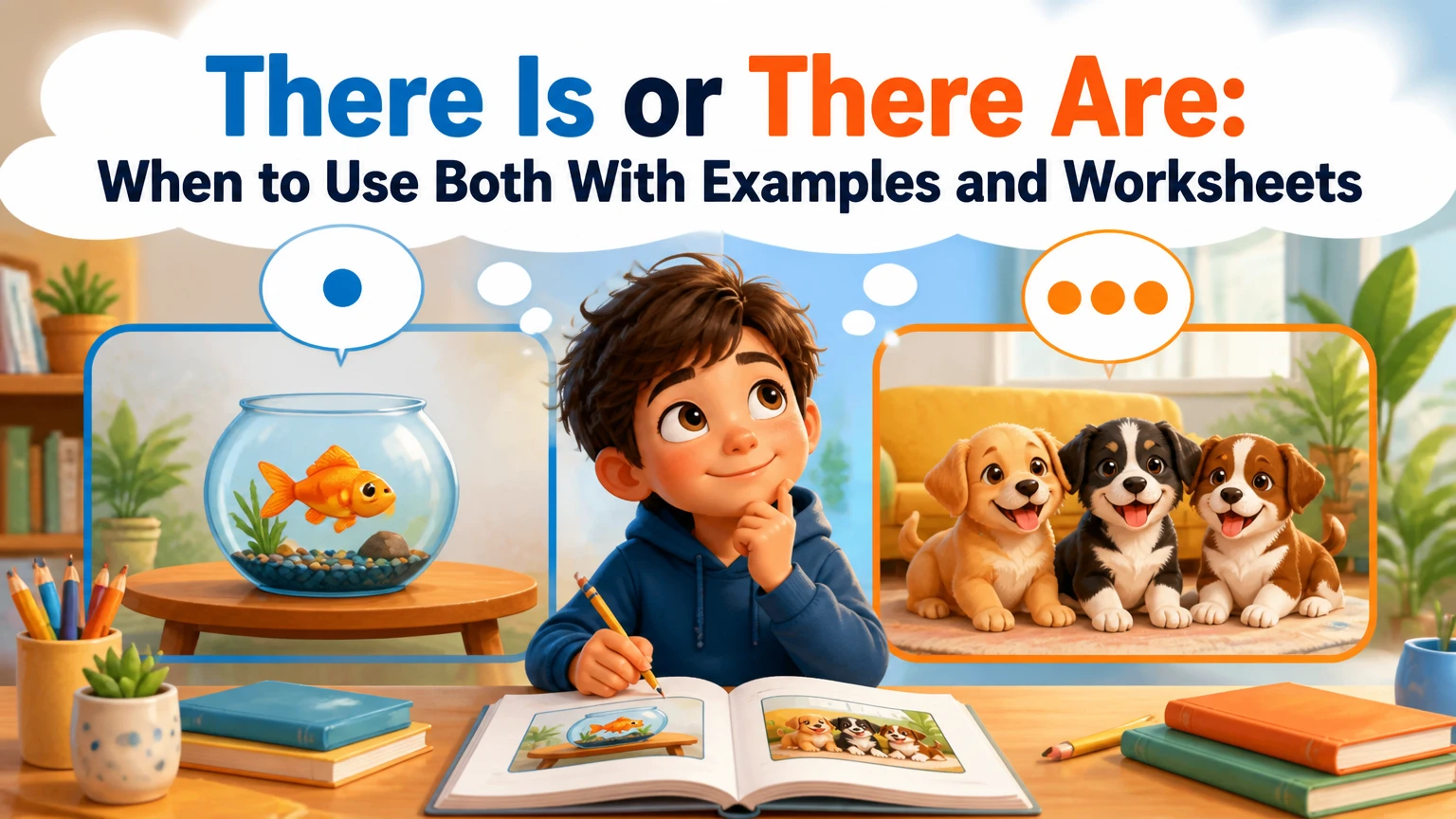
“There is” describes one singular thing or an uncountable substance, while “there are” describes two or more countable things. The verb agrees with the real subject that follows it, not with the word “there”: “There is a problem,” but “There are two problems.” Use these forms to state that something exists or is present.
Key Facts at a Glance
- “There is” precedes a singular countable noun: “There is a lamp.”
- “There is” also precedes an uncountable noun: “There is some water.”
- “There are” precedes a plural countable noun: “There are four lamps.”
- In a question, “there is” becomes “is there,” and “there are” becomes “are there.”
- “There’s” is standard with singular and uncountable nouns, but formal writing should use “there are” with plural nouns.
- In a list, the verb commonly follows the first noun: “There is a desk and two chairs.”
What Do “There Is” and “There Are” Mean?
“There is” and “there are” are existential expressions because they introduce the existence or presence of a person, object, place, condition, or idea. In “There is a key under the mat,” the word “there” introduces the statement, while “a key” is the real subject.
The opening word “there” does not determine singular or plural agreement. The noun phrase after the verb does. Compare these sentences:
- There is one message in the inbox.
- There are six messages in the inbox.
- There is important information in the report.
- There are several pieces of information in the report.
The pattern is useful when the existence of something matters more than its identity. “A bicycle is outside” focuses on the bicycle. “There is a bicycle outside” presents the bicycle as newly noticed information.
The Basic Agreement Rule
| Real subject | Correct form | Example |
|---|---|---|
| One singular noun | There is | There is a visitor. |
| Two or more nouns | There are | There are two visitors. |
| Uncountable noun | There is | There is enough time. |
| Singular collective noun | There is | There is a committee meeting. |
| Plural measurement units | There are | There are three kilometers left. |
A reliable test is to identify the noun immediately after “is” or “are.” Ignore intervening adjectives and modifiers. In “There are several large wooden tables,” the head noun is “tables,” which is plural, so “are” is required.
When Should You Use “There Is”?
Use “there is” before one singular countable noun or before an uncountable noun. Singular countable nouns name one separately identifiable person, animal, object, location, or concept, while uncountable nouns describe substances, categories, or abstractions that English does not normally count as individual units.
Examples with singular countable nouns include:
- There is a pharmacy near the station.
- There is one answer on the page.
- There is an umbrella by the door.
- There is a reason for the delay.
Examples with uncountable nouns include:
- There is some rice in the bowl.
- There is enough evidence to continue.
- There is traffic on the highway.
- There is useful advice in the handbook.
A word can be countable in one meaning and uncountable in another. “Paper” is uncountable when it means the material, as in “There is paper in the printer,” but countable when it means documents or academic articles, as in “There are three papers on the desk.”
Common Uncountable Nouns
| Uncountable noun | Correct expression | Incorrect expression |
|---|---|---|
| Information | There is useful information. | There are useful informations. |
| Advice | There is helpful advice. | There are helpful advices. |
| Furniture | There is new furniture. | There are new furnitures. |
| Money | There is enough money. | There are enough moneys. |
| Luggage | There is too much luggage. | There are too many luggage. |
| Evidence | There is strong evidence. | There are strong evidences. |
To count these nouns, add a countable unit. Write “There are three pieces of advice,” “There are two items of luggage,” or “There are four pieces of evidence.” The unit, not the uncountable noun, controls the verb.
When Should You Use “There Are”?
Use “there are” before a plural countable noun. A plural noun names two or more separately countable people, animals, objects, places, or ideas.
Examples include:
- There are three students in the library.
- There are several solutions to the problem.
- There are two entrances to the museum.
- There are many reasons to revise the policy.
- There are colorful birds in the garden.
Numbers, plural determiners, and plural endings often make the choice visible. Words such as “two,” “many,” “several,” “both,” “few,” and “a number of” normally signal a plural noun and therefore require “there are.”
Be careful with “a lot of,” “some,” and “any.” These expressions can accompany either form:
- There is a lot of noise outside.
- There are a lot of cars outside.
- There is some milk in the refrigerator.
- There are some apples in the refrigerator.
The noun after the quantity phrase supplies the agreement information.
How Do Questions and Negatives Work?
Questions invert the verb and “there,” while negative sentences place “not” after the verb. Use “is there” with singular or uncountable nouns and “are there” with plural nouns.
| Sentence type | Singular or uncountable | Plural |
|---|---|---|
| Statement | There is a meeting. | There are meetings. |
| Negative | There is not a meeting. | There are not any meetings. |
| Contraction | There isn’t a meeting. | There aren’t any meetings. |
| Question | Is there a meeting? | Are there any meetings? |
| Short answer | Yes, there is. | Yes, there are. |
Examples:
- Is there a bank near here?
- Are there any seats available?
- There isn’t enough fuel.
- There aren’t enough tickets.
- Is there any information about the schedule?
- Are there several routes to the airport?
“Any” commonly appears in questions and negative sentences, but it is not itself singular or plural. The following noun remains decisive: “Is there any water?” versus “Are there any bottles?”
Should You Write “There’s” With a Plural Noun?
Standard formal English uses “there are” with plural nouns, although many speakers use “there’s” informally before a plural noun. “There’s two reasons” is common in conversation, but “There are two reasons” is the safer choice in schoolwork, business writing, examinations, and edited prose.
Correct formal examples include:
- There are several advantages to this method.
- There are two files attached to the message.
- There are many people waiting outside.
“There’s” is fully standard before a singular or uncountable noun:
- There’s a problem with the printer.
- There’s some soup on the stove.
- There’s enough time to check the figures.
The contraction “there’re” is grammatically interpretable but uncommon and awkward in standard writing. Use “there are,” even in less formal prose.
How Does Agreement Work With Two Nouns?
With a compound subject, many speakers use proximity agreement, matching the verb to the first noun in the list. “There is a chair and two desks” begins with singular “chair,” while “There are two desks and a chair” begins with plural “desks.”
Examples:
- There is a notebook and three pens on the table.
- There are three pens and a notebook on the table.
- There is a manager and several assistants in the office.
- There are several assistants and a manager in the office.
This pattern is frequent in speech, but it can create disagreement among grammar authorities because the entire coordinated subject contains both singular and plural nouns. In careful formal writing, rewrite the sentence to remove the ambiguity:
- A notebook and three pens are on the table.
- The room contains a notebook and three pens.
- A manager and several assistants are in the office.
The practical editing rule is simple: use proximity agreement for ordinary conversational descriptions, but recast the sentence when precision or a formal register matters.
Which Nouns Confuse Learners Most?
Collective nouns, uncountable nouns, measurements, and titles cause the most errors because their grammatical number may differ from their apparent meaning. The correct verb depends on the noun’s English grammar, not on whether the speaker imagines many real-world people or objects.
Collective Nouns
A collective noun can represent many members but remain grammatically singular when the group acts as one unit:
- There is a crowd outside.
- There is a team meeting at noon.
- There is a committee reviewing the proposal.
- There is a family waiting in reception.
If the sentence names individual members, use a plural noun:
- There are five people outside.
- There are eleven players on the field.
- There are four committee members in the room.
British English sometimes treats collective nouns as plural when the members act separately, while American English more consistently treats the organization as singular. The safest solution is to select the noun that expresses the intended meaning.
Measurements, Time, and Money
A measurement used as one total amount generally takes “there is”:
- There is five dollars in the drawer.
- There is ten minutes left.
- There is three kilometers to the village.
In formal edited writing, many style guides prefer a recast sentence because the measurement can sound awkward after “there is”:
- Five dollars remain in the drawer.
- Ten minutes remain.
- The village is three kilometers away.
When the units are presented as separate countable items, “there are” is correct:
- There are five dollar bills in the drawer.
- There are ten one-minute intervals.
- There are three kilometers of marked trail.
Titles and Names
A book, film, course, or organization title can look plural but function as one name:
- There is a film called The Seven Samurai.
- There is a newspaper called The Times.
- There is a course titled Mathematics for Engineers.
The real subject is “a film,” “a newspaper,” or “a course,” not the word inside the title.
How Does the Pattern Change Across Tenses?
The existential structure changes the form of “be” to show time. Present “there is” and “there are” become “there was” and “there were” in the past, and “there will be” for the future.
| Time | Singular or uncountable | Plural |
|---|---|---|
| Present | There is a delay. | There are delays. |
| Past | There was a delay. | There were delays. |
| Present perfect | There has been a delay. | There have been delays. |
| Future | There will be a delay. | There will be delays. |
| Modal | There may be a delay. | There may be delays. |
Examples:
- There was an error in the original file.
- There were several errors in the original file.
- There has been a change in the schedule.
- There have been several changes in the schedule.
- There will be a test on Friday.
- There may be unexpected costs.
After modal verbs such as “may,” “might,” “can,” and “should,” use “be” for both singular and plural subjects: “There might be a problem” and “There might be several problems.”
What Are the Most Common Mistakes?
The most common errors occur when writers react to meaning instead of grammatical number. A crowd may contain hundreds of people, but “crowd” is singular; information may contain many facts, but “information” is uncountable.
- Using “there are” with an uncountable noun
- Incorrect: There are many information online.
- Correct: There is a lot of information online.
- Alternative: There are many pieces of information online.
- Using “there’s” with a plural noun in formal writing
- Informal speech: There’s several reasons.
- Formal correction: There are several reasons.
- Matching the verb with a later noun
- Incorrect: There are a group of students outside.
- Correct: There is a group of students outside.
- Alternative: There are several students outside.
- Treating “any” as the subject
- Incorrect: Are there any evidence?
- Correct: Is there any evidence?
- Reason: “Evidence” is uncountable.
- Confusing “a number” and “the number”
- There are a number of complaints.
- There is a number of complaints.
- The first expression means “many complaints,” while the second refers to one numerical total and is followed by a singular verb.
- Ignoring the noun after a long modifier
- Correct: There is a detailed explanation of the results.
- Correct: There are several detailed explanations of the results.
- The adjective “detailed” does not affect number.
A Five-Second Editing Method
Use the following five-step check whenever you are uncertain:
- Find “there is” or “there are.”
- Ask what exists or is present.
- Identify the head noun, ignoring adjectives and prepositional phrases.
- Decide whether that noun is singular, plural, or uncountable.
- Replace the form and read the sentence aloud.
Apply the method to “There are a large number of complaints about the service.” The head noun is “number,” but the phrase “a large number of” means many, so plural agreement is standard. In “The number of complaints is rising,” the head noun is “number,” and the phrase refers to one total, so “is” is correct.
A useful practitioner rule is to avoid existential constructions when the sentence becomes difficult to parse. “Several factors influence the outcome” is shorter and clearer than “There are several factors that influence the outcome.”
How Can Teachers and Learners Practice the Rule?
Teachers can begin with visible classroom objects, then introduce uncountable nouns and compound lists after learners control basic singular and plural forms. A ten-minute lesson can use one minute for the rule, four minutes for object descriptions, three minutes for correction, and two minutes for independent practice.
A practical sequence is:
- Point to one object: “There is one board.”
- Point to multiple objects: “There are twenty desks.”
- Add an uncountable noun: “There is some water.”
- Convert statements into questions: “Are there twenty desks?”
- Add negatives: “There aren’t twenty-five desks.”
- Ask students to explain which noun controls the verb.
Learners should keep a personal list of troublesome nouns. Record “advice, information, furniture, evidence, luggage, traffic, equipment, research, news, and homework” with example sentences, because memorizing isolated labels is less effective than memorizing the noun inside a usable phrase.
Worksheet 1: Beginner Fill-in-the-Blank Practice
Instructions: Write there is or there are in each blank.
- __________ a blue bicycle beside the gate.
- __________ four clean towels in the bathroom.
- __________ some coffee in the pot.
- __________ two new students in our class.
- __________ an unusual smell in the kitchen.
- __________ several messages on your phone.
- __________ enough space beneath the desk.
- __________ a museum near the train station.
- __________ many photographs in the album.
- __________ useful advice in the final paragraph.
Worksheet 1 Answer Key
- There is
- There are
- There is
- There are
- There is
- There are
- There is
- There is
- There are
- There is
Questions 1, 5, and 8 contain singular countable nouns. Questions 3, 7, and 10 contain uncountable nouns. The remaining answers use plural countable nouns.
Worksheet 2: Intermediate Forms and Tricky Nouns
Instructions: Choose the correct option.
- There is / There are a tablet and two chargers on the shelf.
- There is / There are two chargers and a tablet on the shelf.
- There isn’t / There aren’t any evidence of damage.
- Is there / Are there enough chairs for the guests?
- Is there / Are there any furniture in the empty room?
- There is / There are several pieces of furniture in the empty room.
- There wasn’t / There weren’t much traffic yesterday.
- There has been / There have been three changes to the timetable.
- There will be / There will are a meeting after lunch.
- There’s / There are many reasons to compare both versions.
Worksheet 2 Answer Key
- There is
- There are
- There isn’t
- Are there
- Is there
- There are
- There wasn’t
- There have been
- There will be
- There are
Number 1 follows proximity agreement because the first listed noun is “a tablet.” In formal writing, rewrite it as “A tablet and two chargers are on the shelf” if the mixed list might distract the reader. Number 5 uses “furniture” as an uncountable noun. Number 7 uses “traffic,” another uncountable noun.
Worksheet 3: Correct the Sentence
Rewrite each sentence correctly.
- There are a problem with the account.
- There is three buses outside.
- There are many advice in the guide.
- There’s several empty seats near the front.
- Are there any information about the price?
- There are a crowd waiting at the entrance.
Worksheet 3 Answers
- There is a problem with the account.
- There are three buses outside.
- There is a lot of advice in the guide.
- There are several empty seats near the front.
- Is there any information about the price?
- There is a crowd waiting at the entrance.
Alternative corrections can use countable units: “There are several pieces of advice in the guide” and “Are there any details about the price?” The second alternative changes the noun rather than forcing “information” into a plural form.
Quick Comparison: “There Is,” “There Are,” and Alternatives
| Purpose | Existential form | More direct alternative | Typical register |
|---|---|---|---|
| Introduce one object | There is a fault. | A fault exists. | Neutral |
| Introduce several factors | There are three factors. | Three factors influence it. | Direct |
| Introduce a substance | There is some water. | Some water remains. | Neutral |
| Describe a location | There is a shop nearby. | A shop is nearby. | Conversational |
| Present a formal finding | There is evidence. | The evidence indicates a result. | Academic |
| State a future event | There will be a review. | The committee will review it. | Formal |
Existential sentences are useful for introducing new information, describing a scene, and answering “What is present?” They are less effective when the real subject already provides the focus. “Three factors determine the outcome” is usually stronger than “There are three factors that determine the outcome.”
This distinction matters in academic and professional writing. Rewriting every existential sentence would be excessive, but replacing repeated “there is” and “there are” constructions can reduce wordiness and place the important noun at the beginning.
FAQ
Is “there is” singular or plural?
“There is” is singular in ordinary subject-verb agreement. Use it with one singular countable noun, such as “a book,” and with uncountable nouns, such as “information,” “water,” or “traffic.” The word “there” does not make the sentence plural.
Is “there are” correct with uncountable nouns?
No. Standard English uses “there is” with uncountable nouns: “There is evidence,” “There is furniture,” and “There is enough money.” Use a countable unit when you need a plural: “There are two pieces of evidence” or “There are several items of furniture.”
Can I say “there is two”?
In informal speech, some speakers say “there’s two” or “there is two,” but standard written English requires “there are two.” Write “There are two options,” “There are two people,” and “There are two problems,” especially in academic, professional, and examination contexts.
Is “there are” always correct with “a lot of”?
No. “A lot of” can precede either singular or plural nouns. Write “There is a lot of noise” because “noise” is uncountable, but write “There are a lot of cars” because “cars” is plural. Examine the noun after the quantity expression.
Which is correct, “there was” or “there were”?
Use “there was” with one singular or uncountable noun and “there were” with a plural noun. Examples include “There was an accident,” “There was heavy rain,” and “There were two accidents.” The same agreement rule applies in the past tense.
Should I avoid “there is” in academic writing?
No. “There is” is grammatically correct and useful when introducing evidence, conditions, or findings. Avoiding every existential sentence is unnecessary; instead, revise repetitive or wordy constructions, such as changing “There are several factors that affect cost” to “Several factors affect cost.”
The Bottom Line
Use “there is” for one singular noun or an uncountable noun, and use “there are” for a plural noun. In questions, use “is there” or “are there”; in negatives, use “isn’t” or “aren’t.” Check the real subject after the verb, especially with uncountable nouns, collective nouns, quantity phrases, and compound lists. That rule answers the question of there is or there are when to use both plus examples worksheets and provides a reliable method for editing every form.