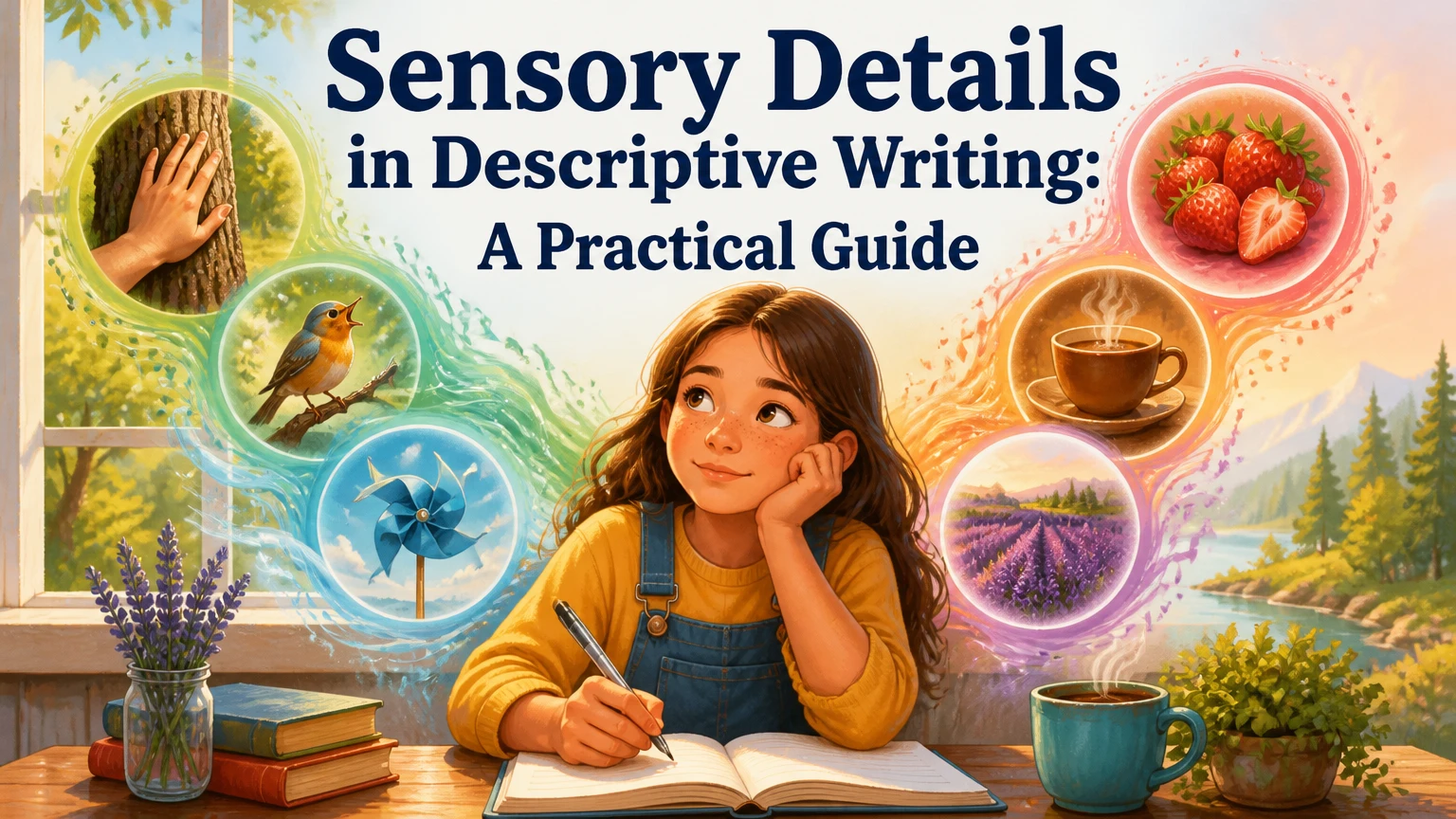
Sensory details in descriptive writing are specific words and phrases that help readers experience a subject through sight, sound, smell, taste, touch, movement, or bodily sensation. Effective sensory language turns an abstract statement such as “the kitchen was unpleasant” into concrete evidence, such as “dishwater cooled around the forks while sour milk clung to the drain.”
Key Facts at a Glance
Sensory details describe physical evidence rather than merely labeling an emotion or quality.
The five primary sensory channels are visual, auditory, olfactory, gustatory, and tactile.
Kinesthetic details describe movement, while organic details describe internal bodily sensations.
A scene usually needs one dominant sense and one or two supporting senses, not every sense in equal measure.
Specific nouns and active verbs usually create sharper imagery than strings of adjectives.
Sensory description should support viewpoint, mood, character, setting, or action.
What Are Sensory Details in Descriptive Writing?
Sensory details in descriptive writing give readers concrete information that can be imagined through the body. “The hallway felt threatening” names an interpretation, while “the motion light clicked off before he reached the stairs” supplies visual, auditory, and psychological evidence that allows the reader to form the interpretation independently.
Sensory detail is not limited to ornate fiction. A memoirist uses the smell of iodine to locate a hospital memory; a product writer describes the drag of a wool sweater against the wrist; a screenwriter specifies a refrigerator’s uneven hum because actors and sound designers can use it.
Sensory Detail Versus Imagery
Sensory detail is the physical input. Imagery is the broader mental picture created by language, which may include sensory description, metaphor, symbolism, and emotional association. “Her voice cracked like thin ice” combines auditory detail with a simile, while “her voice broke on the last word” remains primarily sensory and literal.
The distinction matters during revision. Figurative language can intensify an image, but concrete sensory evidence usually makes the comparison believable. A metaphor cannot compensate for a setting that contains no observable details.
How Does Sensory Language Work?
Sensory language works by giving readers recognizable perceptual cues, which they combine with memory, imagination, and context to construct a scene. Reading a phrase such as “warm rain slid beneath his collar” does not guarantee the exact same brain response as experiencing rain, so writers should treat claims about identical neural activation cautiously.
Research on embodied and grounded cognition, including work discussed by Lawrence Barsalou in 2008, supports the idea that concepts can involve perceptual and bodily information. However, responses vary by experience, culture, disability, language, and context. A reader who has never handled a particular tool may imagine it differently from a carpenter.
The practical conclusion is more useful than an exaggerated neuroscience claim: sensory specificity reduces interpretive distance. Readers do not have to accept “the room was luxurious” because details such as “linen curtains softened the afternoon glare, and the leather chair released a clean, oily smell when she sat down” provide evidence.
What Makes a Sensory Detail Effective?
An effective sensory detail has a perceivable source, a precise attribute, and a reason for appearing at that moment. “A sound came from outside” is weak because the source and quality remain unknown; “a delivery truck reversed with three clipped beeps below the window” gives the reader location, rhythm, and scale.
Strong details also filter through a viewpoint. A mechanic may notice an engine’s irregular idle, while a frightened child notices only the window vibrating. The same setting should not produce identical description from every character.
What Are the Five Main Types of Sensory Details?
The five main types are visual, auditory, olfactory, gustatory, and tactile details. Writers can add kinesthetic and organic sensations when movement or internal bodily experience matters to the scene.
| Sense | Attributes to select | Example | Common writing use |
|---|---|---|---|
| Sight | Color, shape, distance, light, motion | “Blue light pooled beneath the vending machine” | Setting and spatial orientation |
| Sound | Volume, pitch, rhythm, source, silence | “Pipes knocked twice behind the wall” | Tension, place, dialogue |
| Smell | Source, intensity, freshness, persistence | “Bleach stung above the onion smell” | Memory and atmosphere |
| Taste | Flavor, aftertaste, mouthfeel, temperature | “The tea left a chalky bitterness” | Food, illness, intimacy |
| Touch | Texture, pressure, heat, cold, moisture | “The envelope softened under his damp thumb” | Contact and physical stakes |
| Kinesthetic | Direction, speed, balance, effort | “She lurched sideways with the train” | Action and body movement |
| Organic | Pulse, breath, nausea, tension, hunger | “A hard pulse tapped beneath his jaw” | Fear, exertion, emotion |
Visual Details: Sight
Visual description includes more than color. Select shape, scale, contrast, illumination, occlusion, movement, and distance. “A red door” identifies a color, but “red paint blistered around the brass handle” adds age, texture, material, and a focal point.
Avoid cataloguing everything visible. Human attention is selective, so choose the object the viewpoint character would notice or the detail that changes the reader’s understanding of the scene.
Auditory Details: Sound
Auditory description identifies what produces a sound and how that sound behaves. Volume alone is rarely enough; pitch, rhythm, duration, direction, interruption, and silence can distinguish a ceiling fan from a distant helicopter.
Sound is especially useful when characters cannot see clearly. In a suspense scene, a shoe scraping concrete may carry more information than a paragraph describing a dark corridor. In dialogue, pauses, clipped syllables, swallowed words, and changes in volume reveal pressure without naming it.
Olfactory Details: Smell
Smell descriptions become specific when they identify a source and a physical quality. Compare “the house smelled bad” with “wet dog, old frying oil, and something sweet rotting behind the radiator.”
Smell can trigger memory, but the association is not universal. Avoid assuming that one scent always means comfort, danger, childhood, or wealth. A character’s history determines whether gasoline suggests freedom, work, injury, or an ordinary commute.
Gustatory Details: Taste
Taste includes flavor, temperature, texture, coating, and aftertaste. “The soup was delicious” gives a verdict; “ginger burned at the back of her throat, then the broth settled into a salty warmth” gives the reader a sequence.
Taste works best when eating, drinking, illness, kissing, medicine, or oral discomfort matters. It becomes distracting when inserted into a scene with no plausible reason for the character to taste anything.
Tactile Details: Touch
Tactile language describes contact between the body and a surface, substance, object, or temperature. Useful variables include friction, pressure, weight, moisture, roughness, vibration, and duration.
Touch can carry plot information. A key may feel warm because someone used it moments earlier; a floor may flex beneath a character’s weight; a sleeve may catch on a nail during an escape. These details perform narrative work instead of decorating the paragraph.
Kinesthetic and Organic Details
Kinesthetic details describe external movement, balance, speed, and physical effort. Organic details describe internal sensations such as breathlessness, nausea, hunger, muscle tension, heartbeat, and dizziness.
The two categories should not be confused. “He stumbled over the curb” is kinesthetic; “his stomach tightened before he looked down” is organic. Together they can show fear without using the word frightened.
How Do You Add Sensory Details to a Scene?
Add sensory details by identifying the scene’s anchor, drafting the bare action, selecting relevant senses, replacing general language with concrete evidence, integrating details into movement, and pruning anything that slows the passage. A focused revision normally takes 10-20 minutes for 500-800 words.
Step 1: Identify the Anchor
Choose the object, location, person, or action that deserves emphasis. A scene may contain a railway platform, but the anchor could be a child’s missing shoe, the signal light, or the character’s clenched ticket.
Step 2: Draft the Bare Action
Write the scene without decorative description. For example: “Mara opened the freezer and found the body.” This sentence establishes the event before sensory choices influence the pacing.
Step 3: Build a Sensory Matrix
List possible observations, then select details that fit the viewpoint and purpose.
| Anchor | Sight | Sound | Smell | Touch or organic response |
|---|---|---|---|---|
| Freezer door | Frost whitening the seal | Compressor clicking off | Raw metal and bleach | Cold air on her knuckles |
| Train platform | Wet rails under sodium lamps | Brake squeal and announcements | Coal dust and rain | Ticket paper sticking to her palm |
| Abandoned classroom | Sunken ceiling tiles | A blind tapping the window | Dust and pencil shavings | Splinter under a desk |
| Lemon tart | Glossy yellow curd | Fork scraping porcelain | Butter and citrus oil | Sugar grit on the tongue |
Two nonvisual senses are often enough to prevent a visually flat scene. The matrix is a planning aid, not a quota.
Step 4: Replace Labels With Evidence
Trade vague adjectives for precise nouns and verbs.
| General wording | Sensory revision | Added information |
|---|---|---|
| The room was cold | Frost feathered the inside of the window | Temperature and surface |
| The dog was loud | The dog’s bark rattled the mail slot | Volume and location |
| The street smelled bad | Sewer gas rose through the cracked grate | Source and intensity |
| The fabric was soft | The flannel gave beneath each thumb | Texture and action |
| He was nervous | He kept rubbing the damp ticket flat | Behavior and tactile evidence |
Do not mechanically remove every adjective. “Rust-red,” “needle-thin,” and “smoke-sour” can be efficient when they carry exact information.
Step 5: Attach Description to Action
Action prevents sensory description from becoming a static inventory. Instead of writing “the table was dusty,” write “she dragged one finger across the table and left a pale track through the dust.”
This technique also controls pacing. A detail attached to a decision, movement, or reaction advances the scene while establishing its physical conditions.
Step 6: Prune and Read Aloud
Remove details that repeat an attribute, contradict the viewpoint, or interrupt a high-speed moment. Read the passage aloud and mark places where a description delays the verb that matters.
A useful test asks three questions: Can the character perceive this now? Does the detail change mood, geography, character, or action? Would removing it reduce the reader’s understanding? If the answer is no to all three, cut it.
How Many Sensory Details Should a Scene Have?
A scene does not require a fixed number of sensory details, and no reliable universal 70/30 visual-to-nonvisual rule applies across fiction, nonfiction, poetry, or marketing. A practical starting point is one dominant sense plus one or two supporting senses per major beat, then adjusting for viewpoint and pace.
| Scene purpose | Typical dominant sense | Supporting senses | Typical detail density |
|---|---|---|---|
| Fast chase | Kinesthetic, visual | Sound, organic | 1-2 details per sentence |
| Quiet grief | Organic, tactile | Sound, smell | 1 detail per 1-2 sentences |
| Food review | Gustatory, olfactory | Tactile, visual | 2-4 details per dish |
| Horror reveal | Auditory, olfactory | Tactile, visual | 1 precise detail per beat |
| Technical explanation | Visual, tactile | Sound if relevant | 1-2 details per paragraph |
The scene’s emotional temperature matters more than a numerical ratio. A hospital waiting room may need smell and sound because disinfectant and paging systems define the experience. A mountain panorama may legitimately rely mostly on sight.
When Does Sensory Description Become Overload?
Sensory overload occurs when details compete for attention without establishing hierarchy. A paragraph that includes color, fabric, weather, perfume, engine noise, food, temperature, and heartbeat may feel less immersive because the reader cannot tell which perception matters.
Use one dominant image per sentence when the prose moves quickly. During a slower reflective passage, several senses can accumulate if they belong to one object or emotional association.
What Is the Difference Between Sensory Detail and Figurative Language?
Sensory detail states or strongly implies a physical perception, while figurative language creates comparison, substitution, or symbolic meaning. “The iron rail burned her palm” uses tactile detail; “the rail was a branding iron” adds metaphor.
| Technique | Example | Primary function |
|---|---|---|
| Literal sensory detail | “The towel felt coarse” | Physical accuracy |
| Simile | “The towel felt like rope” | Comparison |
| Metaphor | “The towel was rope against his neck” | Compression and emphasis |
| Personification | “The shutters complained in the wind” | Mood and animation |
| Symbolic detail | “The untouched cup cooled beside him” | Implied meaning |
Concrete sensory language should usually come before elaborate figurative language. Readers can evaluate an unusual comparison more easily when the physical scene is already stable.
Which Descriptive Style Should You Use?
Balanced sensory integration is the best default because it preserves scene clarity while adding atmosphere, but minimalist and maximalist styles remain useful under specific conditions. The correct choice depends on genre, narrative speed, audience tolerance, and the detail’s contribution.
| Style | Typical sentence length | Best use | Main risk |
|---|---|---|---|
| Minimalist | 8-16 words | Action, thriller, commercial nonfiction | Clinical or vague settings |
| Balanced | 12-28 words | Literary fiction, memoir, general narrative | Requires selective revision |
| Maximalist | 20-45 words | Poetry, lush fantasy, reflective prose | Delayed action and reader fatigue |
| Technical descriptive | 10-24 words | Manuals, reports, education | Unnecessary abstraction |
A writer can change style within one manuscript. A fast escape may use clipped auditory and kinesthetic details, while the aftermath may slow into smell, temperature, and organic sensation.
How Do Sensory Details Change by Genre?
Sensory details should match the reader’s purpose and the medium’s available channels. Fiction can use internal sensation and memory, marketing can emphasize product-relevant touch or taste, screenwriting should prioritize filmable or audible information, and technical writing should describe measurable properties.
| Genre or medium | Highest-value senses | Example focus | Limit |
|---|---|---|---|
| Literary fiction | Organic, tactile, olfactory | Memory and subjective viewpoint | Avoid ornamental accumulation |
| Horror | Auditory, olfactory, tactile | Absence, contamination, uncertainty | Do not explain every threat |
| Food marketing | Gustatory, olfactory, tactile | Flavor sequence and mouthfeel | Avoid unsupported health claims |
| Screenwriting | Visual, auditory | Props, behavior, sound cues | Internal sensations need action |
| Memoir | Smell, touch, organic | Reconstructed bodily memory | Mark uncertainty where memory is incomplete |
| Technical writing | Visual, tactile | Dimensions, texture, operation | Prefer measurable terms |
Copywriters should connect a sensory claim to a verifiable product property. “Velvety” can describe texture, but “reduces inflammation” is a medical claim requiring evidence and appropriate regulation.
What Are the Most Common Mistakes?
The most common mistakes are relying on sight alone, dumping description into static paragraphs, using familiar clichés, adding impossible perceptions, and confusing emotional labels with physical evidence.
The Sight Trap
Writers often describe what characters see while ignoring sound, temperature, pressure, and smell. Close your eyes during revision and list what the viewpoint character hears, touches, smells, tastes, or feels internally, then retain only details that fit the setting.
Sensory Dumping
A sensory dump pauses action to inventory a room, outfit, or landscape. Distribute description across movement and interaction, so the reader learns the environment as the character crosses it, handles it, or reacts to it.
Cliché Overuse
Phrases such as “deafening silence,” “white as a sheet,” and “heart pounding” communicate quickly but rarely identify a distinctive experience. Replace the cliché with a physical consequence: “The silence made the refrigerator’s relay click sound enormous.”
False Sensory Precision
Specificity is not the same as invented technical vocabulary. A narrator who cannot identify wine varieties should not suddenly distinguish “2018 Barolo tannins” unless the characterization supports that knowledge.
Inaccessible Viewpoint Assumptions
Do not assume every character sees, hears, or processes the environment in the same way. A blind character can perceive spatial changes through echoes, floor texture, air movement, and other people’s behavior, while a deaf character may register vibration, visual movement, and social reactions.
What Are Expert Rules for Stronger Sensory Writing?
Three practitioner rules consistently improve sensory prose. First, select details for narrative function rather than sensory variety. Second, make the character’s attention selective. Third, let physical sensation imply emotion before naming the emotion.
A counterintuitive truth is that fewer details often create stronger immersion. One accurate smell from a source the character recognizes can establish a place more effectively than six generic visual adjectives.
Another useful rule concerns verbs. Active verbs are valuable when they specify physical behavior, such as “scraped,” “flinched,” “clung,” or “buckled,” but replacing every adjective with a verb produces strained prose. Revise for information, not for a percentage target.
A final rule concerns memory. Sensory recollection is reconstructive, not a guaranteed recording. Memoir and autobiographical fiction become more credible when the narrator distinguishes observed fact from remembered impression.
How Much Do Sensory Editing Resources Cost?
Typical sensory-editing costs range from $15-$25 for a reference book, $0.01-$0.03 per word for professional line editing, and $100-$500 for a structured workshop. Actual prices vary by editor experience, manuscript condition, genre, location, and whether developmental feedback is included.
| Resource | Typical cost | Typical timeframe | Best use |
|---|---|---|---|
| Descriptive thesaurus | $15-$25 | Immediate | Vocabulary prompts |
| Writing software | $0-$30 per month | Immediate | Draft organization |
| Sensory line edit | $0.01-$0.03 per word | 2-4 weeks | Sentence-level revision |
| Writing workshop | $100-$500 | 4-8 weeks | Guided practice |
| Developmental edit | $0.03-$0.08 per word | 3-8 weeks | Scene and structure problems |
Reference books such as The Emotion Thesaurus by Angela Ackerman and Becca Puglisi can prompt alternatives, but they should not replace observation. A thesaurus offers possibilities; the character, setting, and plot determine which possibility belongs.
How Can You Revise a Flat Paragraph?
Revise a flat paragraph by identifying its abstract labels, choosing one physical anchor, and adding sensory evidence through the character’s action. Preserve the original event and mood, then replace only the unsupported generalizations.
Flat version:
The market was crowded and unpleasant. People were noisy, and the food smelled bad. Daniel felt nervous as he searched for his sister.
Revised version:
Daniel moved sideways between the stalls, keeping one hand over his wallet. Vendors shouted prices into the crush, while hot oil, crushed coriander, and drain water competed beneath the canvas roof. Someone’s shoulder struck his back. He turned toward every voice, searching for his sister’s red scarf.
The revision adds sound, smell, touch, movement, and a concrete visual target. It also avoids stating “nervous” because the wallet gesture, scanning, and physical contact communicate the condition.
FAQ
Can sensory details be used in academic writing?
Yes, but academic sensory detail must clarify an object, process, field site, or participant experience rather than decorate an argument. A materials report can describe surface roughness with measured values, while an ethnographic study may quote a participant’s sensory account and identify the collection method.
Should every paragraph include sensory language?
No. Every paragraph needs a purpose, not a sensory feature. Definitions, transitions, dialogue, and analytical explanation may work without sensory description, while scenes involving place, embodiment, memory, or physical action usually benefit from it.
How do I write sensory details for a character with synesthesia?
Treat synesthesia as a character-specific perceptual condition, not a universal poetic device. Establish the character’s recurring cross-sensory associations, keep them consistent, and show whether the experience is useful, distracting, involuntary, pleasurable, or distressing.
How can children’s writers use sensory description?
Children’s writers should use concrete words, recognizable sources, and details tied to action. “The glue smelled like sour apples” is more accessible than an abstract atmospheric explanation, while unusual sensory combinations should be supported by context.
Are sensory details appropriate in a horror story?
Yes. Horror often benefits from sound, smell, touch, and organic sensation because limited or unreliable perception creates uncertainty. A damp sleeve, a missing footstep, or a sweet smell in a sealed room can suggest danger without identifying it immediately.
What is the fastest sensory-writing exercise?
Rewrite 100 words of a familiar scene using no color words and no emotion labels. Add two sounds, one tactile sensation, one smell, and one bodily response, then restore only the visual details needed for orientation.
The Bottom Line
Sensory details in descriptive writing make scenes concrete by connecting objects, actions, and emotions to perception. Start with a clear anchor, select the senses that matter to the viewpoint, use precise nouns and active verbs, attach description to action, and cut details that compete without adding meaning. Strong sensory writing is selective, specific, and purposeful.