
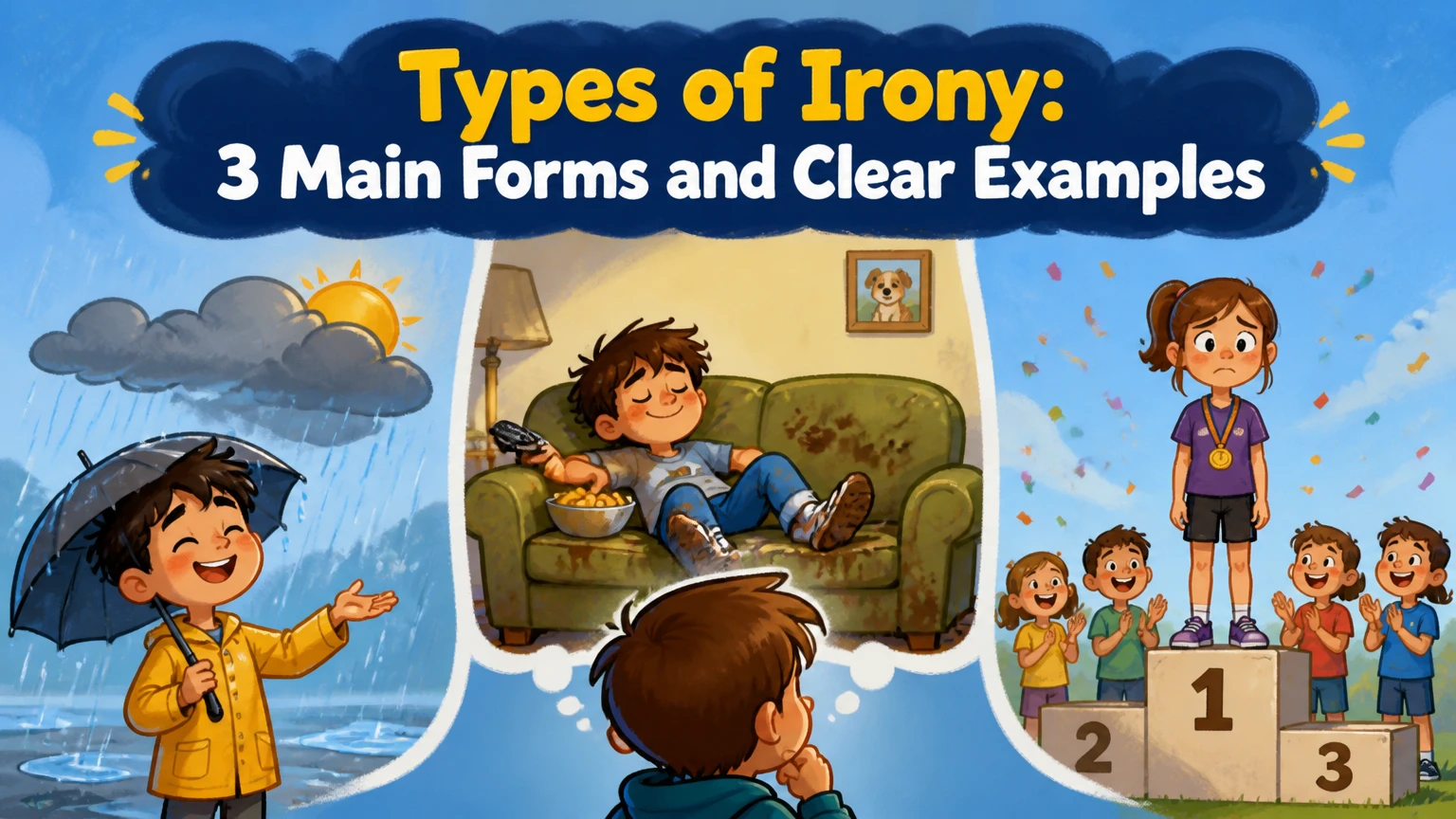
Irony is a literary and rhetorical device in which meaning, expectation, or appearance conflicts with reality. The three main types of irony are verbal irony, situational irony, and dramatic irony: a speaker means more than the words state, an outcome contradicts a reasonable expectation, or an audience knows information hidden from characters.
Key Facts at a Glance
Verbal irony contrasts a speaker’s literal words with the intended meaning.
Situational irony contrasts an expected outcome with the result that actually occurs.
Dramatic irony gives the audience information that one or more characters lack.
Sarcasm is a hostile or mocking use of language that often relies on verbal irony, but the terms are not identical.
Bad luck becomes irony only when the outcome meaningfully contradicts an established expectation, role, intention, or belief.
Irony can produce humor, suspense, tragedy, criticism, surprise, or thematic depth.
What Is Irony?
Irony is a structured mismatch between two levels of meaning or reality. The mismatch may involve words and intention, plans and outcomes, or audience knowledge and character knowledge; irony requires an interpretable contrast, not merely an unexpected event.
The concept comes through Latin ironia and Greek eirōneia, traditionally associated with feigned ignorance. In modern literary study, irony covers several related techniques rather than one mechanism. A character may speak ironically, a plot may turn ironically, or a scene may give readers knowledge withheld from the people inside it.
Irony also depends on recognition. If nobody can identify the relevant expectation or contrast, the event may remain surprising, contradictory, accidental, or confusing rather than ironic. Authors therefore establish a baseline before revealing the opposing meaning or outcome.
How Does Irony Work?
Irony usually follows four stages:
- Baseline: The text establishes an expectation, statement, belief, plan, or information gap.
- Contrast: A different meaning, fact, or outcome appears.
- Recognition: The audience connects the baseline and contrast.
- Effect: The contrast creates humor, suspense, criticism, discomfort, tragedy, or insight.
Consider a town’s fire station burning down because faulty wiring was never repaired. The event becomes situationally ironic when the fire station has been presented as a symbol of protection, particularly if officials publicly praised its safety. The fire itself is unfortunate; the conflict between the institution’s purpose and its destruction supplies the irony.
A useful diagnostic formula is:
Irony = established expectation + meaningful contradiction + recognizable relationship.
Unexpectedness alone is insufficient. A blue car passing a red car is not ironic because no meaningful expectation has been violated.
What Are the Three Main Types of Irony?
The three primary types of irony are verbal, situational, and dramatic. They differ according to where the contradiction occurs: in language, in events, or in the distribution of knowledge between characters and audience.
| Type | Primary contrast | Who recognizes it? | Common effect |
|---|---|---|---|
| Verbal irony | Literal words versus intended meaning | Speaker, listener, or both | Wit, criticism, humor |
| Situational irony | Expected result versus actual result | Audience, characters, or both | Surprise, comedy, thematic reversal |
| Dramatic irony | Audience knowledge versus character knowledge | Audience first | Suspense, dread, tragedy |
| Structural irony | A work’s apparent viewpoint versus its deeper design | Reader over time | Satire, ambiguity, moral criticism |
Structural irony is often treated as a broader interpretive category rather than a fourth primary type. It describes irony sustained across an entire work, while the traditional three-part classification identifies the immediate location of the contrast.
What Is Verbal Irony?
Verbal irony occurs when a speaker’s literal words differ from the meaning the context communicates. The speaker does not simply lie: verbal irony creates a second, intended interpretation that the listener is expected to recover from tone, circumstances, shared knowledge, or contradiction.
A person stepping into a flooded kitchen and saying, “What a beautifully dry room,” uses verbal irony. The literal adjective conflicts with visible conditions, while the intended meaning is clear criticism or humor. Verbal irony can be gentle, bitter, playful, indirect, or politically pointed.
Written communication makes verbal irony less reliable because readers cannot automatically hear pitch, timing, facial expression, or emphasis. A message such as “Great job” may express praise, irritation, or mockery depending on what happened immediately before it.
Is Sarcasm the Same as Verbal Irony?
Sarcasm is not identical to verbal irony. Sarcasm usually adds ridicule, contempt, or a desire to wound, whereas verbal irony can be affectionate, understated, self-deprecating, or morally serious without attacking anyone.
| Expression | Literal wording | Likely intended meaning | Best classification |
|---|---|---|---|
| “Excellent parking” beside a blocked driveway | Praise | The parking is poor | Verbal irony, possibly sarcasm |
| “The patient is slightly inconvenienced” after a major injury | Minimization | The injury is severe | Understatement |
| “That was a little mistake” after deleting a database | Minimization | The mistake was serious | Litotic understatement |
| “You are a genius” after an avoidable error | Praise | The person acted foolishly | Sarcastic verbal irony |
| “I love waiting three hours” in a delayed airport | Positive claim | The speaker dislikes the delay | Verbal irony |
Sarcasm is therefore a frequent subtype or use of verbal irony in ordinary explanations, although literary scholars may distinguish the terms more carefully. The emotional intention matters.
How Do Hyperbole and Litotes Relate to Verbal Irony?
Hyperbole and litotes are techniques that can support verbal irony, but neither automatically qualifies as irony. Hyperbole exaggerates, as in “I have told you a million times”; litotes emphasizes by negating an opposite, as in “That was no small achievement.”
A hurricane survivor saying, “The weather was mildly inconvenient,” uses understatement that may become ironic because the deliberately minimized wording clashes with the extreme reality. A person saying “I am starving” after missing one snack uses hyperbole, but the statement is not necessarily ironic because the speaker may mean it literally as exaggeration.
What Is Situational Irony?
Situational irony occurs when an outcome contradicts a well-established expectation, purpose, plan, or apparent logic. The result must have a meaningful relationship to the expectation; random misfortune and simple coincidence do not meet that standard.
A fire-safety inspector’s own office catching fire after the inspector certifies it as safe can create situational irony. The outcome attacks the central premise of the action, not merely the person’s comfort. The more clearly the text establishes the expectation, the stronger the reversal usually feels.
Situational irony often operates at the level of plot. It can expose overconfidence, reveal unintended consequences, criticize institutions, or make a character’s goal produce the opposite result.
What Are Common Forms of Situational Irony?
Cosmic irony, poetic justice, and historical irony are common labels for particular patterns of situational reversal. They are not universally accepted as fixed subtypes, and a single event may fit more than one label.
| Form | Defining expectation | Reversal pattern | Example |
|---|---|---|---|
| Cosmic irony | Fate or the universe appears indifferent or mocking | Human plans fail despite confidence | A carefully planned escape fails because of an overlooked natural event |
| Poetic justice | Moral behavior should receive a fitting consequence | Vice is punished or virtue rewarded in an unusually apt way | A scammer loses money through the same fraud used on victims |
| Historical irony | A decision produces consequences opposite to its purpose | Institutions or movements undermine their original aim | An introduced species intended for pest control becomes an invasive ecological threat |
| Practical irony | A tool or solution defeats its intended function | The remedy creates the problem | A productivity system consumes the workday it was meant to organize |
The historical example must be documented before it is presented as fact. The cane toad’s introduction to Australia in 1935 is commonly cited as an unintended ecological consequence of biological pest control, although “irony” remains an interpretive description rather than a scientific classification.
What Is Dramatic Irony?
Dramatic irony occurs when the audience knows information that a character does not know. The resulting knowledge gap allows viewers or readers to anticipate consequences while the character continues acting on incomplete information.
In Sophocles’ Oedipus Rex, the audience gradually understands Oedipus’s relationship to the murder and prophecy before Oedipus fully understands it himself. In Shakespeare’s Romeo and Juliet, the audience knows Juliet is alive when Romeo believes she is dead, so Romeo’s decision becomes tragically ironic.
Dramatic irony does not require a surprise ending. In fact, its power often comes from delayed inevitability: the audience watches a character approach a danger that the character cannot perceive.
How Do Tragic and Comic Dramatic Irony Differ?
Tragic dramatic irony turns the knowledge gap toward suffering, irreversible loss, or moral horror. Comic dramatic irony turns the same mechanism toward misunderstanding, embarrassment, mistaken identity, or eventual reconciliation.
| Form | Audience knows | Character believes | Typical result |
|---|---|---|---|
| Tragic dramatic irony | A fatal truth | A false reassuring belief | Dread or grief |
| Comic dramatic irony | Identity or romantic information | A mistaken social interpretation | Laughter or confusion |
| Suspense irony | A hidden threat | Ordinary circumstances are safe | Anticipation |
| Moral dramatic irony | A character’s wrongdoing | The character expects concealment | Exposure or judgment |
Cross-dressing comedies often use comic dramatic irony because the audience knows a character’s identity while other characters interpret the disguise literally. The device remains dramatic irony whether the outcome is amusing or painful.
How Do the Types of Irony Compare?
Verbal, situational, and dramatic irony are best distinguished by the location of the mismatch. Verbal irony is concentrated in an utterance, situational irony in an event or outcome, and dramatic irony in the unequal distribution of information.
| Decision criterion | Verbal irony | Situational irony | Dramatic irony |
|---|---|---|---|
| Main material | Dialogue or narration | Plot event or consequence | Scene structure and knowledge |
| Setup required | Tone, context, shared belief | Goal, purpose, or expectation | Audience access to hidden facts |
| Typical payoff time | Immediate, within seconds or lines | Later in the plot | Across scenes or acts |
| Strongest effect | Wit or criticism | Reversal or thematic surprise | Suspense or dread |
| Main failure risk | Misread as literal speech | Feels like arbitrary coincidence | Reveals too much too early |
| Suitable medium | Conversation, essays, satire | Fiction, film, history | Drama, thriller, tragedy |
The categories can overlap. A character may make a verbally ironic remark during a dramatically ironic scene, while the larger plot also produces a situational reversal. Classification should identify the dominant mechanism rather than force an event into one exclusive box.
Which Type Is Best for a Writer?
Verbal irony works best for concise dialogue and social criticism, situational irony works best for plot reversals, and dramatic irony works best for sustained suspense. The appropriate choice depends on whether the desired effect should arrive immediately or develop through an audience’s knowledge of future consequences.
| Writing goal | Most effective type | Setup requirement | Typical payoff |
|---|---|---|---|
| Add a sharp line of dialogue | Verbal irony | Shared context and readable tone | Immediate recognition |
| Expose institutional failure | Situational irony | Public purpose and contradictory result | Thematic reversal |
| Make readers fear a character’s choice | Dramatic irony | Audience receives hidden information | Delayed tension |
| Punish arrogance through consequences | Situational irony | Clear confidence or boast | Fitting reversal |
| Create mistaken-identity comedy | Dramatic irony | Audience sees the disguise | Repeated misunderstanding |
A practical rule is to keep ironic dialogue selective. If every line is sarcastic, readers lose the contrast between sincere and ironic speech, and the character may seem hostile rather than intelligent.
How Can You Create Irony Deliberately?
To create effective irony, establish a specific expectation, provide enough evidence for recognition, then make the contradiction meaningful rather than random. The audience should understand what was expected and why the actual meaning or result matters.
Use this six-step process:
- Choose the target: Select a belief, promise, goal, role, or assumption.
- Make the baseline visible: State the belief or show the character acting on it.
- Give the audience necessary context: Signal the hidden truth when dramatic irony is intended.
- Design the contrast: Make the words, knowledge, or outcome oppose the baseline.
- Control the delay: Deliver verbal irony quickly; reserve plot irony for a later consequence.
- Check the effect: Confirm that the contradiction produces the intended humor, tension, criticism, or sadness.
For a screenplay, a security-conscious character might explain a building’s perfect protection while the camera shows an unlocked side entrance. The dialogue supplies verbal confidence, the visual information creates dramatic irony, and a later burglary can produce situational irony.
What Is Irony Not Good For?
Irony is not a reliable substitute for direct communication in safety instructions, accessibility-focused writing, emergency notices, or emotionally delicate conversations. A reader who lacks the shared context may interpret an ironic statement literally and act on the wrong meaning.
Irony also cannot rescue a weak plot twist. If the reversal depends on information withheld unfairly, audiences may call it manipulation rather than dramatic irony. A fair setup does not reveal every answer, but it supplies enough evidence for the eventual recognition to feel earned.
Why Is Irony Often Misunderstood?
Irony is often misunderstood because interpretation depends on context, tone, cultural expectations, and the audience’s knowledge. Online text removes vocal cues, while different communities may attach different meanings to the same phrase.
Common errors include:
- Calling every unfortunate event ironic: Rain at a wedding is bad luck unless the event contradicts a relevant expectation, such as a meteorologist publicly guaranteeing clear weather.
- Calling every lie irony: A lie hides information, but irony creates a recognizable tension between literal expression and intended meaning or between expectation and outcome.
- Treating sarcasm as the whole category: Sarcasm is usually sharper and more hostile than other verbal irony.
- Confusing surprise with dramatic irony: Dramatic irony requires the audience to know more than a character before the reveal.
- Calling poetic justice inevitable: Poetic justice is a fitting moral reversal, not a rule that virtue always wins in real life.
- Assuming irony means the exact opposite: Verbal irony may imply criticism, doubt, affection, or distance rather than a simple antonym.
The famous example from Alanis Morissette’s “Ironic,” including rain on a wedding day, illustrates a popular usage dispute. Many listeners call the events ironic, while stricter literary definitions classify several as unfortunate coincidence. Both the cultural usage and the technical distinction should be acknowledged.
Does Irony Have Measurable Rules?
Irony has no reliable universal thresholds such as a zero-second recognition limit, a three-act requirement, or a 100 percent information-transparency rule. Those figures may function as writing heuristics, but they are not established measurements of irony.
Recognition time varies by audience and medium. A short verbal joke may fail if listeners need several seconds to decode it, while a novel can sustain dramatic irony for hundreds of pages. Similarly, an audience does not need absolute certainty about the hidden truth; suspicion can generate dramatic tension before confirmation.
| Claim | Accurate interpretation | Practical replacement |
|---|---|---|
| Verbal irony must register instantly | Fast recognition often helps dialogue | Test the line with readers unfamiliar with the draft |
| Situational irony requires a three-act structure | Large reversals often need extended setup | Establish the expectation before the consequence |
| Dramatic irony requires absolute audience knowledge | Partial knowledge can create suspense | Give readers enough evidence to anticipate danger |
| Irony always means the opposite | Meaning may be criticism, distance, or affection | Identify the intended implication in context |
The strongest quality test is causal and interpretive: can a reader name the expectation, identify the contradiction, and explain why the relationship matters?
Irony, Satire, Sarcasm, and Paradox: What Is the Difference?
Irony is a device involving contrast; satire is a broader mode that uses humor, irony, exaggeration, or ridicule to criticize people, institutions, or beliefs. Sarcasm is a cutting style of expression, while paradox presents an apparently contradictory statement that may reveal a deeper truth.
| Term | Core feature | Typical target | Example |
|---|---|---|---|
| Irony | Meaning or outcome conflicts with expectation | Language, events, knowledge | A safety office burns down |
| Sarcasm | Mocking or scornful expression | A person or behavior | “Brilliant move” after an avoidable error |
| Satire | Sustained criticism through comic or indirect methods | Society, politics, institutions | A fictional state rewards incompetence |
| Paradox | Contradictory-looking proposition | An idea or assumption | “Less is more” |
| Coincidence | Unplanned simultaneous events | No required target | Two strangers wear identical coats |
One passage can use several devices at once. A satirical novel may use verbal irony in dialogue and situational irony in its plot, but satire remains the broader purpose rather than a subtype of irony.
Examples of Irony in Literature and Media
Literary irony becomes easier to identify when the expectation and contradiction are stated separately. The following examples use established works and common narrative patterns.
| Work or scenario | Type | Established expectation | Contradiction |
|---|---|---|---|
| Oedipus Rex by Sophocles | Dramatic and tragic | Oedipus can discover the criminal and escape the prophecy | The investigation reveals his own identity and actions |
| Romeo and Juliet by William Shakespeare | Dramatic and tragic | Romeo believes Juliet is dead | The audience knows Juliet’s death is staged |
| The Gift of the Magi by O. Henry | Situational | Each spouse’s sacrifice will preserve the other’s treasured possession | Their gifts make those possessions temporarily unusable |
| The Rime of the Ancient Mariner by Samuel Taylor Coleridge | Situational and thematic | A sailor should value and protect living creatures | The mariner kills the albatross and suffers from the act |
| A boastful security consultant is robbed | Situational | Expertise should prevent the failure | The consultant’s own confidence accompanies the breach |
| A character praises a disastrous presentation | Verbal | Praise normally signals approval | Context makes the praise criticism |
Examples should be interpreted in context rather than by isolated keywords. A statement containing praise words is not automatically ironic, and a story containing an unexpected ending is not automatically situationally ironic.
FAQ
Is irony always humorous?
No. Irony can be humorous, but dramatic and tragic irony often create fear, grief, or dread. Situational irony may expose institutional failure without producing laughter, while verbal irony can communicate affection, restraint, political criticism, or contempt depending on context.
Can irony be unintentional?
An author or speaker can produce an unintended ironic effect, but deliberate irony normally requires a meaningful contrast that someone recognizes. A public statement may become retrospectively ironic when later events contradict it, even if the original speaker did not intend the contradiction.
What is the simplest way to identify irony?
Look for an established expectation and a meaningful contradiction. Ask whether the contrast concerns words and intention, an outcome and a plan, or audience knowledge and character knowledge. If no clear expectation or relationship exists, the event is probably surprise, coincidence, or bad luck instead.
Is dramatic irony the same as a plot twist?
No. A plot twist changes the audience’s understanding, often through a reveal. Dramatic irony begins when the audience already knows information that a character lacks, so tension develops before the character discovers the truth.
Why does irony work well in tragedy?
Irony makes tragic consequences more painful by separating audience knowledge from character understanding. Readers may recognize danger, mistaken belief, or unavoidable responsibility while the character continues toward the outcome, creating tension that ordinary surprise cannot produce.
How is irony used in everyday speech?
Everyday speakers use verbal irony in understatement, teasing, criticism, and humor. Meaning depends on tone and shared circumstances, so the same words can communicate sincere approval in one setting and sarcasm in another.
The Bottom Line
The main types of irony are verbal, situational, and dramatic. Verbal irony creates tension between words and intended meaning, situational irony reverses an established expectation through events, and dramatic irony gives the audience knowledge that characters do not possess. Types of irony are easiest to distinguish by locating the contradiction, then testing whether the relationship is meaningful rather than merely accidental.


