
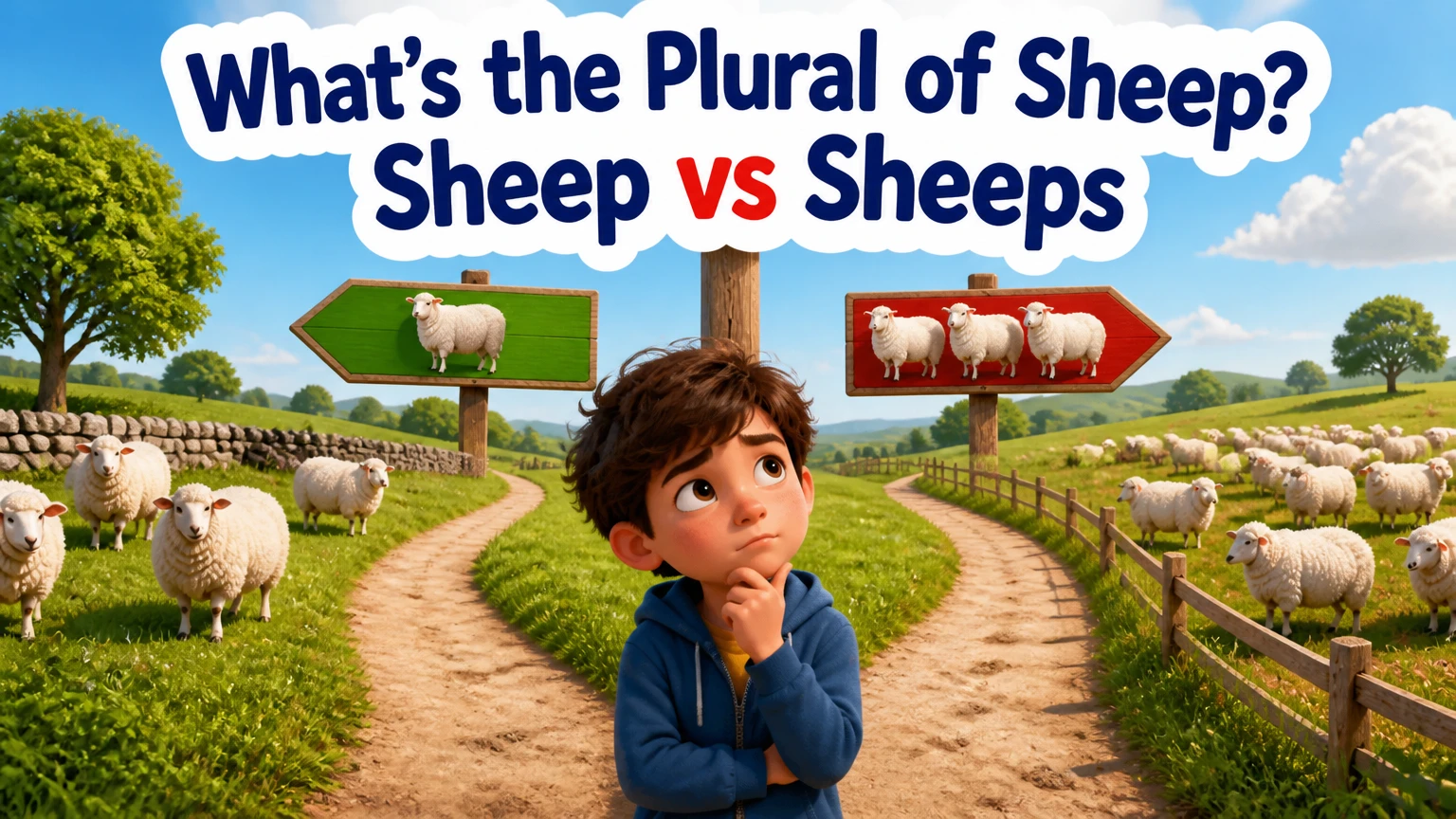
The plural of sheep is sheep. “Sheeps” is not the standard English plural when referring to two or more sheep. The same spelling can describe one animal or several, so surrounding words identify the number: “one sheep is grazing” and “six sheep are grazing.”
Key Facts at a Glance
- Sheep is both the singular and plural form of the animal noun.
- Sheeps is nonstandard in ordinary edited English and should not replace sheep.
- A singular sheep takes singular verbs: “The sheep is ill.”
- Multiple sheep take plural verbs: “The sheep are grazing.”
- The ordinary possessive form is sheep’s for one sheep and sheep’s for several sheep.
- Sheep belongs to the unchanged, or zero-plural, noun group, along with words such as deer and moose.
What Is the Plural of Sheep?
The plural of sheep is sheep, not sheeps. “Sheep” works after numbers and plural determiners, including “two sheep,” “many sheep,” “several sheep,” and “those sheep.” Standard dictionaries such as Cambridge Dictionary and Merriam-Webster list sheep as the plural form.
The noun does not display a visible plural ending. Instead, number appears through a determiner, a quantity word, a verb, or the wider sentence. Compare “a sheep was standing by the gate” with “three sheep were standing by the gate.” The noun remains unchanged while the grammar around it carries the singular or plural meaning.
The form sheeps may appear in learner errors, child language, informal speech, dialect writing, or a name chosen by a business or creative work. Those appearances do not make “sheeps” the standard plural of the animal noun.
| Intended quantity | Correct noun phrase | Correct verb | Incorrect form |
|---|---|---|---|
| 1 animal | one sheep | is | one sheeps |
| 2 animals | two sheep | are | two sheeps |
| 12 animals | twelve sheep | were | twelve sheeps |
| Unknown number | several sheep | have | several sheeps |
| Entire group | the sheep | remain | the sheeps |
Can Sheep Mean One Animal?
Sheep can mean one animal when a singular article, determiner, or verb identifies the number. “A sheep is in the field,” “that sheep has a blue tag,” and “each sheep receives feed” all refer to individual animals.
A bare noun can be less obvious. “Sheep are valuable livestock” normally refers to sheep in general or multiple animals, while “sheep is a common farm animal” sounds unusual unless the writer is discussing the word or the species as a category. English uses context rather than a changed noun ending to resolve the meaning.
The following signals usually identify a singular sheep:
- a sheep or one sheep
- each sheep or every sheep
- this sheep or that sheep
- singular verbs such as is, was, and has
- singular pronouns in carefully controlled writing, such as “the sheep hurt its leg”
A plural reading normally follows two, many, several, these, or those, together with a plural verb.
Why Does Sheep Keep the Same Form?
Sheep keeps the same form because English retained an old Germanic noun pattern in which some animal nouns formed a plural without an added suffix. Modern grammar calls this pattern a zero plural, unchanged plural, or zero-marked plural.
Most English count nouns use -s or -es, as in “lambs,” “fields,” and “watches.” That productive pattern encourages speakers, especially children and language learners, to create “sheeps.” The regular rule is logical, but sheep belongs to an older pattern that modern English preserved.
The word comes from Old English scēap. Historical forms changed in spelling and pronunciation over time, so the claim that sheep had “100 percent structural stability” across Old, Middle, and Modern English is too strong. The important modern fact is simpler: today’s standard noun has one form for singular and plural.
What Is a Zero Plural?
A zero plural is a plural noun whose visible form is identical to its singular form. In “one sheep” and “five sheep,” the noun has no additional plural letters, although the sentence still marks number through other words.
Zero plurals are not a single perfectly uniform category. Some are ordinary count nouns, such as sheep and deer. Others can describe collective categories, mass-like meanings, or specialized contexts. Writers should learn the usage of each noun rather than assume that every animal name behaves identically.
Which Verb Should Follow Sheep?
Use a singular verb when sheep means one animal and a plural verb when sheep means more than one. Write “the sheep is eating” for one sheep and “the sheep are eating” for a flock or multiple animals.
The noun’s unchanged spelling does not remove subject-verb agreement. The verb supplies the number distinction:
| Sentence | Number of sheep | Why the verb is correct |
|---|---|---|
| The sheep is under the tree. | 1 | Singular subject |
| The sheep was tagged yesterday. | 1 | Singular past tense |
| The sheep has a damaged hoof. | 1 | Singular auxiliary |
| The sheep are crossing the road. | 2 or more | Plural subject |
| The sheep were moved indoors. | 2 or more | Plural past tense |
| The sheep have fresh water. | 2 or more | Plural auxiliary |
Modal verbs do not show the distinction themselves. “One sheep can escape” and “several sheep can escape” are both correct because can has the same form with singular and plural subjects. The quantity still comes from the determiner or context.
A common editing mistake is to see the unchanged noun and choose the wrong verb. Replace the subject temporarily with it or they: “The sheep is” corresponds to “it is,” while “the sheep are” corresponds to “they are.”
How Do You Form Sheep’s Possessives?
The possessive form is usually sheep’s for both one sheep and multiple sheep. Write “the sheep’s wool” when one sheep owns or has the wool, and also when several sheep collectively have wool, with the number made clear elsewhere.
English normally adds ’s to a singular noun, including a singular sheep. A plural noun ending in s usually takes only an apostrophe, as in “the farmers’ barn.” Because the plural sheep does not end in s, standard possessive spelling also uses ’s.
| Meaning | Correct phrase | Expanded meaning |
|---|---|---|
| One animal’s wool | the sheep’s wool | the wool of one sheep |
| Several animals’ wool | the sheep’s wool | the wool of several sheep |
| One animal’s pasture | the sheep’s pasture | the pasture used by one sheep |
| Several animals’ pasture | the sheep’s pasture | the pasture used by several sheep |
| Wool belonging to a named flock | the flock’s wool | possession assigned to the flock |
Writers can eliminate ambiguity by adding a number or rewriting the phrase:
- “the wool of one sheep”
- “the wool from six sheep”
- “the flock’s combined wool”
- “the wool of the sheep in the northern pasture”
The error the sheeps wool contains two problems: “sheeps” is not the standard plural, and the possessive apostrophe is missing. The standard correction is the sheep’s wool.
Is Sheeps Ever Correct?
“Sheeps” is not correct as the ordinary plural of sheep in standard edited English. It can appear as a proper name, product name, username, quotation, dialect representation, or deliberate child-language form, but those special uses do not establish it as a standard grammatical plural.
A writer should preserve “sheeps” only when the spelling itself is part of the subject. For example, a sentence about a company called Sheeps may require the capitalized name, just as a sentence about a fictional character named Sheeps would. A quotation may also reproduce a speaker’s nonstandard wording.
The word does not become acceptable merely because a writer means multiple breeds or types. Use:
- breeds of sheep for Suffolk, Merino, Dorset, and other breeds
- types of sheep for broad practical categories
- sheep breeds in a compound noun
- species of sheep when discussing biological classification
“Several sheep breeds are raised in the region” is correct. “Several sheeps are raised in the region” is not the standard alternative.
Which Irregular Plural Pattern Does Sheep Use?
Sheep uses an unchanged plural, while other irregular nouns change vowels, add unusual endings, or preserve foreign forms. The pattern explains why “sheep” does not follow the productive -s rule, but it does not mean every irregular plural behaves alike.
| Singular | Plural | Pattern | Example |
|---|---|---|---|
| sheep | sheep | zero plural | five sheep |
| deer | deer | zero plural | two deer |
| mouse | mice | vowel change | three mice |
| child | children | historical ending | several children |
| criterion | criteria | Greek-derived form | two criteria |
| cactus | cacti or cactuses | competing accepted forms | three cacti |
| tooth | teeth | vowel change | four teeth |
Terms such as irregular plural, zero plural, and unchanged plural overlap but are not identical. “Irregular plural” is the broad category. “Zero plural” identifies the specific absence of a visible ending.
The Cambridge Dictionary describes nouns such as sheep as having “the same form in the singular and plural.” That concise description is more reliable than trying to generate a rule from modern spelling alone.
Which Other Nouns Have Zero Plurals?
Deer, sheep, moose, bison, offspring, aircraft, and series commonly retain the same singular and plural form, although usage depends on the noun and meaning. Fish also commonly has an unchanged plural, while fishes has a separate use for multiple species or kinds of fish.
| Noun | Singular example | Plural example | Important usage note |
|---|---|---|---|
| deer | one deer | eight deer | “Deers” is nonstandard in ordinary use |
| moose | one moose | four moose | “Mooses” is generally avoided |
| bison | one bison | a herd of bison | “Bisons” occurs in some usage |
| offspring | one offspring | several offspring | Number comes from determiners and verbs |
| aircraft | one aircraft | two aircraft | “Aircrafts” is generally nonstandard |
| series | one series | three series | Context or a modifier supplies number |
| fish | one fish | ten fish | “Fishes” can refer to species |
The safest strategy is lexical, not mechanical. Learn the plural listed in a reliable dictionary, then check whether a specialized field uses an additional form.
Why Is Fishes Different From Sheeps?
“Fishes” can be standard when it means multiple species or varieties of fish, but “sheeps” does not normally have an equivalent species-based meaning. “Fish” is usually the plural for multiple individual fish, while “fishes” is common in biological, culinary, or literary contexts involving kinds of fish.
Examples include:
- “The aquarium contains seven fish.”
- “The survey recorded fish from three rivers.”
- “The study compares freshwater fishes from separate habitats.”
- “The cookbook describes the fishes of the Mediterranean.”
The distinction is semantic. Fish names individuals collectively, whereas fishes can emphasize distinct species or groups. Sheep may have many breeds, but English expresses that meaning with sheep breeds, breeds of sheep, or types of sheep, not with “sheeps.”
A specialized text can use unusual terminology, but ordinary readers will interpret “sheeps” as an error. The species argument therefore fails in standard general-purpose writing.
How Can You Check Sheep in Editing?
Check the quantity, surrounding determiner, verb, and possessive function in that order. A five-second edit usually resolves the issue: replace “sheeps” with “sheep,” then verify whether the sentence requires is or are, and finally place the apostrophe correctly.
Use this editing sequence:
- Identify the quantity. Decide whether the sentence refers to one sheep, multiple sheep, a breed, or the word itself.
- Replace the noun. Use sheep in both singular and plural animal references.
- Inspect the determiner. Check whether the sentence says “a sheep,” “one sheep,” “two sheep,” “many sheep,” or “those sheep.”
- Match the verb. Use is, was, has for one; use are, were, have for multiple animals.
- Check possession. Use sheep’s when the noun functions as a possessive.
- Check the intended category. Change “sheeps” to “sheep breeds” if the meaning concerns varieties.
- Read the sentence aloud. Hearing “five sheeps” often exposes the overgeneralized plural immediately.
Software can help, but spellcheckers are not grammar authorities. A custom dictionary, brand name, character name, or regional term may prevent a warning, while a tool may fail to understand whether “sheep is” or “sheep are” fits the context.
What Does the Deer-Swap Test Show?
Replace sheep with deer as a quick diagnostic. If “five deer” sounds correct but “five deers” does not, the comparison reminds you that both nouns commonly use a zero plural.
The test is a memory aid, not a complete grammar test. Not every animal noun behaves like deer or sheep, and some nouns have accepted competing plurals. Confirm unusual cases with a current dictionary when the sentence is academic, legal, technical, or published.
How Should Learners Practice the Rule?
Learners should memorize sheep with a quantity phrase and a matching verb rather than memorize the noun alone. Practice pairs such as “one sheep is” and “four sheep are,” because the verb makes the number distinction visible.
A useful exercise uses six sentence frames:
- “I saw one sheep, and it was…”
- “I saw two sheep, and they were…”
- “Each sheep has…”
- “Several sheep have…”
- “That sheep is…”
- “Those sheep are…”
Children and beginning learners often say “sheeps” through overregularization. Overregularization occurs when a learner applies a productive rule, such as adding -s, to an exception. A calm correction works better than criticism: “Yes, those are three sheep.”
The same method helps with deer, fish, and mouse. Practice must still distinguish patterns: “two mice” is correct, not “two mouse,” because mouse uses an internal vowel change rather than a zero plural.
Does Sheep Refer to Breeds or Species?
Sheep can refer to individual animals, a group, the animal category, or the species in general, but the noun remains sheep in each ordinary meaning. Writers should add a category word when the sentence concerns breeds or taxonomic groups.
Compare these constructions:
| Intended meaning | Recommended wording | Meaning |
|---|---|---|
| Individual animals | seven sheep | seven animals |
| General livestock category | sheep farming | farming involving sheep |
| Breed comparison | four sheep breeds | four genetic or agricultural breeds |
| Biological grouping | species of sheep | distinct species or taxonomic groups |
| Collective group | a flock of sheep | a named group of animals |
“Species of sheep” is not the same grammatical construction as a plural noun sheeps. The preposition of carries the relationship, while sheep remains unchanged.
Technical writing benefits from specificity. “The experiment used sheep” identifies the animals. “The experiment used Merino sheep” identifies a breed. “The experiment compared two sheep species” identifies a biological distinction without inventing a plural form.
What Common Mistakes Replace Sheep?
The most common error is adding the regular plural ending, but writers also confuse plural agreement, possessives, breeds, and species. Correcting the noun alone is insufficient when the surrounding grammar remains inconsistent.
Mistake 1: Adding -s
Incorrect: “The farmer owns eight sheeps.”
Correct: “The farmer owns eight sheep.”
Mistake 2: Using a singular verb for a flock
Incorrect: “The sheep is grazing near the fence,” when the sentence means several animals.
Correct: “The sheep are grazing near the fence.”
Mistake 3: Omitting the possessive apostrophe
Incorrect: “The sheep wool was sold.”
Correct: “The sheep’s wool was sold.”
In some contexts, sheep wool can function as a compound modifier, especially in product or industry language, but the sheep’s wool is the clearer possessive phrase when ownership or source matters.
Mistake 4: Using sheeps for breeds
Incorrect: “The farm raises three sheeps.”
Correct: “The farm raises three sheep breeds.”
Mistake 5: Treating all irregular plurals alike
Incorrect: “Two sheeps and two mouses were outside.”
Correct: “Two sheep and two mice were outside.”
Sheep and mouse are both irregular, but their mechanisms differ. Memorizing a broad label without memorizing the actual form creates new errors.
When Should You Use a Different Wording?
Use a different wording when the unchanged form creates ambiguity about quantity or category. The alternative should clarify the meaning, not manufacture a plural.
For one animal, use one sheep, a sheep, or each sheep. For several animals, use two sheep, a flock of sheep, or several sheep. For breeds, use sheep breeds or breeds of sheep. For wool, use sheep’s wool, wool from sheep, or sheep wool, depending on whether the phrase is possessive or functioning as a compound modifier.
In formal reports, numbers are especially helpful:
- “The trial included 24 sheep.”
- “Each sheep received 2 milligrams of the treatment.”
- “The flock contained 180 sheep.”
- “Samples came from three sheep breeds.”
These constructions make the noun’s number clear even when the spelling does not change.
Is Sheep’s the Same for Singular and Plural Possession?
Yes, sheep’s can represent possession by one sheep or by multiple sheep because the plural noun does not end in -s. Context identifies whether the possessor is singular or plural.
- “The sheep’s leg was injured.” One sheep is the likely possessor.
- “The sheep’s enclosure was repaired.” The enclosure may belong to a flock.
- “The sheep’s wool was collected.” The quantity may be clarified elsewhere.
When precision matters, repeat the number:
- “the one sheep’s leg”
- “the flock’s enclosure”
- “the wool from the 30 sheep”
A plural possessive construction such as sheeps’ is not the normal solution. The spelling incorrectly treats sheep as though its plural form were sheeps. Since the plural is sheep, the possessive ending is ’s.
The Bottom Line
The answer to whats the plural of sheep sheep vs sheeps is direct: the plural of sheep is sheep, and sheeps is not the standard plural. Use “one sheep is” for one animal, “several sheep are” for multiple animals, and “sheep’s” for ordinary possessive constructions. Choose “sheep breeds” when the meaning involves varieties rather than individual animals.
Frequently Asked Questions
Is “a sheep” singular?
Yes. A sheep is singular because the indefinite article a can modify one countable animal. Write “a sheep is grazing,” “one sheep was tagged,” and “each sheep has a number.” The noun remains sheep, but the article, numeral, determiner, and singular verb identify the quantity.
Are “sheep” and “sheeps” pronounced differently?
No standard plural pronunciation exists for sheeps because sheeps is not the standard plural form. The word sheep has the same pronunciation whether it means one animal or several: commonly /ʃiːp/. Quantity comes from context and surrounding grammar.
Can I write “a flock of sheep”?
Yes. A flock of sheep is a standard collective phrase for a group of sheep. The noun after of remains sheep, not sheeps. In American English, a collective noun such as flock may take a singular verb when treated as one unit: “The flock is moving,” while “the sheep are moving” focuses on individual animals.
Is “sheep” countable or uncountable?
Sheep is normally a countable noun because writers can say “one sheep,” “two sheep,” or “100 sheep.” The unchanged plural does not make it a mass noun. In general statements such as “sheep are important livestock,” the noun can refer broadly to the animal category while retaining count-noun grammar.
What is the plural of “sheepdog”?
The usual plural is sheepdogs, because the compound noun ends with the regular count noun dog. The word sheep remains unchanged inside the compound: “one sheepdog,” “two sheepdogs.” The plural rule applies to the head noun, dog, rather than to the modifying word sheep.
What is the plural of “sheep farmer”?
The plural is sheep farmers, not “sheeps farmers.” The head noun farmer takes the regular plural ending, while sheep functions as a modifier describing the farmer’s work. The same structure appears in “sheep farm,” “sheep wool,” and “sheep breed.”


