
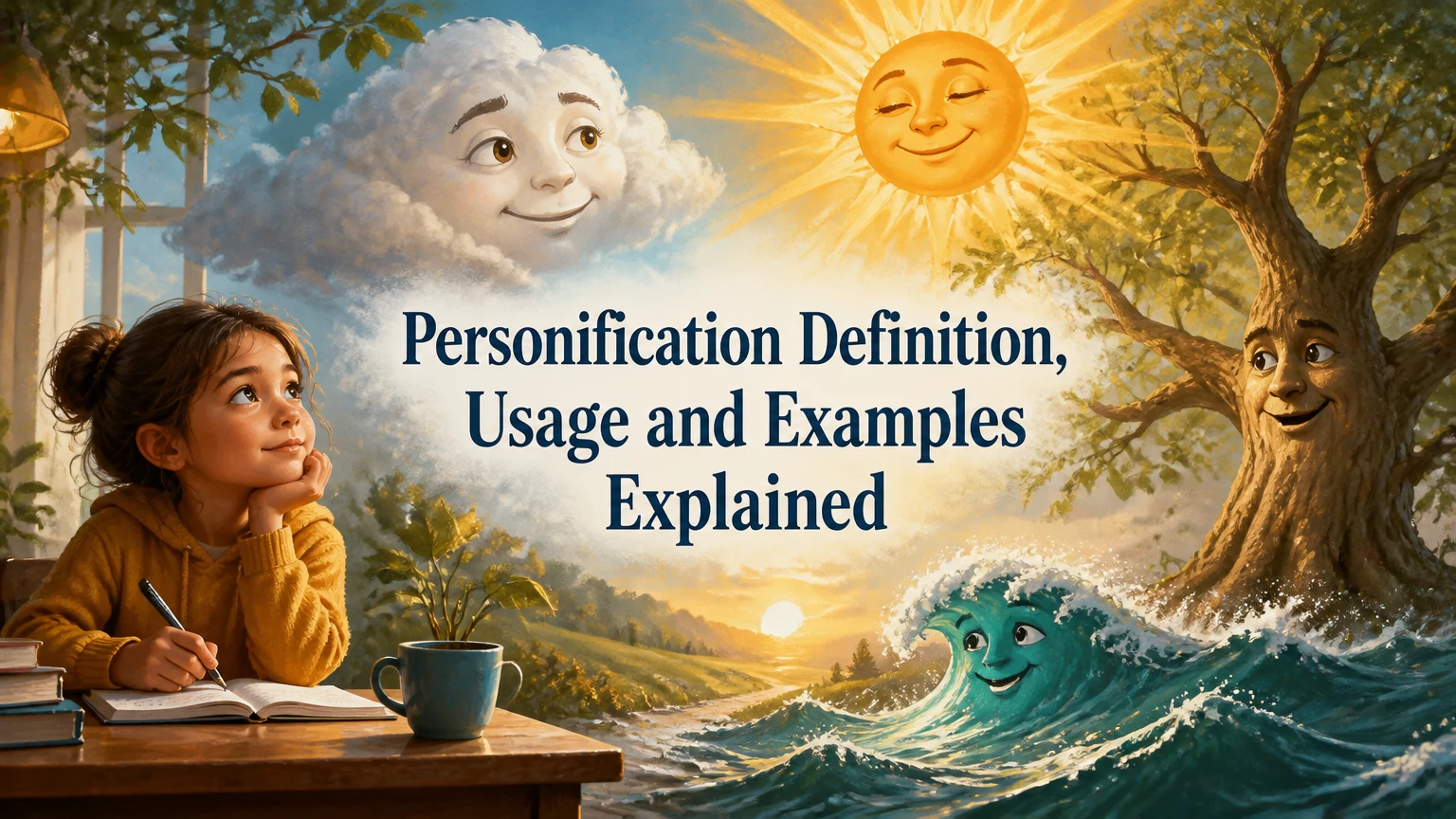
Personification is a figure of speech that gives human qualities, actions, feelings, thoughts, or intentions to a non-human subject. In literature and everyday language, personification makes an object, animal, natural force, institution, or abstract idea easier to imagine by describing it through recognizable human behavior.
Key Facts at a Glance
- Personification describes a non-human subject with a specifically human trait or action.
- “The wind whispered through the trees” personifies the wind because whispering is presented as human-like speech.
- Personification is figurative language, while anthropomorphism usually develops a non-human character that acts like a person more consistently.
- Writers use personification to create imagery, establish tone, express viewpoint, and make abstractions emotionally accessible.
- Strong personification matches the subject’s physical properties with a precise human action.
- Apostrophe involves directly addressing a non-human subject, so it can overlap with personification but is not identical to it.
Personification Definition: What Does It Mean?
Personification means attributing human characteristics to something that is not human. The subject may be an inanimate object, animal, weather event, natural landscape, institution, technology system, or abstract concept such as time, justice, fear, or love.
The human characteristic can be physical, emotional, intellectual, verbal, or intentional. A sentence such as “The old house groaned” gives the house a human or animal-like vocal action, while “Fear followed her home” gives an abstract emotion the ability to move with purpose.
Personification bridges concrete description and human experience. The wind does not literally whisper, and time does not literally march, but those verbs let readers interpret movement, sound, pressure, or inevitability through familiar behavior.
The device has a long history in rhetoric, poetry, religious writing, political speech, and advertising. George Lakoff and Mark Johnson describe the broader mechanism in Metaphors We Live By (1980): “The essence of metaphor is understanding and experiencing one kind of thing in terms of another.” Personification applies that transfer specifically through human attributes.
What Can Be Personified?
Almost any non-human subject can receive human qualities, although the effect depends on context.
| Subject category | Human attribute | Example | Likely effect |
|---|---|---|---|
| Weather | Aggressive action | “The storm pounded the coast.” | Threat and force |
| Object | Physical effort | “The tired engine coughed.” | Age, strain, or failure |
| Abstract idea | Movement or intention | “Justice finally arrived.” | Moral expectation |
| Institution | Speech or judgment | “The court rejected the claim.” | Condensed formal action |
| Technology | Social behavior | “The app welcomed new users.” | Ease and approachability |
| Landscape | Bodily action | “The cliffs watched the harbor.” | Presence and scale |
The subject does not need to be completely lifeless. Animals can be personified when a writer assigns them a distinctly human motive, moral judgment, or social role beyond ordinary animal behavior. “The fox planned its revenge” is personification if the context treats revenge as a human intention rather than a documented animal behavior.
How Does Personification Work?
Personification works by transferring a human action, emotion, thought, voice, or motive onto a non-human subject, allowing readers to interpret the subject through embodied human experience. The transferred trait also changes the passage’s tone, because “the rain fell” is neutral while “the rain sulked against the windows” suggests resentment or gloom.
A reliable way to identify the device is to inspect the sentence for three elements:
- Non-human subject: What object, force, animal, institution, or abstraction receives the description?
- Human attribute: What action, feeling, thought, speech act, or intention would normally belong to a person?
- Interpretive effect: What mood, judgment, or image does the human attribute create?
“The moon watched the sleeping village” contains a physical object, a human perceptual action, and an implied sense of surveillance. The sentence does more than report moonlight. It positions the moon as a silent observer.
Personification often appears through verbs because verbs make non-human subjects active. Adjectives and nouns can also carry the device: “a jealous river,” “a stubborn door,” or “the city’s appetite.” A single word may be enough when the human quality is unmistakable.
What Are the Main Types of Personification?
The main types are physical-action, emotional, mental, verbal, intentional, abstract, and institutional personification. These categories describe the kind of human quality transferred to the non-human subject, not separate literary devices with fixed boundaries.
| Type | Human quality transferred | Example | Typical result |
|---|---|---|---|
| Physical action | Walking, dancing, reaching, limping | “The shadows crept across the wall.” | Movement and visual energy |
| Emotion | Anger, loneliness, joy, jealousy | “The neglected garden looked resentful.” | Emotional atmosphere |
| Mental activity | Remembering, wondering, deciding | “The old photograph remembered summer.” | Nostalgia or reflection |
| Speech or sound | Whispering, arguing, complaining | “The pipes complained all night.” | Audible character and mood |
| Intention | Refusing, pursuing, protecting | “The locked gate denied entry.” | Conflict or resistance |
| Abstract personification | Human form given to time, death, love | “Death knocked before dawn.” | Symbolic weight |
| Institutional personification | Human judgment given to a system | “The law protects tenants.” | Concise social or legal language |
These categories can overlap. “The sea angrily swallowed the boats” combines physical action with emotion, while “History judged the leaders” combines abstraction with mental and moral activity.
Physical and Emotional Examples
Physical personification makes an inanimate subject appear to move like a person. Examples include “The branches clawed at the roof,” “The leaves danced along the pavement,” and “The exhausted staircase climbed toward the attic.”
Emotional personification gives a subject a feeling or temperament. Examples include “The jealous sun hid behind clouds,” “The lonely road stretched beyond the village,” and “The impatient kettle screamed from the stove.”
The distinction matters during analysis. “The branches clawed” creates a threatening image through bodily action, while “the lonely road” creates mood through an emotional label. One emphasizes what the subject appears to do; the other emphasizes how the subject seems to feel.
What Are Effective Personification Examples?
Effective examples connect a specific human trait to a subject’s observable behavior, then use that connection to create a clear mood or idea. The best examples are usually economical because one exact verb can carry more meaning than several decorative adjectives.
| Context | Example | Humanized feature | Reader effect |
|---|---|---|---|
| Nature | “The fog wrapped its arms around the bridge.” | Embrace | Enclosure and uncertainty |
| Household object | “The radiator grumbled before sunrise.” | Complaint | Cold-weather discomfort |
| Vehicle | “The truck refused to start.” | Defiance | Mechanical frustration |
| Time | “Tomorrow waited beyond the locked door.” | Patience or waiting | Suspense and possibility |
| City | “The city swallowed commuters at dawn.” | Consumption | Scale and impersonality |
| Technology | “The dashboard guided her through setup.” | Assistance | Usability and trust |
| Workplace | “The deadline stalked the team.” | Pursuit | Pressure and urgency |
| Memory | “The memory knocked whenever rain began.” | Return or request | Involuntary recollection |
Common examples include “the sun smiled,” “the wind whispered,” “the fire roared,” and “the stars danced.” These are grammatically valid, but frequent exposure has weakened their descriptive force. A writer can usually improve them by replacing a generic verb with one that reflects sound, speed, texture, temperature, or viewpoint.
For example, “The sun smiled over the field” becomes more distinctive as “The winter sun squinted through the factory smoke.” The revised sentence gives the sun a human action while adding season, obstruction, and industrial atmosphere.
How Do You Write Personification?
To write personification, choose a non-human subject, define the intended mood, list human actions that match the subject’s behavior, select one precise verb, and test whether the image supports the scene. A usable sentence often takes 5-15 minutes to draft and revise, although a poem or campaign may require several rounds of testing.
Step 1: Select the Subject
Choose one object, force, abstraction, or animal that matters in the scene. An old car, a locked gate, winter, debt, or a river can all work, but the subject should contribute to the passage rather than decorate it.
Step 2: Set the Mood
Name the intended emotional result in one word, such as anxious, hostile, tender, exhausted, comic, or hopeful. The same subject can produce different meanings: “The sea welcomed the swimmers” is inviting, while “The sea hunted the swimmers” is threatening.
Step 3: List Compatible Human Actions
Brainstorm five actions associated with the mood. For an exhausted car, possible verbs include coughing, wheezing, limping, groaning, and surrendering. Prefer verbs that resemble something the subject could physically suggest.
Step 4: Choose the Most Specific Verb
Select one action that creates the clearest image. “The old car groaned up the hill” is more efficient than “The old car was very tired and made a sad sound while climbing.”
Step 5: Check the Image
Ask whether the subject could plausibly appear to perform the action, whether the human trait matches the mood, and whether the sentence adds meaning. If the personification only makes a familiar object sound poetic, replace it with sensory detail.
A practical revision formula is:
Subject + human action + concrete setting or consequence
Examples include:
- “The deadline stalked the designer through three unfinished drafts.”
- “The shutters shivered whenever the freight train passed.”
- “Justice arrived too late to save the imprisoned man.”
Where Is Personification Used?
Personification is used in literature, poetry, speeches, journalism, advertising, interface writing, education, and everyday idioms. Its function changes by context: fiction uses it to shape atmosphere and viewpoint, while marketing uses it to give an impersonal product or brand a recognizable personality.
Literature and Poetry
Fiction writers use personification to externalize a character’s internal condition. A frightened character may perceive branches as claws, while a grieving character may experience an empty house as refusing to respond.
Poets use the device to compress abstract ideas into images. “Because I could not stop for Death,” from Emily Dickinson’s poem, personifies Death as a caller who takes a journey with the speaker. The human role creates a controlled, conversational encounter with mortality.
Personification can also establish a narrator’s reliability. If a child says that the kitchen “kept secrets,” the phrase reveals the child’s imagination. If an adult narrator uses the same description, it may signal guilt, nostalgia, or psychological instability.
Marketing and Interface Writing
Brands personify products when they describe software as friendly, a vehicle as adventurous, or a security system as watchful. This language can make unfamiliar technology easier to understand, but it should not conceal measurable limitations such as speed, privacy terms, or compatibility.
A product page might say, “The backup system watches over every file,” then specify that automatic backups run every 24 hours and retain versions for 30 days. The human image creates approachability; the specification supplies verifiable meaning.
Speeches and Everyday Language
Political speeches often personify nations, economies, democracy, or history. Everyday expressions include “the alarm clock begged for five more minutes,” “the deadline is breathing down my neck,” and “the road called us home.”
Some expressions become idioms through repeated use. Their figurative origin may be personification, but readers often process them as fixed phrases rather than newly imagined images.
How Should You Analyze Personification?
Analyze personification by naming the non-human subject, identifying the human quality, explaining the literal contrast, and connecting the chosen trait to tone, viewpoint, or theme. Identifying the device alone is incomplete because literary analysis must explain why that particular human behavior appears.
Use this four-part formula:
- Device: The writer personifies the storm.
- Trait: The verb “pursued” gives the storm human intention.
- Effect: Pursuit creates fear because the characters cannot escape it.
- Theme: The image presents nature as an inescapable pressure rather than passive scenery.
A strong paragraph might read:
The phrase “the house held its breath” personifies the house through the human action of holding one’s breath. That action creates suspense because it suggests a temporary pause before danger, while the house becomes an apparent participant in the family’s fear. The image also merges setting and character experience, making silence feel deliberate rather than merely absent.
Analysis should distinguish authorial description from a character’s perception. “The walls leaned closer” may reveal a genuinely supernatural setting, or it may represent a narrator’s claustrophobia. Context determines the interpretation.
How Does Personification Compare With Related Devices?
Personification differs from anthropomorphism, metaphor, simile, symbolism, imagery, and apostrophe by the amount and type of human meaning assigned to the subject. Personification usually creates a local figurative image, while anthropomorphism often sustains human behavior across a character, narrative, or system.
| Device | Defining operation | Example | Key distinction |
|---|---|---|---|
| Personification | Gives a non-human subject a human trait | “The wind whispered.” | Usually brief and figurative |
| Anthropomorphism | Portrays a non-human entity as a person | A talking rabbit runs a shop | Sustained human identity or behavior |
| Metaphor | States or implies one thing is another | “Her voice was velvet.” | Does not require a human quality |
| Simile | Compares with “like” or “as” | “The clouds moved like ships.” | Explicit comparison |
| Symbolism | Gives an element wider conceptual meaning | A dove represents peace | Meaning depends on context and convention |
| Apostrophe | Directly addresses an absent or non-human subject | “O Time, slow down.” | Defined by address, not attribution alone |
A metaphor can contain personification. “The city is a hungry beast” compares the city to an animal, while “the city swallowed the commuters” gives it a bodily action. The second example is personification because swallowing is treated as an intentional, creature-like act.
Apostrophe can overlap with personification when the addressed subject is treated as capable of hearing. “O winter, leave my fields” is apostrophe because the speaker addresses winter and personification because winter receives an implied human capacity to listen and depart.
When Does Personification Fail?
Personification fails when the image is clichéd, physically incoherent, emotionally mismatched, overused, or irrelevant to the passage’s purpose. A sentence can contain technically correct personification and still weaken the writing if the human trait adds no fresh information.
| Failure mode | Weak example | Diagnostic problem | Better revision |
|---|---|---|---|
| Cliché | “The stars danced.” | Familiar image adds little | “The stars shivered above the power lines.” |
| Generic emotion | “The sun smiled.” | Mood remains unclear | “The low sun inspected every broken window.” |
| Physical mismatch | “The rock sprinted downhill.” | Action contradicts scale and motion | “The rock stubbornly blocked the trail.” |
| Overcrowding | “The trees argued while clouds sulked and roads screamed.” | Competing images blur focus | Keep the image that controls the scene |
| Tone mismatch | “The cheerful coffin welcomed him.” | Comic effect may be unintended | Use “The coffin waited beneath the rain.” |
| Technical ambiguity | “The database remembers everything.” | Implies capabilities the system may lack | “The database stores records for seven years.” |
The most useful practitioner rule is one dominant personification per image unit, usually a sentence or short paragraph. More can work in deliberately surreal poetry, but ordinary narrative becomes noisy when every object receives a separate personality.
Personification is also a poor substitute for evidence in technical, legal, medical, and financial writing. “The algorithm decided fairly” hides the criteria and data behind a human verb. State the model’s inputs, rule, confidence threshold, or documented output first, then use figurative language only in an explanatory aside.
Can Animals, Institutions, and Technology Be Personified?
Animals, institutions, and technology can be personified when a writer assigns them a human motive, judgment, emotion, or social role that exceeds literal description. The distinction depends on whether the attributed behavior is presented as figurative shorthand or as a sustained fictional capability.
A dog “guarded the gate” may be literal animal behavior, not personification. A dog “felt betrayed by the empty bowl” is personified because betrayal is a human emotional interpretation.
An institution such as a government, market, court, or school is frequently personified in ordinary prose. “The university welcomed applicants” compresses the actions of many employees and systems into one human-like institutional subject. The sentence is useful, but formal writing may need to identify the responsible department.
Technology creates a similar boundary. “The phone refused to unlock” is personification when the device is described as defiant, although the literal cause may be an incorrect passcode or biometric failure. In user experience writing, human verbs can improve comprehension, but documentation should pair them with exact system behavior.
What Are the Benefits and Limits?
Personification creates memorable imagery, emotional access, tonal control, and concise explanations, but it can also produce cliché, ambiguity, sentimentality, or inaccurate claims. The device works best when the human quality reveals something about the subject, speaker, or situation.
Its principal benefits include:
- Concrete abstraction: “Justice arrived” gives an abstract principle a recognizable entrance.
- Atmosphere: “The hallway held its breath” turns silence into suspense.
- Viewpoint: “The playground sulked in winter” reveals a speaker’s emotional interpretation.
- Compression: “The market panicked” summarizes coordinated selling without listing every participant.
- Memorability: A precise action such as “the door judged every visitor” can remain longer in memory than a neutral description.
The limits are equally practical. Personification can imply agency where none exists, encourage sentimental interpretation, or make prose sound juvenile when every object is given a mood. It should not replace causal explanation, especially when readers need to understand how a machine, institution, or physical process actually operates.
Frequently Asked Questions
Is “the wind howled” personification?
“The wind howled” is usually personification because howling is a human or animal-like vocal action applied to wind. The phrase also uses sound imagery, since readers imagine a harsh audible effect. In a scientific description, however, “wind produced a low-frequency howl through the structure” would describe the physical mechanism more precisely.
Is personification always a metaphor?
Personification is a figurative device closely related to metaphor, but not every metaphor is personification. “The classroom was a furnace” is a metaphor comparing heat and discomfort, while “the classroom rejected every question” personifies the classroom through human judgment or refusal.
What is a simple personification example for students?
“The alarm clock screamed at six o’clock” is a simple example. The alarm clock is non-human, while “screamed” gives it a human vocal action. The verb also communicates volume and annoyance, so the example demonstrates both the device and its emotional effect.
Can personification be one word?
Personification can occur in a single word when that word gives a non-human subject a clearly human quality. In “the jealous moon,” the adjective “jealous” personifies the moon. The surrounding context determines whether the adjective is genuinely figurative or part of an established name or conventional expression.
Is “the leaves danced” a cliché?
“The leaves danced” is recognizable personification, but it may feel clichéd because writers use the image frequently. It becomes fresher when the verb reflects a specific movement, such as “the leaves skittered,” “spiraled,” “hesitated,” or “waltzed beneath the streetlamp,” provided the selected verb matches the scene.
How many examples should a paragraph contain?
Most ordinary prose needs one strong personification per sentence or short paragraph. A cluster of two or three can work when the images share one controlling mood, but unrelated human traits compete for attention and make the passage feel ornamental rather than purposeful.
The Bottom Line
Personification is a figure of speech that assigns human qualities to non-human subjects, including objects, animals, natural forces, institutions, technology, and abstract ideas. To use it well, choose a subject, set a mood, select a physically compatible human action, and revise away clichés. Personification definition usage and examples become clearer when the device is separated from anthropomorphism, metaphor, symbolism, and apostrophe, then connected to the specific effect it creates.


