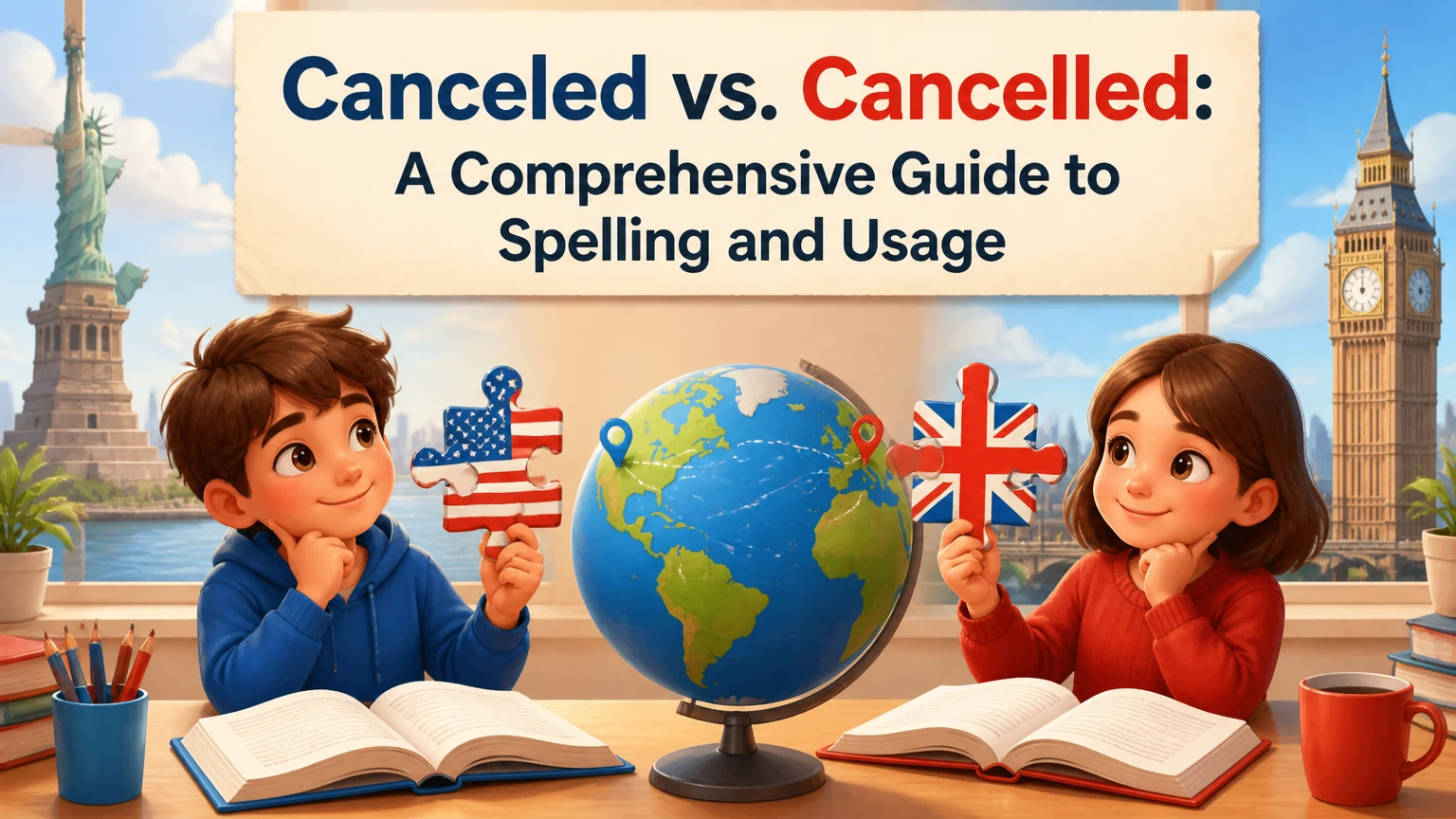
The English language is famous for its regional variations and spelling nuances that often leave writers questioning their choices, especially when dealing with words like canceled and cancelled. These variations appear in many common verb forms such as traveled, modeled, and signaled, where the decision to double the final consonant depends largely on whether you are following American or British English conventions. Understanding these differences is essential for maintaining consistency in professional writing, academic essays, and creative projects, as it ensures your message aligns with the expectations of your specific audience. By mastering these spelling patterns, including canceled, cancelled, canceling, and cancellation, writers can navigate the complexities of international English with total confidence and precision.
Table of Contents
- Definition and Linguistic Function
- Structural Breakdown of the Word
- The Consonant Doubling Rule
- American vs. British English Variations
- The Curious Case of “Cancellation”
- Extensive Examples in Context
- Historical Evolution of the Spelling
- Common Mistakes and Misconceptions
- Practice Exercises and Assessment
- Advanced Topics in Orthography
- Frequently Asked Questions (FAQ)
- Conclusion and Final Tips
Definition and Linguistic Function
At its core, the word cancel functions primarily as a verb, though it can also be used in noun forms within specific industries. To cancel something means to decide that an organized event will not happen, to stop an order for goods or services, or to invalidate a document or stamp. It is a transitive verb, meaning it usually requires a direct object to complete its meaning. For instance, you don’t just “cancel”; you cancel a meeting, a subscription, or a flight.
The past tense and past participle forms—canceled and cancelled—serve to indicate that the action has already occurred. In a sentence, these words can function as the main verb in a perfect tense (e.g., “I have canceled the order”) or as a participial adjective (e.g., “The canceled flight left many passengers stranded”). Regardless of the spelling, the meaning remains identical: the termination or nullification of a previous arrangement.
From a functional standpoint, the word is indispensable in modern communication. We use it in digital contexts when we “cancel” a download, in social contexts when we “cancel” plans with friends, and in legal contexts when we “cancel” a contract. The choice between one ‘l’ or two ‘l’s does not change the semantic value of the word, but it does signal the writer’s adherence to a specific dialect of English.
Structural Breakdown of the Word
To understand why we have two versions of this word, we must look at its structural components. The root word is cancel, which originates from the Old French canceller and the Latin cancellare. The Latin root refers to making cross-bar lines, similar to the way one might draw an ‘X’ over a piece of writing to strike it out or invalidate it.
When we modify the root cancel to indicate different tenses, we add suffixes. The most common suffixes are -ed for the past tense and -ing for the present participle. The structural debate arises during the transition from the root to the suffix. In British English, the final ‘l’ is doubled before adding the suffix, resulting in cancelled and cancelling. In American English, the ‘l’ remains single unless the stress falls on the final syllable.
The word cancel is a two-syllable word: can-cel. The primary stress is on the first syllable (CAN-cel). Under standard American English rules, when the stress is on the first syllable of a multi-syllable word ending in a consonant-vowel-consonant (CVC) pattern, the final consonant is not doubled. This is why Americans write canceled, just as they write traveled or benefited.
The Consonant Doubling Rule
The doubling of consonants in English is governed by specific phonetic and orthographic rules. Generally, if a one-syllable word ends in a single vowel followed by a single consonant, you double the consonant before adding a suffix starting with a vowel (e.g., stop becomes stopped). For words with multiple syllables, the rule becomes more complex.
In American English, the rule is based on word stress. If the final syllable of a multi-syllable word is stressed, you double the consonant (e.g., refer becomes referred). If the final syllable is unstressed, you do not double it (e.g., happen becomes happened). Since cancel has the stress on the first syllable, American English keeps the single ‘l’.
In British English, however, there is a specific exception for words ending in ‘l’. Regardless of where the stress falls, British English typically doubles the ‘l’ when adding a suffix. This is why British writers consistently use cancelled, travelling, and modelling. This distinction is one of the most recognizable markers of the two major English dialects.
American vs. British English Variations
The divergence between canceled and cancelled is a relatively recent phenomenon in the history of the English language. It can be traced back to Noah Webster, the famous American lexicographer. Webster sought to simplify English spelling and make it more logical and distinct from British English. He believed that unnecessary letters should be removed to reflect the actual pronunciation and simplify the learning process.
Webster’s 1828 dictionary popularized many of the spellings we use in the United States today, such as color (instead of colour) and canceled (instead of cancelled). While some of his suggestions were rejected by the public, the single-l spelling of canceled eventually took root in American media, schools, and legal documents. Today, the single-l version is the standard in the United States, while the double-l version remains the standard in the United Kingdom, Canada, Australia, and other Commonwealth nations.
It is important to note that while American English prefers canceled, the double-l version is not considered strictly “wrong” in the U.S.; it is simply much less common. Conversely, using canceled in a British academic setting would likely be marked as an error. For international writers, the best practice is to choose one style and apply it consistently throughout the entire document.
The Curious Case of “Cancellation”
One of the most confusing aspects of this topic is the word cancellation. You might expect that if Americans use canceled with one ‘l’, they would also use cancelation with one ‘l’. However, this is not the case. In both American and British English, cancellation is almost always spelled with two ‘l’s.
The reason for this inconsistency is largely historical and phonetic. The suffix -ation often triggers a change in the stress pattern or follows a different set of Latin-based spelling conventions. While cancelation with one ‘l’ does technically exist and is occasionally found in older American texts, it is extremely rare today. Most style guides, including AP and Chicago, mandate the use of cancellation with two ‘l’s even in American English.
This creates a unique situation where a writer might use canceled (one ‘l’) in one sentence and cancellation (two ‘l’s) in the next. For example: “The airline canceled the flight, which led to the cancellation of my entire vacation.” This is not a mistake; it is the standard application of modern American English spelling rules. It highlights the importance of learning words in their specific forms rather than relying solely on generalized patterns.
Extensive Examples in Context
To truly master the use of these words, it is helpful to see them used in various contexts. Below are several tables demonstrating the different forms and their regional preferences. These examples cover a wide range of scenarios, from formal business communication to casual conversation.
Table 1: Verb Conjugation Comparison
The following table illustrates how the verb “cancel” changes form across American and British English. Note the consistency of the ‘l’ counts within each dialect.
| Tense/Form | American English (US) | British English (UK/Commonwealth) |
|---|---|---|
| Infinitive | to cancel | to cancel |
| Simple Present (He/She/It) | cancels | cancels |
| Simple Past | canceled | cancelled |
| Past Participle | canceled | cancelled |
| Present Participle | canceling | cancelling |
| Noun Form | cancellation | cancellation |
| Agent Noun (Person who cancels) | canceler | canceller |
Table 2: 30 Examples of “Canceled” (American English)
This table provides 30 specific sentences using the American spelling. These examples show how the word is used in everyday life, business, and media in the United States.
| Sentence Number | Example Sentence (US Spelling) |
|---|---|
| 1 | The concert was canceled due to heavy rain. |
| 2 | I canceled my gym membership last month. |
| 3 | She canceled the meeting because she was feeling ill. |
| 4 | The credit card company canceled the fraudulent transaction. |
| 5 | He canceled his subscription to the magazine. |
| 6 | Our flight was canceled because of the snowstorm. |
| 7 | The television show was canceled after only one season. |
| 8 | They canceled the picnic when they saw the dark clouds. |
| 9 | The doctor canceled all appointments for the afternoon. |
| 10 | I have canceled the order for the new furniture. |
| 11 | The school canceled classes for the holiday. |
| 12 | The contract was canceled by mutual agreement. |
| 13 | She canceled her trip to Europe this summer. |
| 14 | The hotel canceled our reservation by mistake. |
| 15 | He canceled the alarm and went back to sleep. |
| 16 | The game was canceled because of a power outage. |
| 17 | I canceled the check before it could be cashed. |
| 18 | The wedding was canceled at the last minute. |
| 19 | The city canceled the parade due to safety concerns. |
| 20 | She canceled the interview to accept another job. |
| 21 | The software update was canceled mid-way. |
| 22 | He canceled the dinner reservation for tonight. |
| 23 | The bank canceled his card after suspicious activity. |
| 24 | The workshop was canceled due to low enrollment. |
| 25 | I canceled my online order before it shipped. |
| 26 | The political rally was canceled for security reasons. |
| 27 | The theater canceled the performance. |
| 28 | She canceled her dental appointment. |
| 29 | The project was canceled by the CEO. |
| 30 | They canceled the lease on the office space. |
Table 3: 30 Examples of “Cancelled” (British English)
This table provides 30 specific sentences using the British spelling. These examples reflect the usage found in the UK, Australia, and Canada.
| Sentence Number | Example Sentence (UK Spelling) |
|---|---|
| 1 | The train was cancelled owing to a signal failure. |
| 2 | I have cancelled my newspaper delivery. |
| 3 | The match was cancelled because the pitch was waterlogged. |
| 4 | She cancelled her appointment with the solicitor. |
| 5 | The festival was cancelled following the tragic news. |
| 6 | He cancelled the transaction at the cash machine. |
| 7 | The flight to London has been cancelled. |
| 8 | They cancelled the party because of a family emergency. |
| 9 | The lecture was cancelled at short notice. |
| 10 | I cancelled the booking via the mobile app. |
| 11 | The subscription was cancelled after the trial period. |
| 12 | The insurance policy was cancelled by the provider. |
| 13 | She cancelled the order for the groceries. |
| 14 | The school trip was cancelled due to lack of interest. |
| 15 | He cancelled the direct debit yesterday. |
| 16 | The play was cancelled because the lead actor was ill. |
| 17 | I cancelled the meeting to focus on the report. |
| 18 | The hotel has cancelled our stay. |
| 19 | The government cancelled the infrastructure project. |
| 20 | She cancelled her hair appointment. |
| 21 | The event was cancelled by the organisers. |
| 22 | He cancelled the credit card immediately. |
| 23 | The seminar was cancelled until further notice. |
| 24 | I cancelled the gym membership last week. |
| 25 | The bus service was cancelled for the day. |
| 26 | The wedding was cancelled by the bride. |
| 27 | They cancelled the contract after the breach. |
| 28 | The update was cancelled during installation. |
| 29 | She cancelled the taxi after finding a lift. |
| 30 | The tour was cancelled due to the pandemic. |
Historical Evolution of the Spelling
The history of English spelling is a journey from chaos to standardization. In the Middle Ages, spelling was largely phonetic and varied from one scribe to another. Words like cancel were spelled in numerous ways, including cancelle or chauncel. It wasn’t until the invention of the printing press and the publication of major dictionaries that spelling began to stabilize.
In the 18th century, Samuel Johnson’s A Dictionary of the English Language (1755) set the standard for British spelling. Johnson tended to favor spellings that reflected the word’s etymological roots, often leading to the retention of double consonants. This established the “double-l” as the standard in the British Isles, a tradition that continues to this day.
Across the Atlantic, the American Revolution sparked a desire for cultural independence from Britain. Noah Webster saw language as a tool for national identity. In his 1806 work, A Compendious Dictionary of the English Language, and his more famous 1828 edition, he systematically removed what he considered “superfluous” letters. His influence was so profound that within a generation, the single-l spellings became the dominant form in American schools and newspapers.
Common Mistakes and Misconceptions
One of the most frequent mistakes writers make is inconsistency. Mixing American and British spellings in the same document creates a disjointed reading experience and can make the writer appear careless. For example, using canceled in the first paragraph and cancelled in the third is a common error that should be avoided by choosing a single style guide and sticking to it.
Another common misconception is that one version is “more correct” than the other. In reality, both are correct within their respective geographic and cultural contexts. While some people believe that cancelled is the “original” or “traditional” spelling, both forms have existed for centuries. The distinction is purely a matter of regional preference and style guide adherence.
A specific error often occurs with the word cancellation. Many American writers mistakenly believe that because they use canceled, they should also use cancelation. As discussed earlier, cancellation with two ‘l’s is the standard in both American and British English. Using the single-l version of cancellation is often flagged as a typo by modern spell-checkers and editors.
Table 4: Correct vs. Incorrect Usage
The following table highlights common spelling errors and the correct forms according to regional standards.
| Context | Incorrect/Non-Standard | Correct (US) | Correct (UK) |
|---|---|---|---|
| Past Tense | cancelded | canceled | cancelled |
| Present Participle | canceling (in UK) | canceling | cancelling |
| Noun Form | cancelation | cancellation | cancellation |
| Agent Noun | cancelor | canceler | canceller |
Practice Exercises and Assessment
To reinforce your understanding of the differences between canceled and cancelled, complete the following exercises. These questions are designed to test your ability to identify regional spellings and apply consistent rules.
Exercise 1: Identify the Dialect
Determine whether each sentence follows American English (US) or British English (UK) conventions based on the spelling of the word “cancel.”
- The meeting was canceled at the last minute. (Answer: US)
- We are cancelling our trip to the countryside. (Answer: UK)
- He has cancelled his subscription to the journal. (Answer: UK)
- The cancellation was processed immediately. (Answer: Both)
- She canceled the order before it was shipped. (Answer: US)
- The flight was cancelled due to fog. (Answer: UK)
- Are you canceling the event? (Answer: US)
- The canceller of the contract must sign here. (Answer: UK)
- The show was canceled after the pilot episode. (Answer: US)
- I have cancelled the credit card. (Answer: UK)
Exercise 2: Fill in the Blanks (American English)
Fill in the blanks using the American English (single-l) form of the word “cancel” where appropriate.
| Question | Sentence | Correct Answer |
|---|---|---|
| 1 | The doctor _____ all his appointments. | canceled |
| 2 | I am _____ my membership today. | canceling |
| 3 | The _____ of the game was a disappointment. | cancellation |
| 4 | The credit card was _____ due to fraud. | canceled |
| 5 | She _____ the reservation yesterday. | canceled |
| 6 | We are _____ the project due to budget cuts. | canceling |
| 7 | He is a frequent _____ of plans. | canceler |
| 8 | The flight has already been _____. | canceled |
| 9 | The _____ policy is quite strict. | cancellation |
| 10 | They _____ the order this morning. | canceled |
Exercise 3: Fill in the Blanks (British English)
Fill in the blanks using the British English (double-l) form of the word “cancel” where appropriate.
| Question | Sentence | Correct Answer |
|---|---|---|
| 1 | The train has been _____. | cancelled |
| 2 | They are _____ the festival this year. | cancelling |
| 3 | The _____ fee is twenty pounds. | cancellation |
| 4 | She _____ her hair appointment. | cancelled |
| 5 | I have _____ the direct debit. | cancelled |
| 6 | We were _____ the meeting when you called. | cancelling |
| 7 | The _____ of the flight caused chaos. | cancellation |
| 8 | The solicitor _____ the contract. | cancelled |
| 9 | He is known for _____ at the last minute. | cancelling |
| 10 | The account was _____ by the bank. | cancelled |
Advanced Topics in Orthography
For advanced learners, the study of canceled vs. cancelled opens the door to a broader linguistic phenomenon known as consonant gemination. This refers to the doubling of a consonant sound or letter. In English, gemination is often used to preserve the “short” sound of a preceding vowel. For example, in the word tapping, the double ‘p’ ensures the ‘a’ is pronounced as a short /æ/ rather than a long /eɪ/ (as in taping).
However, in the case of cancel, the vowel in the second syllable is a “schwa” /ə/—a neutral, unstressed vowel sound. Doubling the ‘l’ does not change the pronunciation of this vowel. This is why Noah Webster felt the second ‘l’ was redundant. The debate over whether to prioritize etymology (the history of the word) or phonetics (the sound of the word) is a central theme in English orthography.
Furthermore, the influence of the internet and global digital media is beginning to blur these lines. While major publications still adhere strictly to their regional styles, casual users on social media often use the two spellings interchangeably. In some cases, the American spelling canceled is gaining ground in the UK due to the dominance of American software and entertainment. Conversely, some Americans use cancelled because they find the double-l more aesthetically pleasing or “formal.” This fluid nature of language suggests that the strict divide between the two spellings may continue to soften over time.
Frequently Asked Questions (FAQ)
1. Is “canceled” or “cancelled” more common in Canada?
In Canada, the double-l spelling (cancelled) is generally the standard, following the British tradition. However, due to Canada’s proximity to the United States, the single-l version (canceled) is also frequently seen and is often accepted in casual contexts. For formal Canadian writing, the double-l is preferred.
2. Does “cancelled” have a different pronunciation than “canceled”?
No, both words are pronounced exactly the same: /ˈkænsəld/. The difference is entirely visual and orthographic, with no impact on how the word is spoken in any dialect of English.
3. Why does “cancellation” have two ‘l’s in American English?
While American English simplified the verb forms to canceled, it retained the double-l in cancellation. This is likely because the word is derived from the Latin cancellatio, and the stress pattern in the four-syllable noun makes the double-l feel more natural to English speakers.
4. Which spelling should I use for a global audience?
If you are writing for a global audience, the most important thing is consistency. If you choose American English, use canceled. If you choose British English, use cancelled. Many international organizations choose one style guide (like the Oxford Style Manual or the AP Stylebook) to ensure all their communications are uniform.
5. Is “cancelation” with one ‘l’ ever correct?
While cancelation is technically a valid spelling and can be found in some dictionaries, it is extremely rare. Using it may lead readers to believe it is a typo. It is much safer and more professional to use cancellation with two ‘l’s regardless of which dialect you are using.
6. What about “canceling” vs. “cancelling”?
The same rules apply to the present participle. Americans use canceling (one ‘l’), while British English users and most other English speakers use cancelling (two ‘l’s). Again, consistency within your document is key.
7. Are there other words that follow this same pattern?
Yes, many verbs ending in ‘l’ follow this pattern. Examples include travel (traveled vs. travelled), model (modeled vs. modelled), signal (signaled vs. signalled), and fuel (fueled vs. fuelled). In all these cases, the American version uses one ‘l’ and the British version uses two.
8. Does Microsoft Word or Google Docs flag “cancelled” as a mistake?
It depends on your language settings. If your document language is set to “English (United States),” the software will likely flag cancelled as a misspelling. If it is set to “English (United Kingdom),” it will flag canceled as a mistake. Always check your software’s language settings before you begin writing.
Conclusion and Final Tips
The choice between canceled and cancelled is a classic example of the rich, though sometimes frustrating, diversity of the English language. While both forms are correct, their usage is strictly divided by geography. In the United States, the single-l canceled is the standard, while in the rest of the English-speaking world, the double-l cancelled remains the dominant form. The most critical rule for any writer is to maintain consistency; switching between the two within a single piece of writing is the only way to truly be “wrong.” To stay organized, always decide on your target audience before you start writing and set your spell-checker accordingly. By paying attention to these small details, you demonstrate a high level of linguistic competence and respect for your readers’ expectations.