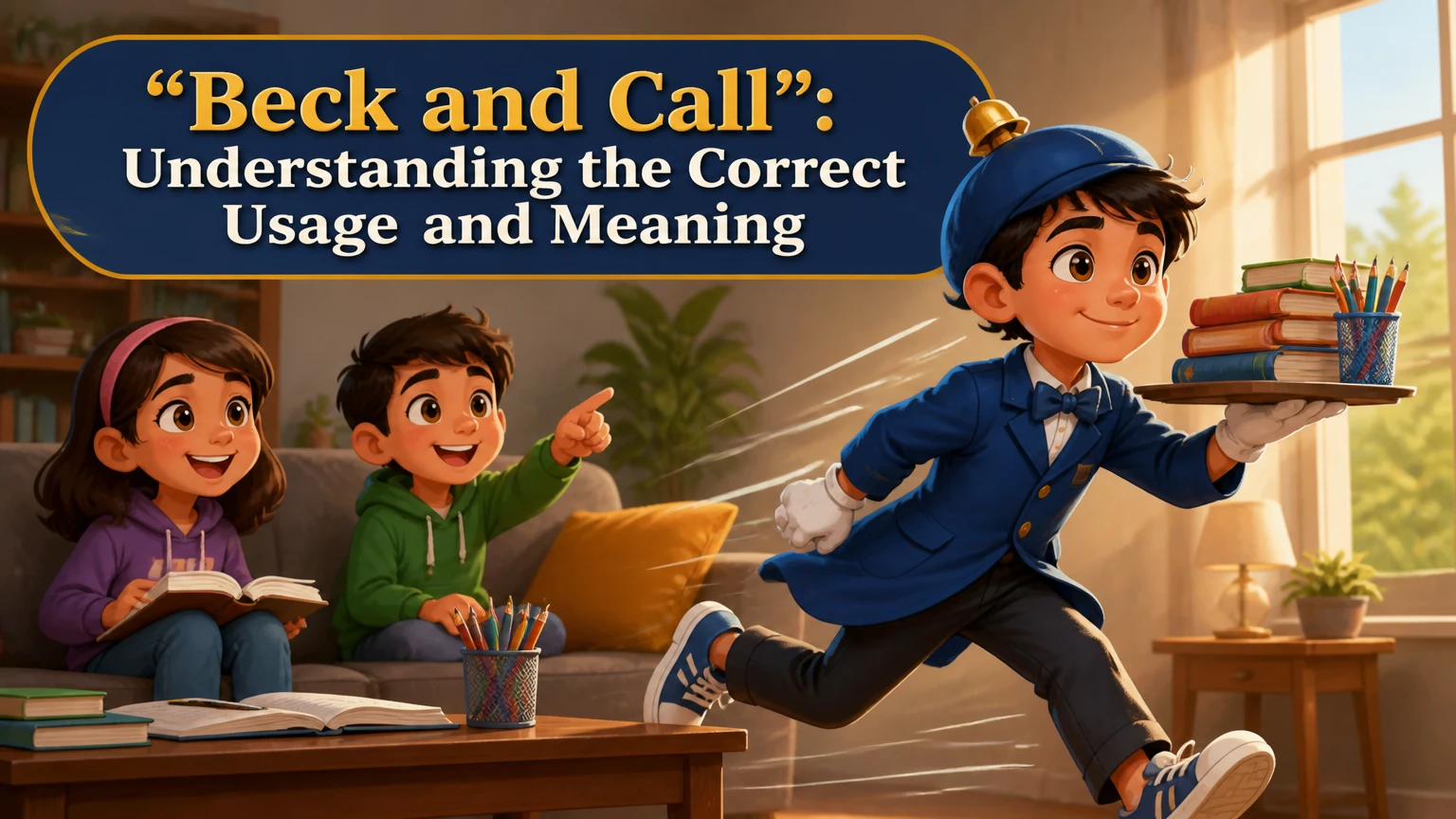
The English language is full of idioms and phrases that can sometimes be confusing, especially when they sound similar. One such potentially confusing phrase is “beck and call.” It’s important to understand the correct form and meaning of such expressions to use them accurately. The correct phrase is “beck and call,” not “beckon call.” This idiom describes a state of being constantly available and ready to obey someone’s commands, like a servant who is always at their master’s disposal. Understanding the proper usage of “beck and call” enhances clarity in communication and avoids misinterpretations. This guide will provide a comprehensive explanation of this idiom, including its origin, meaning, correct usage, common mistakes, and practice exercises. We will explore various examples and scenarios to solidify your understanding of this useful phrase.
This article will be beneficial for English language learners, writers, and anyone interested in improving their command of idioms and idiomatic expressions. Whether you are preparing for an English proficiency test, writing a novel, or simply looking to refine your vocabulary, understanding “beck and call” will be a valuable addition to your linguistic toolkit.
Table of Contents
- Definition of “Beck and Call”
- Origin and History
- Structural Breakdown
- Examples of “Beck and Call” in Sentences
- Usage Rules
- Common Mistakes
- Practice Exercises
- Advanced Topics
- Frequently Asked Questions
- Conclusion
Definition of “Beck and Call”
The idiom “beck and call” means being constantly available and ready to do whatever someone asks. It implies a subservient or obedient position, where one is always at the disposal of another. The term “beck” refers to a gesture, such as a nod or wave, used to summon someone. The phrase suggests that the person is so attentive that they respond immediately to even the slightest signal or command.
In essence, “beck and call” describes a relationship where one person has complete control and the other is expected to obey without question. This phrase is often used to describe situations of servitude, extreme dedication, or unequal power dynamics. The connotation can be negative, implying a lack of autonomy or independence, or it can simply describe a situation where someone is exceptionally attentive and responsive.
Origin and History
The origin of the phrase “beck and call” can be traced back to the Middle Ages. The word “beck” comes from the Old English word “beacen,” meaning a sign or signal. It originally referred to a gesture or nod used to summon someone. Over time, “beck” evolved to mean any form of non-verbal command. The addition of “call” simply reinforces the idea of immediate obedience and availability.
Historically, the phrase was often used in the context of master-servant relationships, where servants were expected to be at their master’s “beck and call” at all times. This reflects the hierarchical social structures of the past, where certain individuals held significant power over others. While the prevalence of such relationships has decreased, the idiom remains in use to describe any situation where one person is expected to be constantly available and obedient to another.
Structural Breakdown
The phrase “beck and call” is a compound noun phrase that functions as an idiom. Let’s break down its structure:
- Beck: This is a noun referring to a gesture or signal, usually a nod or wave, used to summon someone. It implies a silent or subtle command.
- And: This is a conjunction that connects “beck” and “call,” indicating that both actions—responding to a gesture and a verbal command—are expected.
- Call: This is a noun referring to a verbal command or summons. It implies a direct and explicit instruction.
The combination of “beck and call” emphasizes the comprehensive nature of the obedience expected. It’s not just about responding to direct orders (calls) but also to subtle signals (becks). The phrase as a whole functions as a noun, often used after prepositions like “at” or “to,” as in “at someone’s beck and call.”
Examples of “Beck and Call” in Sentences
Understanding the idiom “beck and call” is best achieved through numerous examples. Below are several examples categorized for better understanding:
General Usage
The following table provides examples of “beck and call” used in general contexts. These examples illustrate the basic meaning and usage of the idiom.
| Sentence | Explanation |
|---|---|
| She expected her husband to be at her beck and call. | She wanted him to be constantly available and obedient to her wishes. |
| The wealthy businessman had a team of assistants at his beck and call. | He had assistants who were always ready to carry out his instructions. |
| He resented being at his boss’s beck and call 24/7. | He disliked having to be available to his boss at all times. |
| The dog was trained to be at his owner’s beck and call. | The dog was trained to obey his owner’s commands immediately. |
| I’m not going to be at your beck and call anymore. | I refuse to be constantly available and obedient to you. |
| The company’s success depended on having employees at the customer’s beck and call. | The company’s success relied on employees being highly responsive to customer needs. |
| She treated her staff as if they were at her beck and call. | She acted as though her staff should always be ready to do what she wanted. |
| He enjoyed having his personal chef at his beck and call. | He appreciated having a chef who was always available to cook for him. |
| The politician had a team of advisors at his beck and call. | The politician had advisors who were always ready to provide guidance. |
| She didn’t want to be at the beck and call of her demanding clients. | She didn’t want to be constantly available to her demanding clients. |
| The robot was designed to be at the user’s beck and call. | The robot was designed to obey the user’s commands. |
| He felt like he was at the beck and call of his creditors. | He felt like he had to constantly appease his creditors. |
| The software company prided itself on having customer support at the customer’s beck and call. | The company emphasized the responsiveness of its customer support team. |
| She hated being at the beck and call of her overbearing mother. | She disliked having to constantly obey her mother. |
| The celebrity had a team of assistants at her beck and call. | The celebrity had assistants who were always ready to assist her. |
| He didn’t want his children to grow up thinking the world was at their beck and call. | He didn’t want his children to expect everyone to cater to their needs. |
| The hotel offered concierge services at the guest’s beck and call. | The hotel provided concierge services that were always available to guests. |
| She was tired of being at the beck and call of her demanding job. | She was tired of having to constantly meet the demands of her job. |
| The personal assistant was always at the CEO’s beck and call, ready to handle any task. | The personal assistant was available and prepared to follow the CEO’s instructions at any moment. |
| Being a doctor often means being at the patient’s beck and call, especially during emergencies. | Doctors are often expected to be readily available to assist their patients, particularly in urgent situations. |
Workplace Scenarios
This table focuses on examples of “beck and call” used in workplace settings. These examples highlight the dynamics between employers and employees.
| Sentence | Explanation |
|---|---|
| The intern felt like he was at the beck and call of every senior employee. | The intern felt obligated to fulfill every request from senior employees. |
| She refused to be at the beck and call of her micromanaging boss. | She refused to be constantly available and controlled by her boss. |
| The company culture promoted a sense of being at the customer’s beck and call. | The company encouraged employees to be highly responsive to customer needs. |
| He resented the expectation that he should be at his desk at his manager’s beck and call. | He disliked the expectation of being constantly available to his manager. |
| The executive assistant was at the CEO’s beck and call, managing his schedule and correspondence. | The executive assistant was always available to assist the CEO with his tasks. |
| Many startups require employees to be at the company’s beck and call, working long hours. | Startups often demand that employees be highly available and dedicated. |
| She negotiated a contract that didn’t require her to be at the client’s beck and call on weekends. | She made sure her contract didn’t demand constant availability to the client. |
| The IT support team was at the employees’ beck and call, ready to fix any technical issues. | The IT support team was available to resolve technical problems for employees. |
| The project manager expected the team to be at his beck and call to meet deadlines. | The project manager expected the team to be readily available to meet project deadlines. |
| The sales team prided themselves on being at the customer’s beck and call, providing immediate assistance. | The sales team was proud of their responsiveness to customer inquiries and needs. |
| The receptionist was always at the visitor’s beck and call, providing directions and information. | The receptionist was consistently available to help visitors with their needs. |
| The consultant made it clear that he was not at the company’s beck and call after business hours. | The consultant stated that he would not be available outside of regular work hours. |
| The software developer was at the product manager’s beck and call, implementing new features and bug fixes. | The software developer was ready to execute the product manager’s requests for new features and fixes. |
| The customer service representatives were trained to be at the customer’s beck and call, resolving issues efficiently. | The representatives were trained to promptly and effectively address customer concerns. |
| The research assistant was at the professor’s beck and call, assisting with data collection and analysis. | The research assistant was available to help the professor with research-related tasks. |
| The marketing team was at the client’s beck and call, developing campaigns and strategies. | The marketing team was ready to create and execute marketing initiatives for the client. |
| The event planner was at the client’s beck and call, managing all aspects of the event. | The event planner was available to handle every detail of the event. |
| The tutor was at the student’s beck and call, providing academic support and guidance. | The tutor was always available to help the student with their studies. |
| The chef was at the restaurant owner’s beck and call, creating new dishes and managing the kitchen. | The chef was ready to meet the owner’s expectations by innovating the menu and running the kitchen smoothly. |
| The HR department was at the employee’s beck and call, addressing concerns and providing support. | The HR team was available to assist employees with their questions and issues. |
Relationships and Family
This table illustrates how “beck and call” is used in the context of personal relationships and family dynamics.
| Sentence | Explanation |
|---|---|
| She didn’t want to be at her mother-in-law’s beck and call. | She didn’t want to be constantly obligated to her mother-in-law. |
| He felt like he was at his girlfriend’s beck and call, always doing what she wanted. | He felt he was always catering to his girlfriend’s desires. |
| The children expected their grandparents to be at their beck and call during visits. | The children expected their grandparents to cater to their every need. |
| She refused to be at her husband’s beck and call, asserting her independence. | She refused to be constantly obedient to her husband. |
| He enjoyed having his personal assistant at his beck and call, managing his schedule and errands. | He liked having someone readily available to handle his tasks and appointments. |
| The nanny was at the children’s beck and call, providing care and supervision. | The nanny was there to meet the children’s needs and ensure their safety. |
| She didn’t want her children to think she was at their beck and call, teaching them responsibility. | She didn’t want her children to expect her to always do everything for them. |
| He was always at his friend’s beck and call, helping him with whatever he needed. | He was always ready to assist his friend with any task or problem. |
| The caregiver was at the patient’s beck and call, providing medical and personal assistance. | The caregiver was available to provide the patient with medical and personal care. |
| She didn’t want to be at the beck and call of her demanding family, needing time for herself. | She didn’t want to be constantly obligated to her family, needing personal time. |
| The family dog was at the children’s beck and call, always ready to play and cuddle. | The dog was always available to play with and comfort the children. |
| He felt like he was at the beck and call of his aging parents, providing constant support. | He felt he had to provide constant support to his aging parents. |
| The wedding planner was at the bride’s beck and call, ensuring every detail was perfect. | The wedding planner was available to ensure the bride’s vision was executed flawlessly. |
| She didn’t want her partner to think she was at his beck and call, maintaining her autonomy. | She didn’t want her partner to expect her to always do what he wanted. |
| He was at his wife’s beck and call during her pregnancy, catering to her needs. | He was attentive to his wife’s needs during her pregnancy. |
| The personal trainer was at the client’s beck and call, providing fitness guidance and motivation. | The personal trainer was available to help the client achieve their fitness goals. |
| She didn’t want to be at the beck and call of her controlling sibling, asserting her boundaries. | She didn’t want to be constantly controlled by her sibling, setting limits. |
| He was always at his neighbor’s beck and call, helping with yard work and errands. | He was always ready to assist his neighbor with various tasks. |
| The volunteer was at the community’s beck and call, providing assistance to those in need. | The volunteer was available to help members of the community who needed support. |
| She didn’t want her friends to think she was at their beck and call, balancing her own priorities. | She didn’t want her friends to expect her to always be available, managing her own life. |
Historical Context
This table provides examples of how “beck and call” might be used in historical contexts, reflecting past social structures and power dynamics.
| Sentence | Explanation |
|---|---|
| In feudal times, serfs were at the lord’s beck and call. | Serfs were obligated to obey the lord’s commands. |
| The queen expected her ladies-in-waiting to be at her beck and call. | The queen expected her attendants to be constantly available. |
| During the colonial era, enslaved people were at their owner’s beck and call. | Enslaved people were forced to obey their owner’s commands. |
| The Roman emperor had a legion of soldiers at his beck and call. | The emperor had soldiers ready to carry out his orders. |
| In Victorian England, servants were expected to be at the master’s beck and call. | Servants were expected to be constantly available and obedient. |
| The pharaoh had a vast workforce at his beck and call to build the pyramids. | The pharaoh commanded a large workforce to construct the pyramids. |
| During the Renaissance, artists often had apprentices at their beck and call. | Artists had apprentices who assisted them with their work. |
| In ancient Greece, slaves were at the citizen’s beck and call. | Slaves were obligated to obey the citizen’s commands. |
| The medieval knight had squires at his beck and call, assisting him in battle. | The knight had squires who helped him during combat. |
| During the Gold Rush, prospectors often had assistants at their beck and call. | Prospectors had assistants who helped them search for gold. |
| In the Ottoman Empire, eunuchs were at the sultan’s beck and call. | Eunuchs were responsible for serving the sultan’s needs. |
| During the Industrial Revolution, factory workers were often at the owner’s beck and call. | Factory workers were expected to work long hours and follow orders. |
| In the Roman Republic, senators had clients at their beck and call. | Senators had clients who sought their patronage and support. |
| During the age of exploration, sailors were at the captain’s beck and call. | Sailors were obligated to obey the captain’s commands. |
| In ancient Egypt, scribes were at the pharaoh’s beck and call, recording history and managing affairs. | Scribes were available to document events and manage the pharaoh’s business. |
| During the American Revolution, soldiers were at the general’s beck and call, fighting for independence. | Soldiers were ready to follow the general’s orders to fight for independence. |
| In feudal Japan, samurai had servants at their beck and call, assisting with various tasks. | Samurai had servants who helped them with different duties. |
| During the Victorian era, governesses were at the family’s beck and call, educating and caring for the children. | Governesses were available to teach and look after the family’s children. |
| In ancient China, emperors had eunuchs at their beck and call, managing the imperial household. | Emperors relied on eunuchs to oversee the affairs of the imperial family. |
| During the Roman Empire, gladiators were at the crowd’s beck and call, fighting for their entertainment. | Gladiators performed for the entertainment of the Roman crowds. |
In Literature
This table presents examples of how “beck and call” might appear in literary works, illustrating its usage in storytelling and character development.
| Sentence | Explanation |
|---|---|
| “The king demanded that his courtiers be at his beck and call, ready to fulfill his every whim,” the narrator intoned. | The narrator described the king’s expectation of constant obedience. |
| “I refuse to be at your beck and call, my lord,” she declared, “I am not your servant!” | The character asserted her independence and refused to be subservient. |
| “He had always been at her beck and call, a loyal companion until the very end,” the author wrote. | The author depicted the character’s unwavering loyalty and availability. |
| “The magical creature was at the wizard’s beck and call, ready to cast spells and grant wishes,” the story unfolded. | The magical creature was bound to obey the wizard’s commands. |
| “She had grown tired of being at her family’s beck and call, yearning for a life of her own,” the novel revealed. | The character desired independence from her family’s demands. |
| “The robot was programmed to be at the user’s beck and call, performing tasks with precision and efficiency,” the science fiction tale began. | The robot was designed to obey the user’s commands flawlessly. |
| “The fairy was at the princess’s beck and call, granting her wishes and protecting her from harm,” the fairytale continued. | The fairy was bound to fulfill the princess’s desires and keep her safe. |
| “He had a team of spies at his beck and call, gathering information and carrying out his orders,” the thriller intensified. | The character commanded a network of spies to execute his plans. |
| “She refused to have anyone at her beck and call, preferring to manage her affairs independently,” the biography stated. | The character valued her self-reliance and avoided relying on others. |
| “The genie was at Aladdin’s beck and call, granting him three wishes,” the story enchanted. | The genie was obligated to fulfill Aladdin’s three wishes. |
| “The loyal dog was at his owner’s beck and call, following him everywhere he went,” the children’s book narrated. | The dog was devoted to his owner and always by his side. |
| “He had always been at the city’s beck and call, a dedicated public servant,” the eulogy honored. | The character had dedicated his life to serving the city. |
| “She refused to be at society’s beck and call, challenging conventions and norms,” the essay argued. | The character rejected societal expectations and pursued her own path. |
| “The muse was at the artist’s beck and call, inspiring him with creativity and imagination,” the poem celebrated. | The muse inspired the artist with creative ideas. |
| “He had grown weary of being at the corporation’s beck and call, longing for a simpler life,” the memoir recounted. | The character desired a less demanding and stressful lifestyle. |
| “The guardian angel was at the child’s beck and call, protecting him from danger and guiding him on his path,” the fantasy unfolded. | The guardian angel watched over and protected the child. |
| “She refused to be at the dictator’s beck and call, joining the resistance and fighting for freedom,” the historical novel depicted. | The character opposed the dictator and joined the fight for freedom. |
| “He had a network of informants at his beck and call, providing him with crucial information,” the mystery deepened. | The character relied on informants to gather important information. |
| “She had always been at nature’s beck and call, a devoted environmentalist,” the documentary highlighted. | The character had dedicated her life to protecting the environment. |
| “The dream was at the dreamer’s beck and call, shaping reality and creating new possibilities,” the surreal story ended. | The dream allowed the dreamer to manipulate reality and create new worlds. |
Usage Rules
The idiom “beck and call” follows specific usage rules to ensure clarity and accuracy:
- Prepositions: It is typically used with the prepositions “at” or “to.” For example, “He is at her beck and call” or “She is to be at his beck and call.”
- Possessives: It often includes a possessive pronoun or noun to indicate whose beck and call someone is at. For example, “at my beck and call,” “at the boss’s beck and call,” or “at her mother’s beck and call.”
- Context: Ensure the context implies a subservient or highly responsive relationship. The phrase should accurately reflect the power dynamics or expectations in the situation.
- Correct Form: Always use the correct form, “beck and call,” not “beckon call” or any other variation.
Common Mistakes
Several common mistakes occur when using the idiom “beck and call.” Understanding these errors can help you avoid them:
| Incorrect | Correct | Explanation |
|---|---|---|
| He is at her beckon call. | He is at her beck and call. | “Beckon” is a verb, while “beck” is a noun referring to a gesture. |
| She is in his beck and call. | She is at his beck and call. | The correct preposition is “at,” not “in.” |
| They are to beck and call. | They are to be at someone’s beck and call. | The phrase requires the preposition “at” and a possessive to indicate whose beck and call. |
| I am beck and call for you. | I am at your beck and call. | The correct usage includes the preposition “at” and the possessive pronoun “your.” |
| He expects everyone to beck and call. | He expects everyone to be at his beck and call. | The phrase requires the preposition “at” and a possessive pronoun (“his” in this case). |
Practice Exercises
Test your understanding of the idiom “beck and call” with the following exercises:
Exercise 1: Fill in the Blanks
Fill in the blanks with the correct form of the idiom “beck and call.”
| Question | Answer |
|---|---|
| She expected her children to be __________ her __________. | She expected her children to be at her beck and call. |
| He resented being __________ his boss’s __________ on weekends. | He resented being at his boss’s beck and call on weekends. |
| The company prided itself on having customer support __________ the customer’s __________. | The company prided itself on having customer support at the customer’s beck and call. |
| I am not going to be __________ your __________ anymore. | I am not going to be at your beck and call anymore. |
| The servant was always __________ the master’s __________. | The servant was always at the master’s beck and call. |
| The intern felt like he was __________ every senior employee’s __________. | The intern felt like he was at every senior employee’s beck and call. |
| She refused to be __________ her mother-in-law’s __________. | She refused to be at her mother-in-law’s beck and call. |
| The queen expected her ladies-in-waiting to be __________ her __________. | The queen expected her ladies-in-waiting to be at her beck and call. |
| The robot was programmed to be __________ the user’s __________. | The robot was programmed to be at the user’s beck and call. |
| The fairy was __________ the princess’ __________, granting her wishes. | The fairy was at the princess’ beck and call, granting her wishes. |
Exercise 2: Sentence Completion
Complete the following sentences using the idiom “beck and call” in a meaningful way.
| Question | Answer |
|---|---|
| After years of being a stay-at-home parent, she was tired of being __________. | After years of being a stay-at-home parent, she was tired of being at her children’s beck and call. |
| The demanding client expected the advertising agency to be __________. | The demanding client expected the advertising agency to be at their beck and call. |
| The personal assistant’s job was to be __________. | The personal assistant’s job was to be at the executive’s beck and call. |
| Despite his wealth, he didn’t want his children to think the world was __________. | Despite his wealth, he didn’t want his children to think the world was at their beck and call. |
| The hotel’s concierge service was designed to be __________. | The hotel’s concierge service was designed to be at the guest’s beck and call. |
| As a dedicated doctor, she was used to being __________. | As a dedicated doctor, she was used to being at her patient’s beck and call. |
| The manager expected the team to be __________, especially during the project’s final stages. | The manager expected the team to be at his beck and call, especially during the project’s final stages. |
| In the olden days, servants were generally __________. | In the olden days, servants were generally at their master’s beck and call. |
| The overly protective mother made sure she was always __________. | The overly protective mother made sure she was always at her child’s beck and call. |
| The company’s success was due in part to providing a service that was __________. | The company’s success was due in part to providing a service that was at the customer’s beck and call. |
Exercise 3: Error Correction
Identify and correct the errors in the following sentences related to the idiom “beck and call.”
| Question | Answer |
|---|---|
| She expected her husband to be in her beck and call. | She expected her husband to be at her beck and call. |
| The wealthy businessman had a team of assistants to beck and call. | The wealthy businessman had a team of assistants at his beck and call. |
| He resented being to his boss’s beck and call 24/7. | He resented being at his boss’s beck and call 24/7. |
| The dog was trained to be in his owner’s beck and call. | The dog was trained to be at his owner’s beck and call. |
| I’m not going to be beck and call anymore. |
I’m not going to be at your beck and call anymore. |
Advanced Topics
While “beck and call” is the standard idiomatic expression, it is interesting to look at the linguistic phenomenon known as an eggcorn. An eggcorn is a word or phrase that results from mishearing or misinterpreting another word or phrase, but still makes some sense in the speaker’s mind. “Beckon call” is one of the most common eggcorns in the English language.
The logic behind the mistake is understandable: to “beckon” someone is a real verb meaning to summon them with a gesture. Therefore, a “beckon call” sounds like a summons to come. However, “beck” is already the noun form of that action. Using “beckon” creates a redundant and grammatically incorrect structure within the idiom. In formal writing and professional speech, using the eggcorn “beckon call” is considered a sign of poor proofreading or a lack of vocabulary depth.
Another advanced consideration is the connotative shift of the phrase. While historically it described literal servitude, modern usage often employs the phrase hyperbolically to describe someone who is overly accommodating or a “people pleaser.” When used in a romantic context, it can signal an unhealthy power imbalance, whereas in a high-end service context (like a luxury hotel), it is used as a marketing term to suggest elite levels of responsiveness.
Frequently Asked Questions
Is it “beck and call” or “beckon call”?
The correct phrase is “beck and call.” “Beckon call” is a common misspelling and mispronunciation based on the verb “to beckon.”
What does “beck” mean in this phrase?
In this context, “beck” is a noun that means a silent signal or a gesture used to summon someone, such as a nod of the head or a wave of the hand.
Is “beck and call” an insult?
Not necessarily, but it often carries a negative connotation. It implies that the person being summoned has little autonomy or is being treated like a servant. However, it can also be used to describe someone who is incredibly helpful and dedicated.
Can I use “beck and call” in a formal essay?
Yes, “beck and call” is a recognized English idiom. As long as it is used correctly and fits the tone of your essay, it is perfectly acceptable in formal writing.
What is the opposite of being at someone’s beck and call?
The opposite would be being independent, autonomous, or “one’s own master.” You might say someone is “beholden to no one.”
Conclusion
Mastering idioms like “beck and call” is a significant step in achieving fluency and precision in the English language. By understanding that “beck” refers to a silent gesture and “call” refers to a verbal summons, you can appreciate the full depth of the phrase: being ready to respond to any signal, no matter how subtle.
Remember to always use the preposition “at” and avoid the tempting “beckon call” trap. Whether you are describing a workplace dynamic, a historical relationship, or a scene in a novel, using this phrase correctly will ensure your communication is clear, professional, and linguistically accurate. Through the exercises provided in this guide, you should now feel confident in identifying and using “beck and call” in your daily writing and conversation.