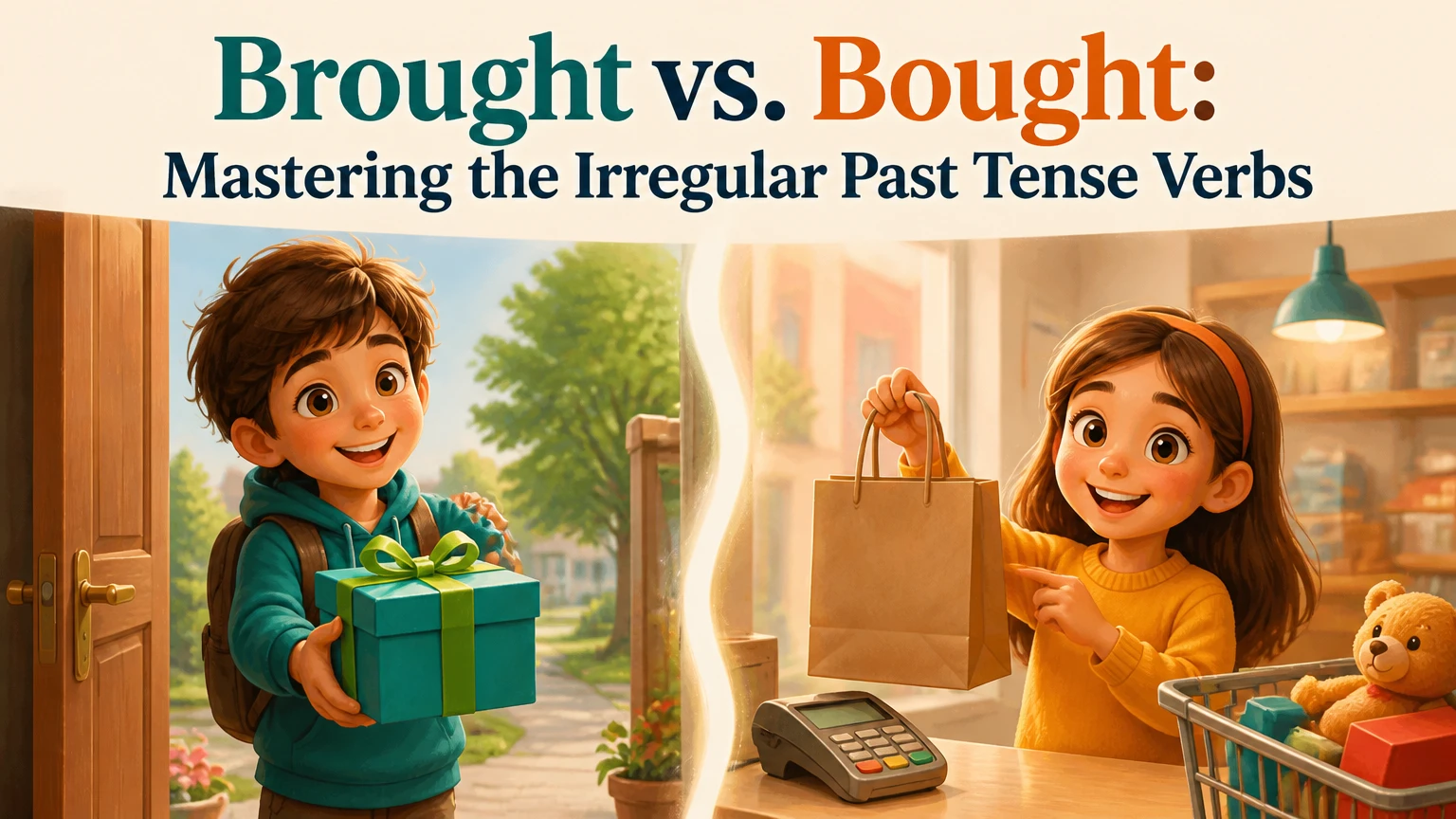
The English language is filled with irregular verbs that can confuse even the most experienced writers, particularly when two high-frequency words sound remarkably similar. Understanding the distinction between “brought” and “bought” is essential for clear communication, as these words represent two very different actions involving the movement or acquisition of items. Many learners struggle with these past tense forms because they share a similar vowel sound and orthographic structure, including the silent “gh” cluster found in words like caught, fought, sought, and thought. By mastering these distinctions, students and professionals can ensure their writing remains precise and professional, avoiding common pitfalls that lead to ambiguity in both academic and casual contexts.
Table of Contents
- 1. Comprehensive Definitions and Classifications
- 2. Structural Breakdown: Etymology and Phonetics
- 3. The Past Tense of Buy: Deep Dive into Bought
- 4. The Past Tense of Bring: Deep Dive into Brought
- 5. Side-by-Side Comparison Tables
- 6. Comprehensive Usage Rules and Contexts
- 7. Idiomatic Expressions and Phrasal Verbs
- 8. Common Mistakes and How to Avoid Them
- 9. Extensive Practice Exercises
- 10. Advanced Linguistic Topics
- 11. Frequently Asked Questions (FAQ)
- 12. Conclusion and Final Tips
1. Comprehensive Definitions and Classifications
To understand the difference between “brought” and “bought,” we must first look at their base forms: bring and buy. Both are irregular verbs, meaning they do not follow the standard pattern of adding “-ed” to form the past tense. Instead, they undergo internal vowel changes and consonant shifts that date back to Old English and Germanic linguistic roots.
Buy is a transitive verb that refers to the act of acquiring something in exchange for money or its equivalent. It is a fundamental concept in commerce and personal finance. When you “buy” something, ownership is transferred from a seller to you. The past tense and past participle form of this action is bought.
Bring is a transitive verb that refers to the act of carrying, conveying, or conducting something or someone to a place or person. It implies movement toward the speaker or a specific destination. Unlike “buy,” which focuses on the transaction, “bring” focuses on the movement and relocation of an object or person. The past tense and past participle form of this action is brought.
Classifying the Verbs
Both verbs are classified as “irregular” because they do not form the past tense as “buyed” or “bringed.” In linguistics, they are often grouped into a category of verbs that end in -ought or -aught in their past forms. This grouping includes seek/sought, think/thought, fight/fought, and catch/caught. Understanding this classification helps learners recognize the pattern: the “r” in the base word bring is preserved in the past tense brought, while the lack of an “r” in buy is reflected in bought.
2. Structural Breakdown: Etymology and Phonetics
The structural evolution of these words explains why they look the way they do today. The “gh” in both brought and bought is a vestige of a Germanic velar fricative sound, similar to the “ch” in the German word “Bach” or the Scottish “loch.” While the sound disappeared from spoken English centuries ago, the spelling remained, creating a silent cluster that frustrates modern learners.
The Phonetic Trap
In many dialects of English, particularly in parts of the United States and the United Kingdom, the vowel sounds in brought and bought are identical. This is known as the “cot-caught merger” in some linguistic circles, where the distinction between certain low-back vowels is lost. Because they sound the same, the only way to distinguish them in speech is through the presence or absence of the “r” sound immediately following the initial “b.”
The “R” Rule
The most effective mnemonic for remembering the difference is the “R Rule.” If the action involves moving something (bring), the past tense must include the “r” (brought). If the action involves a purchase, there is no “r” in the base word (buy), so there is no “r” in the past tense (bought). This simple structural check can prevent the majority of errors associated with these words.
3. The Past Tense of Buy: Deep Dive into Bought
The verb “buy” originates from the Old English bycgan. It has always been a core part of the English vocabulary, reflecting the necessity of trade. When we use bought, we are describing a completed transaction. It is used in both the simple past tense and as a past participle in perfect tenses (e.g., “I have bought”).
In a sentence, bought usually requires a direct object—the thing that was purchased. For example, “She bought a car.” It can also take an indirect object, indicating for whom the item was purchased: “She bought her son a car.” This versatility makes it one of the most common verbs in daily conversation.
Conjugation of Buy
| Tense/Form | Conjugation | Example Sentence |
|---|---|---|
| Infinitive | to buy | I need to buy some milk. |
| Present Simple | buy / buys | He buys a newspaper every morning. |
| Present Continuous | is/am/are buying | They are buying a new house today. |
| Simple Past | bought | We bought this television last year. |
| Past Continuous | was/were buying | I was buying groceries when I saw him. |
| Present Perfect | have/has bought | She has bought all the supplies we need. |
| Past Perfect | had bought | They had bought the tickets before the price rose. |
| Future Simple | will buy | I will buy the gift tomorrow. |
4. The Past Tense of Bring: Deep Dive into Brought
The verb “bring” comes from the Old English bringan. It is a verb of motion and direction. The use of brought indicates that an object or person has been moved from a distant location to a closer one, or to a specific destination mentioned in the context. It is the past tense and past participle form.
A common point of confusion with “bring” is its relationship with “take.” Generally, you bring something toward the speaker and take something away from the speaker. However, in the past tense, brought is exclusively the result of “bring.” If you “brought” your lunch to work, it means you carried it with you when you arrived at your current location.
Conjugation of Bring
| Tense/Form | Conjugation | Example Sentence |
|---|---|---|
| Infinitive | to bring | Please remember to bring your ID. |
| Present Simple | bring / brings | She always brings a gift to parties. |
| Present Continuous | is/am/are bringing | They are bringing the dessert now. |
| Simple Past | brought | I brought my umbrella just in case. |
| Past Continuous | was/were bringing | He was bringing the files when he tripped. |
| Present Perfect | have/has brought | We have brought enough food for everyone. |
| Past Perfect | had brought | She had brought the news before I arrived. |
| Future Simple | will bring | The rain will bring cooler temperatures. |
5. Side-by-Side Comparison Tables
To truly grasp the difference, it is helpful to see these words used in similar contexts. The following tables provide a high volume of examples to illustrate the distinct meanings of “bought” and “brought.” Notice how “bought” always implies a financial or trade-based transaction, while “brought” always implies physical or metaphorical movement.
Table 1: 30 Examples of “Bought” (Purchasing)
| Subject | Verb | Object/Context |
|---|---|---|
| I | bought | a new pair of shoes yesterday. |
| You | bought | the tickets for the concert. |
| He | bought | a coffee for his colleague. |
| She | bought | a beautiful dress for the wedding. |
| It | bought | us some time to finish the project (metaphorical). |
| We | bought | a house in the suburbs. |
| They | bought | groceries for the entire week. |
| The company | bought | a smaller startup last month. |
| My father | bought | a vintage car at the auction. |
| Sarah | bought | flowers for her mother’s birthday. |
| The school | bought | new computers for the lab. |
| Everyone | bought | into the new idea (metaphorical). |
| I have | bought | too many clothes this year. |
| They had | bought | the land before the development started. |
| Who | bought | this delicious cake? |
| We | bought | our flights online. |
| He | bought | insurance for his new phone. |
| She | bought | a gift card for her friend. |
| I | bought | lunch for the whole team. |
| The government | bought | the rights to the land. |
| The museum | bought | a rare painting. |
| They | bought | stock in the tech company. |
| We | bought | supplies for the camping trip. |
| He | bought | a ring to propose to her. |
| She | bought | the last book on the shelf. |
| The chef | bought | fresh ingredients from the market. |
| I | bought | a membership to the gym. |
| They | bought | a round of drinks for everyone. |
| We | bought | tickets for the early show. |
| She | bought | a new laptop for college. |
Table 2: 30 Examples of “Brought” (Carrying/Moving)
| Subject | Verb | Object/Context |
|---|---|---|
| I | brought | my laptop to the meeting. |
| You | brought | your dog to the park. |
| He | brought | us some bad news. |
| She | brought | her kids to the zoo. |
| It | brought | tears to my eyes. |
| We | brought | extra chairs for the guests. |
| They | brought | their own drinks to the party. |
| The wind | brought | a cold chill to the air. |
| My brother | brought | his new girlfriend home. |
| The waiter | brought | the wrong order to the table. |
| The storm | brought | down several trees. |
| She | brought | up an interesting point in class. |
| I have | brought | the documents you requested. |
| They had | brought | maps for the hike. |
| Who | brought | this heavy box inside? |
| We | brought | the laundry in from the rain. |
| He | brought | honor to his family name. |
| She | brought | a smile to everyone’s face. |
| I | brought | my tools to fix the sink. |
| The bus | brought | the tourists to the hotel. |
| The detective | brought | the suspect in for questioning. |
| They | brought | the meeting to a close. |
| We | brought | the boat back to the shore. |
| He | brought | peace to the region. |
| She | brought | her violin to the rehearsal. |
| The postman | brought | a large package today. |
| I | brought | the car to the mechanic. |
| They | brought | attention to the environmental issue. |
| We | brought | our coats because it was cold. |
| She | brought | her portfolio to the interview. |
6. Comprehensive Usage Rules and Contexts
Understanding when to use “brought” or “bought” requires looking at the intent of the sentence. While the “R Rule” is the best shortcut, a deeper understanding of the contexts in which these verbs appear will solidify your grasp. There are specific grammatical environments where one is appropriate and the other is not.
Transitive Nature
Both verbs are typically transitive, meaning they require a direct object. You cannot simply say “I bought” or “I brought” without implying what was bought or brought. If someone asks, “Did you get the milk?” you might answer, “Yes, I bought it” or “Yes, I brought it.” In the first case, you are confirming the purchase; in the second, you are confirming that you have it with you now.
The Role of Prepositions
The prepositions that follow these verbs often change. Bought is frequently followed by “for” (indicating the price or the recipient) or “from” (indicating the seller). Brought is frequently followed by “to” (indicating the destination) or “with” (indicating the person who has the item). This syntactic difference is a great clue for learners.
| Verb | Common Prepositions | Example |
|---|---|---|
| Bought | for, from, at, with (currency) | I bought it for ten dollars from the shop. |
| Brought | to, with, from (origin), back | I brought it to the office with me. |
7. Idiomatic Expressions and Phrasal Verbs
English is rich with phrasal verbs and idioms that use these two words. Misusing “brought” for “bought” in an idiom can make a sentence nonsensical. Because idioms are fixed expressions, they must be memorized as complete units of meaning.
Phrasal Verbs with “Bring/Brought”
The verb “bring” is incredibly productive in forming phrasal verbs. Here are some of the most common ones in their past tense form:
- Brought up: Mentioned a topic or raised a child. (e.g., “She brought up the budget during the meeting.”)
- Brought about: Caused something to happen. (e.g., “The new law brought about significant changes.”)
- Brought down: Caused someone to lose power or made someone sad. (e.g., “The scandal brought down the government.”)
- Brought back: Returned something or reminded someone of the past. (e.g., “That song brought back many memories.”)
- Brought out: Released a new product or highlighted a quality. (e.g., “The company brought out a new model this year.”)
Phrasal Verbs with “Buy/Bought”
While “buy” has fewer phrasal verbs, they are essential for business and social contexts:
- Bought out: Purchased a partner’s share of a business or the entire company. (e.g., “The corporation bought out the local competitor.”)
- Bought into: Believed in an idea or invested in something. (e.g., “I never really bought into his excuses.”)
- Bought up: Purchased all of something available. (e.g., “Speculators bought up all the land near the new airport.”)
- Bought off: Bribed someone to prevent them from interfering. (e.g., “The criminal tried to buy off the witnesses.”)
8. Common Mistakes and How to Avoid Them
The most common mistake is the “spelling swap,” where a writer uses “bought” when they mean “brought” or vice versa. This usually happens because the writer is thinking of the sound of the word rather than the meaning of the base verb. In professional writing, this error can be seen as a sign of carelessness.
The “Bringed” and “Buyed” Error
Children and non-native speakers often over-regularize these verbs, assuming they follow the “-ed” pattern. While “buyed” and “bringed” are logically formed, they are grammatically incorrect in standard English. If you find yourself wanting to add “-ed,” remember that these are “ought” verbs.
Correct vs. Incorrect Examples
| Incorrect | Correct | Reason |
|---|---|---|
| I bought my homework to school. | I brought my homework to school. | You didn’t pay for your homework; you carried it. |
| She brought a new car yesterday. | She bought a new car yesterday. | This was a financial transaction, not just moving a car. |
| He bringed the cake to the party. | He brought the cake to the party. | “Bring” is irregular; the past tense is “brought.” |
| We buyed the house in 2010. | We bought the house in 2010. | “Buy” is irregular; the past tense is “bought.” |
9. Extensive Practice Exercises
To master these verbs, practice is essential. Complete the following exercises to test your understanding of the difference between “brought” and “bought.” The answers are provided in a separate table below the questions.
Exercise 1: Fill in the Blanks
- I ________ a new jacket because it was on sale.
- Who ________ these flowers to the hospital?
- The cat ________ a mouse into the kitchen.
- We ________ our tickets online three weeks ago.
- Has anyone ________ the mail in yet?
- She ________ her best friend to the family dinner.
- They ________ a huge amount of stock before the price went up.
- The rain ________ a sense of relief to the farmers.
- I ________ this book for only five dollars.
- He ________ up the subject of the holidays during lunch.
Exercise 2: Sentence Correction
Identify if the sentence is correct or incorrect. If incorrect, provide the correct word.
- I bought my umbrella to work because it looked like rain.
- She brought a beautiful painting at the art gallery.
- They have bought a new puppy for their children.
- The wind bought the scent of pine through the window.
- We brought some snacks for the long car ride.
- He bought his brother a gift for graduation.
- The news brought a lot of excitement to the town.
- I have brought all the groceries we need for the week. (Careful: Did you pay or carry?)
- The teacher bought the students some extra paper.
- She brought her laptop to the café to do some work.
Answer Key
| Exercise 1 Answers | Exercise 2 Answers |
|---|---|
| 1. bought | 1. Incorrect (brought) |
| 2. brought | 2. Incorrect (bought) |
| 3. brought | 3. Correct |
| 4. bought | 4. Incorrect (brought) |
| 5. brought | 5. Correct |
| 6. brought | 6. Correct |
| 7. bought | 7. Correct |
| 8. brought | 8. Correct (if carrying) / bought (if purchasing) |
| 9. bought | 9. Correct |
| 10. brought | 10. Correct |
10. Advanced Linguistic Topics
For advanced learners, understanding the nuances of these verbs involves looking at how they interact with other parts of speech and how they function in different dialects. In some regional dialects, particularly in parts of the UK and Australia, “brought” and “bought” are occasionally used interchangeably in speech, though this is considered non-standard and incorrect in formal writing.
The “Bring/Take” Distinction in the Past Tense
As mentioned earlier, the distinction between “bring” (to here) and “take” (to there) is a common challenge. In the past tense, this becomes “brought” vs. “took.” If you are at the office and you carried your lunch there in the morning, you say “I brought my lunch.” If you are at home and you carried your lunch to the office, you say “I took my lunch to work.” “Bought” never enters this equation unless you purchased your lunch along the way.
Passive Voice Transformations
Both “brought” and “bought” are used in passive voice constructions. In these cases, the object of the action becomes the subject of the sentence. This is very common in formal reports or news stories.
- Active: The company bought the land.
- Passive: The land was bought by the company.
- Active: The courier brought the package.
- Passive: The package was brought by the courier.
11. Frequently Asked Questions (FAQ)
Q1: Is “bringed” ever a real word?
No, “bringed” is not a standard word in the English language. It is a common mistake made by children or learners who are applying the standard “-ed” rule to an irregular verb. The only correct past tense form of bring is brought.
Q2: Is “buyed” ever a real word?
Similar to “bringed,” “buyed” is incorrect. The English language has used bought as the past tense of buy for centuries. Using “buyed” will be seen as a grammatical error in any formal or informal context.
Q3: How can I remember the “r” in brought?
The easiest way is to remember that bring has an “r” and brought has an “r.” Conversely, buy does not have an “r,” and bought does not have an “r.” Thinking of the “r” as standing for “relocate” or “run” (movement) can also help.
Q4: Can I use “brought” if I bought something and then carried it?
Yes, but the choice depends on which action you want to emphasize. If you want to emphasize the purchase, use bought (“I bought this at the store”). If you want to emphasize that you have it with you now, use brought (“I brought this from the store”).
Q5: Why do they both end in -ought?
This is due to their shared history in the Germanic branch of the Indo-European language family. Many verbs that had a specific type of consonant in their Germanic roots evolved into the “-ought” or “-aught” spelling in Modern English.
Q6: Are “bought” and “brought” pronounced the same?
In many accents, yes, they are identical except for the “r” sound. In some accents, the vowel in “brought” might be slightly longer or more rounded, but for most learners, the presence of the “r” is the only reliable auditory difference.
Q7: What is the past participle of these verbs?
The past participle is the same as the simple past tense for both verbs. So, you would say “I have bought” and “I have brought.” This makes it slightly easier as you only have to learn one irregular form for each verb.
Q8: Can “brought” be used for people?
Yes, “brought” is frequently used for people. For example, “I brought my sister to the party.” “Bought,” however, should only be used for people in the context of historical slavery or metaphorical contexts (like “buying” a player’s contract in sports), which are very different meanings.
12. Conclusion and Final Tips
The distinction between “brought” and “bought” is a fundamental pillar of English grammar that separates the act of movement from the act of commerce. While their spellings and sounds are remarkably similar, their meanings are worlds apart. By keeping the “R Rule” in mind—linking bring to brought—you can navigate these tricky irregular verbs with confidence. Remember that “bought” is always about the money, while “brought” is always about the journey. Consistent practice through reading and writing will eventually make the choice between these two words second nature. Always proofread your work specifically for these “ought” verbs, as they are among the most frequent typos in the English language. With the tables, rules, and exercises provided in this guide, you now have the tools to use these verbs accurately in any situation.