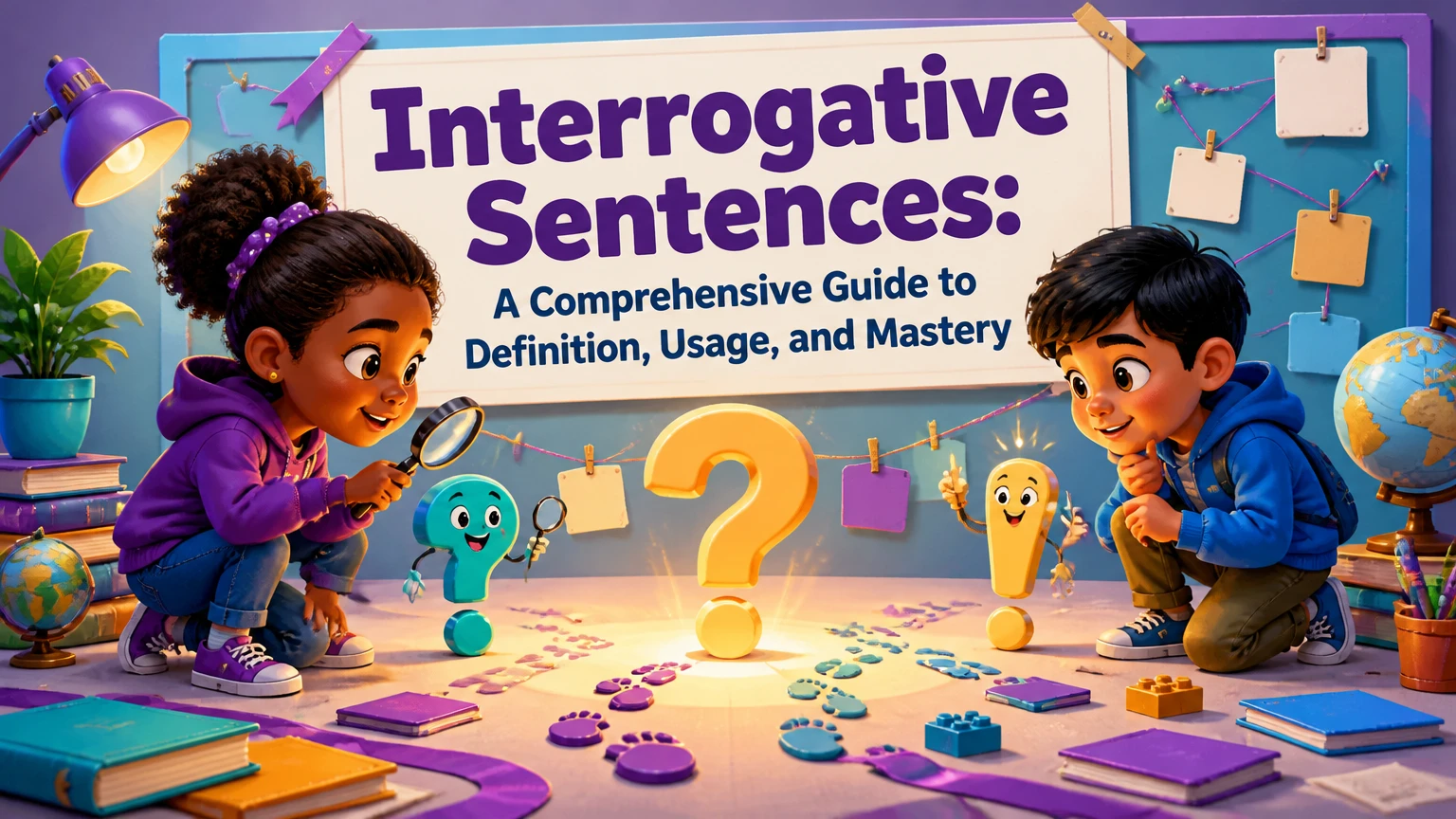
Interrogative sentences are fundamental tools of communication that allow us to seek information, clarify doubts, and engage in meaningful dialogue with others. These sentences are defined by their primary function of asking a question, such as “Where is the library?”, “Do you like coffee?”, “Why are you late?”, and “Can you help me?”. By using these structures, speakers and writers can transform a passive exchange of facts into an active search for knowledge and understanding. Understanding how to construct these questions correctly is essential for anyone looking to achieve fluency in English, as they follow specific word order patterns that differ significantly from standard declarative statements. Whether you are a beginner learning the basics of “who, what, and where” or an advanced student mastering indirect questions and tag questions, this guide will provide the depth and clarity needed to navigate the inquisitive side of the English language.
Table of Contents
- Definition and Function of Interrogative Sentences
- Structural Breakdown and Word Order
- Yes/No Questions: The Basics
- Wh- Questions: Seeking Specific Information
- Choice Questions: Offering Options
- Tag Questions: Seeking Confirmation
- Indirect and Embedded Questions
- Rhetorical Questions: Style and Impact
- Negative Interrogative Sentences
- Comprehensive Examples and Tables
- Usage Rules and Punctuation
- Common Mistakes and How to Avoid Them
- Practice Exercises and Solutions
- Advanced Topics: Inversion and Emphasis
- Frequently Asked Questions (FAQ)
- Conclusion and Final Tips
Definition and Function of Interrogative Sentences
An interrogative sentence is one of the four functional types of sentences in the English language, alongside declarative, imperative, and exclamatory sentences. Its primary purpose is to request information or to ask for a response from a listener or reader. In written English, these sentences are always marked by a question mark (?) at the end, which serves as a visual cue for the reader to adjust their internal intonation.
Functionally, interrogative sentences serve several roles in human interaction. They can be used for simple fact-finding, such as asking for the time or a location. They can also be used to solicit opinions, express surprise, or even issue polite requests and commands. For example, “Could you please pass the salt?” is grammatically a question but functionally a request for action. This versatility makes the interrogative form one of the most dynamic aspects of English grammar.
Linguistically, the hallmark of most interrogative sentences is subject-auxiliary inversion. In a standard statement like “You are happy,” the subject comes before the verb. In the interrogative version, “Are you happy?”, the auxiliary verb moves to the front. This structural shift is what alerts the listener that a question is being asked even before the sentence is completed. Understanding this shift is the first step toward mastering the construction of questions in English.
Structural Breakdown and Word Order
The structure of an interrogative sentence typically follows a specific formula that differs from declarative sentences. While a standard sentence follows a Subject-Verb-Object (SVO) pattern, an interrogative sentence often follows an Auxiliary-Subject-Verb (ASV) pattern. This inversion is the most critical rule for learners to internalize when moving from simple statements to questions.
There are three main components to a standard interrogative structure: the auxiliary verb (or “helping verb”), the subject, and the main verb. Common auxiliary verbs include do, does, did, am, is, are, was, were, have, has, and had. Additionally, modal verbs like can, could, should, will, and would can also function as the initial element in a question. If a sentence does not already have an auxiliary verb, the “do-support” rule requires us to add a form of the verb “to do.”
When using “wh-” words (who, what, where, when, why, how), these words are placed at the very beginning of the sentence, followed immediately by the auxiliary verb. This creates the formula: Wh- Word + Auxiliary + Subject + Main Verb. For example, in the sentence “Where do you live?”, “Where” is the question word, “do” is the auxiliary, “you” is the subject, and “live” is the main verb. Mastering this sequence ensures that your questions sound natural and are grammatically correct.
Yes/No Questions: The Basics
Yes/No questions are the simplest form of interrogatives because they only require a “yes” or “no” for an answer. These questions are formed by placing the auxiliary or modal verb before the subject. If the main verb is a form of “to be” (am, is, are, was, were), it moves to the front of the sentence without needing an additional auxiliary verb.
If the original statement uses a simple present or simple past tense verb other than “to be,” we must use the auxiliary verb do, does, or did. It is important to remember that when using these auxiliaries, the main verb must return to its base form. For instance, “He likes pizza” becomes “Does he like pizza?” (not “Does he likes pizza?”). This is a common area of confusion for many English language learners.
These questions are often used to confirm information or to check for agreement. They are direct and efficient. In spoken English, yes/no questions usually end with a rising intonation, which helps signal to the listener that a response is expected. This melodic rise at the end of the sentence is just as important as the grammatical structure itself in conveying the intended meaning.
Wh- Questions: Seeking Specific Information
Wh- questions, also known as open-ended questions, are used when you need more than a simple yes or no. They are designed to elicit specific details such as time, place, reason, or identity. The “wh-” words include: Who, Whom, Whose, What, Which, When, Where, Why, and How. Each of these words targets a different type of information, making them essential for effective communication.
The grammar of wh- questions follows the same inversion rule as yes/no questions, but with the addition of the question word at the start. For example, “When will the meeting start?” uses the modal “will” before the subject “the meeting.” However, a special rule applies when the wh- word is the subject of the sentence. In cases like “Who called you?”, no inversion is necessary because “Who” is already in the subject position. This distinction is vital for advanced sentence construction.
Wh- questions are the backbone of interviews, investigations, and academic inquiries. They allow for the exploration of complex ideas and the gathering of nuanced data. Unlike yes/no questions, wh- questions typically end with a falling intonation in standard English. This subtle difference in pitch helps distinguish between a request for confirmation and a request for new information.
Choice Questions: Offering Options
Choice questions, often referred to as alternative questions, provide the listener with two or more specific options to choose from. They are structured like yes/no questions but include the coordinating conjunction “or” to link the choices. For example, “Would you like tea or coffee?” presents two distinct possibilities for the listener to consider.
The structure of a choice question can involve choosing between nouns, verbs, adjectives, or even entire clauses. Because the answer is contained within the question itself, the response is usually one of the provided options rather than a simple “yes” or “no.” This makes choice questions particularly useful in service industries, decision-making processes, and social invitations where preferences need to be established quickly.
In terms of intonation, choice questions have a unique pattern. The voice typically rises on the first option and falls on the final option. For instance, in “Do you want to stay (rise) or go (fall)?”, the change in pitch clarifies that these are the only two options being presented. This vocal signaling helps the listener understand the boundaries of the question being asked.
Tag Questions: Seeking Confirmation
Tag questions are short additions placed at the end of a declarative sentence to turn it into a question. They are primarily used to confirm information that the speaker believes to be true or to encourage the listener to agree. A classic example is, “It’s a beautiful day, isn’t it?”. The “tag” consists of an auxiliary verb and a pronoun that matches the subject of the main sentence.
The most important rule for tag questions is the polarity shift. If the main sentence is positive, the tag must be negative. Conversely, if the main sentence is negative, the tag must be positive. For example: “You are coming, aren’t you?” (Positive sentence, negative tag) and “You aren’t coming, are you?” (Negative sentence, positive tag). This balance is what makes tag questions grammatically sound.
Tag questions are highly common in informal conversation and serve a social function. They can be used to soften a statement, make a polite request, or express sarcasm depending on the tone. If the speaker’s voice rises at the end of the tag, it is a genuine question. If the voice falls, the speaker is merely looking for agreement or confirmation of a shared reality.
Indirect and Embedded Questions
Indirect questions are more polite and formal than direct questions. They are often “embedded” within a larger sentence or introduced by phrases like “Could you tell me…” or “I wonder…”. For example, instead of asking “Where is the station?”, a more polite indirect version would be, “Could you tell me where the station is?”. Notice that in indirect questions, the word order reverts to the standard subject-verb pattern.
This lack of inversion is the most common mistake learners make when using indirect questions. Because the “question” is technically a noun clause within a statement, we do not use the auxiliary-subject-verb order. We say, “I don’t know why he left,” not “I don’t know why did he leave.” Mastering this subtlety is a hallmark of upper-intermediate and advanced English proficiency.
Indirect questions are particularly useful in professional settings, when speaking to strangers, or when discussing sensitive topics. They reduce the “sharpness” of a direct inquiry and make the speaker appear more courteous. They are also frequently used in academic writing to present research questions or hypotheses in a more nuanced and sophisticated manner.
Rhetorical Questions: Style and Impact
A rhetorical question is a figure of speech where a question is asked not to elicit an answer, but to make a point or create a dramatic effect. The answer is usually obvious or implied within the context. For example, when someone asks, “Who knows?”, they aren’t actually looking for a list of people with specific knowledge; they are suggesting that the information is impossible to find.
Rhetorical questions are powerful tools in persuasive writing, public speaking, and literature. They engage the audience by forcing them to think about the answer, effectively leading them to the speaker’s intended conclusion. Phrases like “Is the Pope Catholic?” or “Do you want to be successful?” are classic examples where the answer is so apparent that it doesn’t need to be spoken aloud.
While they follow the grammatical structure of standard interrogatives, rhetorical questions function more like emphatic statements. In writing, they still require a question mark, but in speech, they often lack the rising intonation associated with genuine inquiries. Instead, they are often delivered with a tone of irony, frustration, or profound conviction to emphasize the speaker’s perspective.
Negative Interrogative Sentences
Negative interrogative sentences are questions that contain a negative contraction like don’t, shouldn’t, or won’t. These sentences are often used to express surprise, seek confirmation of a negative assumption, or persuade someone to agree with a particular viewpoint. For example, “Don’t you want to come with us?” implies that the speaker expected the person to want to join.
The structure typically places the contracted “n’t” immediately after the auxiliary verb at the beginning of the sentence. If a contraction is not used (which is much more formal), the word “not” usually follows the subject: “Do you not wish to participate?”. This formal construction is rare in everyday conversation but common in legal or highly structured academic contexts.
Negative questions can sometimes be tricky for non-native speakers to answer. In English, if someone asks “Don’t you like pizza?” and you do like it, you should answer “Yes, I do.” If you don’t like it, you answer “No, I don’t.” The answer is based on the fact itself, not on the negative phrasing of the question. This logic differs from many other languages, making it a key point for students to practice.
Comprehensive Examples and Tables
To truly master interrogative sentences, it is helpful to see them organized by their structural patterns and types. Below are several tables that provide a wide variety of examples across different tenses and functions. These tables serve as a quick reference for understanding how verbs shift and how different question words are utilized in real-world English.
Table 1: Yes/No Questions in Different Tenses
The following table demonstrates how yes/no questions are formed across various English tenses, highlighting the change in auxiliary verbs.
| Tense | Declarative Statement | Interrogative Question |
|---|---|---|
| Present Simple (Be) | She is a doctor. | Is she a doctor? |
| Present Simple (Action) | They play soccer. | Do they play soccer? |
| Present Continuous | It is raining. | Is it raining? |
| Past Simple (Be) | He was tired. | Was he tired? |
| Past Simple (Action) | You saw the movie. | Did you see the movie? |
| Past Continuous | We were eating lunch. | Were we eating lunch? |
| Present Perfect | You have finished. | Have you finished? |
| Past Perfect | They had already left. | Had they already left? |
| Future (Will) | She will arrive soon. | Will she arrive soon? |
| Future (Going to) | You are going to help. | Are you going to help? |
| Modal (Can) | He can swim well. | Can he swim well? |
| Modal (Should) | We should go now. | Should we go now? |
| Modal (Must) | I must sign this. | Must I sign this? |
| Present Perfect Cont. | He has been working. | Has he been working? |
| Past Perfect Cont. | She had been crying. | Had she been crying? |
| Future Perfect | They will have arrived. | Will they have arrived? |
| Future Continuous | I will be sleeping. | Will I be sleeping? |
| Conditional | You would like this. | Would you like this? |
| Present Simple (Does) | Mark likes candy. | Does Mark like candy? |
| Past Simple (Did) | Jane went home. | Did Jane go home? |
Table 2: Wh- Questions and Their Functions
This table explores the various “wh-” words and how they are used to extract specific details from a conversation or text.
| Question Word | Information Sought | Example Sentence |
|---|---|---|
| Who | Person (Subject) | Who is calling you? |
| Whom | Person (Object) | Whom did you see? |
| Whose | Possession | Whose shoes are these? |
| What | Thing or Action | What are you doing? |
| Which | Choice from a set | Which color do you prefer? |
| When | Time | When does the train leave? |
| Where | Place | Where is the nearest bank? |
| Why | Reason | Why are you laughing? |
| How | Manner/Process | How do you make pasta? |
| How much | Quantity (Uncountable) | How much sugar do we need? |
| How many | Quantity (Countable) | How many books are there? |
| How often | Frequency | How often do you exercise? |
| How far | Distance | How far is the airport? |
| How long | Duration | How long was the movie? |
| What time | Specific time | What time is the class? |
| What kind of | Description | What kind of music is this? |
| How old | Age | How old is your sister? |
| Whom (Formal) | Object of preposition | To whom should I speak? |
| Whereabouts | General location | Whereabouts do you live? |
| Whatever | Indifference/Emphasis | Whatever did he say? |
Table 3: Common Tag Question Patterns
Tag questions rely on a balance of positive and negative structures. This table provides 20 examples of how to correctly form tags.
| Main Sentence | Tag Question | Full Example |
|---|---|---|
| You are ready | aren’t you? | You are ready, aren’t you? |
| He isn’t here | is he? | He isn’t here, is he? |
| They work hard | don’t they? | They work hard, don’t they? |
| She doesn’t smoke | does she? | She doesn’t smoke, does she? |
| We can go | can’t we? | We can go, can’t we? |
| I shouldn’t stay | should I? | I shouldn’t stay, should I? |
| It was cold | wasn’t it? | It was cold, wasn’t it? |
| They weren’t late | were they? | They weren’t late, were they? |
| You have eaten | haven’t you? | You have eaten, haven’t you? |
| He had finished | hadn’t he? | He had finished, hadn’t he? |
| We will win | won’t we? | We will win, won’t we? |
| She won’t mind | will she? | She won’t mind, will she? |
| There is a problem | isn’t there? | There is a problem, isn’t there? |
| This is yours | isn’t it? | This is yours, isn’t it? |
| I am late | aren’t I? (Irregular) | I am late, aren’t I? |
| Let’s go | shall we? (Irregular) | Let’s go, shall we? |
| Pass the salt | will you? (Request) | Pass the salt, will you? |
| Don’t forget | will you? (Imperative) | Don’t forget, will you? |
| Nobody called | did they? (Irregular) | Nobody called, did they? |
| Everything is okay | isn’t it? | Everything is okay, isn’t it? |
Usage Rules and Punctuation
The most fundamental rule for writing interrogative sentences is the use of the question mark (?). This punctuation mark must be placed at the very end of the sentence, replacing the period. It is important to note that a question mark should not be used for indirect questions that are part of a declarative sentence. For example, “I asked if he was coming.” is a statement about a question, not a question itself, so it ends with a period.
Another crucial rule involves the capitalization of the first word in the sentence. Just like any other sentence type, an interrogative must begin with a capital letter. If a question is broken up by a speaker tag in dialogue, the second part of the question only starts with a capital if it is a new sentence. For example: “Where,” she asked, “are you going?” here “are” is lowercase because it continues the original question.
In terms of verbal usage, intonation is the primary “punctuation” of spoken English. As mentioned earlier, yes/no questions typically rise in pitch at the end, while wh- questions typically fall. Mastering these pitch changes is vital for sounding natural. Additionally, when using “do-support,” ensure the main verb is always in its base form, regardless of the person or number of the subject. This rule is absolute and applies to all questions using do, does, or did.
Common Mistakes and How to Avoid Them
One of the most frequent errors among English learners is forgetting to invert the subject and auxiliary verb. Students often produce sentences like “Why you are late?” instead of the correct “Why are you late?”. This error occurs because the learner is following the word order of a declarative statement. Always remember: in a direct question, the verb (or auxiliary) must jump over the subject to the front.
Another common pitfall is the double question in indirect structures. Learners often say, “Can you tell me where is the bank?”. Because “Can you tell me” is already a question, the second part should follow statement word order: “Can you tell me where the bank is?”. Using inversion twice in the same sentence is grammatically incorrect and can lead to confusion in formal writing.
The misuse of “do” with “be” verbs is also a frequent mistake. You should never say “Do you be happy?” or “Did he was there?”. The verb “to be” is strong enough to move to the front on its own without the help of “do.” The correct forms are “Are you happy?” and “Was he there?”. This distinction between “be” and other action verbs is a cornerstone of English interrogative grammar.
| Incorrect Sentence | Correct Sentence | Rule Explanation |
|---|---|---|
| Who you are? | Who are you? | Invert subject and verb. |
| Does he likes tea? | Does he like tea? | Use base form after “does.” |
| Where they went? | Where did they go? | Add “did” for past simple. |
| I wonder where is he. | I wonder where he is. | No inversion in indirect questions. |
| He is coming, no? | He is coming, isn’t he? | Use proper tag question format. |
| Do you can swim? | Can you swim? | Don’t use “do” with modals. |
Practice Exercises and Solutions
To reinforce your understanding of interrogative sentences, complete the following exercises. These tasks range from simple transformations to correcting complex errors. Consistent practice is the most effective way to internalize the structural rules discussed in this article.
Exercise 1: Transform to Questions
Convert the following declarative sentences into direct interrogative sentences (Yes/No or Wh- as indicated).
- She lives in London. (Yes/No)
- They went to the beach yesterday. (Where)
- He can play the guitar. (Can)
- The meeting starts at 9:00 AM. (What time)
- You have seen this movie before. (Yes/No)
- She is crying because she lost her keys. (Why)
- We are having pasta for dinner. (What)
- They will arrive tomorrow. (When)
- The cat is on the roof. (Where)
- I should call my mother. (Should)
Exercise 2: Correct the Errors
Identify and correct the grammatical error in each of the following questions.
- Where you did go last night?
- Does she has a brother?
- Why they are making so much noise?
- Can you tell me what time is it?
- You are coming to the party, is it?
- What did happen at the office today?
- How much apples did you buy?
- Do you be a student here?
- Whose is this bag? (Wait, this one is tricky—check the possession rule!)
- When the movie starts?
Solutions for Exercises
| Ex 1 Solutions | Ex 2 Solutions |
|---|---|
| 1. Does she live in London? | 1. Where did you go last night? |
| 2. Where did they go yesterday? | 2. Does she have a brother? |
| 3. Can he play the guitar? | 3. Why are they making so much noise? |
| 4. What time does the meeting start? | 4. Can you tell me what time it is? |
| 5. Have you seen this movie before? | 5. You are coming to the party, aren’t you? |
| 6. Why is she crying? | 6. What happened at the office today? (Subject question) |
| 7. What are we having for dinner? | 7. How many apples did you buy? (Countable) |
| 8. When will they arrive? | 8. Are you a student here? |
| 9. Where is the cat? | 9. Whose bag is this? (Better flow) |
| 10. Should I call my mother? | 10. When does the movie start? |
Advanced Topics: Inversion and Emphasis
Beyond basic structures, interrogative forms can be used in advanced ways to provide emphasis or to handle complex grammatical situations. One such area is negative inversion. In formal or literary English, when a sentence begins with a negative or restrictive adverb (like never, seldom, rarely, or hardly), the subject and auxiliary verb must invert, mimicking a question structure. For example: “Never have I seen such a beautiful sunset.” While this is technically a declarative statement, it uses the “interrogative” word order for dramatic effect.
Another advanced concept is the echo question. This occurs when a speaker repeats part of what someone else said as a question to show surprise or to ask for clarification. For example, if someone says, “I just bought a pet tiger,” the response might be, “You bought a what?”. Notice that in echo questions, the “wh-” word often stays at the end of the sentence to emphasize the specific part of the statement that caused shock. This breaks the standard rule of placing the question word at the beginning.
Furthermore, subject questions represent a unique category where the standard inversion rules do not apply. If the question word (usually who or what) is the subject of the sentence, we use the same word order as a statement. Compare “Who did you call?” (Object question with inversion) to “Who called you?” (Subject question without inversion). Advanced learners must be able to distinguish between these two roles to ensure they don’t use “do-support” unnecessarily in subject-based inquiries.
Frequently Asked Questions (FAQ)
1. What is the difference between a direct and an indirect question?
A direct question is a straightforward inquiry like “Where is he?”. An indirect question is more polite and is embedded in another sentence, like “Do you know where he is?”. Crucially, indirect questions do not use subject-verb inversion.
2. When do I use “do, does, or did” in a question?
You use these auxiliaries when the main verb is an action verb in the simple present or simple past tense and there is no other auxiliary verb (like ‘can’ or ‘have’) present. Use “does” for third-person singular, “did” for past tense, and “do” for everything else.
3. Why do we say “Aren’t I?” instead of “Am n’t I?”
“Am n’t I” is difficult to pronounce and is not considered standard English. “Aren’t I” is the accepted irregular tag for “I am.” In very formal contexts, you might see “Am I not?”, but “aren’t I” is the standard for conversation.
4. Can a question end with a preposition?
Yes, in modern English, it is perfectly acceptable and very common to end a question with a preposition. For example, “Who are you talking to?” is more natural than the formal “To whom are you talking?”.
5. What is a “subject question”?
A subject question is one where the question word is the subject of the sentence. In these cases, you don’t need to add “do/does/did” or change the word order. Example: “Who broke the vase?” (not “Who did break the vase?”).
6. Do rhetorical questions always need a question mark?
Yes, even though they don’t require an answer, they are grammatically structured as questions and must end with a question mark in written English.
7. How do I answer a negative question?
In English, you answer based on the fact. If the answer is positive, say “Yes.” If it is negative, say “No.” If someone asks “Don’t you like cake?” and you like it, say “Yes, I do.”
8. What is the “auxiliary” verb?
An auxiliary verb is a “helping” verb that helps form the tense or mood of the main verb. In questions, the auxiliary (like do, have, will, is) moves to the front of the sentence.
Conclusion and Final Tips
Mastering interrogative sentences is a vital step in becoming a confident English speaker. These structures are the tools we use to explore the world, connect with others, and clarify our understanding of complex topics. By focusing on the key rule of subject-auxiliary inversion and learning the specific functions of “wh-” words, you can navigate any conversation with ease. Remember to pay attention to the difference between direct and indirect questions, as this is where many learners face challenges. To continue improving, try to turn everyday observations into questions or practice writing short dialogues that include various types of interrogatives, such as tag questions and choice questions. With consistent practice and attention to the patterns outlined in this guide, you will soon find that asking questions becomes as natural as making statements. Happy learning!