Understanding the grammatical status of the word bacteria is essential for anyone navigating the worlds of science, medicine, or academic writing. In the English language, many words derived from Latin maintain their original pluralization patterns, leading to common confusion regarding whether to use singular or plural verbs. Words that follow this specific linguistic trajectory include bacteria, criteria, phenomena, data, and media. Mastering these distinctions allows writers to maintain professional credibility and ensure that their subject-verb agreement is technically accurate according to standard English conventions.
This guide will explore the etymological roots of the word, its transition from Latin to English, and the modern nuances of its usage in both formal and informal contexts. By the end of this article, you will understand why we say “the bacteria are” rather than “the bacteria is,” and how to correctly identify the singular form, bacterium, when referring to a single organism. Whether you are a student, a researcher, or a language enthusiast, this deep dive into irregular plurals will provide the clarity needed to use these terms with confidence and precision.
Table of Contents
- Definition and Etymological Origins
- Structural Breakdown: Latin vs. English Plurals
- The Singular Form: Bacterium vs. Bacteria
- Comprehensive Usage Rules and Subject-Verb Agreement
- Bacteria in Scientific and Medical Writing
- The Debate: Bacteria as a Collective Noun
- Extensive Examples and Reference Tables
- Common Mistakes and How to Avoid Them
- Advanced Topics: Other Latin Neuter Plurals
- Practice Exercises and Knowledge Checks
- Frequently Asked Questions (FAQ)
- Conclusion and Final Tips
Definition and Etymological Origins
The word bacteria refers to a large group of unicellular microorganisms that lack organelles and an organized nucleus, including some that can cause disease. From a linguistic perspective, bacteria is the plural form of the New Latin word bacterium. The term was introduced into the scientific lexicon in the 19th century, derived from the Greek word baktērion, which translates to “little stick” or “staff.” This name was chosen because the first microbes observed under early microscopes were rod-shaped.
In Latin, nouns ending in -um are typically neuter and belong to the second declension. The standard pluralization rule for these nouns is to replace the -um suffix with an -a. This is why we have bacterium (singular) and bacteria (plural). This pattern is consistent across many scientific terms, though the general public often treats the plural form as a singular mass noun, similar to how the word “water” or “sand” is used.
Historically, the distinction was strictly maintained in all forms of writing. However, as scientific terminology entered the common vernacular, the lines began to blur. In modern casual speech, it is common to hear people say “this bacteria is dangerous,” but in formal, academic, and scientific journals, such usage is still considered a grammatical error. Understanding the history of the word helps us appreciate why the “a” ending signifies plurality rather than femininity or a singular state.
Structural Breakdown: Latin vs. English Plurals
English typically forms plurals by adding -s or -es to the end of a word, such as cat becoming cats or bus becoming buses. However, English is a “mongrel” language that has borrowed heavily from Latin and Greek. When these words were imported, they often brought their original grammatical rules with them. This creates a category of “irregular plurals” that do not follow the standard English “add an s” rule.
The structural breakdown of bacteria follows the Latin second-declension neuter pattern. In this system, the singular nominative case ends in -um, and the plural nominative case ends in -a. Because English speakers are so used to words ending in -a being singular (like area, camera, or idea), the brain often miscategorizes bacteria as a singular noun. This is an example of “morphological reanalysis,” where speakers interpret a word’s structure differently than its historical origin.
To use these words correctly, one must recognize the suffix. When you see -um, think “one.” When you see -a, think “many.” This rule applies to a wide variety of academic terms. If you can remember that medium is the singular of media, you can apply the same logic to bacterium and bacteria. This structural consistency is the backbone of scientific nomenclature.
The Singular Form: Bacterium vs. Bacteria
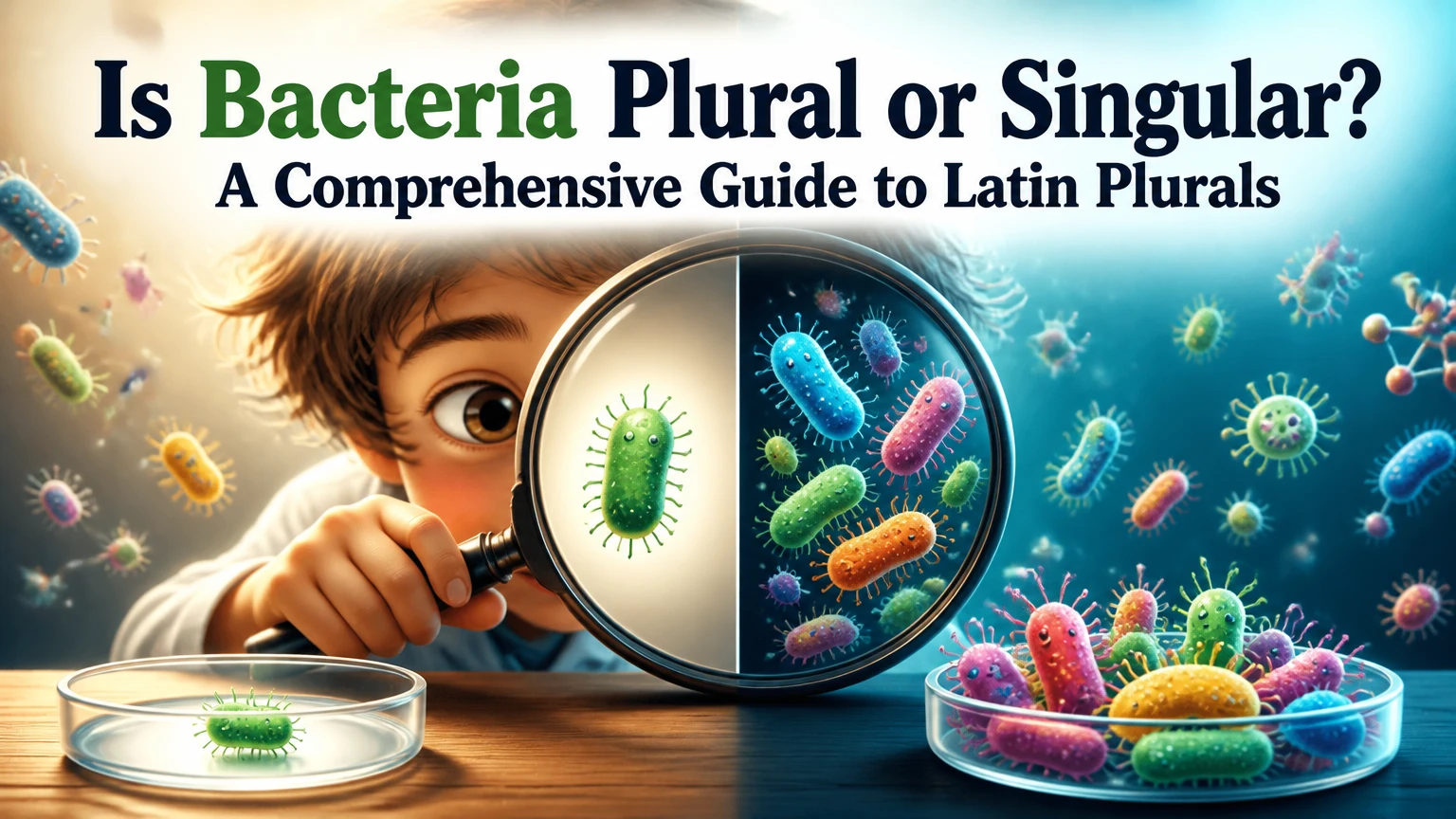
The singular form, bacterium, refers to one individual organism. In a laboratory setting, a scientist might isolate a single bacterium to study its DNA sequence. Conversely, bacteria refers to a colony, a group, or the entire species of these organisms. It is rare in daily life to deal with just one bacterium, which is why the plural form is much more common in our vocabulary.
Because we almost always encounter these organisms in the millions, the word bacteria has started to function like a “non-count” or “mass” noun in the minds of many speakers. Mass nouns, like information or furniture, take singular verbs. However, because bacteria is technically a count noun (you can count individual cells), it must remain plural in formal grammar. Treating bacteria as a singular noun is similar to saying “the students is here” instead of “the students are here.”
The choice between the two depends entirely on the quantity you are discussing. If you are pointing to a single cell under a microscope, use bacterium. If you are discussing the germs on a kitchen counter or the microbiome in the human gut, use bacteria. Using the correct form demonstrates a high level of linguistic precision and scientific literacy.
Comprehensive Usage Rules and Subject-Verb Agreement
The most important rule to remember is that bacteria requires a plural verb. This means using are, were, have, and do rather than is, was, has, and does. This rule applies regardless of whether you are talking about a specific group of bacteria or bacteria in general. For example, “The bacteria are spreading” is correct, while “The bacteria is spreading” is incorrect in formal writing.
Another rule involves the use of demonstrative adjectives. You should use these or those with bacteria, and this or that with bacterium. For instance, “These bacteria are resistant to penicillin” is the proper construction. Using “this bacteria” is a common solecism that should be avoided in professional environments. Similarly, when using pronouns, bacteria should be replaced by they or them, not it.
In some rare cases, particularly in informal British English or specific non-scientific contexts, bacteria is occasionally treated as a collective singular noun. However, this is not yet accepted by major style guides like APA, MLA, or Chicago. In these systems, the plural rule is absolute. If you are writing for a grade, a publication, or a professional audience, always treat the word as plural to ensure your work meets the highest standards of accuracy.
Bacteria in Scientific and Medical Writing
In the fields of microbiology, pathology, and epidemiology, the distinction between bacterium and bacteria is non-negotiable. Scientific writing demands exactness. If a researcher writes about “a new bacteria,” it suggests a lack of fundamental biological knowledge, as “a” is a singular article and “bacteria” is a plural noun. Instead, they should write “a new bacterium” or “a new species of bacteria.”
Scientific nomenclature also involves naming specific types of bacteria, such as Escherichia coli or Staphylococcus aureus. When referring to the species as a whole, the name is singular because “species” can be singular. However, when referring to the organisms themselves, they are bacteria. For example: “S. aureus is a species of bacteria that are often found on the skin.” Here, “is” refers to the species, and “are” refers to the bacteria.
Furthermore, medical professionals must be careful when communicating with patients. While a doctor might say “the bacteria in your system are clearing up” to be grammatically correct, they might find that patients use the word as a singular. Even so, the written medical record should always reflect the correct grammatical pluralization to maintain professional standards and clear communication between healthcare providers.
The Debate: Bacteria as a Collective Noun
There is an ongoing linguistic debate about whether bacteria is undergoing the same transition that the word data has undergone. For many years, data was strictly plural (the singular being datum). Today, data is widely accepted as a collective singular noun in many contexts (e.g., “The data is clear”). Some linguists argue that bacteria is following this path because we perceive a “colony” of bacteria as a single unit.
However, the transition for bacteria is much slower. This is likely because the singular bacterium is still frequently used in biology, whereas datum has almost entirely disappeared from common usage. Because the singular form remains active and necessary for scientific description, the plural form bacteria remains anchored to its plural status. Most grammarians currently reject the “collective noun” argument for bacteria in formal writing.
When you treat a noun as collective, you focus on the group as a single entity. While this makes sense for “the team” or “the family,” it is harder to apply to bacteria because they do not act with a single consciousness or purpose in the same way. They are simply a collection of individual organisms. Therefore, sticking to plural verbs is not only grammatically “safe” but also more logically consistent with the biological reality of the organisms.
Extensive Examples and Reference Tables
To help you master these concepts, the following tables provide a clear comparison of singular and plural forms, common usage patterns, and how to apply these rules in various sentences. These examples cover scientific, medical, and general contexts to provide a holistic view of the word’s application.
The table below illustrates the relationship between the singular bacterium and the plural bacteria across different sentence structures. Pay close attention to the verbs and adjectives that accompany each form.
| Singular Form (Bacterium) | Plural Form (Bacteria) | Grammar Rule Demonstrated |
|---|---|---|
| This bacterium is microscopic. | These bacteria are microscopic. | Subject-Verb Agreement (is/are) |
| The bacterium has a flagellum. | The bacteria have flagella. | Helping Verbs (has/have) |
| A single bacterium was found. | Many bacteria were found. | Quantity Modifiers (a/many) |
| That bacterium causes illness. | Those bacteria cause illness. | Demonstrative Adjectives (that/those) |
| It is a hardy bacterium. | They are hardy bacteria. | Pronoun Replacement (it/they) |
| The bacterium divides every hour. | The bacteria divide every hour. | Present Tense Conjugation |
| One bacterium was isolated. | Several bacteria were isolated. | Numerical Agreement |
| Every bacterium is unique. | All bacteria are unique. | Determiners (every/all) |
| The bacterium‘s cell wall is thick. | The bacteria‘s cell walls are thick. | Possessive Forms |
| Does this bacterium resist heat? | Do these bacteria resist heat? | Interrogative Structures (does/do) |
| Each bacterium was measured. | Both bacteria were measured. | Distributive vs. Dual Agreement |
| The bacterium survives in acid. | The bacteria survive in acid. | Action Verbs |
| A bacterium is a prokaryote. | Bacteria are prokaryotes. | Categorical Definitions |
| That bacterium is dangerous. | Those bacteria are dangerous. | Distance Modifiers |
| The bacterium was stained purple. | The bacteria were stained purple. | Passive Voice Agreement |
| This specific bacterium is rare. | These specific bacteria are rare. | Specificity Agreement |
| The bacterium moved toward the light. | The bacteria moved toward the light. | Past Tense (Unchanged) |
| I saw a bacterium under the lens. | I saw bacteria under the lens. | Direct Object Usage |
| The bacterium is rod-shaped. | The bacteria are rod-shaped. | Descriptive Adjectives |
| Only one bacterium survived. | No bacteria survived. | Negative/Positive Quantities |
The following table provides 20 examples of bacteria used correctly in various scientific and everyday contexts. This will help you see how the word fits naturally into complex sentences while maintaining plural agreement.
| # | Correct Usage of “Bacteria” (Plural) |
|---|---|
| 1 | The bacteria in the yogurt are beneficial for digestion. |
| 2 | Many bacteria thrive in warm, moist environments. |
| 3 | These bacteria have developed a resistance to common antibiotics. |
| 4 | The bacteria were visible only under a high-powered microscope. |
| 5 | Pathogenic bacteria cause a wide range of human diseases. |
| 6 | The bacteria are responsible for the fermentation process. |
| 7 | How many bacteria are present in this water sample? |
| 8 | Some bacteria can survive in extreme temperatures like volcanic vents. |
| 9 | The bacteria multiply rapidly when sugar is present. |
| 10 | Those bacteria belong to the genus Streptococcus. |
| 11 | Beneficial bacteria live in the human gut and help synthesize vitamins. |
| 12 | The bacteria found on the remote island were previously unknown. |
| 13 | Do these bacteria require oxygen to survive? |
| 14 | Nitrogen-fixing bacteria are essential for healthy soil. |
| 15 | The bacteria were killed by the high heat of the autoclave. |
| 16 | Ancient bacteria have been found trapped in Arctic ice. |
| 17 | The bacteria communicate through a process called quorum sensing. |
| 18 | Most bacteria are harmless to humans. |
| 19 | The bacteria were arranged in long chains called filaments. |
| 20 | Soil bacteria play a crucial role in decomposing organic matter. |
In contrast, the table below shows 20 examples of the singular bacterium used correctly. This is particularly useful for those writing lab reports or detailed scientific descriptions where individual organisms are the focus.
| # | Correct Usage of “Bacterium” (Singular) |
|---|---|
| 1 | A single bacterium can reproduce in as little as twenty minutes. |
| 2 | This bacterium is known for its ability to glow in the dark. |
| 3 | The bacterium was isolated from the patient’s blood sample. |
| 4 | Each bacterium has a circular chromosome of DNA. |
| 5 | Does this bacterium possess a protective capsule? |
| 6 | The bacterium uses its flagellum to swim through the liquid. |
| 7 | One bacterium was enough to start a new colony in the petri dish. |
| 8 | The bacterium is approximately two micrometers in length. |
| 9 | That bacterium is a common cause of food poisoning. |
| 10 | The bacterium’s cell wall is made of peptidoglycan. |
| 11 | A bacterium does not have a nucleus. |
| 12 | This particular bacterium thrives in highly acidic conditions. |
| 13 | The bacterium was observed under oil immersion. |
| 14 | Every bacterium in the sample was genetically identical. |
| 15 | Is this bacterium sensitive to penicillin? |
| 16 | The bacterium attaches itself to the host cell surface. |
| 17 | A bacterium is much smaller than a typical plant cell. |
| 18 | The bacterium was identified as a strain of E. coli. |
| 19 | That bacterium is moving very quickly across the slide. |
| 20 | The bacterium was killed by the immune system’s white blood cells. |
Usage Rules: Exceptions and Special Cases
While the rule “bacterium = singular, bacteria = plural” is the gold standard, language is rarely without its nuances. One area of confusion is the use of bacteria as an adjective. In phrases like “bacteria growth” or “bacteria levels,” the word acts as an attributive noun. In these cases, the plural form is usually preferred (e.g., “bacteria levels are high”) because it refers to the levels of many organisms, not just one.
Another special case involves the word “species.” In biology, the name of a species is always treated as a singular unit when referring to the classification. You would say, “The species Bacillus anthracis is dangerous.” However, if you are talking about the actual organisms, you would say, “The Bacillus anthracis bacteria are dangerous.” This distinction is subtle but important for scientific accuracy.
Interestingly, some non-scientific dictionaries have begun to acknowledge the “informal singular” use of bacteria. For example, Merriam-Webster notes that bacteria is sometimes used as a singular, but it includes a “usage note” warning that this is often criticized. If you are writing for a general blog or a casual social media post, you might get away with using it as a singular, but you should be aware that many readers will still perceive it as a mistake.
Common Mistakes and How to Avoid Them
The most frequent error is using bacteria with the singular verb is. This often happens because the speaker is thinking of the bacteria as a “mess” or a “substance” rather than a count of individuals. To avoid this, try replacing the word bacteria in your head with germs. Since you would never say “the germs is,” you will be reminded to say “the bacteria are.”
Another mistake is the creation of “double plurals” like bacterias. Because bacteria is already plural, adding an -s is redundant and incorrect. You will never find the word bacterias in a dictionary or a scientific paper. If you find yourself wanting to pluralize it further, remember that the “a” at the end has already done that job for you.
The table below highlights these common errors alongside their correct counterparts to help you visualize the differences.
| Incorrect Usage | Correct Usage | Explanation |
|---|---|---|
| The bacteria is spreading. | The bacteria are spreading. | Subject-verb agreement; bacteria is plural. |
| I saw a bacteria. | I saw a bacterium. | Use the singular form with the article “a”. |
| There are many bacterias. | There are many bacteria. | “Bacterias” is not a word. |
| This bacteria is harmful. | These bacteria are harmful. | Use plural demonstratives and verbs. |
| The bacterium are small. | The bacteria are small. | Bacterium is singular and cannot take “are”. |
| Each bacteria was tested. | Each bacterium was tested. | “Each” requires a singular noun. |
| The bacteria has died. | The bacteria have died. | Use plural “have” with bacteria. |
| It is a dangerous bacteria. | It is a dangerous bacterium. | Singular article and pronoun require bacterium. |
| That bacteria is blue. | Those bacteria are blue. | Use plural demonstratives. |
| Various bacterias were found. | Various bacteria were found. | Avoid the incorrect plural “bacterias”. |
Advanced Topics: Other Latin Neuter Plurals
To truly master the usage of bacteria, it helps to understand the broader category of Latin-derived nouns in English. Bacteria is part of a family of words that follow the -um to -a transformation. By learning these as a group, the rule for bacteria becomes second nature. This is particularly helpful for students preparing for the SAT, GRE, or medical school entrance exams.
Consider the word data. In formal contexts, data is the plural of datum. While “the data are” is still the standard in academic statistics, “the data is” has become the norm in tech and business. Bacteria has not yet made this jump, but the comparison is useful. Similarly, criteria is the plural of criterion, and phenomena is the plural of phenomenon. Notice how the “a” ending consistently signals a plural state across different fields of study.
The table below provides a reference for these similar Latin and Greek plurals. Understanding this pattern will improve your overall vocabulary and grammatical precision across multiple disciplines.
| Singular (-um / -on) | Plural (-a) | Example Sentence (Plural) |
|---|---|---|
| Bacterium | Bacteria | The bacteria are growing in the dish. |
| Datum | Data | The data are being analyzed now. |
| Criterion | Criteria | Several criteria were used for selection. |
| Phenomenon | Phenomena | Natural phenomena are often unpredictable. |
| Medium | Media | The news media are covering the story. |
| Stratum | Strata | Social strata exist in every culture. |
| Curriculum | Curricula | The school curricula were updated recently. |
| Memorandum | Memoranda | All memoranda have been filed. |
| Addendum | Addenda | The addenda are listed at the end. |
| Ovum | Ova | The ova were fertilized in the lab. |
| Symposium | Symposia | International symposia are held annually. |
| Millennium | Millennia | Many millennia have passed since then. |
| Spectrum | Spectra | The light spectra were measured accurately. |
| Desideratum | Desiderata | The desiderata were clearly outlined. |
| Automaton | Automata | The automata are programmed to move. |
Practice Exercises and Knowledge Checks
Now that we have covered the rules, history, and examples, it is time to test your knowledge. These exercises range from simple identification to complex sentence correction. Answers are provided at the end of the section to help you track your progress.
Exercise 1: Fill in the Blanks
Choose the correct word (bacterium or bacteria) and the correct verb form (is/are, has/have) to complete the sentences below.
- That single __________ (bacterium/bacteria) __________ (is/are) moving toward the sugar.
- Many __________ (bacterium/bacteria) __________ (has/have) developed resistance to this drug.
- The __________ (bacterium/bacteria) in this sample __________ (is/are) harmless.
- Every __________ (bacterium/bacteria) __________ (has/have) a unique genetic code.
- How many __________ (bacterium/bacteria) __________ (is/are) on your hands right now?
- This __________ (bacterium/bacteria) __________ (is/are) known as E. coli.
- The __________ (bacterium/bacteria) __________ (was/were) killed by the disinfectant.
- A __________ (bacterium/bacteria) __________ (does/do) not have a nucleus.
- Those __________ (bacterium/bacteria) __________ (is/are) rod-shaped.
- The __________ (bacterium/bacteria) __________ (has/have) been spreading for days.
Exercise 2: Sentence Correction
Identify the error in each sentence and rewrite it correctly. If the sentence is already correct, write “Correct.”
- The bacterias in the water is making people sick.
- I isolated a bacteria from the soil sample yesterday.
- These bacteria have a very fast reproductive cycle.
- Every bacteria in the colony is identical to its parent.
- That bacteria is the one that causes strep throat.
- The bacteria was visible under the microscope.
- There are several different types of bacterium in the gut.
- Does this bacteria require oxygen to survive?
- The bacteria has been stained for better visibility.
- All the bacteria in the dish are dead.
Answer Key
| Exercise 1 Answers | Exercise 2 Answers |
|---|---|
| 1. bacterium, is | 1. The bacteria in the water are… |
| 2. bacteria, have | 2. I isolated a bacterium from… |
| 3. bacteria, are | 3. Correct. |
| 4. bacterium, has | 4. Every bacterium in the colony is… |
| 5. bacteria, are | 5. That bacterium is… or Those bacteria are… |
| 6. bacterium, is | 6. The bacteria were… or The bacterium was… |
| 7. bacteria, were | 7. …different types of bacteria… |
| 8. bacterium, does | 8. Does this bacterium… or Do these bacteria… |
| 9. bacteria, are | 9. The bacteria have been… |
| 10. bacteria, have | 10. Correct. |
Frequently Asked Questions (FAQ)
1. Is it ever okay to use “bacteria” as a singular noun?
In casual, spoken English, many people use bacteria as a singular noun. However, in any formal writing—including school essays, business reports, and scientific papers—it is considered a mistake. To be safe and professional, always treat bacteria as plural and bacterium as singular.
2. Why don’t we just say “bacterias”?
Because bacteria is already the plural form of the Latin word bacterium. In Latin, the “a” ending functions just like the “s” ending in English. Adding an “s” to bacteria would be like saying “childrens” or “peoples”—it’s a “double plural” and is grammatically incorrect.
3. How do I remember which one is which?
A simple trick is to look at the end of the word. Bacteri-UM ends in “UM,” which sounds like “one” (if you stretch your imagination slightly). Bacteri-A ends in “A,” which is the first letter of “All” or “A lot.” This can help you associate -um with the singular and -a with the plural.
4. Is “data” the same as “bacteria”?
Grammatically, yes. Both are Latin neuter plurals. However, in modern English, data is much more commonly accepted as a singular mass noun than bacteria is. While you might get away with “the data is,” you are much more likely to be corrected for saying “the bacteria is.”
5. What about “antibiotics”? Does that affect the grammar?
No, antibiotics is a standard English plural (singular: antibiotic). When using them together, you might say, “This antibiotic kills these bacteria.” Here, you are using a singular medicine to kill multiple organisms, so the grammar reflects that relationship.
6. Is “microbe” the same as “bacterium”?
Not exactly. Microbe is a general term that includes bacteria, viruses, fungi, and protozoa. Microbe follows standard English rules (microbe/microbes). Bacterium is a specific type of microbe and follows Latin rules. You can have one microbe or many microbes, but you have one bacterium or many bacteria.
7. Can “bacteria” be a collective noun?
While some argue that a colony of bacteria acts as a single unit, most grammarians do not yet accept bacteria as a collective noun. Unlike “team” or “flock,” bacteria is still treated as a count noun in formal English, requiring plural verbs and pronouns.
8. What is the plural of “virus”?
Unlike bacterium, virus is not a second-declension neuter noun in the same way. The plural of virus in English is viruses. It does not become “vira.” This is a common point of confusion, but bacteria and viruses follow different rules because of their specific linguistic histories.
Conclusion and Final Tips
The distinction between bacterium and bacteria is a classic example of how Latin continues to influence modern English. While it may seem like a small detail, using these terms correctly is a hallmark of clear, professional, and scientifically accurate communication. Remember the golden rule: bacterium is for one, and bacteria is for many. Always pair bacteria with plural verbs like are and have, and avoid the temptation to add an “s” to make it “bacterias.”
To master this, pay attention to these words when you read scientific news or textbooks. You will notice that experts are very consistent in their usage. If you are ever in doubt, try substituting the word with “germs”—if “germs” sounds right, use the plural bacteria. With a little practice, navigating these Latin plurals will become a natural part of your writing repertoire, ensuring your work remains authoritative and grammatically sound.