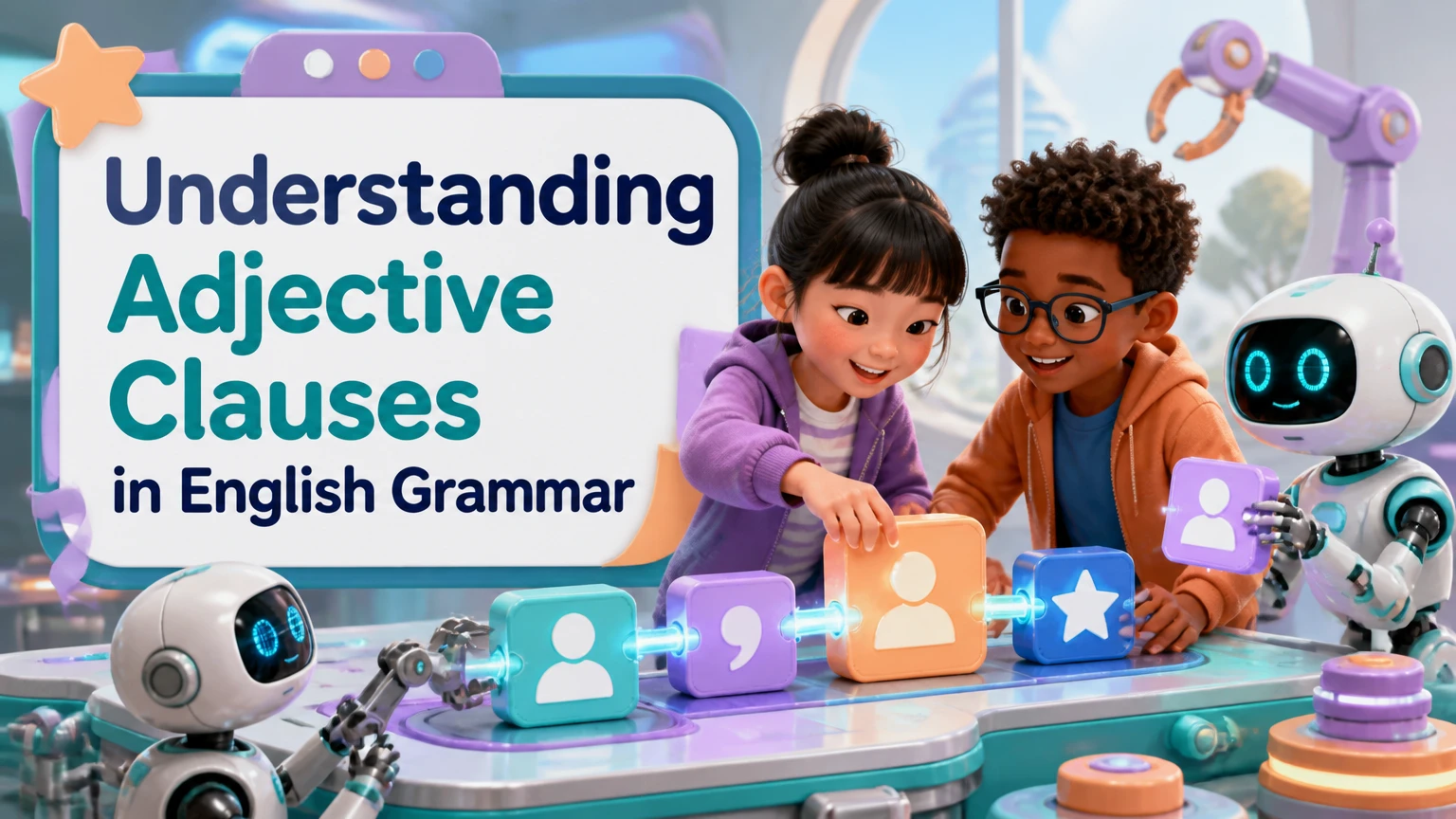
Adjective clauses, also known as relative clauses, are dependent clauses that modify nouns or pronouns. Like adjectives such as beautiful, tall, or expensive, adjective clauses provide additional information about the nouns they describe. These clauses begin with relative pronouns like who, whom, which, that, or relative adverbs like where, when, and why. Mastering adjective clauses is crucial for constructing complex and descriptive sentences, enhancing writing clarity, and achieving a more sophisticated level of English communication. Anyone aiming to improve their grammar skills, from students to professionals, will benefit from a solid understanding of adjective clauses.
Table of Contents
- Definition of Adjective Clauses
- Structural Breakdown of Adjective Clauses
- Types of Adjective Clauses
- Examples of Adjective Clauses
- Usage Rules for Adjective Clauses
- Common Mistakes with Adjective Clauses
- Practice Exercises
- Advanced Topics in Adjective Clauses
- Frequently Asked Questions (FAQ)
- Conclusion
Definition of Adjective Clauses
An adjective clause is a dependent clause that modifies a noun or pronoun in the main clause of a sentence. It functions like an adjective, providing additional information or description about the noun it modifies. Because it is a clause, it contains a subject and a verb. Adjective clauses are also known as relative clauses because they typically begin with a relative pronoun (who, whom, which, that) or a relative adverb (where, when, why). The relative pronoun or adverb connects the adjective clause to the noun or pronoun it modifies, which is called the antecedent.
For instance, in the sentence “The book that I borrowed from the library is very interesting,” the phrase “that I borrowed from the library” is an adjective clause. It modifies the noun “book” by specifying which book is being referred to. Note that the adjective clause contains a subject (“I”) and a verb (“borrowed”).
Adjective clauses can appear directly after the noun they modify or be separated from it by other words, depending on the sentence structure. Their primary role is to add detail and specificity to the noun or pronoun, thereby enriching the overall meaning of the sentence. Without adjective clauses, our sentences would be less descriptive and more generic.
Structural Breakdown of Adjective Clauses
The basic structure of an adjective clause includes a relative pronoun or adverb, a subject (which may be the relative pronoun itself), and a verb. The relative pronoun or adverb links the adjective clause to the noun or pronoun it modifies (the antecedent). Here’s a breakdown of the components:
- Relative Pronouns: who (for people), whom (for people, object form), which (for things), that (for people or things).
- Relative Adverbs: where (for places), when (for times), why (for reasons).
- Subject: The person or thing performing the action in the clause.
- Verb: The action being performed in the clause.
The structure can be represented as follows:
Noun (Antecedent) + Relative Pronoun/Adverb + Subject + Verb (+ Additional Information)
Let’s look at some examples to illustrate this structure:
- The man who helped me was very kind. (who = relative pronoun, helped = verb)
- The house where I lived is now a museum. (where = relative adverb, I = subject, lived = verb)
- The book that she wrote became a bestseller. (that = relative pronoun, she = subject, wrote = verb)
In some cases, the relative pronoun can be omitted, particularly when it functions as the object of the verb in the adjective clause. For example:
- The book (that) I read was fascinating.
Understanding this structure is crucial for both identifying and constructing adjective clauses correctly. The relative pronoun or adverb acts as the bridge connecting the clause to the noun it describes, making sentences more detailed and informative.
Types of Adjective Clauses
There are two main types of adjective clauses: restrictive (or essential) and nonrestrictive (or nonessential). The key difference lies in whether the clause is necessary to identify the noun it modifies. Restrictive clauses are essential for identifying the noun, while nonrestrictive clauses provide additional, but not essential, information.
Restrictive (Essential) Adjective Clauses
A restrictive adjective clause is essential to the meaning of the sentence because it identifies or limits the noun it modifies. If a restrictive clause is removed, the meaning of the sentence changes significantly or becomes unclear. These clauses are not set off by commas.
For example, in the sentence “The students who study hard get good grades,” the clause “who study hard” is restrictive. It specifies which students are being referred to – only those who study hard. Without this clause, we wouldn’t know which students the sentence is talking about.
Key characteristics of restrictive adjective clauses:
- Essential to the meaning of the sentence.
- Not set off by commas.
- Identifies or limits the noun it modifies.
Nonrestrictive (Nonessential) Adjective Clauses
A nonrestrictive adjective clause provides additional information about the noun it modifies, but this information is not essential for identifying the noun. If a nonrestrictive clause is removed, the basic meaning of the sentence remains the same. These clauses are always set off by commas.
For example, in the sentence “My sister, who lives in London, is a doctor,” the clause “who lives in London” is nonrestrictive. It provides extra information about the sister, but it’s not necessary to identify her. We already know who the sentence is talking about – “My sister.”
Key characteristics of nonrestrictive adjective clauses:
- Provides additional, nonessential information.
- Set off by commas.
- Does not limit or identify the noun, simply adds detail.
The choice between using a restrictive or nonrestrictive clause depends on whether the information is essential for identifying the noun. Correct punctuation is crucial for distinguishing between the two types.
Examples of Adjective Clauses
To further illustrate the use of adjective clauses, let’s look at several examples organized by type and relative pronoun/adverb.
Restrictive Adjective Clause Examples
These examples demonstrate how restrictive adjective clauses are essential for identifying the nouns they modify. Note that no commas are used in these sentences.
The following table provides 20 examples of restrictive adjective clauses used in sentences.
| Sentence | Adjective Clause | Noun Modified |
|---|---|---|
| The book that I borrowed from the library is overdue. | that I borrowed from the library | book |
| The man who called earlier wants to speak with you. | who called earlier | man |
| The car which I bought last year is already having problems. | which I bought last year | car |
| The movie that we watched last night was terrifying. | that we watched last night | movie |
| The student who scored the highest on the exam received a scholarship. | who scored the highest on the exam | student |
| The restaurant where we had dinner last week is now closed. | where we had dinner last week | restaurant |
| The reason why I am late is because of the traffic. | why I am late | reason |
| The person who sent this package forgot to include a return address. | who sent this package | person |
| The song that is playing on the radio is my favorite. | that is playing on the radio | song |
| The phone which I just bought has a cracked screen. | which I just bought | phone |
| The teacher who taught us history is retiring this year. | who taught us history | teacher |
| The house that has the blue door is for sale. | that has the blue door | house |
| The coffee that I made this morning was too strong. | that I made this morning | coffee |
| The shoes which I wore to the party were uncomfortable. | which I wore to the party | shoes |
| The project that we are working on is due next week. | that we are working on | project |
| The city where I grew up is very different now. | where I grew up | city |
| The time when I feel most creative is in the morning. | when I feel most creative | time |
| The problem that we are facing is lack of funding. | that we are facing | problem |
| The solution that they proposed seems promising. | that they proposed | solution |
| The game that everyone is playing is very addictive. | that everyone is playing | game |
Nonrestrictive Adjective Clause Examples
These examples illustrate how nonrestrictive adjective clauses provide additional, nonessential information about the nouns they modify. Note that commas are used to set off these clauses.
The following table provides 20 examples of nonrestrictive adjective clauses used in sentences.
| Sentence | Adjective Clause | Noun Modified |
|---|---|---|
| My mother, who is a teacher, loves to read. | who is a teacher | mother |
| Paris, which is the capital of France, is a beautiful city. | which is the capital of France | Paris |
| My car, which is very old, still runs well. | which is very old | car |
| The Eiffel Tower, which is a famous landmark, attracts millions of tourists. | which is a famous landmark | Eiffel Tower |
| My brother, who is a doctor, works at the local hospital. | who is a doctor | brother |
| London, where I used to live, is a vibrant city. | where I used to live | London |
| The book, which I found at a used bookstore, is a first edition. | which I found at a used bookstore | book |
| My dog, who is very friendly, loves to play with children. | who is very friendly | dog |
| The movie, which was directed by Steven Spielberg, is a classic. | which was directed by Steven Spielberg | movie |
| My house, which is located near the beach, has a beautiful view. | which is located near the beach | house |
| My grandmother, who is 90 years old, is still very active. | who is 90 years old | grandmother |
| Rome, which is known for its ancient ruins, is a popular tourist destination. | which is known for its ancient ruins | Rome |
| My favorite restaurant, which is just around the corner, serves delicious pasta. | which is just around the corner | restaurant |
| The concert, which was held outdoors, was amazing. | which was held outdoors | concert |
| My neighbor, who is a talented musician, plays the piano beautifully. | who is a talented musician | neighbor |
| The park, where I often go for walks, is very peaceful. | where I often go for walks | park |
| My office, which is on the top floor, has a great view of the city. | which is on the top floor | office |
| The museum, which is open every day, has a fascinating collection of artifacts. | which is open every day | museum |
| My best friend, who I have known since childhood, is getting married next year. | who I have known since childhood | best friend |
| The garden, which is full of colorful flowers, attracts many bees and butterflies. | which is full of colorful flowers | garden |
Adjective Clauses with Different Relative Pronouns/Adverbs
This section provides examples of adjective clauses using various relative pronouns and adverbs.
The following table provides 20 examples of adjective clauses using various relative pronouns and adverbs.
| Relative Pronoun/Adverb | Sentence | Adjective Clause | Noun Modified |
|---|---|---|---|
| Who | The woman who lives next door is a doctor. | who lives next door | woman |
| Whom | The person whom I spoke to was very helpful. | whom I spoke to | person |
| Which | The car which is parked outside is mine. | which is parked outside | car |
| That | The book that I recommended is out of stock. | that I recommended | book |
| Where | The city where I was born is very different now. | where I was born | city |
| When | The day when we met was a sunny afternoon. | when we met | day |
| Why | The reason why I am late is because of the traffic. | why I am late | reason |
| Whose | The student whose essay won the competition is very talented. | whose essay won the competition | student |
| Who | The teacher who gave the lecture is an expert in the field. | who gave the lecture | teacher |
| Whom | The candidate whom the committee selected has extensive experience. | whom the committee selected | candidate |
| Which | The painting which hangs in the gallery is a masterpiece. | which hangs in the gallery | painting |
| That | The idea that you suggested is worth considering. | that you suggested | idea |
| Where | The restaurant where we celebrated our anniversary has closed down. | where we celebrated our anniversary | restaurant |
| When | The year when the Berlin Wall fell was a turning point in history. | when the Berlin Wall fell | year |
| Why | The explanation why he resigned remains a mystery. | why he resigned | explanation |
| Whose | The author whose book I admire is giving a lecture tonight. | whose book I admire | author |
| Who | The actor who played the lead role received critical acclaim. | who played the lead role | actor |
| Whom | The artist whom I interviewed is exhibiting their work next month. | whom I interviewed | artist |
| Which | The song which became a hit was originally a B-side. | which became a hit | song |
| That | The claim that she made was later proven false. | that she made | claim |
Usage Rules for Adjective Clauses
Using adjective clauses correctly involves several rules regarding the choice of relative pronouns/adverbs and punctuation. Here are some key guidelines:
- Use who and whom for people: Who is used as the subject of the clause (e.g., “The man who is speaking is my boss”). Whom is used as the object of the verb or preposition in the clause (e.g., “The person to whom I gave the letter was very grateful”). In informal English, who is often used instead of whom.
- Use which for things: Which is used to modify nouns that are not people (e.g., “The car which I bought is very reliable”).
- Use that for people or things: That can be used in place of who or which in restrictive clauses (e.g., “The book that I read was fascinating”). However, that cannot be used in nonrestrictive clauses.
- Use where for places: Where is used to modify nouns that refer to locations (e.g., “The city where I live is very vibrant”).
- Use when for times: When is used to modify nouns that refer to times (e.g., “The day when we met was unforgettable”).
- Use why for reasons: Why is used to modify the noun “reason” (e.g., “The reason why I am late is because of traffic”).
- Punctuation is crucial: Use commas to set off nonrestrictive clauses, but do not use commas with restrictive clauses.
- Omission of relative pronouns: In some cases, the relative pronoun can be omitted, especially when it is the object of the verb in the adjective clause (e.g., “The book I read was interesting” – here, “that” is omitted).
Adhering to these rules will help ensure that your use of adjective clauses is grammatically correct and clear.
Common Mistakes with Adjective Clauses
Several common mistakes can occur when using adjective clauses. Recognizing these errors can help you avoid them in your writing.
The following table provides examples of common errors in using adjective clauses, along with corrections.
| Incorrect | Correct | Explanation |
|---|---|---|
| The book, that I borrowed, is interesting. | The book that I borrowed is interesting. | “That” should not be used with commas in a restrictive clause. |
| My sister who lives in London, is a doctor. | My sister, who lives in London, is a doctor. | A nonrestrictive clause requires commas. |
| The reason because I am late is traffic. | The reason why I am late is traffic. | Use “why” instead of “because” after “reason.” |
| The city which I grew up is beautiful. | The city where I grew up is beautiful. | Use “where” to refer to places. |
| The man whom is standing over there is my boss. | The man who is standing over there is my boss. | “Who” is used as the subject of the clause. |
| The car, that I bought last year, is red. | The car that I bought last year is red. | Restrictive clauses should not be set off by commas when using “that”. |
| My friend, that I met in college, is visiting me. | My friend, who I met in college, is visiting me. | “That” cannot be used in nonrestrictive clauses referring to people. |
| The house where it is located near the park is for sale. | The house which is located near the park is for sale. | Avoid redundant use of “it is” with “where.” Use “which” instead. |
| The time when I feel most relaxed, is in the morning. | The time when I feel most relaxed is in the morning. | Avoid unnecessary commas within a restrictive clause. |
| The person to who I gave the package was grateful. | The person to whom I gave the package was grateful. | Use “whom” as the object of a preposition. |
| The reason, why I am upset, is because of the delay. | The reason I am upset is because of the delay. | Avoid unnecessary commas and redundant use of “why.” |
| The student whose he got the highest score won a prize. | The student who got the highest score won a prize. | Do not use “he” after “whose.” |
| My hometown, that is very small, is in California. | My hometown, which is very small, is in California. | Use “which” in nonrestrictive clauses. |
| The movie what I watched last night was scary. | The movie that I watched last night was scary. | Use “that” instead of “what” to introduce the adjective clause. |
| The day when I graduate, will be a happy one. | The day when I graduate will be a happy one. | Avoid unnecessary commas within the sentence. |
| The teacher who’s class I enjoy the most is retiring. | The teacher whose class I enjoy the most is retiring. | Use “whose” to show possession. |
| The gift whom I received was beautiful. | The gift which I received was beautiful. | Use “which” for things. |
| The building, where I work at, is very old. | The building where I work is very old. | Do not use “at” after “where” when it refers to a place of work or residence. |
| The book, that she wrote, became a bestseller. | The book that she wrote became a bestseller. | Restrictive clause, so no comma needed with “that”. |
| The person, whom helped me, was very kind. | The person who helped me was very kind. | “Who” is used as the subject of the clause. |
By being aware of these common errors, you can ensure that your adjective clauses are accurate and effectively convey your intended meaning.
Practice Exercises
Test your understanding of adjective clauses with these exercises. Identify the adjective clause in each sentence and state whether it is restrictive or nonrestrictive. Add commas where necessary.
Exercise 1: Identifying Adjective Clauses
| Question | Your Answer | Correct Answer |
|---|---|---|
| 1. The car that is parked outside is mine. | Adjective Clause: that is parked outside; Type: Restrictive | |
| 2. My sister who lives in London is a doctor. | Adjective Clause: who lives in London; Type: Nonrestrictive (requires commas) | |
| 3. The book which I borrowed from the library is overdue. | Adjective Clause: which I borrowed from the library; Type: Restrictive | |
| 4. The Eiffel Tower which is a famous landmark attracts many tourists. | Adjective Clause: which is a famous landmark; Type: Nonrestrictive (requires commas) | |
| 5. The student who studies hard gets good grades. | Adjective Clause: who studies hard; Type: Restrictive | |
| 6. My dog who is very friendly loves to play with children. | Adjective Clause: who is very friendly; Type: Nonrestrictive (requires commas) | |
| 7. The movie that we watched last night was terrifying. | Adjective Clause: that we watched last night; Type: Restrictive | |
| 8. My house which is located near the beach has a beautiful view. | Adjective Clause: which is located near the beach; Type: Nonrestrictive (requires commas) | |
| 9. The man who called earlier wants to speak with you. | Adjective Clause: who called earlier; Type: Restrictive | |
| 10. My grandmother who is 90 years old is still very active. | Adjective Clause: who is 90 years old; Type: Nonrestrictive (requires commas) |
Exercise 2: Completing Sentences with Adjective Clauses
Complete the following sentences by adding an appropriate adjective clause. Indicate whether the clause is restrictive or nonrestrictive.
| Question | Your Answer | Example Answer |
|---|---|---|
| 1. The teacher, __________, is retiring next year. | The teacher, who has taught here for 20 years, is retiring next year. (Nonrestrictive) | |
| 2. The car __________ is very expensive. | The car that I want to buy is very expensive. (Restrictive) | |
| 3. Paris, __________, is a popular tourist destination. | Paris, which is known for its beautiful architecture, is a popular tourist destination. (Nonrestrictive) | |
| 4. The students __________ will receive an award. | The students who scored the highest on the test will receive an award. (Restrictive) | |
| 5. My friend, __________, is visiting me next week. | My friend, who I haven’t seen in years, is visiting me next week. (Nonrestrictive) | |
| 6. The house __________ is on sale. | The house that has a red door is on sale. (Restrictive) | |
| 7. My dog, __________, loves to play fetch. | My dog, who is a golden retriever, loves to play fetch. (Nonrestrictive) | |
| 8. The movie __________ was directed by Christopher Nolan. | The movie that I watched last night was directed by Christopher Nolan. (Restrictive) | |
| 9. My neighbor, __________, is a talented artist. | My neighbor, who lives across the street, is a talented artist. (Nonrestrictive) | |
| 10. The book __________ is a bestseller. | The book that she wrote is a bestseller. (Restrictive) |
Advanced Topics in Adjective Clauses
For advanced learners, there are more complex aspects of adjective clauses to explore. These include reduced adjective clauses and the use of prepositional phrases within adjective clauses.
- Reduced Adjective Clauses: These are adjective clauses that have been shortened, often by omitting the relative pronoun and the auxiliary verb “be.” For example, “The book that is lying on the table is mine” can be reduced to “The book lying on the table is mine.” This is common with present participle phrases.
- Prepositional Phrases in Adjective Clauses: Adjective clauses can include prepositional phrases to add more detail. For example, “The person to whom I spoke was very helpful.” Here, “to whom” includes the preposition “to.”
Understanding these advanced topics can further refine your understanding and use of adjective clauses, allowing for more concise and sophisticated writing.
Frequently Asked Questions (FAQ)
Here are some frequently asked questions about adjective clauses:
- What is the difference between an adjective clause and an adjective phrase?
An adjective clause contains a subject and a verb, while an adjective phrase does not. An adjective clause is a dependent clause that modifies a noun or pronoun, whereas an adjective phrase is a group of words that functions as an adjective but lacks a subject and a verb.
- Can I use “that” in nonrestrictive clauses?
No, “that” cannot be used in nonrestrictive clauses. Use “who” or “which” instead.
- When can I omit the relative pronoun in an adjective clause?
You can omit the relative pronoun when it functions as the object of the verb in the adjective clause. For example, “The book I read was interesting” (where “that” is omitted).
- How do I know if an adjective clause is restrictive or nonrestrictive?
If the clause is essential for identifying the noun, it is restrictive and does not need commas. If the clause provides additional, nonessential information, it is nonrestrictive and requires commas.
- What is the function of a relative adverb in an adjective clause?
A relative adverb (where, when, why) connects the adjective clause to the noun it modifies and provides information about place, time, or reason, respectively.
- Why is punctuation important with adjective clauses?
Punctuation, specifically the use of commas, is crucial because it distinguishes between restrictive and nonrestrictive clauses. Incorrect punctuation can change the meaning of the sentence.
- Can an adjective clause modify a pronoun?
Yes, an adjective clause can modify a pronoun. For example: “Those who are interested should sign up now.”
- What is a reduced adjective clause?
A reduced adjective clause is a shortened form of an adjective clause, often omitting the relative pronoun and the auxiliary verb “be.” For example: “The book lying on the table is mine.”
Conclusion
Adjective clauses are essential tools for adding detail and clarity to your writing. By understanding the different types of adjective clauses—restrictive and nonrestrictive—and mastering the rules for their use, you can significantly improve your English grammar skills. Remember to choose the correct relative pronouns and adverbs, pay close attention to punctuation, and practice identifying and constructing adjective clauses in various contexts. Mastering adjective clauses such as that define, which clarify, and who specify, enhances your ability to express complex ideas with precision. With consistent practice, you’ll be able to use adjective clauses confidently and effectively in your writing and speaking.