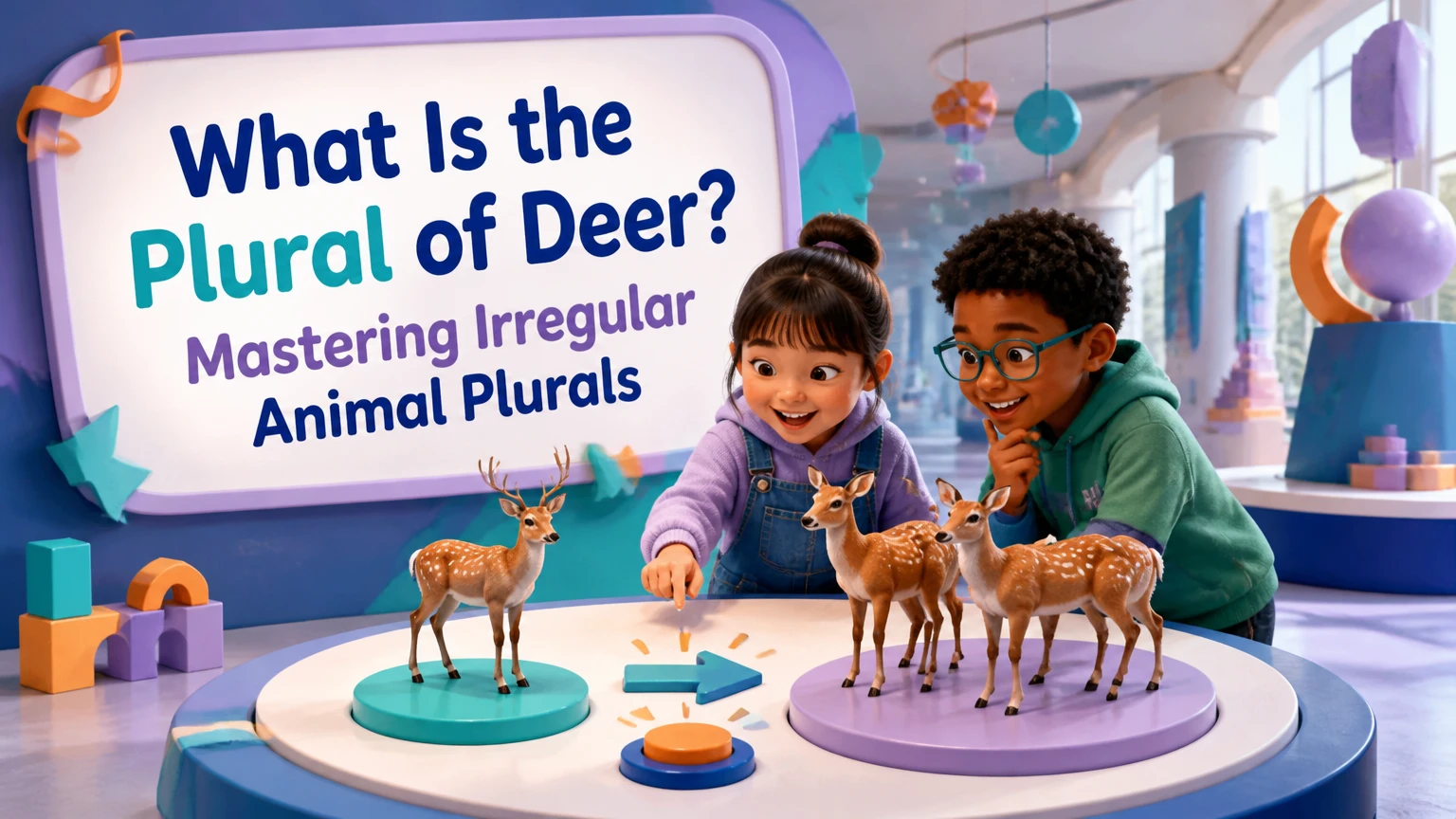
The English language is famous for its intricate rules and even more famous for the exceptions that seem to break those rules at every turn. When discussing forest wildlife, many learners and native speakers alike find themselves questioning whether to say “deer” or “deers” when referring to more than one animal. This linguistic phenomenon belongs to a category known as zero plurals, where the singular and plural forms of a noun are identical, such as deer, sheep, fish, bison, and moose. Understanding these nuances is essential for anyone looking to achieve a high level of grammatical precision, from students writing academic essays to creative writers describing natural landscapes. By mastering these irregular forms, you can communicate more naturally and avoid the common pitfalls that often confuse those navigating the complexities of English morphology.
Table of Contents
- Definition and Linguistic Classification
- Structural Breakdown of the Word “Deer”
- Historical Context: Why Is It Not “Deers”?
- Types of Plurals in English
- Deer vs. Deers: When (If Ever) to Use “Deers”
- Extensive Examples and Tables
- Comprehensive Usage Rules
- Common Mistakes and How to Avoid Them
- Collective Nouns for Deer
- Practice Exercises and Worksheets
- Advanced Topics: Dialect and Style
- Frequently Asked Questions (FAQ)
- Conclusion
Definition and Linguistic Classification
The word deer refers to any of the ruminant mammals of the family Cervidae, which are characterized by having deciduous antlers, usually in the males only. In grammatical terms, “deer” is a count noun, meaning it represents an entity that can be counted as individual units. However, it is specifically categorized as an invariant noun or a zero plural noun. This means that the morphological structure of the word does not change regardless of whether the quantity is singular or plural.
In most English nouns, we indicate plurality by adding a suffix, typically “-s” or “-es.” For example, one “cat” becomes two “cats.” However, deer belongs to a small, elite group of words that resisted this change throughout the evolution of Middle English. Linguistically, this is often tied to the Old English neuter strong declension, where certain words did not take a plural ending in the nominative and accusative cases.
Functionally, the word “deer” serves as both the subject and the object in sentences, and its number (singular or plural) is determined by the context, the accompanying articles, or the verb conjugation. If you say “The deer is eating,” you are referring to one animal. If you say “The deer are eating,” you are referring to multiple animals. This reliance on syntax over morphology is a hallmark of the English language’s Germanic roots.
Structural Breakdown of the Word “Deer”
To understand why “deer” remains “deer,” we must look at its structural elements. Phonetically, it is a single-syllable word (/dɪər/) consisting of a voiced dental stop, a high front vowel (or diphthong depending on dialect), and a liquid “r.” Structurally, it lacks any pluralizing morpheme. In standard English, the plural “deer” is considered the “unmarked” plural form.
When we break down the word in a sentence, we look at the Determiner + Noun + Verb agreement. Because the noun itself does not change, the determiner (like “a,” “that,” “those,” or “many”) and the verb provide the necessary clues for the reader. This is known as agreement or concord. If the determiner is “that,” the noun is singular; if it is “those,” the noun is plural.
Furthermore, “deer” is a generic noun when used to describe the species as a whole. For instance, in the sentence “The deer is a graceful animal,” the speaker might be referring to the entire species rather than one specific individual. This adds another layer of complexity to its usage, as the singular form can represent a collective concept.
Historical Context: Why Is It Not “Deers”?
The history of the word “deer” is fascinating. In Old English, the word was dēor, which actually meant “beast” or “animal” in a general sense. It is cognate with the German word Tier and the Dutch word dier, both of which still mean “animal.” Over time, the meaning of the English word narrowed—a process called semantic narrowing—to refer specifically to the antlered family of Cervidae.
During the transition from Old English to Middle English, many nouns began to adopt the “-s” plural ending, which was originally used for only one class of masculine nouns. However, words that were neuter in Old English, like dēor and scēap (sheep), frequently maintained their zero plural forms. While most words eventually succumbed to the “s” trend, several common animals used for food or hunting kept their original invariant forms.
This preservation is often seen in words associated with hunting or the “wild.” In historical hunting culture, many animals were referred to in the singular even when discussed in bulk. This tradition has survived into modern English, leaving us with a list of exceptions that students must memorize, as they no longer follow the standard evolutionary path of the language.
Types of Plurals in English
To understand where “deer” fits, we must categorize the different ways English handles plurals. English plurals are generally divided into regular and irregular forms. Regular plurals follow predictable patterns, while irregular plurals require specific knowledge of the word’s history or category.
The following table outlines the main categories of plurals in English to provide perspective on the “deer” exception.
| Category | Rule | Examples |
|---|---|---|
| Regular Plurals | Add -s or -es | Dogs, Boxes, Trees, Lamps, Phones |
| Zero Plurals (Invariant) | No change from singular | Deer, Sheep, Moose, Series, Species |
| Vowel Mutation (Ablaut) | Change the internal vowel | Man/Men, Goose/Geese, Tooth/Teeth |
| En-Plurals | Add -en suffix | Child/Children, Ox/Oxen |
| Latin/Greek Roots | Follow original language rules | Cactus/Cacti, Datum/Data, Thesis/Theses |
| F to V Change | Change -f/-fe to -ves | Leaf/Leaves, Knife/Knives, Wolf/Wolves |
As seen in the table above, “deer” falls into the Zero Plurals category. This category is relatively small but contains some of the most frequently used words in the English language. Mastery of this group is a hallmark of an advanced English speaker.
Deer vs. Deers: When (If Ever) to Use “Deers”
One of the most common questions is: “Is ‘deers’ ever correct?” The short answer is no in standard modern English. If you are writing a formal essay, a news report, or a business email, you should always use “deer” as the plural. However, like many rules in English, there is a very specific, technical exception.
In scientific or biological contexts, “deers” is occasionally used when referring to multiple species of deer. For example, if a biologist is studying the differences between Whitetail deer, Mule deer, and Reindeer, they might write about “the various deers of North America.” This follows the same logic as “fishes” or “fruits,” which are used when discussing different varieties or species rather than multiple individuals of the same type.
Despite this technical exception, “deers” is often perceived as a grammatical error or “child speak” in everyday conversation. For 99% of situations, “deer” is the only correct choice. Using “deers” in a casual conversation about a group of animals in a field will likely result in a correction from a teacher or a confused look from a native speaker.
Extensive Examples and Tables
To truly master the use of “deer,” it is helpful to see it used in various sentence structures. The following examples demonstrate how the word functions as both a singular and plural noun in different tenses and contexts. Pay close attention to the verbs and articles surrounding the word.
| Context | Singular Usage | Plural Usage |
|---|---|---|
| Subjective Case | The deer is standing near the creek. | The deer are standing near the creek. |
| Objective Case | I saw a deer in the garden. | I saw five deer in the garden. |
| With Demonstratives | That deer looks hungry. | Those deer look hungry. |
| Possessive Case | The deer’s antlers are sharp. | The deer’s antlers are sharp. (Note: Same spelling!) |
| Indefinite Pronouns | Each deer was tagged by the ranger. | All deer must be protected. |
| Quantifiers | There is one deer left. | There are several deer left. |
In the table below, we explore 30 specific examples of “deer” used in sentences to illustrate the diversity of its application. This will help you internalize the pattern of using the same word for both numbers.
| # | Example Sentence | Number (S/P) |
|---|---|---|
| 1 | A lone deer emerged from the misty woods. | Singular |
| 2 | The hunters tracked the deer for three miles. | Plural |
| 3 | Every deer in this park is accustomed to humans. | Singular |
| 4 | We saw dozens of deer grazing in the meadow. | Plural |
| 5 | The deer was startled by the sound of the car. | Singular |
| 6 | How many deer did you spot during your hike? | Plural |
| 7 | The baby deer stayed close to its mother. | Singular |
| 8 | Migrating deer often cross this highway at night. | Plural |
| 9 | The deer‘s tracks were visible in the fresh snow. | Singular/Poss. |
| 10 | These deer are known for their impressive antlers. | Plural |
| 11 | I haven’t seen a single deer all day. | Singular |
| 12 | The forest is home to many deer and elk. | Plural |
| 13 | A deer jumped over the high fence with ease. | Singular |
| 14 | The deer gather at the salt lick every evening. | Plural |
| 15 | Is that a deer or a statue in the yard? | Singular |
| 16 | The deer were grazing peacefully before the dog barked. | Plural |
| 17 | The deer population has increased this year. | Plural (Collective) |
| 18 | Each deer has a unique pattern of spots when young. | Singular |
| 19 | The deer are shedding their winter coats. | Plural |
| 20 | I saw the deer disappear into the thicket. | Singular/Plural |
| 21 | That deer has a broken hoof. | Singular |
| 22 | Two deer were fighting in the clearing. | Plural |
| 23 | The deer is a symbol of gentleness in many cultures. | Singular (Generic) |
| 24 | Look at all those deer! | Plural |
| 25 | The deer‘s habitat is being destroyed by urban sprawl. | Singular/Poss. |
| 26 | Several deer were caught in the camera trap. | Plural |
| 27 | A deer can run up to 35 miles per hour. | Singular |
| 28 | The deer are very active during the dawn hours. | Plural |
| 29 | Wait, I think I see a deer behind that tree. | Singular |
| 30 | The deer moved silently through the underbrush. | Singular/Plural |
Comprehensive Usage Rules
Using the word “deer” correctly involves more than just knowing its plural form. You must also understand how it interacts with other parts of speech. Here are the definitive rules for using “deer” in various grammatical contexts.
Rule 1: Subject-Verb Agreement
The most important rule is that the verb must match the intended number of the noun. Because “deer” does not change, the verb is the only indicator of whether you are talking about one or many. Use “is,” “was,” or “has” for singular; use “are,” “were,” or “have” for plural.
Rule 2: Articles and Determiners
Use “a” or “an” (though “an” is not used with deer) only for the singular. Use words like “many,” “few,” “several,” or numbers (two, three, four) for the plural. The word “the” can be used for both singular and plural, so it does not help distinguish number on its own.
Rule 3: Possessive Forms
This is where it gets tricky. In most English words, we add ‘s for singular possessive and s’ for plural possessive. However, since the plural of deer does not end in “s,” we add ‘s for both singular and plural possessive. For example, “The deer’s tail” (one deer) and “The deer’s habitat” (many deer) look identical. Context is the only way to tell them apart.
Rule 4: Compound Nouns
When “deer” is part of a compound noun, the same rules apply. Words like reindeer, whitetail, and fallow deer all follow the zero plural rule. You would say “two reindeer,” not “two reindeers.”
| Singular | Plural | Incorrect Form |
|---|---|---|
| Reindeer | Reindeer | Reindeers |
| Mule deer | Mule deer | Mule deers |
| Elk (often) | Elk (or Elks) | Elks (Acceptable but less common) |
| Caribou | Caribou | Caribous |
| Red deer | Red deer | Red deers |
Common Mistakes and How to Avoid Them
Even advanced learners make mistakes with zero plurals. The most frequent error is overregularization. This is a cognitive process where a speaker applies a general rule (adding -s) to an exception. Children do this naturally (“I have two feets”), and language learners often do the same with “deers.”
Another common mistake is verb disagreement. A writer might use a singular verb with a plural intent because the noun looks singular. For example: “Three deer is standing there” is incorrect. The number of the noun (three) requires the plural verb “are.”
Finally, avoid using “deers” in the possessive plural. Many people think that because it is plural, it must have an “s” before the apostrophe. Remember: deer’s is the correct possessive form for both one and many. “The deers’ food” is incorrect; it should be “The deer’s food.”
| Incorrect | Correct | Reason |
|---|---|---|
| I saw three deers. | I saw three deer. | Zero plural rule. |
| The deer are a beautiful animal. | The deer is a beautiful animal. | Generic singular usage. |
| Many deers live here. | Many deer live here. | Plural form is “deer.” |
| The deer’s are running. | The deer are running. | Apostrophes are for possession, not plurals. |
| Those deer is big. | Those deer are big. | Plural demonstrative requires plural verb. |
Collective Nouns for Deer
When you want to describe a group of deer, you don’t always have to rely on the word “deer.” English has specific collective nouns that add flavor and precision to your writing. Using these terms correctly shows a high level of English proficiency.
The most common collective noun for deer is a herd. This is the standard term used for most large groups of hoofed mammals. However, there are more poetic and traditional terms used in literature and hunting, such as a parcel of deer or a mob of deer (the latter is more common in Australian English for certain species). For specific types of deer, like roe deer, the term is a bevy.
Using a collective noun changes the verb agreement. A collective noun is usually treated as a singular unit. For example: “The herd of deer is moving south.” Here, the verb “is” agrees with “herd,” not “deer.” This is a useful trick for avoiding the singular/plural confusion of the word “deer” itself.
Practice Exercises and Worksheets
Test your knowledge with the following exercises. These are designed to challenge your understanding of subject-verb agreement, possessives, and the zero plural rule.
Exercise 1: Fill in the Blanks
Choose the correct form of the verb or the noun to complete the sentence.
- There (is / are) five deer in the meadow right now.
- I saw a (deer / deers) crossing the road this morning.
- The (deer’s / deers’) antlers are shed every year.
- How many (deer / deers) did the conservationist count?
- That (deer / deers) has a very thick coat for the winter.
- A group of (deer / deers) is called a herd.
- The (deer / deers) are known for their speed and agility.
- (This / These) deer is much larger than the one we saw yesterday.
- (That / Those) deer are migrating to the valley for the season.
- The hunter followed the (deer / deers) tracks into the forest.
Exercise 2: Error Correction
Identify and correct the error in each of the following sentences. Some sentences may be correct.
- The deers in the backyard are eating the hostas.
- Each deer has its own personality.
- The forest was filled with many deers.
- The deer’s are very quiet when they move.
- I spotted a reindeer at the zoo.
- Two reindeers were pulling the sled.
- The deer is a very common animal in Pennsylvania.
- We saw several deers during our trip to the mountains.
- The white-tailed deer’s population is growing.
- Look! The deer is running away! (Referring to three animals)
| Ex # | Question | Correct Answer |
|---|---|---|
| 1.1 | Verb choice | are |
| 1.2 | Noun choice | deer |
| 1.3 | Possessive choice | deer’s |
| 1.4 | Noun choice | deer |
| 1.5 | Noun choice | deer |
| 2.1 | Correction | Change “deers” to “deer” |
| 2.3 | Correction | Change “deers” to “deer” |
| 2.4 | Correction | Change “deer’s” to “deer” (plural, not possessive) |
| 2.6 | Correction | Change “reindeers” to “reindeer” |
| 2.8 | Correction | Change “deers” to “deer” |
Advanced Topics: Dialect and Style
In the world of linguistics, rules are often more flexible than they appear in textbooks. While “deer” is the standard plural in formal English, certain dialects or regional variations might use “deers” in specific folk contexts. However, these are rare and generally considered “non-standard.” For an English learner, sticking to the standard “deer” is always the safest and most professional path.
Another advanced topic is the use of “deer” as an uncountable noun in the context of meat. When deer is hunted for food, the meat is called venison. Unlike “deer,” which is a count noun (you can have one deer or two deer), venison is a mass noun (you have some venison, not “a venison”). This distinction is important for culinary writing.
Finally, consider the stylistic choice of using the singular to represent the plural in a “sporting” context. In older British English and some hunting circles, it was common to say “We are hunting deer” or “We are hunting lion,” using the singular form to represent the prey as a category. While this sounds archaic today, it explains why many animal names in English have retained their zero plural forms—they were historical “quarry” words.
Frequently Asked Questions (FAQ)
1. Is “deers” a word in the dictionary?
Yes, “deers” appears in most dictionaries, but it is typically listed as a “non-standard” plural or noted for use only when referring to multiple species. For general use, dictionaries specify “deer” as the plural form.
2. Why do we say “dogs” but not “deers”?
This is due to the history of the English language. “Dog” comes from an Old English word that eventually joined the majority of nouns that take the “-s” plural. “Deer” remained in a small group of words that kept their original plural form from Old English.
3. Is it “two deer” or “two deers”?
It is always “two deer.” Using “two deers” is grammatically incorrect in standard English.
4. How do I make “deer” possessive if it’s plural?
You add an apostrophe and an “s” (deer’s). For example: “The deer’s tracks were all over the garden.” This applies whether you are talking about one deer or a hundred deer.
5. Are there other animals like deer?
Yes, several other animals follow the zero plural rule, including sheep, fish, moose, bison, and shrimp. Each of these words stays the same in both singular and plural forms.
6. Can I use “deers” if I am talking about different types of deer?
Yes, in a scientific or biological context, you can use “deers” to refer to different species (e.g., “The deers of the world include elk, moose, and reindeer”). However, this is very rare in everyday speech.
7. Is “reindeers” correct?
No, the plural of reindeer is reindeer. Just like its root word, it follows the zero plural rule. “Rudolph and the other reindeer” is the correct way to phrase it.
8. What is the plural of “moose”? Is it “meese”?
While it would follow the pattern of “goose/geese,” the plural of moose is actually just “moose.” It is another zero plural word, just like deer.
Conclusion
Mastering the plural of “deer” is a significant milestone in your journey toward English fluency. While the rule is simple—the word doesn’t change—the implications for subject-verb agreement and possessive forms require careful attention. Remember that “deer” serves as both the singular and the plural, and the context of your sentence will provide the necessary clarity for your audience. Avoid the temptation to add an “s” unless you are engaged in a highly technical scientific discussion about multiple species. By practicing these rules and paying attention to the examples provided, you will soon find that using zero plurals becomes second nature. Continue exploring the fascinating history of English grammar, and you will discover that every exception has a story to tell.