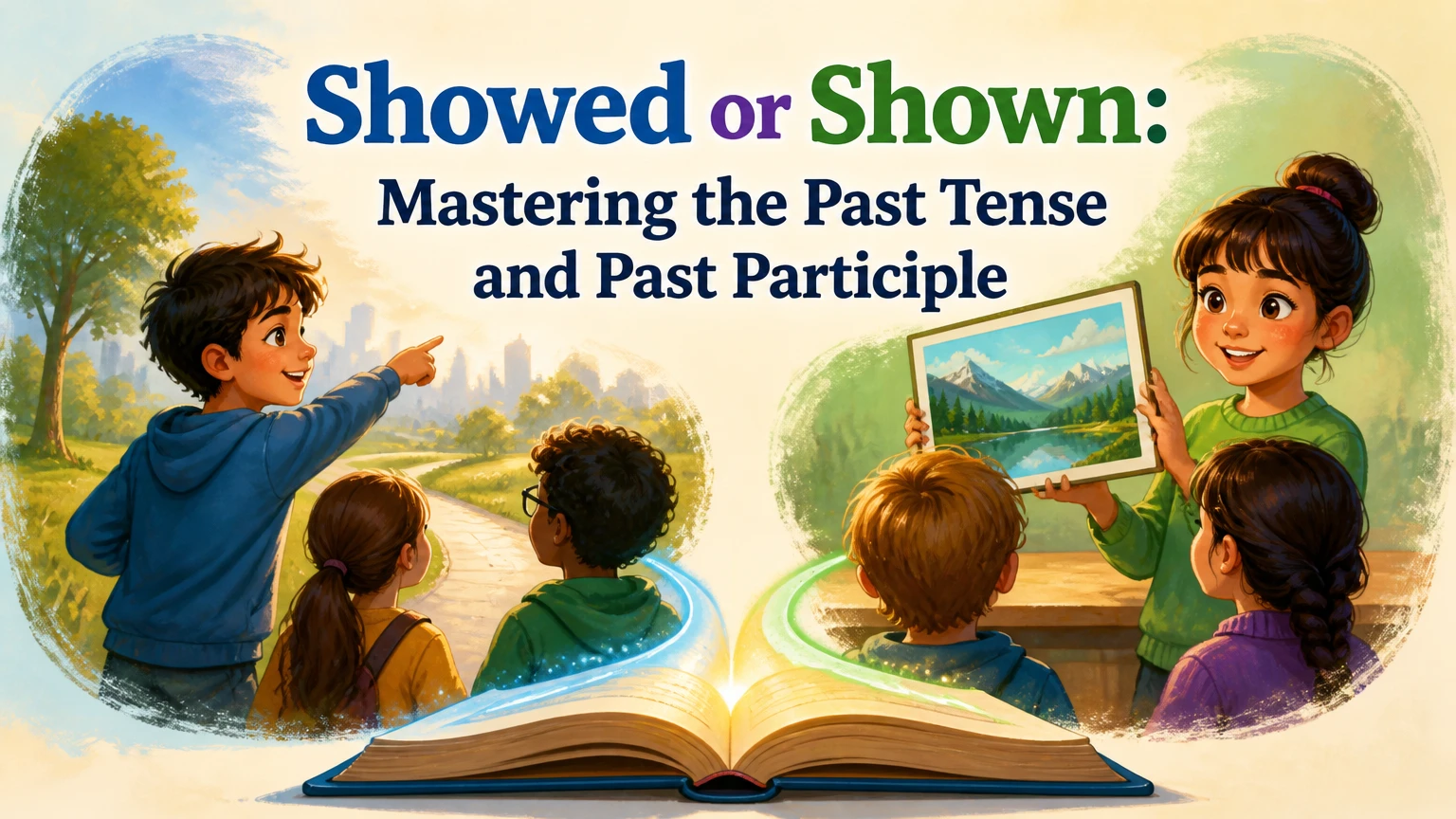
Understanding the correct usage of the verb show is essential for achieving fluency and precision in English writing and speech. This verb is unique because it functions as a regular verb in its simple past form but often behaves like an irregular verb in its past participle form, leading to common variations such as showed, shown, and occasionally showed again. These different forms allow us to express actions across various timeframes, including instances where we showed a movie last night, have shown great improvement lately, or are showing a new exhibit today. Mastering these distinctions is vital for students, professionals, and creative writers who wish to avoid grammatical inconsistencies and convey their ideas with absolute clarity. By learning how to navigate the nuances between the simple past and the perfect tenses, you can ensure your communication remains professional and grammatically sound in any context.
Table of Contents
- Definition and Classification of the Verb Show
- Structural Breakdown of Conjugations
- The Core Difference: Showed vs. Shown
- Using Showed in the Simple Past Tense
- Using Shown as a Past Participle
- Showed and Shown in the Passive Voice
- The Adjectival Use of Shown
- Regional Variations and Historical Context
- Extensive Examples and Comparison Tables
- Comprehensive Usage Rules and Exceptions
- Common Mistakes and How to Avoid Them
- Advanced Topics: Phrasal Verbs and Idioms
- Practice Exercises and Assessment
- Frequently Asked Questions (FAQ)
- Conclusion and Final Tips
Definition and Classification of the Verb Show
The verb show is a fundamental element of the English language, primarily used to describe the act of allowing something to be seen, displaying an object, or demonstrating a particular quality or behavior. It originates from Old English sceawian, which meant “to look at” or “to behold,” but over centuries, the meaning shifted toward the act of making others behold something.
In modern linguistics, show is classified as a mixed verb or a semi-irregular verb. While most regular verbs follow a predictable pattern for both the past tense and the past participle (e.g., walk/walked/walked), show creates a bridge between regular and irregular patterns. It uses the regular -ed suffix for the simple past (showed) but prefers the irregular -n suffix for the past participle (shown).
The function of this verb extends beyond physical sight. It is frequently used in academic writing to indicate evidence (The data shows a trend), in emotional contexts to describe feelings (He showed great courage), and in instructional settings (She showed me how to code). Understanding its various forms is the first step toward grammatical mastery.
Structural Breakdown of Conjugations
To use show correctly, we must look at its principal parts. Every English verb has four or five main forms: the base form, the third-person singular, the present participle, the simple past, and the past participle. For show, these forms are particularly interesting because of the “shown” variant.
The base form is show. We use this for the present tense (except for the third person) and with modal verbs like can, will, or should. The third-person singular is shows, used with he, she, or it. The present participle is showing, used for continuous or progressive actions.
The complexity arises in the past. The simple past is showed. This is the only standard form for actions that were completed at a specific time in the past without the help of an auxiliary verb. The past participle is shown, which is used in perfect tenses (have shown, had shown) and in the passive voice (was shown).
Table 1: Principal Parts of the Verb Show
| Form | Verb Word | Usage Example |
|---|---|---|
| Base Form (Infinitive) | Show | I want to show you my garden. |
| Third-Person Singular | Shows | He shows a lot of potential. |
| Present Participle | Showing | They are showing the film now. |
| Simple Past | Showed | She showed us the way home. |
| Past Participle | Shown | We have shown the results to the boss. |
The Core Difference: Showed vs. Shown
The primary distinction between showed and shown lies in their grammatical function. Showed is a “stand-alone” verb form in the past tense. It does not require a “helper” or auxiliary verb like have, has, or had to function. For example: “The magician showed us a trick.”
In contrast, shown is the past participle. In the active voice, it almost always requires an auxiliary verb to create a perfect tense. You would not say “I shown him the book”; instead, you must say “I have shown him the book.” This “helper” verb is the signal that the participle form is required.
Another way to remember the difference is through the concept of “completion.” Showed refers to a completed action in the past. Shown, when used in the present perfect (have shown), refers to an action that happened at an unspecified time or an action that has relevance to the present moment.
Using Showed in the Simple Past Tense
The simple past tense is used to describe actions that started and finished at a specific time in the past. When using showed, you are typically telling a story or reporting a finished event. It is the standard choice for narrative history and daily reports of past activities.
One important rule to remember is that showed is never used with have, has, or had in modern standard English when functioning as a verb. While “had showed” was once more common in older literature, modern style guides almost universally prefer “had shown.” Therefore, if you are writing a sentence without an auxiliary verb, showed is your primary candidate.
Consider the sentence: “The teacher showed the students the diagram.” Here, the action is a simple fact of the past. There is no emphasis on the ongoing state or the relationship to the present; it is merely a point on a timeline that has already passed.
Using Shown as a Past Participle
The past participle shown is one of the most versatile forms of the verb. Its primary role is to form the perfect tenses. The present perfect (has/have shown) indicates an action that occurred at an indefinite time or began in the past and continues to the present. The past perfect (had shown) indicates an action completed before another past action.
For example, “The research has shown that exercise improves mood.” This suggests that the research findings are currently relevant and established. If we said, “The research showed that exercise improves mood,” we might be referring to one specific study conducted in 1995.
Additionally, shown is the required form for the future perfect tense (will have shown). “By the end of the week, we will have shown the presentation to all three departments.” In all these instances, the presence of an auxiliary verb (have, has, had, will have) necessitates the use of the participle shown.
Showed and Shown in the Passive Voice
The passive voice is a grammatical construction where the subject of the sentence receives the action rather than performing it. In the passive voice, we always use a form of the verb to be followed by the past participle. Therefore, shown is the correct choice for passive constructions.
Compare these two sentences: “The curator showed the painting” (Active) and “The painting was shown by the curator” (Passive). In the second sentence, “was” is the helper verb, which triggers the use of the past participle “shown.”
Using “was showed” is generally considered a grammatical error in formal writing. While you might hear it in certain dialects or casual speech, it is best to stick to “was shown” or “were shown” to maintain a professional tone. This applies across all tenses of the passive voice: “is being shown,” “will be shown,” and “had been shown.”
The Adjectival Use of Shown
Past participles frequently function as adjectives in English. When shown is used to modify a noun, it describes the state of that noun. For instance, in the phrase “the colors shown on the screen,” the word shown acts as an adjective describing the colors.
We see this often in technical documentation and academic papers. Phrases like “as shown in Figure 1″ or “the evidence shown above” are standard. In these cases, shown is not acting as a primary verb but as a descriptor of the figure or evidence.
It is very rare to use showed as an adjective. You would never say “the showed map”; you would always say “the shown map” or, more naturally, “the map that was shown.” This distinction further reinforces the rule that shown is the participle form intended for complex grammatical structures.
Regional Variations and Historical Context
Language is constantly evolving, and the verb show has a history that explains some of the modern confusion. Historically, show was a regular verb (show/showed/showed). Over time, it began to take on the irregular past participle shown, likely influenced by similar-sounding verbs like know/known or grow/grown.
In modern American and British English, shown is the overwhelmingly preferred past participle. However, you may still find showed used as a past participle in some older texts or specific regional dialects. For example, some dictionaries still list showed as an acceptable but less common past participle.
Despite these variations, if you are writing for an international audience, an academic institution, or a professional business environment, shown is the only “safe” choice for the past participle. Using showed as a past participle (e.g., “I have showed”) may be perceived as a mistake by many readers.
Extensive Examples and Comparison Tables
To truly understand how these forms function, it is helpful to see them side-by-side in various contexts. The following tables provide a comprehensive look at how showed and shown are used across different tenses and sentence structures.
Table 2: 25 Examples of Showed in the Simple Past (Active Voice)
| Subject | Verb (Simple Past) | Object/Complement |
|---|---|---|
| I | showed | him the way to the station. |
| You | showed | great kindness to the strangers. |
| He | showed | his ID to the security guard. |
| She | showed | the world what she was capable of. |
| It | showed | signs of wear and tear. |
| We | showed | our tickets at the entrance. |
| They | showed | the guests to their rooms. |
| The doctor | showed | the X-ray to the patient. |
| The sun | showed | its face for a brief moment. |
| The map | showed | a hidden path through the woods. |
| My father | showed | me how to change a tire. |
| The movie | showed | the effects of climate change. |
| The witness | showed | the jury the evidence. |
| The company | showed | a profit for the first time. |
| The clock | showed | it was already midnight. |
| The teacher | showed | the solution on the board. |
| The dog | showed | its teeth when the mailman arrived. |
| The athlete | showed | remarkable stamina. |
| The experiment | showed | surprising results. |
| The artist | showed | her latest paintings. |
| The child | showed | his drawing to his mother. |
| The guide | showed | us the historical landmarks. |
| The website | showed | an error message. |
| The team | showed | excellent cooperation. |
| The mirror | showed | every detail of his face. |
The table above illustrates that showed is used directly after the subject to indicate a past action. There are no helping verbs like have or was in these sentences.
Table 3: 25 Examples of Shown in the Present Perfect (Active Voice)
| Subject | Auxiliary + Shown | Object/Complement |
|---|---|---|
| I | have shown | the data to the committee. |
| You | have shown | a lot of patience today. |
| He | has shown | us his new car. |
| She | has shown | interest in the project. |
| It | has shown | no improvement since yesterday. |
| We | have shown | them our support. |
| They | have shown | mercy to the prisoners. |
| The study | has shown | a link between diet and health. |
| The manager | has shown | great leadership skills. |
| History | has shown | that empires eventually fall. |
| The software | has shown | several bugs recently. |
| The weather | has shown | signs of clearing up. |
| The actor | has shown | his range in this role. |
| The economy | has shown | steady growth this year. |
| The evidence | has shown | him to be innocent. |
| The coach | has shown | faith in the young players. |
| The city | has shown | resilience after the storm. |
| The report | has shown | where we need to improve. |
| The cat | has shown | no fear of the dog. |
| The technology | has shown | its potential to change lives. |
| The student | has shown | dedication to her studies. |
| The pilot | has shown | calmness under pressure. |
| The garden | has shown | beautiful blooms this spring. |
| The company | has shown | respect for the environment. |
| The music | has shown | his deep emotional roots. |
In Table 3, you can see that shown is always accompanied by have or has. This is the standard construction for the present perfect tense.
Table 4: 20 Examples of Shown in the Passive Voice
| Subject (Receiver) | Verb to be + Shown | Context |
|---|---|---|
| The film | was shown | at the local cinema. |
| The results | were shown | to the public yesterday. |
| The way | was shown | by a local guide. |
| The error | is shown | in red text. |
| The exhibit | will be shown | next month in Paris. |
| The proof | has been shown | to the judge. |
| The house | was being shown | to potential buyers. |
| The diagram | is shown | on page twenty. |
| The video | was shown | during the meeting. |
| The path | had been shown | to us earlier. |
| The difference | can be shown | with a simple chart. |
| The truth | must be shown | to the world. |
| The slides | were shown | in chronological order. |
| The patient | was shown | how to use the crutches. |
| The data | is being shown | on the monitor. |
| The winner | was shown | on live television. |
| The secret | was shown | to only a few people. |
| The document | will be shown | upon request. |
| The painting | was shown | under special lighting. |
| The route | is shown | on the GPS screen. |
Table 4 demonstrates that in the passive voice, the word shown is used regardless of the tense (past, present, or future), provided there is a form of the verb to be present.
Comprehensive Usage Rules and Exceptions
To use showed and shown effectively, one must internalize a few core rules. These rules act as a roadmap for choosing the correct word in any given sentence. While English is full of exceptions, the rules for show are relatively stable in modern usage.
Rule 1: Use showed for the simple past. If you are describing a single, completed action in the past and you do not have a helping verb, showed is your only choice. Example: “Yesterday, I showed him the house.”
Rule 2: Use shown for the past participle. If you have a helping verb like has, have, had, is, was, or been, you should almost always use shown. Example: “I have shown him the house many times.”
Rule 3: Use shown as an adjective. When the word is describing a noun rather than acting as the main verb of the sentence, shown is the standard form. Example: “The shown figures are accurate.”
The “Old English” Exception: You may occasionally encounter showed used as a past participle in literature from the 18th or 19th centuries. While “He has showed” was once considered acceptable, it is now obsolete in formal writing. If you see it in a classic novel, recognize it as a historical artifact rather than a modern rule.
Common Mistakes and How to Avoid Them
Even native speakers occasionally trip up on the distinction between these two forms. The most frequent error is using shown as a simple past tense verb without a helper. This is often heard in casual speech but should be avoided in writing.
Another common mistake is using showed with a helping verb. While “has showed” is technically listed in some dictionaries, it sounds “off” to most educated ears and is often marked as incorrect in academic or professional settings.
Table 5: Correct vs. Incorrect Usage
| Incorrect Sentence | Correct Sentence | Explanation |
|---|---|---|
| I shown him the book. | I showed him the book. | Shown requires an auxiliary verb like “have.” |
| She has showed us the way. | She has shown us the way. | The past participle “shown” is preferred with “has.” |
| The movie was showed last night. | The movie was shown last night. | Passive voice requires the past participle “shown.” |
| They had showed interest before. | They had shown interest before. | Past perfect tense requires “shown.” |
| He shown me his new phone. | He showed me his new phone. | Simple past tense uses “showed.” |
To avoid these mistakes, always look for the “helper” verb. If you see have, has, had, or was, reach for shown. If the verb is standing alone in the past tense, reach for showed.
Advanced Topics: Phrasal Verbs and Idioms
The verb show is part of several common phrasal verbs and idioms. The rules for showed and shown remain the same within these structures, but the meanings change significantly. Understanding these can help you sound more like a native speaker.
Show up: To arrive or appear.
Example: “He showed up late to the meeting.” / “He has finally shown up.”
Show off: To display something proudly or to behave in a way that attracts attention.
Example: “She showed off her new ring.” / “He has been shown off as the star pupil.”
Show around: To give someone a tour of a place.
Example: “The agent showed us around the apartment.” / “We have been shown around the facility.”
Show the ropes: An idiom meaning to teach someone how to do a job or activity.
Example: “My mentor showed me the ropes.” / “I have been shown the ropes by the best in the business.”
Show one’s hand: To reveal one’s intentions or resources.
Example: “The negotiator showed his hand too early.” / “The cards have been shown.”
Practice Exercises and Assessment
Now that we have covered the rules and examples, it is time to test your knowledge. Complete the following exercises to ensure you have mastered the use of showed and shown.
Exercise 1: Fill in the Blanks
Choose the correct form (showed or shown) for each sentence.
- The scientist has _______ that the hypothesis was correct.
- Yesterday, my brother _______ me his new collection of coins.
- Were the children _______ how to solve the puzzle?
- I would have _______ you the letter if I had it with me.
- The graph _______ a significant increase in sales last month.
- By the time we arrived, the movie had already been _______.
- She _______ great courage during the difficult trial.
- Has he _______ any signs of recovery yet?
- The path was _______ to us by an old map.
- We _______ our identification at the gate.
Exercise 2: Identify the Error
Each sentence below contains one error regarding the use of showed or shown. Rewrite the sentence correctly.
- The teacher has showed us the answer twice.
- He shown me his garden yesterday afternoon.
- The documents were showed to the board of directors.
- I have showed you everything I know about this topic.
- They shown a lot of respect during the ceremony.
- The video had been showed to the police before the trial.
- She showed up late, but she has not shown us why. (Wait, this one is actually correct! Let’s try: She shown up late.)
- The results of the test were showed on the screen.
- Have you showed your parents your grades yet?
- The magician showed us a trick, but he hasn’t showed us how it works.
Table 6: Answer Key for Exercises
| Exercise 1 Answers | Exercise 2 Corrected Sentences |
|---|---|
| 1. shown | 1. The teacher has shown us the answer twice. |
| 2. showed | 2. He showed me his garden yesterday afternoon. |
| 3. shown | 3. The documents were shown to the board of directors. |
| 4. shown | 4. I have shown you everything I know about this topic. |
| 5. showed | 5. They showed a lot of respect during the ceremony. |
| 6. shown | 6. The video had been shown to the police before the trial. |
| 7. showed | 7. She showed up late. |
| 8. shown | 8. The results of the test were shown on the screen. |
| 9. shown | 9. Have you shown your parents your grades yet? |
| 10. showed / shown | 10. …but he hasn’t shown us how it works. |
Frequently Asked Questions (FAQ)
1. Is “showed” ever a past participle?
While some dictionaries list “showed” as an acceptable past participle, it is much less common than “shown” in modern usage. In formal writing, you should always use “shown” after helping verbs like have, has, or had. Using “showed” as a participle may be seen as a mistake in academic or professional contexts.
2. Can I use “shown” without a helping verb?
Generally, no. In standard English, “shown” is the past participle and requires an auxiliary verb (like have, has, or was) when it is acting as a verb. If you are describing a simple past action without a helper, use “showed.” The only exception is when “shown” is used as an adjective (e.g., “The data shown here…”).
3. Which is more common in British English: showed or shown?
Both American and British English follow the same general rule: “showed” for the simple past and “shown” for the past participle. There is no significant regional difference in how these two words are used in formal contexts today.
4. How do I remember the difference between the two?
A simple trick is the “N” rule. The word shown ends in N, just like the words known, grown, and thrown, which are all past participles that require a helper verb. If you see a helper verb, look for the “N”!
5. Is “had showed” wrong?
In modern standard English, “had showed” is considered incorrect or at least non-standard. You should use “had shown” to form the past perfect tense. “Showed” is strictly for the simple past (e.g., “I showed”).
6. What about the word “showen”?
The word “showen” is not a standard English word. It is a common misspelling or a mistaken formation of the past participle. The only correct forms are “showed” and “shown.”
7. Can “showed” be used in the passive voice?
It is best to avoid using “showed” in the passive voice. Instead of saying “The film was showed,” say “The film was shown.” The passive voice always pairs a form of to be with the past participle, and “shown” is the standard participle.
8. Does this rule apply to “show off”?
Yes, the rules apply to all phrasal verbs containing show. You would say “He showed off his trophy” (simple past) or “He has shown off his trophy” (present perfect).
Conclusion and Final Tips
Mastering the difference between showed and shown is a significant milestone in your journey toward English proficiency. By remembering that showed is the simple past and shown is the past participle, you can navigate complex tenses and passive constructions with confidence. Always keep an eye out for auxiliary verbs like have, has, and was, as these are your primary cues to use the form shown. Conversely, when you are telling a straightforward story about the past, showed will be your reliable companion. Consistent practice and attention to detail in your reading will help these patterns become second nature. Keep writing, keep practicing, and you will soon find that choosing the correct form of show becomes an effortless part of your communication style.