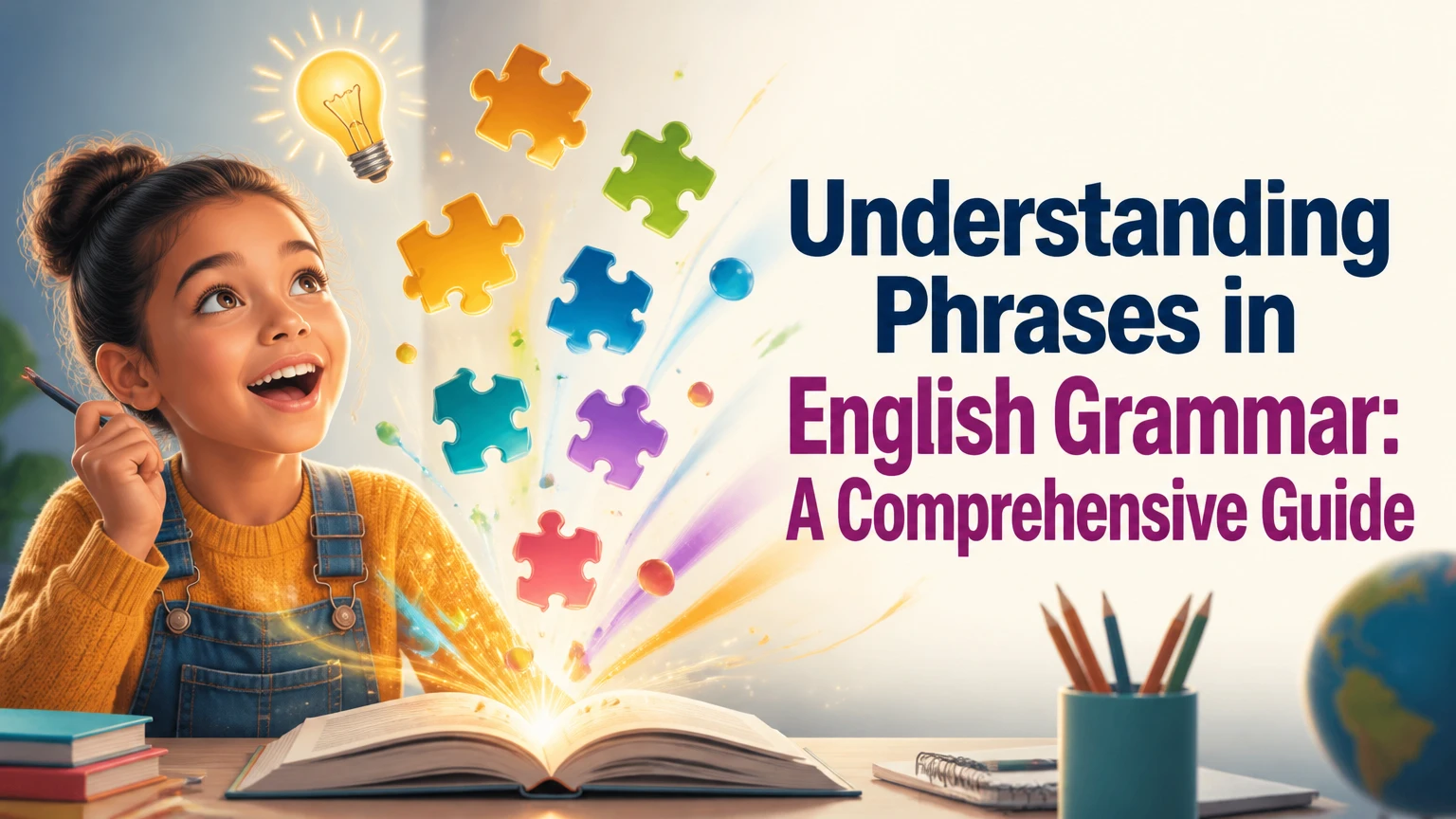
In English grammar, a phrase is a group of related words that does not contain a subject and a verb working together to form a clause. Phrases function as a single unit within a sentence. They can act as nouns, adjectives, adverbs, or other parts of speech. Understanding phrases is crucial for constructing clear and grammatically correct sentences. For example, prepositional phrases like in the morning, after the rain, and under the bridge provide essential details about time and location. Similarly, verb phrases such as is running, has been completed, and will be attending describe actions with greater precision. Mastering the use of phrases allows for more sophisticated and nuanced communication, benefiting students, writers, and anyone looking to improve their English language skills.
Table of Contents
- What is a Phrase? A Comprehensive Definition
- Structural Breakdown of Phrases
- Types of Phrases
- Examples of Phrases
- Usage Rules for Phrases
- Common Mistakes with Phrases
- Practice Exercises
- Advanced Topics in Phrases
- Frequently Asked Questions (FAQ)
- Conclusion
What is a Phrase? A Comprehensive Definition
A phrase is a group of related words that lacks both a subject and a predicate working together. This absence of a subject-verb combination distinguishes it from a clause. While a phrase can contain a subject or a verb, it cannot contain both functioning together to form a complete thought. Instead, a phrase functions as a single unit within a sentence, modifying or describing other elements. Understanding the role and function of phrases is crucial for constructing grammatically correct and stylistically effective sentences.
Phrases can serve various grammatical functions, acting as nouns, adjectives, adverbs, or other parts of speech. Consider the prepositional phrase with great enthusiasm. This phrase acts as an adverb, modifying a verb by describing how an action is performed. Similarly, the noun phrase the old, wooden house functions as a noun, identifying a specific entity. The flexibility of phrases allows writers to add detail and nuance to their writing, creating more vivid and engaging prose. Recognizing and using different types of phrases effectively is a key skill for any English language learner.
Structural Breakdown of Phrases
The structure of a phrase depends on its type and function within a sentence. Each type of phrase has its own characteristic components and arrangement. Understanding these structural elements is essential for identifying and using phrases correctly. For example, a prepositional phrase typically begins with a preposition, followed by a noun phrase as its object. A verb phrase consists of a main verb and any auxiliary verbs that precede it. Noun phrases often include determiners, adjectives, and nouns. Let’s explore the common structural elements of different types of phrases.
Noun Phrase Structure: A noun phrase typically centers around a noun and may include modifiers such as articles (a, an, the), adjectives, and other nouns acting as adjectives. For example, in the noun phrase the big, red ball, ‘ball’ is the head noun, while ‘the’, ‘big’, and ‘red’ are modifiers that describe the ball. The order of these elements often follows specific conventions, such as placing articles before adjectives.
Verb Phrase Structure: A verb phrase includes the main verb and any auxiliary verbs that precede it. Auxiliary verbs, such as be, have, and do, help to express tense, mood, and voice. For instance, in the verb phrase has been running, ‘has’ and ‘been’ are auxiliary verbs, and ‘running’ is the main verb. The arrangement of these verbs determines the tense and aspect of the action being described.
Prepositional Phrase Structure: A prepositional phrase begins with a preposition and ends with a noun phrase, which serves as the object of the preposition. Common prepositions include in, on, at, by, for, and with. For example, in the prepositional phrase in the garden, ‘in’ is the preposition, and ‘the garden’ is the noun phrase acting as the object of the preposition. The prepositional phrase modifies another element in the sentence, often providing information about location, time, or manner.
Adjective Phrase Structure: An adjective phrase consists of an adjective and any modifiers that enhance or qualify its meaning. These modifiers can include adverbs or prepositional phrases. For example, in the adjective phrase very beautiful, ‘very’ is an adverb that modifies the adjective ‘beautiful’, intensifying its meaning. Similarly, in the phrase happy about the news, the prepositional phrase ‘about the news’ modifies the adjective ‘happy’, specifying the reason for the happiness.
Adverb Phrase Structure: An adverb phrase consists of an adverb and any modifiers that enhance or qualify its meaning. These modifiers can include other adverbs or prepositional phrases. For example, in the adverb phrase quite slowly, ‘quite’ is an adverb that modifies the adverb ‘slowly’, intensifying its meaning. Similarly, in the phrase eagerly for the prize, the prepositional phrase ‘for the prize’ modifies the adverb ‘eagerly’, specifying the reason for the eagerness.
Types of Phrases
English grammar includes various types of phrases, each with its own structure and function. Understanding these different types is essential for effective communication. The main types of phrases include noun phrases, verb phrases, prepositional phrases, adjective phrases, adverb phrases, infinitive phrases, gerund phrases, participle phrases, and absolute phrases. Each type plays a distinct role in sentence construction, adding detail and nuance to written and spoken language.
Noun Phrases
A noun phrase includes a noun and all its modifiers. It functions as a noun within a sentence, acting as a subject, object, or complement. The head of the phrase is the noun itself, and the modifiers provide additional information about the noun. For example, in the phrase the tall, old tree, ‘tree’ is the head noun, and ‘the’, ‘tall’, and ‘old’ are modifiers. Noun phrases can be simple or complex, depending on the number and type of modifiers included.
Verb Phrases
A verb phrase consists of a main verb and any auxiliary verbs that precede it. It expresses the action or state of being in a sentence. The verb phrase indicates tense, mood, and voice. For example, in the phrase will be going, ‘will’ and ‘be’ are auxiliary verbs, and ‘going’ is the main verb. Verb phrases are essential for conveying the timing and nature of actions in a sentence.
Prepositional Phrases
A prepositional phrase begins with a preposition and ends with a noun phrase, called the object of the preposition. These phrases modify other elements in the sentence, providing information about location, time, manner, or other relationships. For example, in the phrase on the table, ‘on’ is the preposition, and ‘the table’ is the object of the preposition. Prepositional phrases add detail and context to sentences.
Adjective Phrases
An adjective phrase consists of an adjective and any modifiers that enhance or qualify its meaning. These modifiers can include adverbs or prepositional phrases. For example, in the phrase very happy, ‘very’ is an adverb that modifies the adjective ‘happy’. Adjective phrases describe nouns or pronouns, providing additional information about their qualities or characteristics.
Adverb Phrases
An adverb phrase consists of an adverb and any modifiers that enhance or qualify its meaning. These modifiers can include other adverbs or prepositional phrases. For example, in the phrase quite slowly, ‘quite’ is an adverb that modifies the adverb ‘slowly’. Adverb phrases modify verbs, adjectives, or other adverbs, providing information about how, when, where, or to what extent something happens.
Infinitive Phrases
An infinitive phrase consists of an infinitive (to + base form of a verb) and any modifiers or complements. It can function as a noun, adjective, or adverb in a sentence. For example, in the phrase to run a marathon, ‘to run’ is the infinitive, and ‘a marathon’ is its complement. Infinitive phrases add flexibility and variety to sentence structure.
Gerund Phrases
A gerund phrase consists of a gerund (a verb ending in -ing that functions as a noun) and any modifiers or complements. It functions as a noun in a sentence. For example, in the phrase running a marathon, ‘running’ is the gerund, and ‘a marathon’ is its complement. Gerund phrases provide a way to use verbs as nouns, adding versatility to sentence construction.
Participle Phrases
A participle phrase consists of a participle (a verb form used as an adjective) and any modifiers or complements. It functions as an adjective, modifying a noun or pronoun. There are two types of participles: present participles (ending in -ing) and past participles (usually ending in -ed or -en). For example, in the phrase running quickly, ‘running’ is the present participle, and ‘quickly’ is its modifier. In the phrase broken by the storm, ‘broken’ is the past participle, and ‘by the storm’ is its modifier.
Absolute Phrases
An absolute phrase modifies an entire clause or sentence. It consists of a noun or pronoun and a participle, along with any modifiers. It is set off from the rest of the sentence by commas. For example, in the sentence The weather being warm, we decided to go for a walk, ‘The weather being warm’ is the absolute phrase. Absolute phrases add extra information or context to a sentence without directly modifying a specific word.
Examples of Phrases
To further illustrate the different types of phrases, here are several examples organized by category. These examples demonstrate how phrases function within sentences and how they contribute to the overall meaning.
The following table provides examples of noun phrases, showcasing their structure and function within sentences.
| Noun Phrase | Example Sentence |
|---|---|
| The old, wooden chair | The old, wooden chair was covered in dust. |
| A bright, sunny day | We decided to go for a walk on a bright, sunny day. |
| The tall, green grass | The tall, green grass swayed in the wind. |
| My favorite book | I lost my favorite book yesterday. |
| Her new car | Her new car is very fast. |
| The delicious chocolate cake | We all enjoyed the delicious chocolate cake. |
| A small, furry kitten | She found a small, furry kitten in the garden. |
| The long, winding road | The long, winding road led to the village. |
| His first attempt | His first attempt was unsuccessful. |
| Our next meeting | Our next meeting is scheduled for next week. |
| The clear blue sky | The clear blue sky made the day perfect. |
| A warm cup of coffee | I need a warm cup of coffee to wake up. |
| The heavy, metal door | The heavy, metal door creaked open. |
| Their beautiful garden | Their beautiful garden is full of flowers. |
| The fast-moving train | The fast-moving train sped past the station. |
| A rare and valuable coin | He collected a rare and valuable coin. |
| The important business meeting | The important business meeting lasted for hours. |
| My little brother | My little brother is learning to ride a bike. |
| Her favorite song | Her favorite song always makes her smile. |
| The old, stone bridge | The old, stone bridge is a historical landmark. |
| A cold glass of water | I drank a cold glass of water after my run. |
| The bright morning sun | The bright morning sun woke me up early. |
| His last chance | He knew this was his last chance to succeed. |
| Our best friend | Our best friend is moving to another city. |
| The crowded city streets | The crowded city streets were full of people. |
The following table provides examples of verb phrases, showcasing their structure and function within sentences.
| Verb Phrase | Example Sentence |
|---|---|
| Is running | She is running a marathon next week. |
| Has been completed | The project has been completed on time. |
| Will be attending | He will be attending the conference tomorrow. |
| Should have studied | I should have studied more for the exam. |
| Could be improved | The design could be improved with some changes. |
| Was singing | She was singing beautifully at the concert. |
| Had finished | They had finished their work before the deadline. |
| Must be joking | You must be joking if you think that’s true. |
| Might have known | I might have known he would be late. |
| Can be seen | The stars can be seen clearly tonight. |
| Will be traveling | They will be traveling to Europe next summer. |
| Has been working | He has been working on this project for months. |
| Should have known | I should have known better than to trust him. |
| Could be happening | This could be happening if we’re not careful. |
| Was reading | She was reading a book when I called. |
| Had eaten | We had eaten dinner before the movie started. |
| Must have left | He must have left already; he’s not here. |
| Might be sleeping | They might be sleeping; it’s very early. |
| Can be done | This task can be done easily with the right tools. |
| Will be finished | The report will be finished by Friday. |
| Has been repaired | The car has been repaired and is ready to go. |
| Should be arriving | They should be arriving any minute now. |
| Could have been | It could have been a disaster, but we managed. |
| Was being developed | The new software was being developed for years. |
| Had been waiting | We had been waiting for hours when the train arrived. |
The following table provides examples of prepositional phrases, showcasing their structure and function within sentences.
| Prepositional Phrase | Example Sentence |
|---|---|
| In the morning | I like to exercise in the morning. |
| After the rain | The flowers bloomed after the rain. |
| Under the bridge | We found shelter under the bridge. |
| With great enthusiasm | She accepted the award with great enthusiasm. |
| By the river | They built their house by the river. |
| At the store | I bought some groceries at the store. |
| For my friend | This gift is for my friend. |
| On the table | The book is on the table. |
| From the heart | He spoke from the heart. |
| To the park | We walked to the park. |
| Over the mountain | The hikers climbed over the mountain. |
| Through the forest | The path led through the forest. |
| Around the world | She traveled around the world. |
| Before the storm | We arrived home before the storm. |
| During the meeting | He asked a question during the meeting. |
| Without hesitation | She answered without hesitation. |
| Because of you | I succeeded because of you. |
| Instead of coffee | I drank tea instead of coffee. |
| According to the report | According to the report, sales are up. |
| In addition to that | In addition to that, we need more staff. |
| By means of hard work | He achieved success by means of hard work. |
| For the sake of peace | They negotiated for the sake of peace. |
| On behalf of the team | I thank you on behalf of the team. |
| With respect to your opinion | With respect to your opinion, I disagree. |
| Due to unforeseen circumstances | The event was canceled due to unforeseen circumstances. |
The following table provides examples of adjective phrases, showcasing their structure and function within sentences.
| Adjective Phrase | Example Sentence |
|---|---|
| Very happy | She was very happy with her gift. |
| Extremely tall | The building is extremely tall. |
| Incredibly beautiful | The sunset was incredibly beautiful. |
| Quite interesting | The book was quite interesting. |
| Really excited | He was really excited about the trip. |
| So delicious | The cake was so delicious. |
| Fairly certain | I am fairly certain I locked the door. |
| More confident | She felt more confident after the practice. |
| Less expensive | This car is less expensive than that one. |
| Equally important | Both tasks are equally important. |
| Happy about the news | She was happy about the news. |
| Excited for the party | He is excited for the party. |
| Anxious about the exam | I am anxious about the exam. |
| Proud of her achievement | They are proud of her achievement. |
| Grateful for the help | We are grateful for the help. |
| Aware of the risks | They are aware of the risks. |
| Similar to that one | This dress is similar to that one. |
| Different from what I expected | The result was different from what I expected. |
| Responsible for the project | She is responsible for the project. |
| Ready for the challenge | He is ready for the challenge. |
| Certain of his success | He is certain of his success. |
| Afraid of the dark | She is afraid of the dark. |
| Capable of doing anything | He is capable of doing anything. |
| Dependent on her parents | She is dependent on her parents. |
| Eager to learn more | He is eager to learn more. |
Usage Rules for Phrases
Using phrases correctly involves understanding their structure, function, and relationship to other elements in a sentence. Here are some key usage rules to keep in mind.
Placement: The placement of a phrase in a sentence can affect its meaning and clarity. Prepositional phrases, for example, should be placed as close as possible to the word they modify to avoid ambiguity. Similarly, adjective phrases should be placed near the nouns or pronouns they describe.
Punctuation: Phrases that are nonessential to the meaning of the sentence should be set off by commas. These are called nonrestrictive phrases. Essential phrases, which are necessary for the sentence to make sense, should not be set off by commas. These are called restrictive phrases.
Agreement: While phrases themselves do not have subjects and verbs that need to agree, the elements they modify must agree with the subject of the sentence. For example, if a noun phrase is used as the subject of a sentence, the verb must agree in number with the head noun of the phrase.
Clarity: Ensure that the meaning of a phrase is clear and unambiguous. Avoid using phrases that are awkwardly worded or that could be interpreted in multiple ways. Use parallel structure when listing phrases to maintain consistency and readability.
Common Mistakes with Phrases
Even experienced writers can make mistakes when using phrases. Here are some common errors to watch out for.
Misplaced Modifiers: A misplaced modifier is a phrase that is placed too far away from the word it is intended to modify, leading to confusion. For example:
| Incorrect | Correct |
|---|---|
| I saw a dog running down the street with a long tail. | I saw a dog with a long tail running down the street. |
Dangling Modifiers: A dangling modifier is a phrase that does not clearly modify any word in the sentence. This often occurs when the subject of the phrase is missing or unclear. For example:
| Incorrect | Correct |
|---|---|
| Having finished the homework, the TV was turned on. | Having finished the homework, I turned on the TV. |
Lack of Parallelism: When listing phrases, ensure that they are parallel in structure. This means using the same grammatical form for each phrase. For example:
| Incorrect | Correct |
|---|---|
| I enjoy swimming, hiking, and to read books. | I enjoy swimming, hiking, and reading books. |
Practice Exercises
Test your understanding of phrases with these practice exercises. Identify the type of phrase used in each sentence and explain its function.
Exercise 1: Identify the Type of Phrase
| Sentence | Type of Phrase |
|---|---|
| The cat slept on the windowsill. | |
| Running a marathon is a great achievement. | |
| She is very happy with her results. | |
| He will be going to the party. | |
| To learn new things is my goal. | |
| The book, covered in dust, was very old. | |
| The weather being nice, we went for a walk. | |
| She spoke with great passion. | |
| My old, blue car is reliable. | |
| He walked quite slowly down the street. |
Answer Key: Exercise 1
| Sentence | Type of Phrase |
|---|---|
| The cat slept on the windowsill. | Prepositional Phrase |
| Running a marathon is a great achievement. | Gerund Phrase |
| She is very happy with her results. | Adjective Phrase |
| He will be going to the party. | Verb Phrase |
| To learn new things is my goal. | Infinitive Phrase |
| The book, covered in dust, was very old. | Participle Phrase |
| The weather being nice, we went for a walk. | Absolute Phrase |
| She spoke with great passion. | Prepositional Phrase |
| My old, blue car is reliable. | Noun Phrase |
| He walked quite slowly down the street. | Adverb Phrase |
Exercise 2: Identify the Correct Sentence
Choose the correct sentence from the options below:
-
A) Having finished the dinner, the dishes were cleared.
B) Having finished the dinner, I cleared the dishes. -
A) The man walked down the street, wearing a hat.
B) Wearing a hat, the street was walked down by the man. -
A) She enjoys to read books, hiking, and swimming.
B) She enjoys reading books, hiking, and swimming. -
A) I saw a bird flying in the sky with colorful feathers.
B) I saw a bird with colorful feathers flying in the sky. -
A) Being tired, the bed was welcomed.
B) Being tired, I welcomed the bed. -
A) He spoke with passion and was very convincing.
B) He spoke with passion and very convincing. -
A) After eating lunch, the movie was watched.
B) After eating lunch, we watched the movie. -
A) The book was laying on the table.
B) The book was lying on the table. -
A) She is interesting in learning more.
B) She is interested in learning more. -
A) They are planning on going to the beach tomorrow.
B) They plan to go to the beach tomorrow.
Answer Key: Exercise 2
- B
- A
- B
- B
- B
- A
- B
- B
- B
- B
Advanced Topics in Phrases
For advanced learners, there are several more complex aspects of phrases to explore. These include the use of appositive phrases, the distinction between reduced relative clauses and participle phrases, and the role of phrases in creating stylistic effects.
Appositive Phrases: An appositive phrase is a noun phrase that renames or identifies another noun or noun phrase. It is usually set off by commas. For example, in the sentence My brother, a doctor, lives in New York, ‘a doctor’ is an appositive phrase that renames ‘My brother’.
Reduced Relative Clauses: A reduced relative clause is a relative clause (a clause that modifies a noun) that has been shortened by omitting the relative pronoun and the auxiliary verb. For example, the relative clause who is running can be reduced to the participle phrase running in the sentence The man running down the street is my neighbor.
Phrases in Stylistic Effects: Phrases can be used to create various stylistic effects in writing, such as emphasis, rhythm, and tone. For example, using a series of parallel phrases can create a sense of balance and harmony, while using a long, complex phrase can create a sense of drama or suspense.
Frequently Asked Questions (FAQ)
Here are some frequently asked questions about phrases in English grammar.
Q: What is the difference between a phrase and a clause?
A: A phrase is a group of related words that does not contain a subject and a verb working together. A clause, on the other hand, contains both a subject and a verb. A clause can be either independent (able to stand alone as a sentence) or dependent (unable to stand alone as a sentence).
Q: Can a phrase contain another phrase?
A: Yes, a phrase can contain another phrase. For example, a prepositional phrase can contain a noun phrase as its object, such as “in the big, old house.”
Q: How do I identify the type of phrase used in a sentence?
A: To identify the type of phrase, look at the function of the phrase within the sentence. If it acts as a noun, it’s a noun phrase; if it acts as an adjective, it’s an adjective phrase; if it acts as an adverb, it’s an adverb phrase, and so on. Also, consider the structure of the phrase. Prepositional phrases begin with a preposition, infinitive phrases begin with ‘to’ and a verb, and so on.
Q: What is the difference between a gerund phrase and a participle phrase?
A: Both gerund and participle phrases contain a verb ending in ‘-ing’, but they function differently. A gerund phrase functions as a noun, while a participle phrase functions as an adjective. For example, “Running is good exercise” (gerund phrase) vs. “The running water sounded peaceful” (participle phrase).
Q: How important is it to use phrases correctly?
A: Using phrases correctly is essential for clear and effective communication. Incorrect or ambiguous use of phrases can lead to confusion and misinterpretation. Mastering the use of phrases will greatly
improve your writing style, allowing you to build complex sentences that remain easy for your audience to follow.
Q: Can a phrase function as the subject of a sentence?
A: Absolutely. Certain types of phrases, particularly noun phrases, gerund phrases, and infinitive phrases, frequently act as subjects. For example, in the sentence “To travel the world is my dream,” the infinitive phrase “To travel the world” serves as the subject.
Q: What is a “dangling” phrase?
A: A dangling phrase (often a dangling participle) occurs when the word the phrase is intended to modify is missing from the sentence. This makes the phrase appear to modify the wrong subject, often with humorous or confusing results, such as “Walking down the street, the trees were beautiful” (which implies the trees were walking).
Conclusion
Phrases are the fundamental building blocks of the English language. While they may lack the complete structural independence of clauses, their ability to function as single units—acting as nouns, verbs, adjectives, or adverbs—gives them immense power in sentence construction. By mastering the different types of phrases, from simple noun phrases to complex absolute phrases, you can significantly enhance the precision and variety of your writing.
Remember that the key to using phrases effectively lies in their placement and clarity. Always ensure that your modifiers are close to the words they describe and that your lists maintain a parallel structure. With practice, the use of phrases will become second nature, allowing you to express complex ideas with elegance and ease. Whether you are preparing for an exam, writing a professional report, or simply looking to improve your daily communication, a solid grasp of phrases is an invaluable asset in your linguistic toolkit.