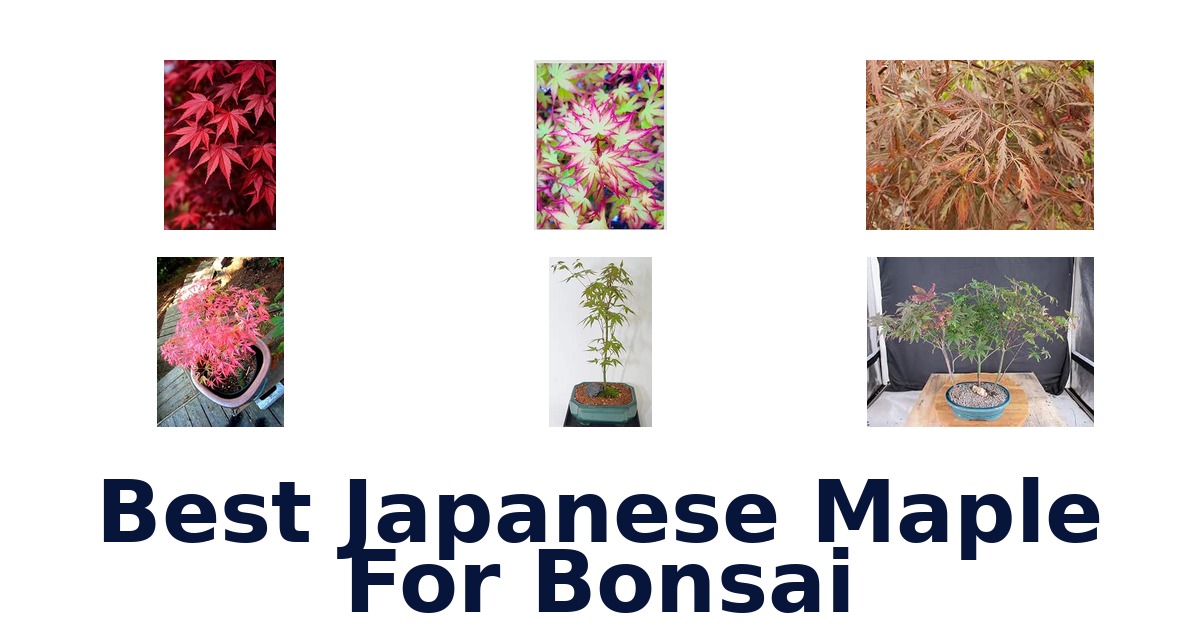
A strong Japanese maple bonsai choice offers either an established tree ready to display or suitable live stock with a manageable growth habit. For an immediate bonsai, the seven-year-old Celestial Bonsai arrives in a ceramic pot with a watering tray, moss, stone, and care instructions. For a Japanese maple forest, LOVE MY BONSAI provides a three-tree planting that is already 6–8 years old.
If you want to train a tree yourself, compact varieties such as Berry Dwarf and Kamagata are listed as bonsai-friendly or suitable for bonsai. These products differ in readiness, mature size, and even species: Brussel’s Bonsai is a trident maple, not a Japanese maple.
Compare those distinctions before choosing, and remember that the outdoor Japanese maple options need seasonal care and may lose their leaves in winter.
Celestial Bonsai Japanese Maple is the strongest choice for someone who wants a Japanese maple bonsai that is already potted and display-ready. It is listed as a seven-year-old deciduous tree, measures about 7 by 7 by 12 inches, and comes in a 6-inch ceramic pot with a watering tray, moss, stone, and care instructions. If you would rather start with a small tree to train, consider Berry Dwarf or Kamagata; both are presented as bonsai-suitable options.
Our Top Picks
 Best Overall
Celestial Bonsai Japanese Maple
This seven-year-old Japanese maple arrives in a 6-inch ceramic pot with a watering tray, moss, stone, and care instructions.
View on Amazon Best Forest Display
The established outdoor forest is 6–8 years old, 14–15 inches tall, and combines three red and green Japanese maple trees.
View on Amazon Most Compact
Its stated mature height of about 2 feet and bonsai-friendly habit make it a compact Japanese maple candidate for training.
View on Amazon- Dwarf Training Stock Kamagata Japanese Maple
- Beginner-Friendly Bonsai Brussel's Bonsai Trident Maple
Compare Japanese Maple Options by Type and Use
| # | Product | Material Feature | Buy |
|---|---|---|---|
| 1 | 1. Celestial Bonsai Japanese MapleBest Overall | — | View on Amazon |
| 2 | 2. LOVE MY BONSAI Maple ForestBest Forest Display | — | View on Amazon |
| 3 | 3. Berry Dwarf Japanese MapleMost Compact | Live dwarf Acer palmatum plant, nursery… | View on Amazon |
| 4 |  4. Kamagata Japanese MapleDwarf Training Stock | Organic | View on Amazon |
| 5 |  5. Hanami Nishiki Japanese MapleSpring-Color Dwarf Maple | Organic | View on Amazon |
| 6 |  6. Brussel's Bonsai Trident MapleBeginner-Friendly Bonsai | — | View on Amazon |
| 7 |  7. Hirt's Gardens Inaba ShidareWeeping Maple for Outdoor Training | — | View on Amazon |
| 8 |  8. Bloodgood Japanese MapleRed-Foliage Bonsai Training | Live rooted plant, 2-year growth, nursery… | View on Amazon |
| 9 |  9. Japanese Red Maple Live PlantRed Maple Bonsai Starter | Live plant, rooted tree, natural soil… | View on Amazon |
| 10 |  10. Jonsteen Japanese Maple SeedlingSeedling-Growing Bonsai Project | Natural | View on Amazon |
Detailed Reviews: Best Japanese Maple For Bonsai
#1 · Best Overall
1. Celestial Bonsai Japanese Maple
Best for: Mature Potted Bonsai Display.
Why it ranks #1: This seven-year-old Japanese maple arrives in a 6-inch ceramic pot with a watering tray, moss, stone, and care instructions.
A seven-year-old Japanese maple arrives in a 6-inch ceramic bonsai pot with a watering tray, moss, stone, and rock, supplying a complete display arrangement. Its approximately 7-by-7-by-12-inch size suits a compact presentation, while red fall leaves provide seasonal color before winter dormancy.
The ceramic pot and included watering tray provide a ready-made display and watering setup, while the moss, stone, and rock contribute to its arranged presentation. At approximately 7 inches long by 7 inches wide by 12 inches high, it has a defined size for choosing a display location. The tree is seven years old and deciduous: it turns red in fall and has no leaves in winter. The listing says care instructions are included and specifies watering as its care instruction.
- Seven-year-old Japanese maple bonsai
- 6-inch ceramic bonsai pot
- Watering tray, moss, stone, and rock included
- Approximate dimensions of 7 × 7 × 12 inches
- It has no leaves in winter because it is deciduous.
Skip it if you want to shape a young tree from its early growth; Kamagata Japanese Maple 1 – Year Live Tree is listed as a one-year tree.
This fits buyers seeking a mature, compact potted maple display with included decorative elements and a watering tray. Keep its seasonal leaf cycle in mind: the tree turns red in fall and is bare in winter.
Full product details
| Brand | Celestial Bonsai |
|---|---|
| Color | Red |
| Manufacturer | Celestial Bonsai LLC |
| Care Instructions | water |
Listed on Amazon as: Japanese Maple, deciduous Tree Turn red Leaves in Fall, no Leaves in The Winter, 7 Years Old
View on Amazon#2 · Best Forest Display
2. LOVE MY BONSAI Maple Forest
Best for: Three-Tree Forest Display.
Why it ranks #2: The established outdoor forest is 6–8 years old, 14–15 inches tall, and combines three red and green Japanese maple trees.
A planting of three red and green Japanese maple trees gives this 6–8-year-old bonsai forest a layered composition from the outset. At 14–15 inches tall, it offers an established display scale for a patio, deck, or garden, with seasonal foliage transitions adding further visual change.
The three-tree forest arrangement creates a group planting rather than a single-trunk composition, while its 14–15-inch height makes the display suitable for patios, decks, and garden spaces. It is intended to stay outdoors year-round and should receive partial shade to full sun; the care instructions also call for regular watering to maintain consistent moisture. Leaves turn green before the fall color show, but this deciduous bonsai has no foliage in winter and may arrive bare in autumn or winter.
- Three-tree forest of red and green Japanese maples
- Established tree age of 6–8 years
- Measures 14–15 inches tall
- Outdoor care guidance specifies partial shade to full sun
- As a deciduous tree, it has no foliage during winter.
Skip it if you need a foliage display in winter; Brussel's Bonsai Small Maple Live Bonsai Tree is also deciduous, so look for an evergreen.
Pick this for an established, multi-tree Japanese maple composition on an outdoor patio, deck, or garden. It needs regular moisture and suitable sun exposure, and its winter dormancy means the forest will be bare.
Full product details
| Brand | LOVE MY BONSAI |
|---|---|
| Color | Evergreen |
| Manufacturer | Love My Bonsai |
| Special Features | Compact |
| Care Instructions | Keep outdoors in partial shade to full sun. Provide sun exposure to show best colors in early spring and late into the season. Water regularly to maintain consistent moisture. This deciduous bonsai will have no foliage during winter months and may be shipped with no foliage during autumn and winter. |
| Special Feature | Compact |
Listed on Amazon as: Japanese Maple Bonsai Tree Forest
View on Amazon#3 · Most Compact
3. Berry Dwarf Japanese Maple
- Material Feature: Live dwarf Acer palmatum plant, nursery…
Best for: Ultra-Compact Bonsai Maple.
Why it ranks #3: Its stated mature height of about 2 feet and bonsai-friendly habit make it a compact Japanese maple candidate for training.
A mature height of about 2 feet makes the Berry Dwarf Japanese Maple unusually compact for buyers planning a container or bonsai-style display. It arrives established in a 3-by-6-inch nursery pot, combining small eventual size with seasonal foliage interest for patios and other limited spaces.
The stated 2-foot mature height helps buyers plan a small-space planting or bonsai-style display without starting with a larger-growing maple. Its established 3-by-6-inch nursery pot provides a container-grown starting point for continued cultivation. The listing describes the plant as low-maintenance and long-lived, and notes seasonal color changes for year-round foliage interest. It is also identified as suitable for patios and decorative planting, making its compact growth useful beyond bonsai training.
- About 2 feet tall at maturity
- Established in a 3-by-6-inch nursery pot
- Listed for containers and bonsai
- Seasonal foliage color changes
- The listing does not state a hardiness zone.
Skip it if you need a listed hardiness range to plan outdoor growing; Kamagata Japanese Maple 1 – Year Live Tree is specified for zones 5–9.
Choose this for a small patio, container, or bonsai-style project where a roughly 2-foot mature height matters. The listing omits a hardiness zone, so climate suitability is not established by the supplied details.
Full product details
| Brand | Japanese Maples and Evergreens |
|---|---|
| Color | Black,Bronze,Green,Yellow |
| Manufacturer | Japanese Maples and Evergreens |
| Material Feature | Live dwarf Acer palmatum plant, nursery grown, non-GMO, established in 3×6 inch nursery pot |
| Material Features | Live dwarf Acer palmatum plant, nursery grown, non-GMO, established in 3×6 inch nursery pot |
| Special Features | ultra dwarf growth habit, compact ornamental tree, bonsai friendly plant, container garden maple, small space landscaping tree |
| Care Instructions | Plant in partial sun to light shade in well-draining soil. Protect from hot afternoon sun and strong winds. Water regularly and mulch to retain moisture. See more |
| Special Feature | ultra dwarf growth habit, compact ornamental tree, bonsai friendly plant, container garden maple, small space landscaping tree See more |
Listed on Amazon as: Berry Dwarf Japanese Maple Tree – Acer palmatum Compact Maple – Mini Ornamental Tree – 2 Ft Mature Height – Perfect for Containers & Bonsai – 3×6 Inch Pot
View on Amazon#4 · Dwarf Training Stock
4. Kamagata Japanese Maple
- Material Feature: Organic
Best for: Compact Bonsai Starter.
Why it ranks #4: The listing calls Kamagata perfect for bonsai and gives a dwarf mature height of 3–4 feet; it ships in a container with soil.
A true dwarf that reaches only 3–4 feet at maturity gives the Kamagata Japanese Maple a manageable scale for bonsai training. Its red and green spring growth and delicate, changing leaves add seasonal character, while shipment in a soil-filled container provides a rooted starting point for growing.
The listed 3–4-foot mature height distinguishes this dwarf from larger Japanese maples and gives growers a compact plant to train over time. Red and green spring growth, followed by delicate changing leaves, makes its seasonal appearance part of the appeal. It ships in a container with soil, so the plant arrives rooted rather than as a bare seedling. Its stated hardiness zones are 5–9; match that range to your outdoor growing conditions.
- True dwarf with a stated 3–4-foot mature height
- Red and green spring growth
- Delicate leaves change through the seasons
- Shipped in a container with soil
- The listing gives no current plant height or age beyond identifying it as a one-year tree.
Skip it if you need an already-shaped bonsai; Brussel's Bonsai Small Maple Live Bonsai Tree arrives as a potted bonsai.
A good fit for growers who want to train a compact Japanese maple from a young, soil-rooted plant and value seasonal foliage. Its stated zones are 5–9; it is a starter tree, not a finished bonsai.
Full product details
| Brand | Japanese Maples and Evergreens |
|---|---|
| Color | Green,Orange,Yellow |
| Material Feature | Organic |
| Material Features | Organic |
| Special Features | Durable |
| Special Feature | Durable |
Listed on Amazon as: Kamagata Japanese Maple 1 – Year Live Tree
View on Amazon#5
5. Hanami Nishiki Japanese Maple
- Material Feature: Organic
Best for: Spring-Color Dwarf Maple.
Why it ranks #5: This dwarf Japanese maple is listed at 3 feet tall by 4 feet wide in 10 years, with spring red leaf edges and container-grown shipping.
Red edges emerging on light green leaves in early spring give the Hanami Nishiki Japanese Maple a distinctive seasonal cue for bonsai enthusiasts. This dwarf plant is listed at 3 feet tall by 4 feet wide in 10 years, offering a compact-growing maple with a notable foliage display.
The early-spring contrast of red leaf edges against light green centers supplies a clear seasonal feature to observe as the plant grows. Its stated 3-foot height and 4-foot spread in 10 years help buyers judge the space needed for cultivation or bonsai development. The plant is professionally grafted and shipped in a soil-filled container, providing a rooted start. It is listed for full sun to part shade and hardiness zones 5–8, and may be dormant from November through May.
- Red leaf edges emerge on light green leaves in early spring
- Listed at 3 feet tall by 4 feet wide in 10 years
- Professionally grafted at the nursery
- Suitable for full sun to part shade in zones 5–8
- It may be dormant from November through May, with no active foliage during that period.
Skip it if you need a foliage display through winter; LOVE MY BONSAI Japanese Maple Bonsai Tree Forest is also deciduous, so choose an evergreen instead.
This suits growers drawn to spring leaf contrast and a dwarf Japanese maple they can develop over time. Account for its listed 4-foot spread and seasonal dormancy, and provide a site within zones 5–8.
Full product details
| Brand | Japanese Maples and Evergreens |
|---|---|
| Color | Coral red and green |
| Item Weight | 1.8 pounds |
| Manufacturer | Japanese Maples and evergreens |
| Material Feature | Organic |
| Material Features | Organic |
| Model Number | Acer palmatum 'Shaina 1yr |
| Special Features | Low Maintenance, red tipped leaves in spring, fall colors |
| Special Feature | Low Maintenance, red tipped leaves in spring, fall colors |
Listed on Amazon as: Hanami Nishiki Japanese Maple 2 – Year Live Plant
View on Amazon#6 · Beginner-Friendly Bonsai
6. Brussel's Bonsai Trident Maple
Best for: Potted Trident Maple Bonsai.
Why it ranks #6: It is a live, potted outdoor bonsai described as beginner-friendly and suitable for styling, though it is a trident maple rather than Japanese maple.
A live trident maple bonsai arrives in a ceramic pot, giving buyers an established potted tree rather than a seedling to raise first. Its classic branching structure suits traditional bonsai styling, and seasonal leaf changes bring shifting color and visual interest across the year.
The ceramic pot provides a ready display vessel, while the tree’s classic branching structure offers a foundation for traditional bonsai styling. It is described as suitable for shaping and maintaining over time, so owners can continue developing its form rather than treating it as a static decoration. Seasonal foliage changes add an evolving outdoor display. The listing calls it beginner-friendly and low-maintenance, but directs owners to a separate care guide for specific care instructions.
- Live trident maple bonsai tree
- Ceramic pot included
- Classic branching structure for traditional styling
- Seasonal leaf changes bring evolving color
- The listing does not specify the tree’s dimensions or hardiness zone.
Skip it if you want a maple with a stated mature height and hardiness range; Kamagata Japanese Maple lists both.
Choose this for a ready-potted trident maple that you can display and shape over time, particularly if classic branching and seasonal foliage appeal. The listing identifies it as an outdoor bonsai, so plan an outdoor setting.
Full product details
| Brand | Brussel's Bonsai |
|---|---|
| Color | Trident Maple |
| Container Material | Ceramic |
| Manufacturer | Brussel's Bonsai |
| Part Number | DT0925TM |
| Special Features | Beginner Friendly, Low Maintenance |
| Care Instructions | See Product Care Guide |
| Special Feature | Beginner Friendly, Low Maintenance |
| Style Name | Ceramic Pot |
Listed on Amazon as: Brussel's Bonsai – Small Maple Live Bonsai Tree, Potted Outdoor Plant
View on Amazon#7
7. Hirt's Gardens Inaba Shidare
Best for: Weeping Maple for Outdoor Training.
Why it ranks #7: The listing identifies it as Acer palmatum dissectum and explicitly says bonsai or outdoors, but its 6–10-foot mature height calls for training.
Inaba Shidare’s weeping form and burgundy-red fall color give this Japanese maple a distinctive silhouette and seasonal accent for outdoor bonsai growing. The plant arrives in a 5.5-inch pot and is listed for zones 5–9, with a mature height of 6–10 feet.
The 5.5-inch pot provides a contained starting point for a grower considering bonsai or outdoor planting, while the weeping Inaba Shidare form gives the tree its characteristic outline. Its listed 6–10-foot mature height and 8–15-foot spread are useful when deciding whether to train it in a container or give it landscape space. The plant prefers sun or part shade, and burgundy-red fall color adds a seasonal display. Its stated hardiness range is zones 5–9.
- Inaba Shidare weeping variety
- Supplied in a 5.5-inch pot
- Burgundy-red fall color
- Listed for zones 5–9
- Its stated mature height of 6–10 feet and spread of 8–15 feet call for substantial space if grown in the landscape.
Skip it if you want a maple listed at about 2 feet tall at maturity; Berry Dwarf Japanese Maple Tree is the more compact option.
Consider this for a grower drawn to a weeping maple and burgundy fall color, with bonsai or outdoor use in mind. Its listed landscape dimensions are substantial, so plan for training or ample space.
Full product details
| Brand | Hirt's Gardens |
|---|---|
| Color | Mixed |
| Item Weight | 10.1 pounds |
| Manufacturer | Hirt's Gardens |
Listed on Amazon as: Inaba Shidare Japanese Maple – Bonsai or Outdoors – Acer palmatum – 5.5" Pot
View on Amazon#8
8. Bloodgood Japanese Maple
- Material Feature: Live rooted plant, 2-year growth, nursery…
Best for: Red-Foliage Bonsai Training.
Why it ranks #8: This two-year live Japanese maple is described as suitable for bonsai training and containers, with deep red foliage and hardiness in zones 5–8.
Deep red foliage from spring to fall gives the two-year-old Bloodgood Japanese Maple a long seasonal color window for bonsai training. It is a rooted live plant listed for zones 5–8, and the supplied details describe it as compact and container-friendly as well as suitable for bonsai.
The deep red spring-to-fall foliage provides extended seasonal interest, while the rooted, two-year-old plant gives growers an established starting point for training. Its listed compact size and container-friendly traits support a bonsai or potted-plant approach, and its zones 5–8 hardiness range helps with outdoor planning. The listing also describes it as slow-growing and low-maintenance. No exact mature height or spread is supplied, so allow for growth rather than treating it as a finished miniature.
- Deep red foliage from spring to fall
- Two-year-old rooted live plant
- Listed as suitable for bonsai and containers
- Hardy in zones 5–8
- The supplied details do not give an exact mature height or spread.
Skip it if you need a stated mature height near 2 feet for a small container; Berry Dwarf Japanese Maple Tree lists that size.
This suits growers seeking a rooted Bloodgood to train as bonsai or grow in a container, with red foliage and zones 5–8 hardiness. Its mature dimensions are unspecified, so plan for continued growth.
Full product details
| Brand | Japanese Maples and Evergreens |
|---|---|
| Color | Red |
| Item Weight | 1.7 pounds |
| Manufacturer | Japanese Maples and Evergreens |
| Material Feature | Live rooted plant, 2-year growth, nursery grown, shipped in pot or grow bag |
| Material Features | Live rooted plant, 2-year growth, nursery grown, shipped in pot or grow bag |
| Special Features | deep red leaves, cold hardy, low maintenance, slow growing, compact size, ornamental appeal, great for bonsai, deer resistant, easy to grow, container friendly, stunning fall color, seasonal interest, unique branching |
| Care Instructions | Plant in well-draining soil with partial sun. Water regularly until established, then reduce. Mulch base to retain moisture. Prune in late winter for shape. Avoid over-fertilizing to maintain compact growth. |
| Special Feature | deep red leaves, cold hardy, low maintenance, slow growing, compact size, ornamental appeal, great for bonsai, deer resistant, easy to grow, container friendly, stunning fall color, seasonal interest, unique branching See more |
| Style Name | Japanese |
Listed on Amazon as: Bloodgood Red Japanese Maple Tree – 2 Year Live Plant – Acer palmatum 'Bloodgood' by – Japanese Maples and Evergreens
View on Amazon#9
9. Japanese Red Maple Live Plant
- Material Feature: Live plant, rooted tree, natural soil…
Best for: Red Maple Bonsai Starter.
Why it ranks #9: The 1–2-foot tree in a 3-inch pot is described as a bonsai starter, but its broader landscaping uses make it less bonsai-specific.
A young Japanese red maple measuring 1–2 feet tall arrives rooted in a 3-inch pot, offering a defined starting scale for a bonsai project. Its deep burgundy-red foliage is listed from spring through fall, while compact size and container-friendly traits also suit patios and small gardens.
The 1–2-foot starting height and 3-inch pot give buyers a clear sense of the plant’s current scale for container growing or bonsai development. Its deep red leaves provide seasonal color from spring through fall, and the listing identifies it as a rooted live plant with bonsai potential. It is also described as shade tolerant and cold hardy, with slow to moderate growth. The supplied details do not specify a hardiness zone or mature height, so those factors remain open for planning.
- Young rooted Japanese red maple, 1–2 feet tall
- Supplied in a 3-inch pot
- Deep burgundy-red foliage from spring through fall
- Listed as container-friendly with bonsai potential
- The listing gives no specific hardiness zone or mature height.
Skip it if you need a listed mature height and hardiness range; Kamagata Japanese Maple 1 – Year Live Tree states both.
Pick this for a small, rooted red maple starter suited to bonsai training, container growing, or a patio. Its current height is stated, but mature dimensions and a precise hardiness zone are not provided.
Full product details
| Brand | Japanese Maples and Evergreens |
|---|---|
| Color | red |
| Container Material | plastic |
| Material Feature | Live plant, rooted tree, natural soil, nursery grown, non-GMO, chemical free |
| Material Features | Live plant, rooted tree, natural soil, nursery grown, non-GMO, chemical free |
| Model Number | Japanese Red Maple Tree |
| Special Features | Compact size, ornamental foliage, brilliant red color, container friendly, bonsai potential, slow to moderate growth, four-season interest, landscape focal point, shade tolerant, cold hardy |
| Care Instructions | Plant in well-draining soil in partial shade or morning sun. Water regularly during the first growing season to establish roots. Protect from harsh afternoon sun and strong winds. Mulch to retain moisture and regulate soil temperature. Fertilize lightly in spring if needed. See more |
| Special Feature | Compact size, ornamental foliage, brilliant red color, container friendly, bonsai potential, slow to moderate growth, four-season interest, landscape focal point, shade tolerant, cold hardy See more |
Listed on Amazon as: Japanese Red Maple Live Plant – 1-2 Ft Tall Tree in 3 Inch Pot – Outdoor Ornamental Dwarf Red Maple for Landscaping, Patio, Garden or Bonsai Starter – Hardy Deciduous Shade Tree
View on Amazon#10
10. Jonsteen Japanese Maple Seedling
- Material Feature: Natural
Best for: Seedling-Growing Bonsai Project.
Why it ranks #10: This is a live Japanese maple seedling with care instructions and a species tag, but the supplied details do not identify bonsai suitability.
A live Japanese maple seedling arrives with a cylindrical root plug, care instructions, and a species ID tag, giving growers a documented starting point for raising a tree. Its seedling format suits buyers who want to guide development from an early stage rather than begin with a shaped bonsai.
The cylindrical root plug keeps the product in seedling form, while the included care instructions give the grower guidance for establishing the live tree. A species ID tag also identifies the maple as it develops, which can help keep plant records clear in a collection. The supplied details do not state a mature height, hardiness zone, foliage color, or bonsai styling, so buyers should not rely on those specifics when planning placement or training.
- Live Japanese maple tree seedling
- Cylindrical root plug included
- Care instructions included
- Species ID tag included
- The listing provides no hardiness zone or mature-size details.
Skip it if you want a stated dwarf size for bonsai planning; Berry Dwarf Japanese Maple Tree lists a mature height of about 2 feet.
This is for a patient grower who wants to raise a Japanese maple from seedling stage and values the included care sheet and species tag. Plan around the limited size and climate information in the listing.
Full product details
| Brand | The Jonsteen Company |
|---|---|
| Included Components | Care instructions, Live tree seedling (cylindrical root plug), Species ID tag |
| Manufacturer | The Jonsteen Company |
| Material Feature | Natural |
| Material Features | Natural |
| Special Features | 100% guaranteed |
| Special Feature | 100% guaranteed |
Listed on Amazon as: Japanese Maple | Small Tree Seedling | The Jonsteen Company
View on AmazonAvoid confusing a bonsai with bonsai-growing stock
A tree described as bonsai-friendly is not necessarily a finished bonsai. Celestial Bonsai Japanese Maple is already a seven-year-old tree in a 6-inch ceramic pot, while LOVE MY BONSAI Maple Forest is a mature three-tree outdoor planting. By contrast, Berry Dwarf Japanese Maple and Kamagata Japanese Maple are live nursery plants described as bonsai-suitable; their listings do not say they arrive shaped as finished bonsai.
That distinction matters because a young or nursery-grown tree requires you to develop its form over time. Brussel’s Bonsai Trident Maple is a potted, shapeable bonsai, but the listing identifies it as a trident maple, not Acer palmatum.
If the exact species matters, do not treat “maple bonsai” and “Japanese maple bonsai” as interchangeable. Match the product’s stated species and format to whether you want an established display or training material.
Plan for leaf drop and seasonal delivery
A leafless Japanese maple in the dormant season is not automatically a failed plant. The Celestial Bonsai listing says the tree has no leaves in winter, and LOVE MY BONSAI Maple Forest may also ship without foliage in autumn or winter. Hanami Nishiki Japanese Maple is listed as dormant from November through May.
These details make timing a key part of judging what arrives: a bare deciduous tree can be consistent with its stated seasonal cycle. Avoid selecting a product solely for its pictured foliage if you expect the same appearance year-round.
Also distinguish outdoor suitability from indoor display: the forest is explicitly intended to stay outdoors, and the other Japanese maple listings describe live outdoor or garden plants. If you need a year-round leafy indoor tree, these product facts do not establish that any of these maples will meet that expectation.
How to Choose a Japanese Maple for Bonsai
Finished bonsai or tree to train
Choose first between a display-ready bonsai and a young tree you will shape. Celestial Bonsai Japanese Maple is seven years old and comes in a 6-inch ceramic pot with a watering tray and care instructions; LOVE MY BONSAI Maple Forest is a 6–8-year-old, 14–15-inch outdoor forest. For training stock, Kamagata Japanese Maple is a one-year tree listed as perfect for bonsai, while Berry Dwarf Japanese Maple is a nursery plant with bonsai-friendly use.
The established trees suit buyers seeking an already planted composition. The younger options suit buyers who want to develop a tree’s form and are comfortable with a less finished starting point.
Mature size and compact growth
Check the stated mature dimensions rather than assuming every Japanese maple will stay bonsai-sized. Berry Dwarf Japanese Maple is listed at about 2 feet tall, Kamagata Japanese Maple at 3–4 feet, and Hanami Nishiki Japanese Maple at 3 feet tall by 4 feet wide in 10 years. Hirt’s Gardens Inaba Shidare is listed at 6–10 feet tall with an 8–15-foot spread.
Those figures describe the varieties, not necessarily the size of a trained bonsai. The smallest listed varieties are more appealing when you want compact starting material or container use; a larger-growing variety may suit someone prepared to manage its growth through bonsai training.
Species, season, and growing location
Confirm both the species and the intended growing location before you order. The Japanese maple candidates include Acer palmatum varieties, while Brussel’s Bonsai Trident Maple is a different maple identified as trident maple. Hardiness information also varies: Kamagata is listed for zones 5–9, Hanami Nishiki for zones 5–8, and Inaba Shidare for zones 5–9.
LOVE MY BONSAI Maple Forest specifically says to keep it outdoors, and Celestial Bonsai Japanese Maple is described as deciduous with no winter leaves. Buyers focused on a Japanese maple species should choose a listing that identifies it as such; buyers should also compare the stated zones with their location and account for seasonal dormancy.
Which Japanese Maple Bonsai Should You Choose?
For a ready-to-display Japanese maple, choose Celestial Bonsai Japanese Maple: it is seven years old and includes a ceramic pot, watering tray, moss, stone, and care instructions. If you want a larger outdoor composition, LOVE MY BONSAI Maple Forest offers three trees and an established 14–15-inch forest. For compact material to train, Berry Dwarf Japanese Maple is listed at about 2 feet mature height, while Kamagata Japanese Maple is explicitly described as perfect for bonsai and reaches 3–4 feet.
Choose Brussel’s Bonsai Trident Maple only if a trident maple suits you; it is a potted, shapeable bonsai but not a Japanese maple. If you prefer another Acer palmatum to train, Hirt’s Gardens Inaba Shidare is explicitly listed for bonsai or outdoor growing.
Related Buying Guides
- Best Fungicide For Japanese Maple
- Best Fertilizer For Japanese Maple In Container
- Best Soil For Japanese Maple In Container
Frequently Asked Questions
How much direct sun or shade should a Japanese maple bonsai receive?
Give it bright outdoor light with some protection from harsh afternoon sun, especially in hot weather. Morning sun and afternoon shade can help limit leaf scorch, while a very shady spot may reduce vigor. Light needs vary with climate and cultivar, so watch the leaves and adjust its position if they show stress.
How often should a Japanese maple bonsai be watered, and how can I avoid drying it out?
Water when the soil surface begins to feel dry, then water thoroughly so the root zone is moistened. Check the pot daily during warm, windy weather because small containers can dry quickly; do not rely on a fixed calendar. Ensure excess water can drain, and avoid letting the root ball become completely dry.
Can a Japanese maple bonsai stay outdoors through winter in my climate?
Usually, it should experience seasonal dormancy outdoors, but protection depends on your local winter conditions and the tree’s hardiness. A shallow bonsai pot exposes roots to colder temperatures than garden soil does. Shelter the pot from severe freezes and drying winds, and check local climate guidance for the specific cultivar before winter.
What should I look for in a Japanese maple to train as bonsai?
Choose a tree described as bonsai-suitable or one with a compact growth habit, then consider how much training you want to do. Berry Dwarf is listed at about 2 feet mature height, and Kamagata at 3–4 feet; both are presented as options to train. Check the listing for age and whether it arrives potted.
Is a trident maple the same as a Japanese maple?
No. Brussel’s Bonsai is identified as a trident maple, not a Japanese maple. It may suit someone seeking a potted, shapeable maple bonsai, but choose an Acer palmatum listing if a Japanese maple is essential.
Inaba Shidare is explicitly listed as an Acer palmatum for bonsai or outdoor growing.
Final Words
For the most complete display-ready option, choose Celestial Bonsai Japanese Maple: the article lists it as a seven-year-old tree supplied with a ceramic pot, watering tray, moss, stone, and care instructions. For a forest composition, LOVE MY BONSAI offers three trees. If you prefer training smaller material, consider Berry Dwarf or Kamagata.
Confirm the cultivar and winter conditions suit your climate before choosing.