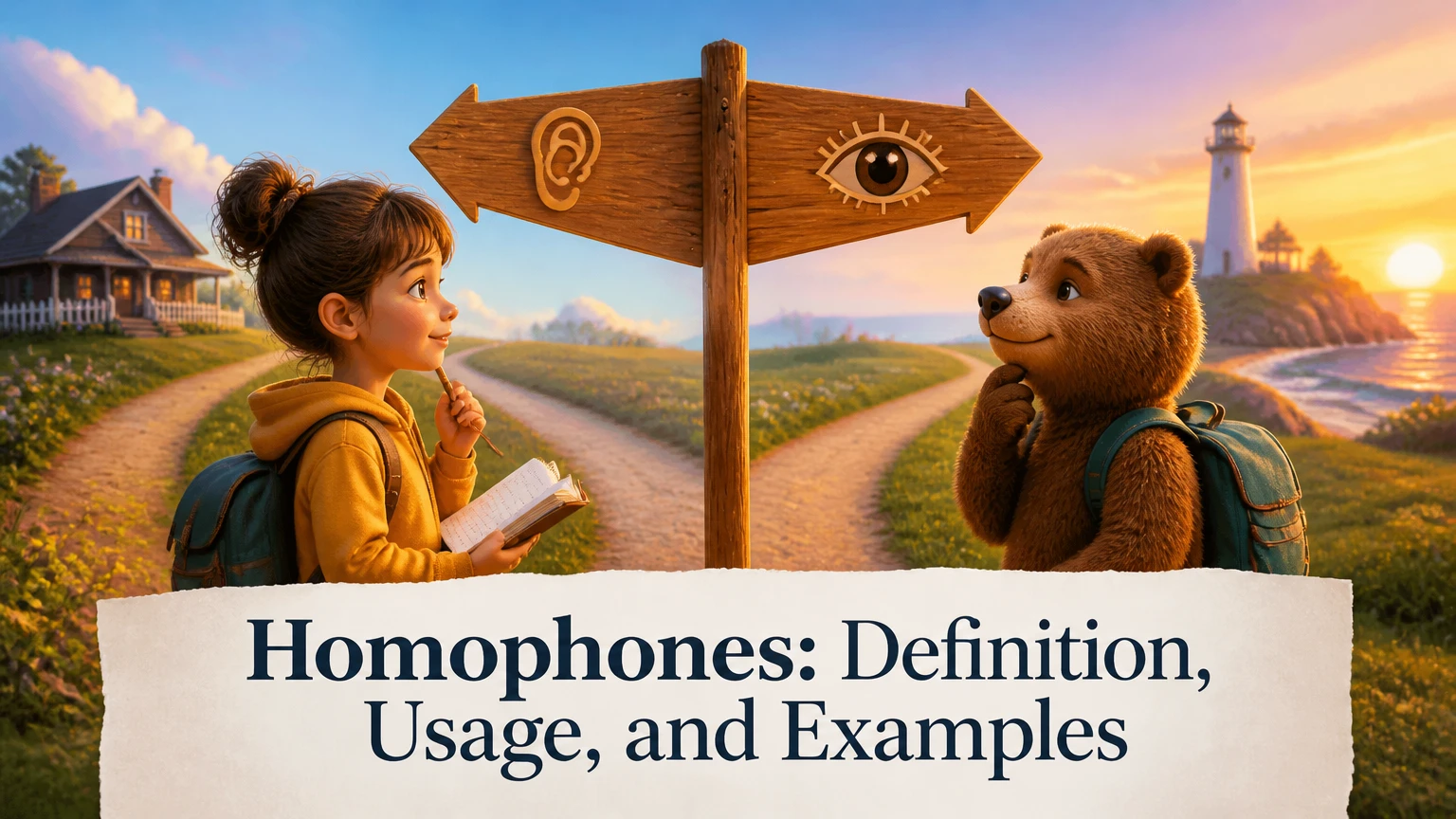
Homophones are words that sound alike but have different meanings and often different spellings. Understanding homophones is crucial for effective communication, as using the wrong word can completely change the meaning of a sentence. Common examples include “there,” “their,” and “they’re”; “to,” “too,” and “two”; and “hear” and “here.” Correctly distinguishing between homophones, such as knowing when to use “affect” versus “effect” or “cite” versus “sight,” enhances clarity and precision in both writing and speaking. This guide is designed for students, writers, and anyone looking to improve their command of the English language and avoid common errors in word usage.
Table of Contents
- Definition of Homophones
- Structural Breakdown
- Types and Categories of Homophones
- Examples of Homophones
- Usage Rules for Homophones
- Common Mistakes with Homophones
- Practice Exercises
- Advanced Topics
- Frequently Asked Questions (FAQ)
- Conclusion
Definition of Homophones
A homophone is a word that shares the same pronunciation as another word but has a different meaning, origin, or spelling. The term “homophone” comes from the Greek words homos (meaning “same”) and phone (meaning “sound”). Homophones can be a significant source of confusion in writing, as the correct word must be chosen based on context rather than sound alone. For instance, consider the words “see” (to perceive with the eyes) and “sea” (a large body of saltwater). Although they sound identical, their meanings are entirely different, and using one in place of the other would result in an error.
Structural Breakdown
Understanding the structure of homophones involves recognizing that the similarity lies solely in their pronunciation. The spelling and meaning are distinct. Homophones can be categorized based on their grammatical function (e.g., nouns, verbs, adjectives) and their specific meanings. Additionally, the etymology, or origin, of homophones often varies significantly, reflecting different historical pathways of language development. The key to mastering homophones is to focus on the context in which a word is used and to understand the subtle nuances of each word’s meaning. Pay attention to sentence structure and the surrounding words to determine the appropriate homophone.
Types and Categories of Homophones
Homophones can be broadly categorized based on their spelling and the degree of similarity in pronunciation. Here are some common types:
Perfect Homophones
Perfect homophones have identical pronunciations and different spellings and meanings. These are the most common type of homophones and often cause the most confusion. Examples include “there/their/they’re,” “to/too/two,” and “hear/here.”
Homographs (also Homonyms) that are Homophones
Words that are spelled the same and sound the same but have different meanings are called homonyms. When these words also have different origins, they are known as homographs that are homophones. For example, “bat” (the animal) and “bat” (the equipment used in baseball) are spelled and pronounced the same but have different meanings and origins.
Near Homophones
Near homophones are words that are pronounced almost identically but have slight differences in pronunciation, often due to regional accents or variations in speech. These differences might involve stress patterns or minor vowel shifts. An example might be “pen” and “pin” in some dialects.
Examples of Homophones
The English language is filled with homophones. The following tables provide examples to illustrate the variety and common usage of these words.
Table 1: Common Homophones A-D
This table lists common homophones, starting from A to D, providing clarity on their meanings and usage.
| Homophone 1 | Homophone 2 | Homophone 3 | Meanings | Examples |
|---|---|---|---|---|
| air | heir | Air: the invisible gaseous substance surrounding the earth; Heir: a person legally entitled to the property or rank of another on that person’s death. | The air was crisp and clean. He is the heir to the throne. | |
| ate | eight | Ate: past tense of eat; Eight: the number 8. | I ate my breakfast. She counted to eight. | |
| be | bee | Be: to exist; Bee: a flying insect. | To be or not to be. A bee stung me. | |
| buy | by | bye | Buy: to purchase; By: near, next to; Bye: short for goodbye. | I want to buy a car. He stood by the door. Bye for now! |
| cell | sell | Cell: a small room; Sell: to exchange for money. | The prisoner was in a cell. They want to sell their house. | |
| cent | scent | sent | Cent: a unit of currency; Scent: a smell; Sent: past tense of send. | It costs one cent. The flower has a nice scent. I sent a letter. |
| cite | sight | site | Cite: to quote as evidence; Sight: the ability to see; Site: a location. | You must cite your sources. My sight is good. This is the construction site. |
| coarse | course | Coarse: rough in texture; Course: a direction or a class. | The sand was coarse. I am taking a course in history. | |
| dear | deer | Dear: beloved or expensive; Deer: an animal. | My dear friend. A deer ran across the road. | |
| die | dye | Die: to stop living; Dye: to change the color of something. | People die eventually. I want to dye my hair. | |
| dew | due | Dew: moisture that condenses on surfaces; Due: owed or expected. | The grass was covered in dew. The rent is due tomorrow. | |
| done | dun | Done: completed; Dun: a brownish-gray color. | I am done with my work. The horse was a dun color. | |
| days | daze | Days: plural of day; Daze: a state of confusion. | There are seven days in a week. He was in a daze after the accident. | |
| desert | dessert | Desert: a dry, barren area; Dessert: a sweet course eaten at the end of a meal. | The Sahara is a vast desert. We had ice cream for dessert. | |
| doe | dough | Doe: a female deer; Dough: a mixture of flour and water used for baking. | The doe was grazing in the meadow. The dough needs to rise. | |
| dual | duel | Dual: consisting of two parts; Duel: a fight between two people. | The car has a dual exhaust system. They fought a duel with swords. | |
| dam | damn | Dam: a barrier constructed to hold back water; Damn: to condemn or curse. | The Hoover Dam is impressive. I damn this bad luck. | |
| dire | dyer | Dire: extremely serious or urgent; Dyer: a person who dyes fabric. | The situation was dire. The dyer used natural pigments. | |
| discreet | discrete | Discreet: careful and prudent; Discrete: individually separate and distinct. | She was very discreet about the secret. These are discrete data points. | |
| draft | draught | Draft: a preliminary version of a document; Draught: a current of air. | I need to write a first draft. There was a cold draught in the room. |
Table 2: Common Homophones E-L
This table continues the list of common homophones, covering words from E to L, to further illustrate their meanings and correct usage.
| Homophone 1 | Homophone 2 | Meanings | Examples | |
|---|---|---|---|---|
| earn | urn | Earn: to gain or deserve; Urn: a vase for ashes. | I earn money at my job. The ashes were placed in an urn. | |
| eye | I | Eye: the organ of sight; I: the pronoun referring to oneself. | My eye hurts. I am going to the store. | |
| ewe | you | yew | Ewe: a female sheep; You: the pronoun referring to the person being addressed; Yew: a type of evergreen tree. | The ewe grazed in the field. You should study hard. The garden had a yew tree. |
| flew | flu | Flew: past tense of fly; Flu: short for influenza. | The bird flew away. I have the flu. | |
| for | four | fore | For: a preposition; Four: the number 4; Fore: the front part of something. | This is for you. I have four apples. The fore of the ship. |
| forth | fourth | Forth: onward or outward; Fourth: the number 4th. | They went back and forth. It is the fourth of July. | |
| foul | fowl | Foul: offensive or unpleasant; Fowl: a bird, especially a domestic one. | The smell was foul. We had fowl for dinner. | |
| genes | jeans | Genes: units of heredity; Jeans: trousers made of denim. | Genes determine our traits. I wear jeans every day. | |
| gait | gate | Gait: a person’s manner of walking; Gate: a barrier used to close an opening in a wall or fence. | Her gait was unsteady. Close the gate behind you. | |
| gild | guild | Gild: to cover thinly with gold; Guild: an association of craftspeople or merchants. | They gild the edges of the book. He belongs to a trade guild. | |
| grate | great | Grate: to shred food; Great: large or excellent. | Grate the cheese. That’s a great idea. | |
| groan | grown | Groan: to make a deep sound of pain or disapproval; Grown: past participle of grow. | He let out a groan. She has grown taller. | |
| hair | hare | Hair: filaments growing from the skin; Hare: an animal similar to a rabbit. | I have long hair. The hare hopped away. | |
| hall | haul | Hall: a corridor or large room; Haul: to pull or drag with effort. | The meeting is in the hall. They had to haul the boat out of the water. | |
| heal | heel | Heal: to become healthy again; Heel: the back part of the foot. | The wound will heal quickly. My heel hurts. | |
| hear | here | Hear: to perceive with the ears; Here: in or at this place. | I can hear you. Come here. | |
| hi | high | Hi: a greeting; High: of great vertical extent. | Hi, how are you? The mountain is very high. | |
| him | hymn | Him: pronoun referring to a male; Hymn: a religious song. | I saw him yesterday. We sang a hymn in church. | |
| hole | whole | Hole: an opening through something; Whole: complete or entire. | There is a hole in the wall. I ate the whole pizza. | |
| hour | our | Hour: a unit of time; Our: belonging to us. | It will take an hour. This is our house. | |
| idle | idol | Idle: lazy or not active; Idol: a person or thing that is greatly admired. | He is idle and doesn’t work. She is my idol. | |
| in | inn | In: inside; Inn: a hotel. | The cat is in the box. We stayed at the inn. | |
| isle | aisle | I’ll | Isle: an island; Aisle: a passage between rows of seats; I’ll: contraction of I will. | The isle is beautiful. Walk down the aisle. I’ll see you later. |
| knew | new | Knew: past tense of know; New: recently made or obtained. | I knew the answer. I have a new car. | |
| knight | night | Knight: a medieval warrior; Night: the period of darkness. | The knight was brave. It is dark at night. | |
| knot | not | Knot: a fastening made by tying a rope or string; Not: a word used to express negation. | Tie a knot. I am not going. | |
| know | no | Know: to be aware of; No: a negative response. | I know the answer. No, thank you. | |
| lea | lee | Lea: a meadow; Lee: the side sheltered from the wind. | The cattle grazed in the lea. We sought shelter in the lee of the cliff. | |
| lessen | lesson | Lessen: to make or become less; Lesson: a unit of instruction. | We need to lessen the noise. The lesson was informative. | |
| loan | lone | Loan: a sum of money that is borrowed; Lone: solitary or isolated. | I need to take out a loan. He was a lone wolf. |
Table 3: Common Homophones M-R
This table adds more examples of common homophones, from M to R, along with their definitions and example sentences for better understanding.
| Homophone 1 | Homophone 2 | Meanings | Examples | |
|---|---|---|---|---|
| made | maid | Made: past tense of make; Maid: a female servant. | I made a cake. The maid cleaned the room. | |
| male | Mail: letters and packages; Male: a man or boy. | I received the mail. He is a male. | ||
| main | mane | Main: chief or principal; Mane: the long hair on the neck of a horse or lion. | The main reason is this. The horse has a beautiful mane. | |
| meat | meet | mete | Meat: animal flesh that is eaten; Meet: to encounter or come together; Mete: to dispense or allot. | I ate some meat. Let’s meet for lunch. They will mete out justice. |
| might | mite | Might: power or possibility; Mite: a tiny creature. | He might be late. There is a mite on the plant. | |
| moose | mousse | Moose: a large deer-like animal; Mousse: a dessert. | I saw a moose in the forest. She ate chocolate mousse. | |
| morning | mourning | Morning: the early part of the day; Mourning: the expression of sorrow. | Good morning! She is in mourning for her loss. | |
| muscle | mussel | Muscle: a tissue that contracts to produce movement; Mussel: a type of shellfish. | He has a strong muscle. I ate a mussel. | |
| nay | neigh | Nay: no (old-fashioned); Neigh: the sound a horse makes. | Nay, I disagree. The horse gave a loud neigh. | |
| none | nun | None: not any; Nun: a member of a religious order of women. | I have none left. The nun prayed in the chapel. | |
| oar | or | ore | Oar: a long pole with a flat blade used for rowing; Or: a conjunction; Ore: a natural rock or sediment containing valuable minerals. | Use the oar to row the boat. Do you want tea or coffee? The mine produces iron ore. |
| one | won | One: the number 1; Won: past tense of win. | I have one apple. He won the race. | |
| pain | pane | Pain: physical suffering; Pane: a sheet of glass in a window. | I feel pain in my leg. The window pane is broken. | |
| pair | pear | pare | Pair: two things that are similar and used together; Pear: a fruit; Pare: to trim by cutting away the outer edges. | I have a pair of shoes. I ate a pear. Pare the apple carefully. |
| passed | past | Passed: past tense of pass; Past: gone by in time. | He passed the test. In the past, things were different. | |
| peace | piece | Peace: freedom from disturbance; Piece: a portion of something. | We want peace. Can I have a piece of cake? | |
| peak | peek | pique | Peak: the top of a mountain; Peek: to look quickly; Pique: to arouse interest or curiosity. | The mountain peak was covered in snow. I took a peek through the keyhole. The story piqued my interest. |
| plain | plane | Plain: not decorated or elaborate; Plane: an aircraft. | The dress was plain. I flew in a plane. | |
| pole | poll | Pole: a long, slender piece of wood or metal; Poll: a survey. | The flag is on a pole. The poll showed a close race. | |
| pour | poor | pore | Pour: to flow rapidly; Poor: lacking sufficient money; Pore: a tiny opening in the skin. | Pour the milk. He is poor. My skin has large pores. |
| practice | practise | Practice: to perform an activity regularly; Practise: (British spelling) to perform an activity regularly. | I need to practice the piano. I need to practise the piano. | |
| pray | prey | Pray: to offer a prayer to a deity; Prey: an animal that is hunted and killed by another for food. | I pray every night. The lion stalked its prey. | |
| pride | pride | Pride: a feeling of deep pleasure or satisfaction; Pride: a group of lions. | He felt pride in his work. A pride of lions. | |
| principal | principle | Principal: the head of a school; Principle: a fundamental truth or proposition. | The principal gave a speech. He has strong principles. | |
| profit | prophet | Profit: a financial gain; Prophet: a person regarded as inspired by a deity. | The company made a huge profit. The prophet spoke of the future. | |
| raise | rays | raze | Raise: to lift or elevate; Rays: beams of light; Raze: to completely destroy. | Raise your hand. The sun’s rays are strong. They will raze the old building. |
| real | reel | Real: actually existing; Reel: a cylinder on which film, thread, or wire is wound. | This is a real diamond. The fishing line is on a reel. | |
| right | write | rite | Right: morally good or justifiable; Write: to mark letters or words on a surface; Rite: a religious or solemn ceremony. | That is the right answer. I will write a letter. The rite was performed in the temple. |
| road | rode | rowed | Road: a way or route between two places; Rode: past tense of ride; Rowed: propelled a boat with oars. | The road is long. He rode his bike. They rowed the boat. |
| roe | row | Roe: the eggs of fish; Row: a line of things or people. | She ate salmon roe. There is a row of seats. | |
| role | roll | Role: a part played by an actor or person; Roll: to move by turning over. | He played the role of Hamlet. The ball will roll down the hill. | |
| root | route | Root: the part of a plant that attaches it to the ground; Route: a way or course taken in getting from a starting point to a destination. | The root of the tree is deep. What is the best route to the city? |
Table 4: Common Homophones S-Z
This table completes the list of common homophones, from S to Z, providing comprehensive examples and definitions for each word.
| Homophone 1 | Homophone 2 | Homophone 3 | Meanings | Examples |
|---|---|---|---|---|
| sail | sale | Sail: a piece of material extended on a mast to catch the wind; Sale: the exchange of goods for money. | The ship has a white sail. The store is having a sale. | |
| sea | see | Sea: the expanse of salt water that covers most of the earth’s surface; See: to perceive with the eyes. | The sea is blue. I can see you. | |
| seam | seem | Seam: a line where two pieces of fabric are joined; Seem: to appear to be. | The seam is coming undone. He seems happy. | |
| scene | seen | Scene: a sequence of continuous action in a play, movie, or book; Seen: past participle of see. | The scene was dramatic. I have seen that movie. | |
| serf | surf | Serf: an agricultural laborer bound under the feudal system to work on his lord’s estate; Surf: the mass or line of foam formed by waves breaking on a seashore or reef. | The serf worked the land. We went to surf at the beach. | |
| shake | sheik | Shake: to move with quick, forcible movements; Sheik: an Arab leader. | Shake the bottle well. The sheik arrived in his palace. | |
| shear | sheer | Shear: to cut the wool off a sheep; Sheer: very thin or steep. | They shear the sheep in the spring. The cliff was sheer. | |
| shoe | shoo | Shoe: a covering for the foot; Shoo: to drive away. | I bought a new pair of shoes. Shoo, fly! | |
| shone | shown | Shone: past tense of shine; Shown: past participle of show. | The sun shone brightly. I have shown you the way. | |
| side | sighed | Side: a position to the left or right; Sighed: emitted a long, deep audible breath expressing sadness, relief, or fatigue. | Which side are you on? She sighed with relief. | |
| so | sew | sow | So: to such a great extent; Sew: to join or attach by stitches; Sow: to plant seeds. | It is so hot today. I need to sew the button. Sow the seeds in the garden. |
| sole | soul | Sole: the bottom of the foot or shoe; Soul: the spiritual or immaterial part of a human being. | The sole of my shoe is worn out. He has a kind soul. | |
| some | sum | Some: an unspecified amount or number; Sum: the total of two or more numbers. | I want some cake. What is the sum of 2 and 2? | |
| son | sun | Son: a male child; Sun: the star that provides light and heat to the earth. | He is my son. The sun is shining. | |
| steel | steal | Steel: a strong, hard, greyish-blue alloy of iron with carbon and usually other elements; Steal: to take (another person’s property) without permission or legal right and without intending to return it. | The bridge is made of steel. Don’t steal anything. | |
| stationary | stationery | Stationary: not moving; Stationery: writing materials. | The car is stationary. I need to buy some stationery. | |
| stayed | staid | Stayed: remained in a place; Staid: sedate, respectable, and unadventurous. | I stayed at home. He had a staid personality. | |
| straight | strait | Straight: extending or moving uniformly in one direction without curving or bending; Strait: a narrow passage of water connecting two seas or two large areas of water. | Walk straight ahead. The strait connects the two seas. | |
| sweet | suite | Sweet: having a pleasant taste; Suite: a set of rooms designated for one person’s or family’s use or for a particular purpose. | The candy is sweet. We booked a hotel suite. | |
| tale | tail | Tale: a fictitious or true narrative or story; Tail: the hindmost part of an animal. | He told a tall tale. The dog wagged its tail. | |
| team | teem | Team: a group of people working together; Teem: be full of or swarming with. | Our team won the game. The river began to teem with fish. | |
| there | their | they’re | There: in or at that place; Their: belonging to them; They’re: contraction of they are. | Look over there. It is their house. They’re coming to visit. |
| through | threw | Through: moving in one side and out the other; Threw: past tense of throw. | He walked through the door. She threw the ball. | |
| to | too | two | To: expressing motion or direction; Too: also or excessively; Two: the number 2. | Go to school. It is too cold. I have two sisters. |
| vane | vain | vein | Vane: a device that shows wind direction; Vain: producing no result or overly proud; Vein: a tube carrying blood. | The weather vane spun. He made a vain attempt. Blood flows through the vein. |
| waist | waste | Waist: the part of the body between the ribs and hips; Waste: use carelessly or discarded material. | The belt fits my waist. Do not waste water. | |
| wait | weight | Wait: to stay where one is or delay action; Weight: a body’s relative mass. | Please wait for me. He lifted the heavy weight. | |
| war | wore | War: a state of armed conflict; Wore: past tense of wear. | The war lasted years. She wore a red dress. | |
| way | weigh | whey | Way: a method or route; Weigh: to find out how heavy something is; Whey: the watery part of milk. | Which way should we go? Weigh the produce. Curds and whey. |
| weak | week | Weak: lacking strength; Week: a period of seven days. | I felt weak after the flu. I’ll see you next week. | |
| wear | where | Wear: to have on one’s body; Where: in or to what place. | What will you wear? Where are you going? | |
| weather | whether | Weather: the state of the atmosphere; Whether: expressing a doubt or choice between alternatives. | The weather is lovely. I don’t know whether to go. | |
| which | witch | Which: asking for information specifying one or more people or things; Witch: a woman thought to have magic powers. | Which color do you like? The witch cast a spell. | |
| who’s | whose | Who’s: contraction of who is or who has; Whose: belonging to or associated with which person. | Who’s at the door? Whose keys are these? | |
| wood | would | Wood: the material from a tree; Would: indicating the consequence of an imagined event. | The table is made of wood. I would go if I could. | |
| your | you’re | Your: belonging to you; You’re: contraction of you are. | Is this your book? You’re doing a great job. |
Usage Rules for Homophones
To use homophones correctly, you must rely on linguistic cues and grammatical rules rather than sound. Here are the primary methods for ensuring accuracy:
1. Rely on Context
Context is the most powerful tool for distinguishing homophones. In the sentence “I want to buy a gift,” the presence of the word “gift” indicates that the verb meaning “to purchase” is required, not the preposition “by.”
2. Parts of Speech
Often, homophones belong to different parts of speech. For example, “passed” is a verb (the past tense of pass), while “past” is typically a noun or adjective. If your sentence needs an action, choose “passed.”
3. Use Mnemonic Devices
Creating simple memory aids can help. For “stationary” vs. “stationery,” remember that stationery is for writing letters, while stationary means standing still.
Common Mistakes with Homophones
Even experienced writers can slip up when typing quickly or failing to proofread. Here are some of the most frequent errors:
- Their vs. There vs. They’re:
They’re going to there house.
They’re going to their house. - Its vs. It’s: “Its” is possessive; “It’s” is a contraction for “it is.”
The dog wagged it’s tail.
The dog wagged its tail. - Affect vs. Effect: “Affect” is usually a verb; “Effect” is usually a noun.
The medicine had a strange affect.
The medicine had a strange effect. - Loose vs. Lose: “Loose” means not tight; “Lose” means to be deprived of something.
Don’t loose your keys!
Don’t lose your keys!
Practice Exercises
Choose the correct word:
- I could (hear / here) the music from my room.
- The (principal / principle) of the school is retiring.
- We need to (pare / pair / pear) down the expenses.
- (Whose / Who’s) responsible for this mess?
- The (weather / whether) is expected to be sunny.
Answers: 1. hear, 2. principal, 3. pare, 4. Who’s, 5. weather
Advanced Topics
Regional Homophones
Some words are homophones in certain dialects but not in others. This is often referred to as a merger. For example, the “cot-caught” merger in many American accents makes these two words homophones, whereas in British English, they have distinct vowel sounds.
Homophones and Wordplay
Homophones are the foundation of many puns and jokes. A classic example is: “Why was six afraid of seven? Because seven eight (ate) nine!” This relies on the listener recognizing the sound of the number “eight” as the verb “ate.”
Frequently Asked Questions (FAQ)
What is the difference between a homophone and a homonym?
All homonyms are homophones because they sound the same, but not all homophones are homonyms. Homonyms must have the same spelling, whereas homophones can have different spellings (like “see” and “sea”).
How can I avoid homophone errors in my writing?
The best way is to proofread slowly. Spell-checkers often miss homophone errors because the word itself is spelled correctly, even if it is the wrong word for the context. Reading your work aloud can also help you catch these mistakes.
Are “accept” and “except” homophones?
In many dialects, yes, they are pronounced identically. However, “accept” means to receive, while “except” means to exclude.
Conclusion
Mastering homophones is a hallmark of a skilled communicator. While they can be tricky due to their identical sounds, paying close attention to context, spelling, and grammar will help you avoid common pitfalls. By familiarizing yourself with the tables and rules provided in this guide, you can improve your writing accuracy and ensure your message is always clear and professional.