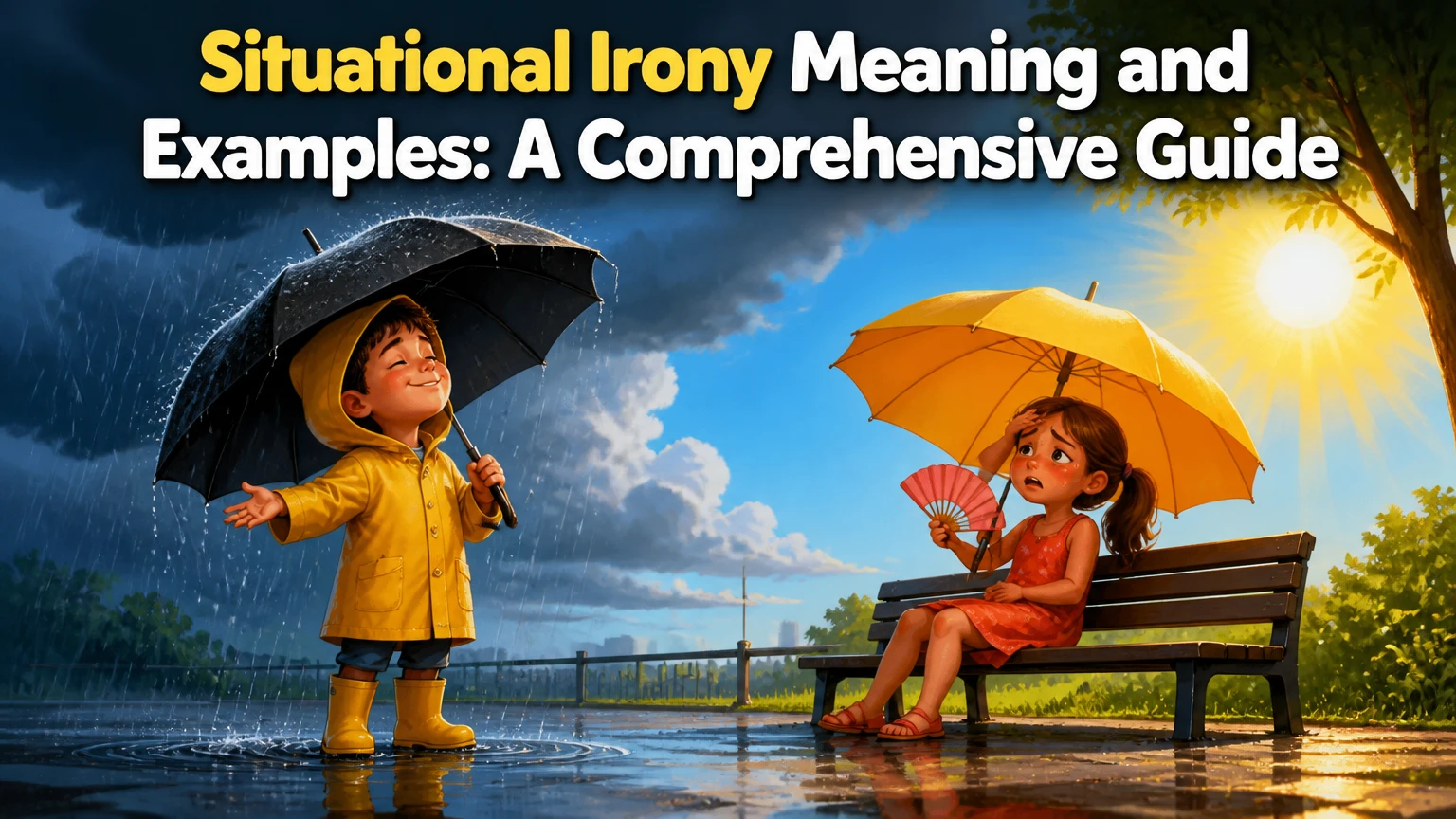
Situational irony is a sophisticated literary and linguistic device that occurs when there is a significant discrepancy between what is expected to happen and what actually transpires. This concept manifests in everyday life and storytelling through occurrences such as a fire station burning down, a pilot having a fear of heights, a traffic jam on the way to a protest against traffic, or a marriage counselor filing for divorce. By subverting our expectations, situational irony creates a sense of surprise, tragedy, or humor that enriches our understanding of the human experience.
Mastering the nuances of situational irony is essential for students, writers, and language enthusiasts who wish to analyze literature more deeply or craft more engaging narratives. It serves as a powerful tool for highlighting the unpredictability of life and the limitations of human foresight. Understanding this concept allows learners to distinguish between simple coincidence and true irony, a distinction that is often blurred in casual conversation but remains vital in academic and creative contexts.
Table of Contents
- Comprehensive Definition of Situational Irony
- Structural Breakdown of Irony
- Types and Categories of Situational Irony
- Extensive Examples and Comparative Tables
- Usage Rules and Literary Functions
- Common Mistakes: Irony vs. Coincidence
- Practice Exercises and Assessments
- Advanced Topics: Cosmic Irony and Poetic Justice
- Frequently Asked Questions (FAQ)
- Conclusion and Final Tips
Comprehensive Definition of Situational Irony
At its core, situational irony is a literary technique in which the outcome of a situation is the exact opposite of what was intended or anticipated. It is not merely a surprising turn of events; rather, it requires a specific set of expectations to be established, only for those expectations to be flipped in a way that feels meaningful or poignant. This form of irony is distinct from verbal irony, where one says the opposite of what they mean, and dramatic irony, where the audience knows something the characters do not.
The function of situational irony in language and literature is multifaceted. It can be used to provide a moral lesson, to mock a character’s hubris, or to emphasize the chaotic nature of the universe. When a professional thief is robbed by a pickpocket, the irony lies in the reversal of roles and the subversion of the thief’s perceived mastery over his craft. This reversal forces the reader or observer to reconsider their assumptions about the world.
In a grammatical and structural sense, situational irony often relies on a “contrast of conditions.” This involves a “Condition A” (the expectation based on logic or social norms) and a “Condition B” (the reality that contradicts those norms). To identify situational irony, one must look for the “twist” that renders the initial effort or status of a character futile or contradictory. It is the “punchline” of reality that often leaves us reflecting on the complexity of cause and effect.
Structural Breakdown of Irony
To understand how situational irony is constructed, we must look at the three primary components that make it effective: the Expectation, the Action, and the Result. Without these three pillars, a situation might just be unfortunate or weird, but not necessarily ironic. The following sections break down these structural elements in detail.
The Expectation
The expectation is the foundation of irony. It is built upon common sense, professional roles, or specific plot setups. For instance, we expect a doctor to be healthy, a police officer to follow the law, and a weather forecaster to know when it will rain. This expectation creates a mental “contract” with the audience about how a situation should logically progress.
The Action or Intent
This phase involves the character taking a specific step to achieve a goal. Ironically, the action taken to prevent an outcome often becomes the very thing that causes it. This is frequently seen in tragedies where a character tries to escape a prophecy, only to fulfill it through their very attempts at evasion. The intent is usually positive or protective, which makes the subsequent failure more impactful.
The Result (The Subversion)
The result must be the “polar opposite” of the expectation. If a person buys a high-tech security system to prevent theft, and the installation technician steals their jewelry, the result subverts the expectation of safety. The result provides the “ironic sting” that distinguishes the situation from a mere accident or a simple failure.
Types and Categories of Situational Irony
Situational irony is a broad umbrella that covers several specific variations. Each variation serves a different emotional or narrative purpose, ranging from the lighthearted to the devastatingly tragic. Understanding these categories helps in identifying the specific “flavor” of irony present in a text or real-life event.
Tragic Irony
Tragic irony occurs when the reversal of expectations leads to a catastrophic or deeply sad ending. This is a staple of classical Greek drama and Shakespearean plays. In these instances, the audience feels a sense of “inevitable doom” as they watch characters’ well-intentioned plans crumble into ruin. The irony heightens the tragedy by showing how close the character was to success or safety.
Comic Irony
Comic irony is used to create humor by highlighting the absurdity of a situation. It often involves characters who are victims of their own arrogance or quirks. For example, a man who spends hours bragging about his superior sense of direction only to get lost in his own neighborhood provides a moment of comic irony. The “fall from grace” is minor and serves to entertain rather than devastate.
Cosmic Irony (Irony of Fate)
Cosmic irony suggests that a higher power, the universe, or “fate” is intentionally manipulating events to thwart human desires. It creates a sense that the world is indifferent or even hostile to human planning. When a man survives a treacherous war only to trip over a rug and die at his homecoming party, the irony feels “cosmic” because it suggests a cruel joke played by destiny.
Poetic Irony (Poetic Justice)
Poetic justice is a specific type of situational irony where characters get what they deserve in a way that is fittingly ironic. If a greedy businessman spends his life hoarding money and eventually loses it all due to a minor clerical error he himself implemented to save costs, it is considered poetic justice. The punishment fits the “crime” in a way that feels satisfyingly symmetrical.
Extensive Examples and Comparative Tables
To truly grasp situational irony, it is helpful to see it applied across various contexts. The following tables provide a wide array of examples categorized by their setting and the nature of the irony involved. These examples demonstrate how the “expectation vs. reality” dynamic functions in practice.
The table below explores common situational irony found in professional and everyday life. These are scenarios where the role or purpose of an individual or object is contradicted by the outcome.
| Subject/Scenario | The Expectation | The Ironic Reality |
|---|---|---|
| A Fire Station | A place equipped to put out fires and remain safe. | The fire station burns to the ground. |
| A Marriage Counselor | An expert at keeping relationships together. | The counselor files for a third divorce. |
| A Police Station | A secure location where criminals are brought. | Someone steals the police chief’s car from the lot. |
| A Sign Maker | Someone skilled in spelling and communication. | The sign says: “We value high quality eduction.” |
| A Fitness Instructor | A person who maintains a healthy lifestyle. | The instructor has a heart attack while eating fast food. |
| A Pilot | Someone who flies planes for a living. | The pilot has a debilitating fear of heights. |
| A Cybersecurity Expert | Someone who protects data from hackers. | The expert’s personal bank account is hacked. |
| A Lifeguard | A person who saves others from drowning. | The lifeguard drowns in a shallow bathtub. |
| An Anti-Technology Activist | Someone who avoids modern gadgets. | The activist uses a viral YouTube video to spread their message. |
| A Dentist | A professional who promotes oral hygiene. | The dentist has a mouth full of cavities. |
| A Weather Forecaster | Someone who predicts the weather accurately. | Their outdoor wedding is ruined by an unpredicted storm. |
| A Librarian | A person who values quiet and order. | The librarian has a very loud, booming voice. |
| A Pesticide Company | A business that kills insects. | Their main office is shut down due to a termite infestation. |
| An English Teacher | A master of grammar and spelling. | The teacher fails a basic literacy test. |
| A Plumber | Someone who fixes leaks and water issues. | The plumber’s own house floods because of a burst pipe. |
| A Chef | A person who cooks gourmet meals. | The chef eats frozen dinners every night at home. |
| A Motivational Speaker | Someone who inspires others to find happiness. | The speaker suffers from chronic depression. |
| A Traffic Cop | A person who enforces driving laws. | The cop gets a ticket for speeding on their way to work. |
| A Barber | A person who cuts and styles hair. | The barber is completely bald. |
| A Surgeon | A person with steady hands and precision. | The surgeon is clumsy and drops things constantly. |
Next, we look at situational irony in literature and media. These examples show how writers use the device to create plot twists and emotional resonance. The irony here is often more complex, involving character arcs and thematic development.
| Work/Character | The Setup/Expectation | The Ironic Twist |
|---|---|---|
| The Gift of the Magi | Della sells her hair to buy a watch chain for Jim. | Jim sells his watch to buy combs for Della’s hair. |
| Oedipus Rex | Oedipus flees home to avoid killing his father. | His flight leads him directly to his biological father. |
| Romeo and Juliet | Romeo drinks poison to be with a “dead” Juliet. | Juliet wakes up right after he dies. | The sailors are surrounded by the ocean. | “Water, water, everywhere, nor any drop to drink.” |
| Fahrenheit 451 | Firemen are supposed to put out fires. | In this world, firemen start fires to burn books. |
| The Necklace | A woman spends years in poverty to replace a lost diamond necklace. | She discovers years later the original was a cheap fake. |
| Star Wars: Revenge of the Sith | Anakin joins the dark side to save Padmé from dying. | His turn to the dark side is what causes her death. |
| The Wonderful Wizard of Oz | The characters seek the Wizard to grant their wishes. | They already possessed the qualities they sought. |
| Harry Potter | Voldemort tries to kill Harry to prevent a prophecy. | His attempt is what gives Harry the power to defeat him. |
| The Story of an Hour | Louise is expected to be devastated by her husband’s death. | She feels a sense of joyful freedom instead. |
| Titanic (Real Life/Movie) | The ship was advertised as “unsinkable.” | It sank on its very first voyage. |
| The Cask of Amontillado | Fortunato is dressed as a jester (a symbol of fun). | He is led to a gruesome, dark death. |
| Macbeth | Macbeth kills the King to gain security and power. | The murder leads to his total paranoia and downfall. |
| Animal Farm | The animals revolt to create an equal society. | The pigs become even more tyrannical than the humans. |
| The Great Gatsby | Gatsby acquires wealth to win Daisy back. | His wealth and the lifestyle it requires lead to his death. |
| Of Mice and Men | George kills Lennie out of mercy and love. | Killing a loved one is usually an act of hate or malice. |
| The Lottery | The town prepares for a “lottery” (usually a good thing). | The “winner” is stoned to death by the community. |
| Les Misérables | Javert spends his life upholding the law. | He commits suicide because he cannot reconcile law and mercy. |
| The Interlopers | Two enemies reconcile while trapped under a tree. | They are eaten by wolves before anyone knows they made peace. |
| Spider-Man | Peter Parker gets powers to make his life easier. | The powers make his personal life infinitely more difficult. |
To further clarify the concept, let’s look at a table of “Ironic Objects.” These are things designed for one purpose that end up serving or causing the opposite. This table helps students see irony in the physical world around them.
| Object | Intended Purpose | Ironic Outcome |
|---|---|---|
| Safety Scissors | To prevent cutting or injury. | A person cuts themselves while trying to open the package. |
| Alarm Clock | To wake someone up at a specific time. | The power goes out, causing the person to oversleep. |
| Car GPS | To prevent the driver from getting lost. | The GPS leads the driver into a dead end or a lake. |
| Umbrella | To keep the user dry during rain. | The wind blows it inside out, making the user wetter. |
| Smoke Detector | To alert people of a fire. | The detector catches fire because of a short circuit. |
| Self-Help Book | To help people organize their lives. | The reader becomes so obsessed with the book they lose their job. |
| Bulletproof Vest | To protect the wearer from bullets. | The wearer is killed by a knife (which the vest doesn’t stop). |
| Antibacterial Soap | To kill bacteria and keep hands clean. | It breeds “super-bacteria” that are resistant to soap. |
| Weight Loss Pills | To help a person lose weight. | The pills cause a hormonal imbalance that leads to weight gain. |
| Air Freshener | To make a room smell better. | The chemicals in it cause a smell that makes people nauseous. |
| Privacy Software | To keep a user’s data private. | The software company sells the user’s data to advertisers. |
| Sunscreen | To protect the skin from burning. | The wearer is allergic to the lotion and gets a chemical burn. |
| Fire Extinguisher | To douse flames in an emergency. | The extinguisher explodes when exposed to high heat. |
| Dictionary | To provide correct spellings of words. | The word “dictionary” is misspelled on the cover. |
| Brake Pads | To stop a car from moving. | The pads fail, causing the car to speed down a hill. |
| Life Jacket | To keep a person afloat. | The jacket is too heavy and pulls the person down. |
| Security Camera | To record and prevent theft. | The camera is stolen by a thief who wasn’t caught on tape. |
| Heart Medication | To improve heart health. | The medication causes a sudden heart attack as a side effect. |
| Recycling Bin | To save the environment and reduce waste. | The bin is made of non-recyclable plastic and ends up in a landfill. |
| Translator App | To help people communicate across languages. | It translates “Hello” as an insult, causing a fight. |
Usage Rules and Literary Functions
Using situational irony effectively requires more than just a “twist.” Writers must follow certain “unwritten rules” to ensure the irony resonates with the audience. If the irony is too forced, it feels like a gimmick; if it is too subtle, it might be missed entirely. Here are the key rules for using situational irony in writing and analysis.
Rule 1: Establish a Clear Expectation
The audience must understand what is “supposed” to happen. If you are writing about a professional diver who is afraid of water, you must first establish their prowess or the prestige of their career. The irony only works if the reader shares the expectation that a diver should be comfortable in the water. Without this setup, the fear of water is just a random character trait.
Rule 2: Ensure Logical Connection
The ironic result should be logically connected to the initial situation. It shouldn’t be a random “bolt from the blue.” For example, if a man builds a giant wall to keep neighbors out, it is ironic if the wall falls on him. It is not situational irony if he builds a wall and then wins the lottery. The irony must stem from the context of the wall itself.
Rule 3: Use Irony to Reveal Theme or Character
In literature, irony is rarely used just for a surprise. It usually reveals something about the character’s flaws or the story’s theme. For instance, in The Great Gatsby, the irony of Gatsby’s death (dying for a crime he didn’t commit, while the person he loved abandons him) highlights the emptiness of the “American Dream.” The irony serves a deeper purpose than just shocking the reader.
Rule 4: Maintain a Consistent Tone
The tone of the irony must match the tone of the work. Tragic irony should feel heavy and inevitable, while comic irony should feel light and observational. Mixing these up without care can confuse the reader’s emotional response. A character dying in a “funny” ironic way in a serious drama can break the immersion and make the story feel insensitive.
Common Mistakes: Irony vs. Coincidence
The most frequent error in using the word “ironic” is confusing it with “coincidental” or “unfortunate.” This was famously highlighted by critics of Alanis Morissette’s song “Ironic,” where many of the examples (like rain on your wedding day) are actually just bad luck. Understanding the difference is crucial for proper grammar and literary analysis.
| Feature | Situational Irony | Coincidence/Bad Luck |
|---|---|---|
| Definition | A reversal of expectations; the opposite of what was intended. | Two events happening at once by chance; a random negative event. |
| Expectation | Crucial. There must be a reason to expect the opposite. | Not required. It’s just a random occurrence. |
| Example 1 | A fire station burning down (The one place meant to stop fires). | A house burning down (Just a sad, random accident). |
| Example 2 | A traffic jam on the way to receive an award for “Best Traffic Planning.” | A traffic jam when you are already late for work. |
| Example 3 | Winning the lottery and dying the next day (The win was for a long life). | Losing your wallet on the same day you lost your keys. |
| Key Feeling | “That is so fitting/contradictory.” | “What are the odds?” or “That’s too bad.” |
To avoid these mistakes, always ask: “Is the outcome the opposite of what was intended by the person’s role or actions?” If the answer is no, it is likely just a coincidence. For example, if you run into a friend at the grocery store, that is a coincidence. If you run into your “hermit” friend who claims they never leave their house at the grocery store, that is irony.
Practice Exercises and Assessments
Testing your knowledge is the best way to ensure you can identify and use situational irony correctly. Complete the following exercises to sharpen your skills. The answers are provided in a separate table below.
Exercise 1: Identify the Irony
Determine whether each of the following scenarios is Situational Irony or Coincidence/Bad Luck.
- A man buys a gun for protection but accidentally shoots himself in the foot with it.
- It rains on the day of a planned picnic.
- A famous singer loses her voice right before a world tour.
- A vegan dies from choking on a piece of broccoli.
- A professional dog trainer’s own dog bites him during a TV interview.
- You buy a new car and it gets a flat tire the next day.
- A person posts on Facebook about how useless social media is.
- A student fails a test because they forgot to study.
- The headquarters of the “Global Warming is a Hoax” foundation is flooded by rising sea levels.
- A man wins a “Lifetime Achievement Award” and dies the following week.
Exercise 2: Create the Irony
For each “Expectation” provided, write an “Ironic Reality” that creates a situational irony.
| Scenario | Expectation | Your Ironic Reality |
|---|---|---|
| 1. A Shoemaker | To have the best shoes in town. | _________________________________ |
| 2. A Speeding Ticket | To discourage fast driving. | _________________________________ |
| 3. A “Keep Off Grass” Sign | To protect the lawn from being stepped on. | _________________________________ |
| 4. A Marriage Proposal | To lead to a happy wedding. | _________________________________ |
| 5. A Wealthy Heir | To live a life of luxury and ease. | _________________________________ |
Answer Key for Exercise 1
| Question Number | Correct Answer | Explanation |
|---|---|---|
| 1 | Situational Irony | The gun meant for protection caused the harm. |
| 2 | Bad Luck | Rain is a random weather event, not a reversal of intent. |
| 3 | Bad Luck | While unfortunate, it’s a common medical occurrence. |
| 4 | Situational Irony | The food they chose for health/ethics caused their death. |
| 5 | Situational Irony | An expert in dog behavior should be able to control their own dog. |
| 6 | Bad Luck | New cars are not expected to be immune to nails in the road. |
| 7 | Situational Irony | Using the very thing you are criticizing to criticize it. |
| 8 | Logical Consequence | Failing because of not studying is expected, not ironic. |
| 9 | Situational Irony | The phenomenon they denied is what destroyed their base. |
| 10 | Situational Irony | The award for a “lifetime” is given just as the lifetime ends. |
Advanced Topics: Cosmic Irony and Poetic Justice
For advanced learners, situational irony can be explored through the lens of philosophy and complex narrative structures. Two of the most interesting sub-types are Cosmic Irony and Poetic Justice. These concepts deal with the “why” behind the irony, suggesting that the universe itself might have a sense of humor or a sense of morality.
Cosmic Irony: The “Gods” are Laughing
Cosmic irony, often associated with the writer Thomas Hardy, posits that human beings are mere playthings of fate. In this view, the irony isn’t just a coincidence; it’s a deliberate act by a cold, indifferent universe to mock human ambition. If a man works his whole life to save for retirement and dies the day he receives his first pension check, a cosmic ironist would say the universe timed it that way on purpose. This type of irony is often used in naturalism and fatalistic literature to emphasize human powerlessness.
Poetic Justice: Moral Symmetry
Unlike cosmic irony, which can feel cruel, poetic justice feels “right.” It is a form of situational irony where the outcome is a direct and fitting punishment or reward for a character’s actions. If a character uses a specific lie to ruin someone else’s reputation, and that exact lie eventually leads to their own downfall, justice has been served “poetically.” It satisfies the reader’s desire for a moral order in the world, even if that order is achieved through ironic means.
The Irony of the “Self-Fulfilling Prophecy”
This is a classic trope in mythology and fantasy. A character receives a prophecy (e.g., “You will be killed by a man with one eye”) and takes extreme measures to avoid it (e.g., killing every one-eyed man they meet). Ironically, one of the men they tried to kill survives, loses an eye in the process, and returns to kill the character out of revenge. The attempt to avoid the fate is what created the fate. This is the ultimate form of situational irony because the “Action” and the “Result” are perfectly mirrored.
Frequently Asked Questions (FAQ)
Q1: Is situational irony the same as a plot twist?
A: Not necessarily. All situational ironies are plot twists, but not all plot twists are ironic. A plot twist is just a surprise. For it to be ironic, the surprise must be the opposite of what the setup led us to expect. If a character’s “dead” father suddenly shows up, it’s a twist. If a character’s father, who was a famous swimmer, drowns in a puddle, it’s situational irony.
Q2: Can situational irony be unintentional?
A: In real life, situational irony is almost always unintentional; it’s just how events unfold. In literature, however, it is always intentional on the part of the author. The author carefully constructs the scenario to ensure the irony is felt by the reader.
Q3: Why do people often misuse the word “ironic”?
A: People often use “ironic” as a synonym for “weird” or “unfortunate.” This is because the concepts are related—they all involve unexpected events. However, the lack of a “subversion of expectation” makes the casual usage technically incorrect in a grammatical or literary sense.
Q4: What is the difference between situational and dramatic irony?
A: Situational irony involves a discrepancy between expectation and reality for everyone (characters and audience). Dramatic irony involves a discrepancy between what a character knows and what the audience knows. In dramatic irony, the “twist” is known by the audience beforehand.
Q5: Is situational irony always funny?
A: No. It can be tragic, horrifying, or simply thought-provoking. While “comic irony” is a popular category, many of the most famous examples in literature (like Oedipus Rex) are deeply tragic.
Q6: How can I use situational irony in my own writing?
A: Start by giving your character a strong goal or a specific professional trait. Then, think of the one thing that would most contradict that goal or trait. If they are a chef, have them lose their sense of taste. If they are a runner, have them get stuck in a slow-moving elevator. The contradiction is the key.
Q7: Does situational irony require a person to be involved?
A: Usually, yes, because irony relies on human expectations. However, objects can be ironic if their intended human purpose is subverted (like the “unsinkable” ship sinking). The irony still relates back to the human expectation of that object.
Q8: What is the “irony of situation” in poetry?
A: In poetry, it often functions through imagery. A poem might describe a beautiful, lush garden that is actually a graveyard. The contrast between the life-giving imagery and the presence of death creates a situational irony that deepens the poem’s meaning.
Conclusion and Final Tips
Situational irony is a powerful and versatile tool that adds depth to both our language and our storytelling. By focusing on the subversion of expectations, it forces us to look beyond the surface of events and consider the underlying contradictions of life. Whether it is a billboard for a spelling bee with a typo or a wealthy man dying of hunger, these moments capture our attention because they challenge our sense of logic and order. To master this concept, always look for the “Expectation vs. Reality” dynamic and ensure that the outcome is a meaningful reversal rather than a random accident.
As you continue your studies, try to spot situational irony in the news, in movies, and in your daily interactions. Remember that the best irony is that which reveals a deeper truth about a character or a situation. Keep practicing with the exercises provided, and soon you will be able to distinguish true irony from mere coincidence with ease. Happy writing and analyzing!