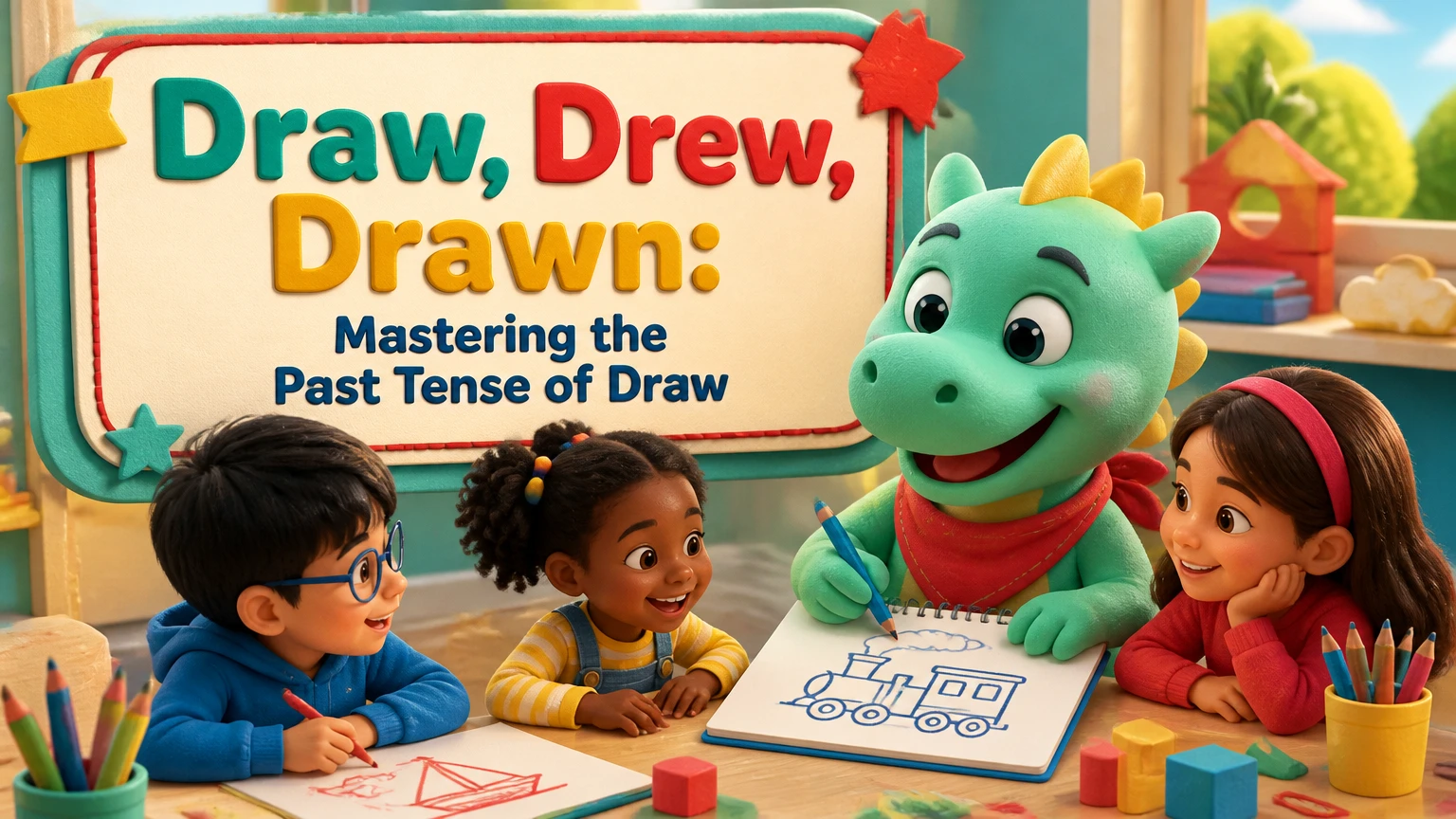
The verb “draw” is a common word with multiple meanings, but when referring to creating images or pulling something, it’s crucial to understand its past tense forms. The past tense and past participle forms of “draw” can sometimes be confusing, particularly distinguishing between “drew” and “drawn.” For example, “I drew a picture yesterday,” and “I have drawn many sketches.” Knowing when to correctly use “drew” as the simple past tense and “drawn” as the past participle is essential for clear and accurate communication. This knowledge is beneficial for students, writers, artists, and anyone looking to improve their English grammar skills. Understanding these forms ensures proper sentence construction in both spoken and written English.
Table of Contents
- Definition of Draw, Drew, and Drawn
- Structural Breakdown
- Types and Categories of “Draw”
- Examples of “Draw,” “Drew,” and “Drawn”
- Usage Rules
- Common Mistakes
- Practice Exercises
- Advanced Topics
- FAQ
- Conclusion
Definition of Draw, Drew, and Drawn
The verb “draw” is a versatile word with several meanings. Its primary meaning involves creating a picture or diagram using lines, typically with a pencil, pen, or crayon. For example, a child might draw a house, or an artist might draw a portrait. However, “draw” also has other meanings, such as pulling something (draw a curtain), attracting something (draw a crowd), or selecting something randomly (draw a card). Understanding these different meanings is key to using the correct tense.
Drew is the simple past tense of “draw.” It indicates that the action of drawing, pulling, or attracting happened at a specific point in the past. For example, “Yesterday, I drew a landscape,” or “The magician drew a rabbit from his hat.” In these sentences, “drew” signifies a completed action in the past.
Drawn is the past participle of “draw.” It is used with auxiliary verbs like “have,” “has,” “had,” “is,” “are,” “was,” and “were” to form perfect tenses (present perfect, past perfect, future perfect) and passive voice constructions. For example, “I have drawn several sketches this week” (present perfect), or “The winning name was drawn from a hat” (passive voice). The past participle “drawn” indicates a completed action with relevance to a specific time frame or a state of being.
Structural Breakdown
The verb “draw” is an irregular verb, meaning its past tense and past participle forms do not follow the standard “-ed” ending rule. Here’s a breakdown of its principal parts:
- Base Form: draw
- Simple Past: drew
- Past Participle: drawn
- Present Participle: drawing
Understanding these forms is crucial for correct usage. The simple past “drew” stands alone to describe a completed action in the past, while the past participle “drawn” requires an auxiliary verb.
Here’s a table summarizing the verb forms:
| Verb Form | Example | Usage |
|---|---|---|
| Base Form (Draw) | I like to draw in my free time. | Present tense, infinitive |
| Simple Past (Drew) | She drew a portrait of her friend. | Completed action in the past |
| Past Participle (Drawn) | He has drawn many beautiful pictures. | Perfect tenses, passive voice |
| Present Participle (Drawing) | They are drawing in the park. | Continuous tenses |
Types and Categories of “Draw”
The verb “draw” can be categorized based on its different meanings and usages. Here are some primary categories:
1. Artistic Creation
This is the most common meaning of “draw,” referring to the act of creating pictures or diagrams using lines.
2. Physical Action
This refers to the act of pulling or moving something, such as drawing a curtain or drawing water from a well.
3. Selection by Chance
This refers to selecting something randomly, such as drawing a name from a hat or drawing a card from a deck.
4. Attraction or Allurement
This refers to attracting someone or something, such as drawing a crowd or drawing attention.
Each of these categories uses “draw,” “drew,” and “drawn” slightly differently, which impacts sentence construction and meaning. For instance, in artistic creation, one might say, “She drew a beautiful landscape,” while in physical action, one might say, “He drew the curtains closed.” Understanding these nuances is important for precise communication.
Examples of “Draw,” “Drew,” and “Drawn”
To illustrate the usage of “draw,” “drew,” and “drawn,” here are several examples categorized by their meaning:
Artistic Creation Examples
The following table provides examples of “draw,” “drew,” and “drawn” in the context of artistic creation. This helps to illustrate how each form is used to describe the action of creating art.
| Sentence | Tense | Explanation |
|---|---|---|
| I like to draw portraits in my free time. | Present | General statement about a hobby. |
| She drew a beautiful landscape yesterday. | Past | Completed action of creating a drawing in the past. |
| He has drawn many sketches in his notebook. | Present Perfect | Action completed over a period of time, with relevance to the present. |
| They are drawing animals for their art project. | Present Continuous | Action in progress at the present time. |
| The artist will draw a caricature of you. | Future | Action that will happen in the future. |
| She had drawn the picture before I arrived. | Past Perfect | Action completed before another action in the past. |
| The child was drawing on the wall with crayons. | Past Continuous | Action in progress at a specific time in the past. |
| If I had more time, I would draw every day. | Conditional | Hypothetical action. |
| Having drawn the outline, she began to add details. | Perfect Participle | Action completed before another action. |
| The portrait was drawn from a photograph. | Passive Voice | The subject receives the action. |
| Please draw a map to your house. | Imperative | A command or request. |
| He is known for having drawn some of the most iconic comic book characters. | Perfect Gerund | Action completed before another action (used as a noun). |
| The students must draw their own conclusions. | Modal Verb | Expressing obligation or necessity. |
| She used to draw cartoons when she was younger. | Past Habit | Action that was a regular habit in the past. |
| He is going to draw a mural on the school wall. | Future Intent | Expressing intention to do something in the future. |
| The art teacher wanted him to draw something original. | Infinitive | Used after “to” to express purpose. |
| Drawing is a relaxing hobby for many people. | Gerund | Using the verb as a noun. |
| The lines she has drawn are very precise. | Present Perfect | Completed action with current relevance. |
| After he drew the sketch, he painted it. | Past | Completed action in the past followed by another past action. |
| By the time I arrived, he had already drawn the entire scene. | Past Perfect | Action completed before another past action. |
Physical Action Examples
The following table focuses on the use of “draw,” “drew,” and “drawn” when referring to the physical act of pulling or moving something. These examples demonstrate how the verb functions in contexts beyond artistic creation.
| Sentence | Tense | Explanation |
|---|---|---|
| He can draw water from the well. | Present | Ability to perform an action. |
| She drew the curtains to block the sunlight. | Past | Completed action of pulling the curtains. |
| They have drawn a map to find the treasure. | Present Perfect | Action completed with present relevance (the map exists now). |
| He is drawing the cart up the hill. | Present Continuous | Action in progress. |
| The horse will draw the carriage through the park. | Future | Action that will happen in the future. |
| They had drawn the boat ashore before the storm hit. | Past Perfect | Action completed before another action in the past. |
| The child was drawing the toy closer. | Past Continuous | Action in progress at a specific time in the past. |
| If you pull hard enough, you can draw the nail out. | Conditional | Hypothetical action. |
| Having drawn the sword, he prepared to fight. | Perfect Participle | Action completed before another action. |
| The blanket was drawn over her shoulders. | Passive Voice | The subject receives the action. |
| Draw the rope tighter! | Imperative | A command or request. |
| He is known for having drawn the secret from the witness. | Perfect Gerund | Action completed before another action (used as a noun). |
| You must draw the line somewhere. | Modal Verb | Expressing obligation or necessity. |
| She used to draw comfort from her friends. | Past Habit | Action that was a regular habit in the past. |
| He is going to draw inspiration from nature. | Future Intent | Expressing intention to do something in the future. |
| The detective wanted him to draw out the whole story. | Infinitive | Used after “to” to express purpose. |
| Drawing attention to the issue is important. | Gerund | Using the verb as a noun. |
| The information she has drawn is very valuable. | Present Perfect | Completed action with current relevance. |
| After he drew the bucket from the well, he drank the water. | Past | Completed action in the past followed by another past action. |
| By the time I arrived, he had already drawn all the water. | Past Perfect | Action completed before another past action. |
Selection by Chance Examples
This table illustrates the usage of “draw,” “drew,” and “drawn” when referring to selecting something randomly, such as in a lottery or game. Understanding this usage is important for accurately describing events involving chance.
| Sentence | Tense | Explanation |
|---|---|---|
| They will draw a name from the hat. | Future | Action that will happen in the future. |
| She drew the winning ticket. | Past | Completed action of selecting the winning ticket. |
| The winner has been drawn. | Present Perfect | Action completed with present relevance (the winner is now known). |
| They are drawing lots to decide who goes first. | Present Continuous | Action in progress. |
| We will draw straws to see who cleans up. | Future | Action that will happen in the future. |
| The teams had drawn their opponents before the tournament started. | Past Perfect | Action completed before another action in the past. |
| The card was being drawn from the deck by the dealer. | Past Continuous | Action in progress at a specific time in the past. |
| If we draw the right card, we win. | Conditional | Hypothetical action. |
| Having drawn a spade, he lost the game. | Perfect Participle | Action completed before another action. |
| The short straw was drawn by John. | Passive Voice | The subject receives the action. |
| Draw a card, any card! | Imperative | A command or request. |
| She is known for having drawn the lucky number. | Perfect Gerund | Action completed before another action (used as a noun). |
| They must draw numbers in order to determine the sequence. | Modal Verb | Expressing obligation or necessity. |
| He used to draw names for secret Santa every year. | Past Habit | Action that was a regular habit in the past. |
| She is going to draw a raffle ticket at the event. | Future Intent | Expressing intention to do something in the future. |
| The organizers wanted him to draw the winning name. | Infinitive | Used after “to” to express purpose. |
| Drawing lots is a fair way to decide. | Gerund | Using the verb as a noun. |
| The sequence she has drawn is quite favorable. | Present Perfect | Completed action with current relevance. |
| After he drew the ace, he won the hand. | Past | Completed action in the past followed by another past action. |
| By the time I arrived, they had already drawn all the names. | Past Perfect | Action completed before another past action. |
Usage Rules
The correct usage of “draw,” “drew,” and “drawn” depends on the tense and context of the sentence. Here are some key rules:
- Use “draw” for the present tense and infinitive form. For example, “I draw every day,” or “I want to draw a picture.”
- Use “drew” for the simple past tense. For example, “Yesterday, I drew a portrait.”
- Use “drawn” for the past participle, with auxiliary verbs. For example, “I have drawn many pictures,” or “The winning number was drawn.”
- Pay attention to the context. The meaning of “draw” can change the sentence’s overall structure.
It is important to remember that “drawn” always needs a helping verb, unlike “drew” which stands alone as the simple past tense.
Common Mistakes
One of the most common mistakes is using “drawed” as the past tense of “draw.” This is incorrect; the correct past tense is “drew.” Another frequent error is using “drew” instead of “drawn” with auxiliary verbs. For example:
| Incorrect | Correct | Explanation |
|---|---|---|
| I have drew a picture. | I have drawn a picture. | “Drawn” is the past participle and must be used with “have.” |
| Yesterday, I drawn a landscape. | Yesterday, I drew a landscape. | “Drew” is the simple past tense; “drawn” requires an auxiliary verb. |
| He drawed a caricature. | He drew a caricature. | “Drawed” is not a valid form of the verb. |
Avoiding these common mistakes will significantly improve the accuracy of your writing and speaking.
Practice Exercises
Complete the following sentences with the correct form of “draw” (draw, drew, or drawn).
| Question | Answer |
|---|---|
| 1. She always likes to ______ in her sketchbook. | draw |
| 2. Yesterday, he ______ a beautiful portrait. | drew |
| 3. They have ______ lots to decide who goes first. | drawn |
| 4. The artist is currently ______ a mural on the wall. | drawing |
| 5. The winning ticket was ______ from the raffle. | drawn |
| 6. He ______ the curtains closed to block out the light. | drew |
| 7. I have never ______ such a detailed picture before. | drawn |
| 8. She will ______ a map to help us find the treasure. | draw |
| 9. The children were ______ pictures with crayons. | drawing |
| 10. Please ______ a line under the correct answer. | draw |
Advanced Exercise: Rewrite the following sentences using the passive voice.
| Question | Answer |
|---|---|
| 1. The artist drew a portrait of her. | A portrait of her was drawn by the artist. |
| 2. They drew the winning name from the hat. | The winning name was drawn from the hat. |
| 3. He drew the curtains closed. | The curtains were drawn closed by him. |
| 4. She drew a map to the treasure. | A map to the treasure was drawn by her. |
| 5. The children drew pictures with crayons. | Pictures were drawn with crayons by the children. |
| 6. The architect drew a blueprint of the building. | A blueprint of the building was drawn by the architect. |
| 7. The committee drew up the proposal. | The proposal was drawn up by the committee. |
| 8. The crowd drew closer to the stage. | The stage was drawn closer to by the crowd. |
| 9. The detective drew information from the suspect. | Information was drawn from the suspect by the detective. |
| 10. The company drew criticism for its decision. | Criticism was drawn by the company for its decision. |
Advanced Topics
For advanced learners, exploring the nuances of “draw” in idioms and figurative language can be beneficial. For example, the idiom “draw a blank” means to fail to remember something. The phrase “draw the line” means to set a limit or boundary. Understanding these idiomatic expressions requires contextual awareness and a deeper understanding of the English language.
Furthermore, exploring the historical evolution of the verb “draw” can provide insights into its various meanings and usages. Etymological analysis can reveal how the verb’s meaning has expanded over time, contributing to its versatility in modern English.
FAQ
- Q: What is the difference between “drew” and “drawn”?
A: “Drew” is the simple past tense of “draw,” used to describe a completed action in the past without any auxiliary verbs. “Drawn” is the past participle of “draw,” used with auxiliary verbs like “have,” “has,” “had,” “is,” “are,” “was,” and “were” to form perfect tenses and passive voice constructions.
- Q: Can I use “drawed” as the past tense of “draw”?
A: No, “drawed” is not a correct form. The correct past tense of “draw” is “drew.”
- Q: When should I use “drawn” instead of “drew”?
A: Use “drawn” when you need the past participle form, typically with auxiliary verbs. For example, “I have drawn,” “It was drawn,” or “Having drawn.”
- Q: What are some common mistakes when using “draw,” “drew,” and “drawn”?
A: Common mistakes include using “drawed” as the past tense, using “drew” with auxiliary verbs instead of “drawn,” and confusing the different meanings of “draw” in various contexts.
- Q: How can I improve my understanding of these verb forms?
A: Practice using “draw,” “drew,” and “drawn” in different sentences and contexts. Pay attention to the tense and voice of the sentence, and review examples to reinforce your understanding.
- Q: Is “draw” an irregular verb?
A: Yes, “draw” is an irregular verb because its past tense (drew) and past participle (drawn) do not follow the standard “-ed” ending rule.
- Q: Can “draw” be used in the passive voice?
A: Yes, “draw” can be used in the passive voice. The past participle “drawn” is used with a form of the verb “be” (is, are, was, were, been, being). For example, “The picture was drawn by the artist.”
- Q: Are there any idiomatic expressions that use “draw”?
A: Yes, there are many idiomatic expressions that use “draw.” Examples include “draw a blank” (to fail to remember), “draw the line” (to set a limit), and “draw attention” (to attract notice).
Conclusion
Mastering the past tense forms of “draw”—namely “drew” and “drawn”—is essential for effective communication in English. Understanding the difference between the simple past tense “drew,” used for completed actions in the past, and the past participle “drawn,” used with auxiliary verbs in perfect tenses and passive constructions, ensures accuracy and clarity in both writing and speech. By studying examples, practicing exercises, and avoiding common mistakes, learners can confidently use these verb forms. Remember to pay attention to the context and tense of the sentence to choose the correct form. With consistent practice, you’ll be able to accurately and confidently use “draw,” “drew,” and “drawn” in any situation.