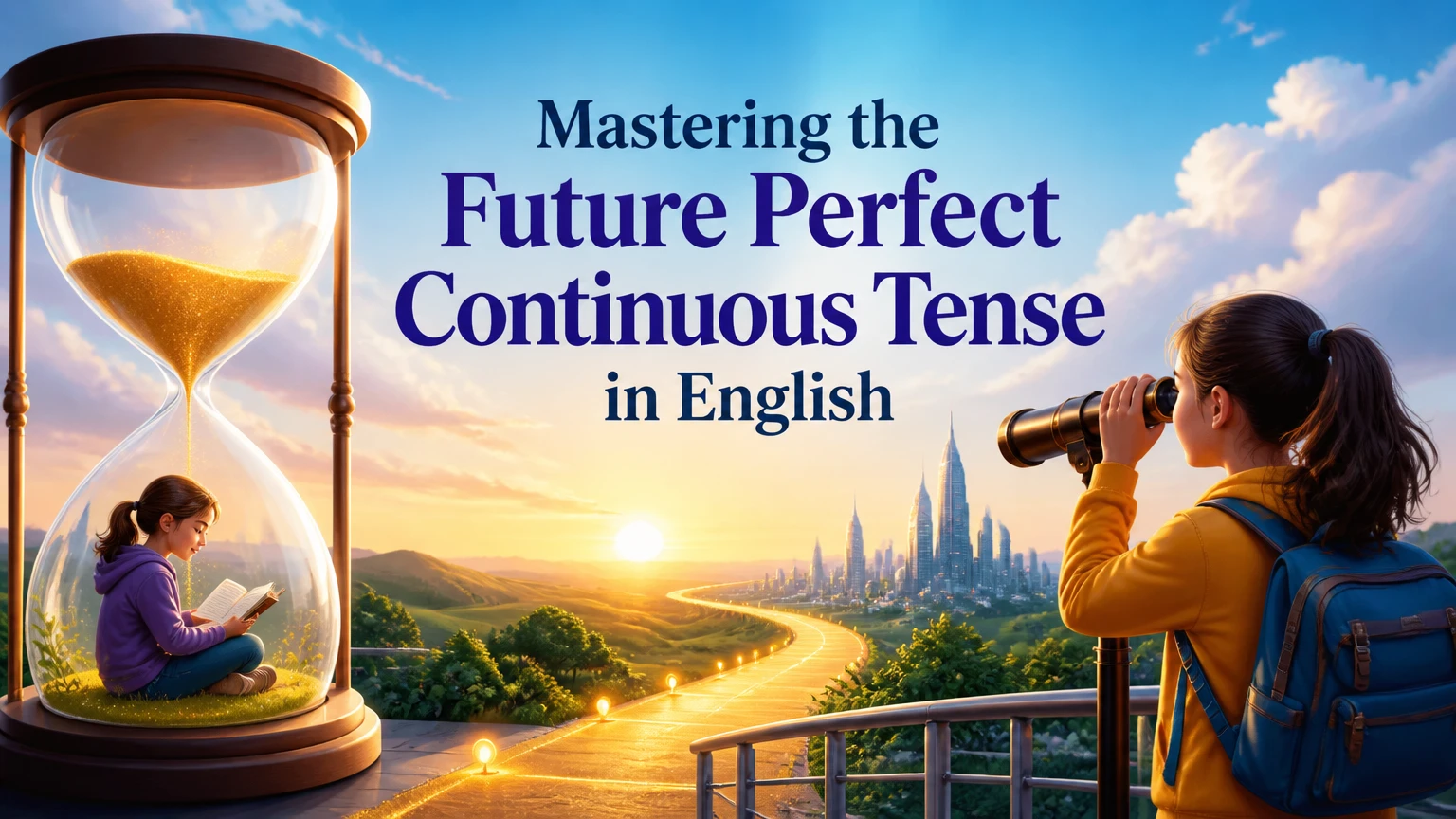
The future perfect continuous tense is a sophisticated grammatical structure used to describe actions that will continue up until a specific point in the future. This tense allows speakers to emphasize the duration or ongoing nature of an activity, such as will have been working, will have been living, will have been studying, or will have been waiting. By using this tense, you can provide a sense of perspective on how much time will have accumulated by a certain deadline or milestone. It is particularly useful for writers and professionals who need to project timelines or describe long-term commitments that are still in progress at a future date. Understanding this complex tense helps learners move from intermediate to advanced proficiency, allowing for more nuanced and precise communication in both academic and professional settings.
Table of Contents
- 1. Comprehensive Definition and Function
- 2. Structural Breakdown: Formula and Patterns
- 3. The Affirmative Form: Constructing Positive Statements
- 4. The Negative Form: Expressing Non-Continuous Actions
- 5. The Interrogative Form: Asking Questions
- 6. Emphasizing Duration with “For” and “Since”
- 7. Essential Time Markers and Prepositions
- 8. Expressing Cause and Effect in the Future
- 9. Future Perfect vs. Future Perfect Continuous
- 10. Future Continuous vs. Future Perfect Continuous
- 11. The Role of Stative Verbs and Exceptions
- 12. Usage in Professional and Business Contexts
- 13. Usage in Academic and Formal Writing
- 14. Common Mistakes and How to Avoid Them
- 15. Contractions and Pronunciation Patterns
- 16. Extensive Examples: Personal Life
- 17. Extensive Examples: Career and Education
- 18. Extensive Examples: Travel and Projects
- 19. Advanced Topics: Passive Voice and Nuance
- 20. Practice Exercises and Solutions
- 21. Frequently Asked Questions (FAQ)
- 22. Conclusion and Final Learning Tips
1. Comprehensive Definition and Function
The future perfect continuous, also known as the future perfect progressive, is a verb tense that indicates a continuous action that will be completed at some specified time in the future. It looks “backwards” from a point in the future to describe the duration of an event that started in the past, present, or even in the future, as long as it continues up to that reference point. This tense is almost always used with a time expression that indicates the “deadline” or the point of measurement.
The primary function of this tense is to highlight the length of time. While the future perfect focuses on the completion of an event, the future perfect continuous focuses on the process and the duration. For example, if you say “In December, I will have lived here for five years,” you are using the future perfect to state a fact of completion. However, saying “In December, I will have been living here for five years” emphasizes the ongoing nature of your residence and the time spent during that period.
It is important to note that this tense is relatively rare in casual spoken English compared to the simple future or present continuous. However, it is vital for mastery of the language because it provides a specific temporal logic that other tenses cannot replicate. It allows the speaker to project themselves into the future and look back at the continuity of their life or work, creating a bridge between the future and the time preceding it.
Contextually, this tense is often found in performance reviews, anniversary speeches, project planning, and biographical writing. It helps in setting expectations and illustrating endurance. Because it requires several auxiliary verbs, it can feel “heavy” to learners, but its logical structure is quite consistent once the basic formula is mastered.
2. Structural Breakdown: Formula and Patterns
The structure of the future perfect continuous is one of the most complex in English because it involves four distinct components. To form this tense, you must combine the modal will, the auxiliary verb have, the past participle of “to be” (been), and the present participle (verb + -ing) of the main action verb.
The formula remains the same regardless of the subject (I, you, he, she, it, we, they). This is a relief for many learners, as there is no need to worry about subject-verb agreement for the auxiliary verbs. Unlike the present perfect, where we switch between “has” and “have,” the future perfect continuous always uses “will have been.”
Below is a breakdown of the components:
| Subject | Modal | Auxiliary (Perfect) | Auxiliary (Continuous) | Main Verb (Present Participle) |
|---|---|---|---|---|
| I / You / We / They | will | have | been | working |
| He / She / It | will | have | been | studying |
This sequence is rigid. You cannot say “will been having” or “have will been.” The order of operations must be strictly followed to convey the correct meaning. The modal “will” sets the future time, “have been” establishes the perfect aspect (looking back), and the “-ing” ending establishes the continuous aspect (ongoing nature).
3. The Affirmative Form: Constructing Positive Statements
Affirmative statements in the future perfect continuous are used to make confident predictions about the duration of an activity. These sentences usually require a time reference, often introduced by “by,” “by the time,” or “for.” Without a time reference, the sentence can feel incomplete because the tense is inherently tied to a specific future milestone.
For example, “I will have been sleeping” sounds strange on its own. However, “By 8:00 AM, I will have been sleeping for nine hours” makes perfect sense. It establishes a clear point in time and a clear duration. This helps the listener understand exactly how much “progress” has been made in the activity by the time the clock hits eight.
In many cases, the “by the time” clause uses the simple present tense, even though it refers to a future event. This is a common rule in English: in time clauses referring to the future, we use the present tense. For instance, “By the time she arrives, I will have been waiting for two hours.” Note that we do not say “By the time she will arrive.”
4. The Negative Form: Expressing Non-Continuous Actions
To make a sentence negative in the future perfect continuous, we place the word not between “will” and “have.” In spoken English, “will not” is almost always contracted to won’t. The rest of the structure (have been + verb-ing) remains exactly the same.
Negative forms are used to clarify that a certain duration will not have been reached or that an action will not have been ongoing by a certain point. For example, “I won’t have been working there long enough to get a promotion by July.” This indicates that the required tenure for the promotion will not be met by that date.
It is important to distinguish between “not having started” and “not having been doing.” The negative future perfect continuous specifically addresses the lack of continuous duration. It is less common than the affirmative form but essential for setting boundaries and managing expectations in projects and personal goals.
5. The Interrogative Form: Asking Questions
Questions in this tense are formed by moving the modal will to the beginning of the sentence, before the subject. The formula becomes: Will + [subject] + have been + [verb-ing]? This structure is used to inquire about the duration of an action at a specific point in the future.
For example: “Will you have been living in London for a decade by next year?” This question asks the listener to calculate the duration of their residence at a future milestone. Because these questions are quite long, they are often used in formal interviews or detailed planning sessions rather than casual “small talk.”
We can also form “Wh-” questions (Who, What, Where, Why, How long). For instance: “How long will you have been practicing the piano by the time the recital starts?” In this case, the “How long” serves as the primary focus, highlighting the duration which is the core purpose of this tense.
6. Emphasizing Duration with “For” and “Since”
The future perfect continuous is the ultimate “duration” tense. To express this duration, we rely heavily on the prepositions for and since. “For” is used to indicate a length of time (five minutes, two weeks, six years), while “since” is used to indicate a specific starting point (Monday, January, 2010).
However, there is a catch: “since” is rarely used directly within the future perfect continuous clause itself. Instead, we typically use “for” to describe the total duration up to the future point. If we want to mention the start date, we often use it in a separate clause or with a different tense. For example, we say “By next month, I will have been working here for three years,” rather than “since 2021.”
Using “for” helps the listener visualize the “block” of time that has passed. It creates a sense of achievement or exhaustion, depending on the context. If you say, “By the time the marathon ends, she will have been running for four hours,” you are emphasizing the physical toll and the magnitude of the effort through that duration.
7. Essential Time Markers and Prepositions
Because the future perfect continuous requires a future reference point, certain time markers are indispensable. These markers act as the “anchor” for the sentence. Without them, the use of the tense is often grammatically correct but contextually confusing.
Common markers include:
- By… (By tomorrow, By next year, By 5:00)
- By the time… (By the time you get here, By the time the sun sets)
- When… (When I graduate, When the movie ends)
- At the end of… (At the end of this month, At the end of the semester)
These markers usually appear at the beginning or the end of the sentence. If they appear at the beginning, a comma is typically used: “By the end of the day, I will have been typing for eight hours.” If they are at the end, no comma is needed: “I will have been typing for eight hours by the end of the day.”
8. Expressing Cause and Effect in the Future
One of the more advanced uses of the future perfect continuous is to show cause and effect in the future. Just as the present perfect continuous can show why someone is tired now (“I’m tired because I’ve been running”), the future version shows why someone will be in a certain state in the future.
Example: “When I see you, my eyes will be tired because I will have been studying all night.” Here, the continuous action (studying) is the cause of the future state (tired eyes). This usage adds a layer of descriptive depth to your storytelling and helps the listener anticipate future situations based on the actions leading up to them.
This cause-and-effect relationship is powerful in persuasive writing and negotiation. By highlighting the continuous effort that will have been exerted, you can justify future outcomes, such as needing a break, requesting a promotion, or explaining the wear and tear on equipment.
9. Future Perfect vs. Future Perfect Continuous
The choice between the future perfect and the future perfect continuous often depends on whether you want to emphasize the result or the process. The future perfect (will have + past participle) focuses on a finished action. The future perfect continuous (will have been + verb-ing) focuses on the ongoing duration.
Consider these two sentences:
- “By tomorrow, I will have written the report.” (Focus: The report is finished.)
- “By tomorrow, I will have been writing the report for two days.” (Focus: The time spent writing.)
In the first sentence, the completion of the report is the important news. In the second sentence, the speaker is highlighting how much work they have put in. This distinction is subtle but crucial for conveying the right tone. If you want to impress someone with your productivity, use the future perfect. If you want to emphasize your hard work or the time commitment, use the future perfect continuous.
10. Future Continuous vs. Future Perfect Continuous
Another common point of confusion is the difference between the future continuous (will be + verb-ing) and the future perfect continuous. The future continuous simply describes an action that will be in progress at a specific time. It does not look back at how long that action has been happening.
For example:
- “At 5:00, I will be working.” (This tells us what you are doing at that moment.)
- “At 5:00, I will have been working for eight hours.” (This tells us how long you have been doing it by that moment.)
The future perfect continuous is more “informative” because it includes the history of the action relative to the future point. Use the simple future continuous for scheduling and the future perfect continuous for tracking duration and progress.
11. The Role of Stative Verbs and Exceptions
A critical rule in English grammar is that stative verbs (verbs that describe states, feelings, or conditions rather than actions) are generally not used in continuous tenses. This rule applies to the future perfect continuous as well. Verbs like know, believe, love, hate, want, need, belong, and be should be used in the future perfect simple instead.
Incorrect: “By next year, I will have been knowing him for ten years.”
Correct: “By next year, I will have known him for ten years.”
Because “knowing” is a state and not a physical action you can see someone doing, it doesn’t fit the continuous aspect. If you are unsure whether a verb is stative, ask yourself if you can “see” a person performing the action in a single moment. You can see someone “running,” but you cannot see someone “knowing.”
16. Extensive Examples: Personal Life
The following table provides 25 examples of the future perfect continuous tense used in everyday personal contexts. These examples illustrate how we talk about hobbies, living situations, and personal milestones.
| Subject | Future Perfect Continuous Phrase | Time Reference / Context |
|---|---|---|
| I | will have been living | in this house for a decade next month. |
| You | will have been waiting | for the bus for twenty minutes by the time it arrives. |
| She | will have been practicing | yoga for three years by the end of this summer. |
| He | will have been dating | Sarah for six months when they go on vacation. |
| We | will have been traveling | across Europe for two weeks by next Tuesday. |
| They | will have been renovating | their kitchen for a month by the time the party starts. |
| My dog | will have been barking | for an hour if we don’t get home soon. |
| The gardener | will have been planting | flowers for three hours by noon. |
| I | will have been studying | Spanish for two years by the time I visit Madrid. |
| You | will have been playing | video games all day if you don’t stop now. |
| She | will have been cooking | for the guests since 4:00 PM. |
| He | will have been driving | for six hours by the time he reaches the coast. |
| We | will have been saving | money for a new car for three years by December. |
| They | will have been dancing | at the club for hours by midnight. |
| The kids | will have been sleeping | for ten hours by the time they wake up. |
| I | will have been writing | in my journal every day for a year by January 1st. |
| You | will have been wearing | those shoes for five years by next season. |
| She | will have been teaching | her daughter to read for six months by her birthday. |
| He | will have been exercising | regularly for a year by the time he runs the race. |
| We | will have been planning | this wedding for eighteen months by the date. |
| They | will have been watching | the series for three hours by the finale. |
| I | will have been volunteering | at the shelter for a year by the end of the month. |
| You | will have been gardening | all morning by the time I get there. |
| She | will have been learning | the piano for five years by her next recital. |
| He | will have been collecting | stamps for twenty years by the time he retires. |
17. Extensive Examples: Career and Education
In professional and academic settings, the future perfect continuous is used to emphasize tenure, project duration, and study habits. The table below lists 25 examples relevant to work and school environments.
| Subject | Future Perfect Continuous Phrase | Time Reference / Context |
|---|---|---|
| I | will have been working | at this company for fifteen years by June. |
| The CEO | will have been leading | the firm for a decade by the next annual meeting. |
| The team | will have been developing | this software for two years by the launch date. |
| She | will have been researching | cure for months by the time the results are published. |
| He | will have been teaching | at the university for thirty years when he retires. |
| We | will have been negotiating | this contract for weeks by Friday. |
| They | will have been building | the skyscraper for three years by next spring. |
| The intern | will have been assisting | us for three months by the end of the week. |
| I | will have been studying | for the bar exam for six months by July. |
| You | will have been managing | the department for a year by the time you’re promoted. |
| She | will have been writing | her dissertation for two years by graduation. |
| He | will have been coding | the new app for five months by the beta test. |
| We | will have been preparing | the presentation for days by the meeting time. |
| They | will have been auditing | the books for a week by the time they finish. |
| The students | will have been testing | for two hours by the time the bell rings. |
| I | will have been attending | the seminar for three days by Wednesday. |
| You | will have been collaborating | with the marketing team for a month by then. |
| She | will have been interviewing | candidates for eight hours by the end of the day. |
| He | will have been practicing | the speech for hours by the time he hits the stage. |
| We | will have been operating | under the new budget for a year by next January. |
| They | will have been analyzing | the data for weeks by the deadline. |
| The professor | will have been lecturing | for ninety minutes by the break. |
| I | will have been tracking | these expenses for a quarter by April. |
| You | will have been using | this software version for a year by the next update. |
| The engineers | will have been testing | the bridge for months before it opens. |
14. Common Mistakes and How to Avoid Them
One of the most frequent errors is the misuse of stative verbs. As mentioned earlier, verbs like “own,” “seem,” or “understand” do not work in the continuous form. Learners often say, “I will have been owning this car for five years,” which is incorrect. Instead, use the future perfect: “I will have owned this car for five years.” Always check if the verb represents a physical or mental action that can be ongoing.
Another common mistake is incorrect word order in negatives and questions. Students often place “not” in the wrong spot, saying “I will have not been working” instead of “I will not have been working.” In questions, they might forget to move “will” to the front, saying “You will have been working?” with rising intonation instead of the correct “Will you have been working?”
The omission of “been” is also a regular hurdle. Because the tense is so long, it is easy to forget one of the auxiliary verbs. Writing “I will have working” or “I will been working” changes the meaning entirely or results in an ungrammatical sentence. Every piece of the formula (will + have + been + -ing) is necessary for the tense to function correctly.
Finally, many learners confuse the future perfect continuous with the future continuous. Remember that the “perfect” part of the name implies a look back at the duration. If you aren’t mentioning how long an action has been happening, you probably just need the future continuous. “I will be working” is for a point in time; “I will have been working for five hours” is for a duration.
| Incorrect Sentence | Correct Sentence | Reason for Correction |
|---|---|---|
| I will have been knowing her for years. | I will have known her for years. | “Know” is a stative verb. |
| By then, he will have been work here. | By then, he will have been working here. | Missing “-ing” suffix. |
| Will have you been waiting long? | Will you have been waiting long? | Subject must follow “will” in questions. |
| I won’t have been being tired. | I won’t be tired. | “Be” is stative and rarely used in this tense. |
| They will been having been studying. | They will have been studying. | Redundant auxiliary verbs. |
19. Advanced Topics: Passive Voice and Nuance
The future perfect continuous in the passive voice is extremely rare and often considered too cumbersome for practical use. The formula would be: will + have + been + being + past participle. For example: “The road will have been being repaired for two months by the time it opens.” While grammatically possible, most native speakers would avoid this by using the active voice or a different tense entirely.
In terms of nuance, the future perfect continuous can be used to imply inevitability or expectation. When we say, “He will have been drinking again,” we are using the future perfect continuous to make an assumption about a current or future state based on past patterns. This is a more “modal” use of the tense, where “will” expresses a strong probability rather than a definite future time.
Furthermore, the choice between “will” and “be going to” in this tense is technically possible (“I am going to have been working…”), but “will” is almost universally preferred. “Be going to” makes the already long sentence even longer and more difficult to process. In advanced writing, sticking to “will” ensures clarity and maintains the rhythmic flow of the sentence.
20. Practice Exercises and Solutions
Test your knowledge with the following exercises. These are designed to challenge your understanding of structure, stative verbs, and time markers.
Exercise 1: Fill in the Blanks
Complete the sentences using the future perfect continuous form of the verb in parentheses.
- By midnight, we __________ (dance) for five hours.
- By the time he retires, he __________ (work) at the hospital for forty years.
- How long __________ you __________ (study) English by the end of this course?
- In October, she __________ (live) in Paris for exactly a year.
- They __________ (not/travel) for very long when they reach the first stop.
- By 6:00 PM, I __________ (wait) for you for two hours!
- When the film ends, the actors __________ (perform) for nearly three hours.
- By next week, the team __________ (train) together for a full month.
- He __________ (drive) for ten hours by the time he sees the city lights.
- We __________ (save) for our trip for two years by the time we finally leave.
Exercise 2: Identify the Error
Each sentence below contains one error. Identify and correct it.
| Sentence with Error | Corrected Sentence |
|---|---|
| By next year, I will been working here for five years. | By next year, I will have been working here for five years. |
| Will you have being studying all night? | Will you have been studying all night? |
| She will have been knowing him for a decade. | She will have known him for a decade. |
| I will not have been wait for long. | I will not have been waiting for long. |
| By tomorrow, they will have been finish the project. | By tomorrow, they will have finished the project. (or “will have been working on”) |
| How long will been you living there? | How long will you have been living there? |
| We will have being traveling for weeks. | We will have been traveling for weeks. |
| He will have been played the guitar for hours. | He will have been playing the guitar for hours. |
| By the time you arrive, I will have been cook. | By the time you arrive, I will have been cooking. |
| They won’t have been study for the exam. | They won’t have been studying for the exam. |
Solutions for Exercise 1
- will have been dancing
- will have been working
- will (you) have been studying
- will have been living
- won’t have been traveling
- will have been waiting
- will have been performing
- will have been training
- will have been driving
- will have been saving
21. Frequently Asked Questions (FAQ)
Q: Can I use “going to” instead of “will”?
A: Technically, yes. You can say “I am going to have been working.” However, it is very rare because it is wordy and awkward. “Will” is the standard choice for this tense.
Q: Is this tense used often in daily conversation?
A: No, it is one of the least used tenses in casual speech. However, it is very common in formal writing, project management, and when someone wants to emphasize their hard work or a long-standing commitment.
Q: What is the main difference between future perfect and future perfect continuous?
A: The future perfect focuses on the completion of an action (I will have finished). The future perfect continuous focuses on the duration of an action (I will have been working for five hours).
Q: Why can’t I say “I will have been knowing”?
A: “Know” is a stative verb. Stative verbs describe states of being, not actions. In English, we generally do not use stative verbs in any continuous (-ing) tense.
Q: Do I always need to use “for” or “since”?
A: You almost always need a time reference, and “for” is the most common way to show the duration. Without a time marker, the future perfect continuous usually sounds incomplete.
Q: Can I use this tense for short actions?
A: Generally, no. This tense is designed for actions that have a significant duration. Using it for something that takes two seconds, like “sneezing,” would sound very strange unless it was a repetitive, ongoing situation.
Q: Is “won’t” the only contraction?
A: You can also contract the subject and “will,” such as “I’ll have been,” “You’ll have been,” or “They’ll have been.” These are very common in spoken English.
Q: How do I know when to stop using this tense?
A: If you find that the sentence is becoming too difficult for your listener to follow, or if you don’t need to emphasize the duration, switch to the future perfect simple or the future continuous.
22. Conclusion and Final Learning Tips
The future perfect continuous tense is a powerful tool for expressing duration and continuity in the future. While its structure (will have been + verb-ing) may seem daunting at first, its consistency across all subjects makes it easier to memorize than many other tenses. Remember to use it when you want to look back from a future point and highlight how long an action has been in progress. Avoid using it with stative verbs and always include a clear time reference to anchor your sentence. To master this tense, practice writing sentences about your own life milestones, such as your next work anniversary or graduation date. With regular practice, using phrases like will have been studying or will have been living will become a natural part of your advanced English repertoire. Keep focused on the “process” rather than just the “result,” and you will find this tense to be an invaluable asset in your communication. Happy learning!