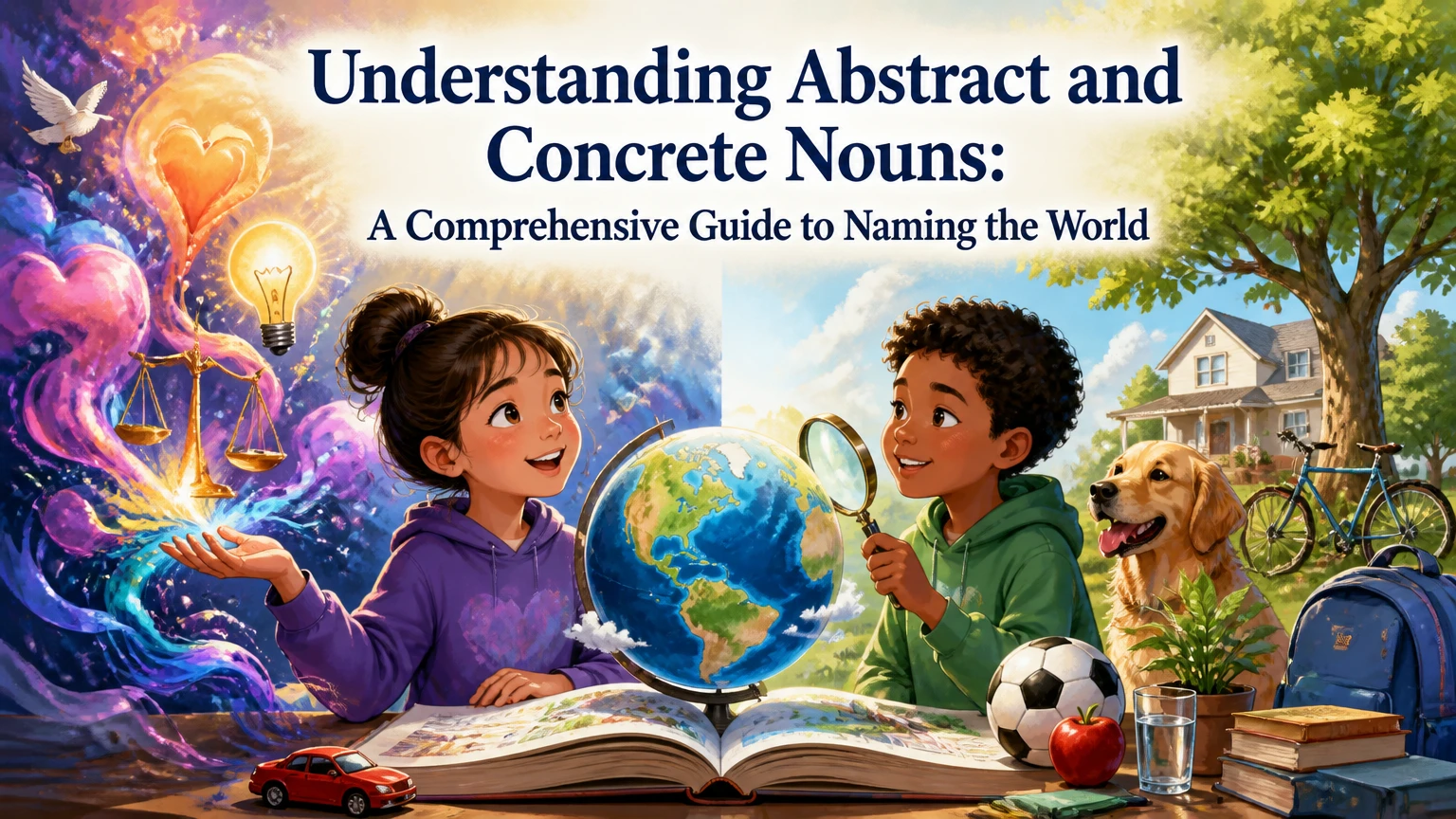
Nouns serve as the foundational building blocks of the English language, acting as the primary labels we use to identify everything that exists in our reality and our imagination. At the most fundamental level, these labels are categorized into two distinct groups based on how we perceive them: concrete nouns and abstract nouns. Concrete nouns represent tangible entities that we can engage with through our physical senses, such as table, apple, dog, rain, and perfume. Conversely, abstract nouns represent intangible concepts, qualities, or states of being that exist only in the mind, including freedom, courage, happiness, wisdom, and friendship. Understanding the distinction between these two categories is essential for writers and students alike, as it dictates how we use imagery, how we construct metaphors, and how we convey complex philosophical ideas through language. By mastering the nuances of concrete and abstract nouns, you can move from simple descriptive writing to profound, evocative storytelling that resonates with both the senses and the intellect.
Table of Contents
- 1. Comprehensive Definitions
- 2. Structural Breakdown: Concrete Nouns
- 3. Structural Breakdown: Abstract Nouns
- 4. Sensory Classification of Concrete Nouns
- 5. Categories of Abstract Nouns
- 6. Suffix Patterns for Creating Abstract Nouns
- 7. Extensive Examples and Comparison Tables
- 8. Comprehensive Usage Rules and Grammar Patterns
- 9. Common Mistakes and How to Avoid Them
- 10. Advanced Topics: The Concrete-Abstract Spectrum
- 11. Practice Exercises and Solutions
- 12. Frequently Asked Questions (FAQ)
- 13. Conclusion
1. Comprehensive Definitions
In the study of linguistics, a noun is a word that functions as the name of a specific object or set of objects. However, “objects” can be interpreted in two very different ways. The distinction between concrete and abstract nouns is primarily a philosophical and psychological one, rooted in human perception and the physical world.
What is a Concrete Noun?
A concrete noun refers to a physical object that occupies space and can be perceived by at least one of the five senses: sight, hearing, smell, taste, or touch. If you can see it, hear it, smell it, taste it, or touch it, it is a concrete noun. These nouns are the “anchors” of language, providing clear, unmistakable references to the material world. For example, thunder is a concrete noun because you can hear it, even if you cannot touch it. Air is a concrete noun because you can feel it against your skin as wind, even if you cannot see it.
What is an Abstract Noun?
An abstract noun refers to an idea, quality, state, or concept that does not have a physical presence. You cannot perceive an abstract noun through your five senses. You cannot “touch” loyalty, nor can you “smell” democracy. These nouns represent the internal world of human thought, emotion, and social constructs. They are often the subjects of philosophy, psychology, and complex literature. While you can see the effects of an abstract noun (like seeing someone smile because of joy), you cannot see the joy itself as a physical object.
2. Structural Breakdown: Concrete Nouns
Concrete nouns are generally more straightforward to identify because they correlate directly with physical reality. However, they can be further divided into sub-classifications that help us understand their grammatical behavior. Concrete nouns can be proper or common, and they can be countable or uncountable.
Proper concrete nouns refer to specific, named entities, such as Mount Everest or The Eiffel Tower. Common concrete nouns are general labels for classes of objects, such as mountain or building. This distinction is important for capitalization rules. Furthermore, many concrete nouns are countable, meaning they can have a plural form (e.g., one chair, two chairs). Others are uncountable, such as water or sand, which represent masses rather than individual units.
The following table provides a breakdown of how concrete nouns interact with other grammatical categories to demonstrate their versatility in the English language.
| Category | Sub-type | Definition | Examples |
|---|---|---|---|
| Proper | Named Entities | Specific people, places, or things. | London, Jupiter, Albert Einstein, Titanic |
| Common | General Entities | General groups or types of things. | City, planet, scientist, ship |
| Countable | Individual Units | Things that can be counted as units. | Bottle, cat, keyboard, tree |
| Uncountable | Mass Nouns | Substances or masses that aren’t counted. | Milk, rice, oxygen, gold |
| Collective | Groups of Objects | A single word for a group of concrete things. | Bouquet, fleet, herd, stack |
3. Structural Breakdown: Abstract Nouns
Abstract nouns are often derived from other parts of speech, such as verbs or adjectives. This process is known as nominalization. For instance, the verb to think can be transformed into the abstract noun thought. The adjective happy can be transformed into the abstract noun happiness. Understanding these roots helps learners identify abstract nouns even when the words are complex.
Unlike concrete nouns, abstract nouns are predominantly uncountable. We rarely speak of having “three courages” or “five wisdoms.” However, some abstract nouns can become countable when they refer to specific instances or types of the concept. For example, while beauty is generally abstract and uncountable, we might refer to the beauties of the natural world, meaning specific beautiful features or sights.
Abstract nouns often function as the “theme” of a sentence or a piece of writing. They allow us to summarize complex human experiences into a single word. When a writer says, “The injustice was unbearable,” they are using an abstract noun to encapsulate a wide range of unfair actions and systemic problems into one conceptual container.
4. Sensory Classification of Concrete Nouns
To truly master concrete nouns, one must understand that “physical presence” is not limited to things you can hold in your hand. The five senses provide a framework for testing whether a noun is concrete. If a noun passes even one of these sensory tests, it is classified as concrete.
Sight: This is the most common sensory engagement. Anything you can see—from a galaxy to a microbe—is a concrete noun. Even if you need a telescope or a microscope to see it, the object still has a physical form.
Hearing: Sounds are concrete because they consist of physical vibrations in the air. Nouns like melody, shout, whisper, and clatter are concrete. You cannot “hold” a song, but your ears physically process the sound waves it produces.
Smell: Odors and scents are caused by physical molecules entering the nasal passage. Therefore, words like aroma, stench, fragrance, and smoke are concrete nouns.
Taste: Flavor is a chemical reaction on the tongue. Nouns like sweetness (when referring to the physical taste of sugar), bitterness, salt, and spice are concrete in a culinary context.
Touch: This involves physical contact or temperature. Nouns like texture, heat, cold, pressure, and roughness are concrete because they describe physical sensations felt by the body.
| Sense | Noun Example | Physical Justification |
|---|---|---|
| Sight | Lightning | Visible light discharge in the atmosphere. |
| Hearing | Echo | Sound waves reflecting off a surface. |
| Smell | Perfume | Liquid particles dispersed in the air. |
| Taste | Honey | Viscous substance that triggers taste buds. |
| Touch | Velvet | Fabric with a specific tactile surface. |
5. Categories of Abstract Nouns
Because abstract nouns cover everything that isn’t physical, they are incredibly diverse. To make them easier to study, we can group them into several logical categories: Emotions, States of Being, Philosophical Concepts, and Qualities.
Emotions and Feelings
These are the internal responses we have to external stimuli. While we might show physical signs of these emotions (like crying), the emotion itself is an internal, abstract experience. Examples include anger, despair, elation, and grief.
States and Attributes
These nouns describe the condition someone or something is in, or a characteristic they possess. Freedom is a state of being; poverty is a socioeconomic state; bravery is an attribute of a person’s character.
Ideas and Concepts
These are the complex structures of human thought and society. They often involve systems of governance, belief, or logic. Examples include capitalism, evolution, ethics, and justice.
Time and Measurement
Interestingly, many words related to time are abstract. While we can see a clock (concrete), we cannot see time itself. Therefore, century, moment, opportunity, and future are considered abstract nouns.
| Category | Examples | Contextual Use |
|---|---|---|
| Emotions | Love, Hate, Envy, Compassion, Fear, Pride | Describing internal human experiences. |
| States | Chaos, Peace, Luxury, Sleep, Death, Youth | Describing a condition or period of time. |
| Qualities | Honesty, Patience, Intelligence, Skill, Humility | Describing traits or characteristics. |
| Concepts | Liberty, Truth, Culture, Information, Belief | Describing broad ideas or social systems. |
6. Suffix Patterns for Creating Abstract Nouns
One of the most effective ways to identify or create abstract nouns is to look at the word’s ending, or suffix. In English, many abstract nouns are formed by adding specific suffixes to adjectives or verbs. This is a key part of morphology that helps learners expand their vocabulary rapidly.
For example, the suffix -ness is frequently added to adjectives to create a noun representing that quality. Kind becomes kindness. The suffix -tion or -ion is often added to verbs to create a noun representing the action or the result of the action. Educate becomes education.
The following table outlines the most common suffixes used to form abstract nouns, providing a roadmap for recognizing these intangible words in complex texts.
| Suffix | Root Word (Type) | Abstract Noun |
|---|---|---|
| -ness | Weak (Adj) | Weakness |
| -ity / -ty | Pure (Adj) | Purity |
| -ment | Govern (Verb) | Government |
| -tion / -sion | Decide (Verb) | Decision |
| -ship | Friend (Noun) | Friendship |
| -hood | Child (Noun) | Childhood |
| -ism | Critic (Noun) | Criticism |
| -ance / -ence | Silent (Adj) | Silence |
| -dom | Free (Adj) | Freedom |
| -th | Grow (Verb) | Growth |
7. Extensive Examples and Comparison Tables
To truly understand the difference between these two types of nouns, it is helpful to see them side-by-side. Often, a concrete noun can be the physical manifestation of an abstract noun. For instance, a wedding ring is a concrete noun, but it represents the abstract noun commitment or marriage.
In the following tables, we provide a massive list of examples to saturate your understanding of how these words function in various contexts. Pay attention to how the concrete nouns are things you can touch or see, while the abstract nouns are things you can only think about or feel emotionally.
| Concrete Noun (Tangible) | Abstract Noun (Intangible) |
|---|---|
| Book | Knowledge |
| Bed | Sleep |
| Flag | Patriotism |
| Prison | Justice |
| Handshake | Agreement |
| Tear | Sorrow |
| Money | Wealth |
| Brain | Intelligence |
| Church | Religion |
| Heart | Love |
| Soldier | Bravery |
| Diploma | Education |
| Clock | Time |
| Gavel | Law |
| Gift | Generosity |
| Map | Direction |
| Mirror | Vanity |
| Microscope | Science |
| Shield | Protection |
| Baby | Innocence |
| Throne | Power |
| Bread | Hunger |
| Ice | Coldness |
| Cradle | Infancy |
| Key | Access |
| Puppet | Control |
| Feather | Lightness |
| Mountain | Height |
| Stethoscope | Health |
| Dictionary | Definition |
The table above demonstrates that for almost every physical object, there is a corresponding abstract concept. This relationship is what allows writers to use symbolism. By describing a concrete object, a writer can make the reader think about an abstract idea.
8. Comprehensive Usage Rules and Grammar Patterns
While the definitions are simple, the way these nouns function in sentences can be complex. There are specific rules regarding articles (a, an, the), pluralization, and subject-verb agreement that differ between concrete and abstract nouns.
Rule 1: Pluralization
Most concrete nouns are countable. You can have one desk or ten desks. Abstract nouns, however, are usually uncountable (mass nouns). You cannot have “three informations” or “many patiences.” If you need to quantify an abstract noun, you often have to use a “unit of measurement” or an adjective. For example, instead of “many advices,” we say “many pieces of advice.”
Rule 2: The Use of Articles
Because abstract nouns are often uncountable, they frequently appear without an article when used in a general sense. For example: “Patience is a virtue.” You would not say “A patience is a virtue.” However, when the abstract noun is specific, you can use “the”: “The patience she showed was incredible.” Concrete nouns usually require an article or a determiner (e.g., “I saw a bird,” “Look at the car”).
Rule 3: Adjective Placement
Adjectives describing concrete nouns usually focus on physical attributes (color, size, shape). Adjectives describing abstract nouns focus on intensity, duration, or value. We speak of a large box (concrete) but great courage (abstract). We speak of a red apple (concrete) but bitter disappointment (abstract).
| Feature | Concrete Nouns | Abstract Nouns |
|---|---|---|
| Plural Forms | Common (chairs, dogs, cities) | Rare (usually uncountable) |
| Indefinite Articles (a/an) | Used with singular count nouns | Rarely used |
| Quantifiers | Many, few, several | Much, little, a great deal of |
| Subject-Verb Agreement | Can be singular or plural verb | Almost always singular verb |
9. Common Mistakes and How to Avoid Them
Even advanced English learners sometimes struggle with the nuances of abstract and concrete nouns. The most common errors involve treating abstract nouns as countable or using imagery that mixes the two categories in a confusing way.
Mistake 1: Pluralizing Uncountable Abstract Nouns
Incorrect: He gave me many knowledges about the subject.
Correct: He gave me much knowledge about the subject. (Or: He gave me many facts…)
Knowledge is a concept, not a physical unit. Therefore, it cannot be pluralized in standard English.
Mistake 2: Using the Wrong Quantifier
Incorrect: There is few hope left for the survivors.
Correct: There is little hope left for the survivors.
“Few” is used for countable concrete nouns (few people, few books). “Little” is used for uncountable abstract nouns (little hope, little time).
Mistake 3: Confusing the Noun with the Adjective
Sometimes students use the adjective form when they need the abstract noun. This is common with words ending in -y or -ness.
Incorrect: His brave was inspiring to everyone.
Correct: His bravery was inspiring to everyone.
| Incorrect Sentence | Correct Sentence | Reason for Correction |
|---|---|---|
| The happinesses of the children. | The happiness of the children. | Abstract nouns are usually singular. |
| I have many work to do. | I have much work to do. | “Work” (the concept) is uncountable. |
| She felt a grief. | She felt grief. | Emotions don’t use indefinite articles. |
| The honests of the man. | The honesty of the man. | Use the noun form, not the adjective. |
10. Advanced Topics: The Concrete-Abstract Spectrum
In linguistics and philosophy, the line between concrete and abstract is not always a hard wall; sometimes it is a spectrum. Some nouns can shift categories depending on their usage in a sentence. This is known as contextual shifting.
Consider the word light. In the sentence “Turn off the light,” the word refers to a physical lamp or the visible photons in the room—a concrete noun. However, in the sentence “She is the light of my life,” the word refers to a source of joy or inspiration—an abstract noun. This metaphorical usage is a hallmark of sophisticated English.
Another advanced concept is nominalization in academic writing. Academic prose relies heavily on abstract nouns to discuss theories and patterns. Instead of saying “People migrated because they wanted to be free,” an academic might write, “The migration was driven by a desire for liberty.” Here, “migration” and “liberty” are abstract nouns that summarize complex human behaviors into manageable concepts. Mastering this allows students to write more formally and persuasively.
Finally, we have Collective Abstract Nouns. These are words that describe a group of ideas or a system. Philosophy is an abstract noun, but it contains thousands of individual ideas. Literature is an abstract noun, even though it is made up of concrete books. Understanding these “umbrella” terms is vital for categorizing information.
11. Practice Exercises and Solutions
To solidify your understanding, complete the following exercises. These are designed to test your ability to identify, categorize, and correctly use both concrete and abstract nouns.
Exercise 1: Identification
Identify whether the bolded word in each sentence is Concrete or Abstract.
- The perfume smelled like roses.
- Justice must be served in the courtroom.
- The puppy barked at the mailman.
- He had great pride in his work.
- The thunder shook the windows.
- Her intelligence surprised the teachers.
- Please pass the salt.
- Freedom is a fundamental human right.
- The ocean was a deep shade of blue.
- We must have faith in the process.
Exercise 2: Suffix Transformation
Convert the following adjectives or verbs into abstract nouns using the correct suffix.
| Root Word | Abstract Noun (Answer) |
|---|---|
| 1. Strong (Adj) | __________ |
| 2. Imagine (Verb) | __________ |
| 3. Lonely (Adj) | __________ |
| 4. Appear (Verb) | __________ |
| 5. Likely (Adj) | __________ |
| 6. Partner (Noun) | __________ |
| 7. Real (Adj) | __________ |
| 8. Fail (Verb) | __________ |
| 9. Brave (Adj) | __________ |
| 10. Neighbor (Noun) | __________ |
Exercise 3: Solutions
Exercise 1 Answers: 1. Concrete, 2. Abstract, 3. Concrete, 4. Abstract, 5. Concrete, 6. Abstract, 7. Concrete, 8. Abstract, 9. Concrete, 10. Abstract.
Exercise 2 Answers: 1. Strength, 2. Imagination, 3. Loneliness, 4. Appearance, 5. Likelihood, 6. Partnership, 7. Reality, 8. Failure, 9. Bravery, 10. Neighborhood.
12. Frequently Asked Questions (FAQ)
Q: Can a noun be both concrete and abstract?
A: Yes, depending on the context. As mentioned with the word “light,” many words have both a literal (concrete) and figurative (abstract) meaning. “Heart” is a concrete organ in biology, but an abstract symbol for love in poetry.
Q: Is “air” a concrete or abstract noun?
A: “Air” is a concrete noun. Even though you cannot see it, it is made of physical gas molecules (oxygen, nitrogen, etc.) that you can feel as wind and that have physical weight and pressure.
Q: Are emotions always abstract nouns?
A: Yes. While the expression of an emotion (a smile, a tear, a scream) is concrete because you can see or hear it, the emotion itself (happiness, sadness, anger) is an internal state and therefore abstract.
Q: How do I know if an abstract noun is countable?
A: Most are uncountable. However, if the word refers to a specific instance of the concept, it might be countable. For example, “A memory” (one specific event) vs. “He has a bad memory” (the general ability to remember).
Q: Is “music” concrete or abstract?
A: This is a common debate. Most grammarians classify “music” as concrete because it consists of physical sound waves that can be heard. However, “music theory” or the “beauty of music” would be abstract.
Q: Why is “time” considered abstract?
A: Time cannot be seen, touched, or smelled. We can see the effects of time (like aging) or the tools used to measure it (like clocks), but time itself is a conceptual framework created by humans to understand the sequence of events.
Q: Are collective nouns concrete or abstract?
A: It depends on what they are collecting. A “herd of cows” is concrete because the cows are physical. A “set of rules” is abstract because rules are concepts.
Q: Is “dream” concrete or abstract?
A: “Dream” is generally considered abstract. While it happens in the brain, it is an intangible series of thoughts and images that cannot be perceived by others through the five senses.
13. Conclusion
Mastering the distinction between abstract and concrete nouns is a vital step in becoming a proficient communicator in English. Concrete nouns allow us to ground our language in reality, providing the sensory details that make descriptions vivid and clear. Abstract nouns, on the other hand, allow us to explore the depths of human experience, discussing complex ideas like liberty, virtue, and philosophy. By understanding how these nouns are formed, how they are pluralized, and how they function within sentences, you can enhance both your reading comprehension and your writing style. Remember that the best writing often combines both: using concrete imagery to illustrate abstract concepts. As you continue your language journey, pay close attention to the nouns around you—whether you can touch them with your hands or only reach them with your mind.