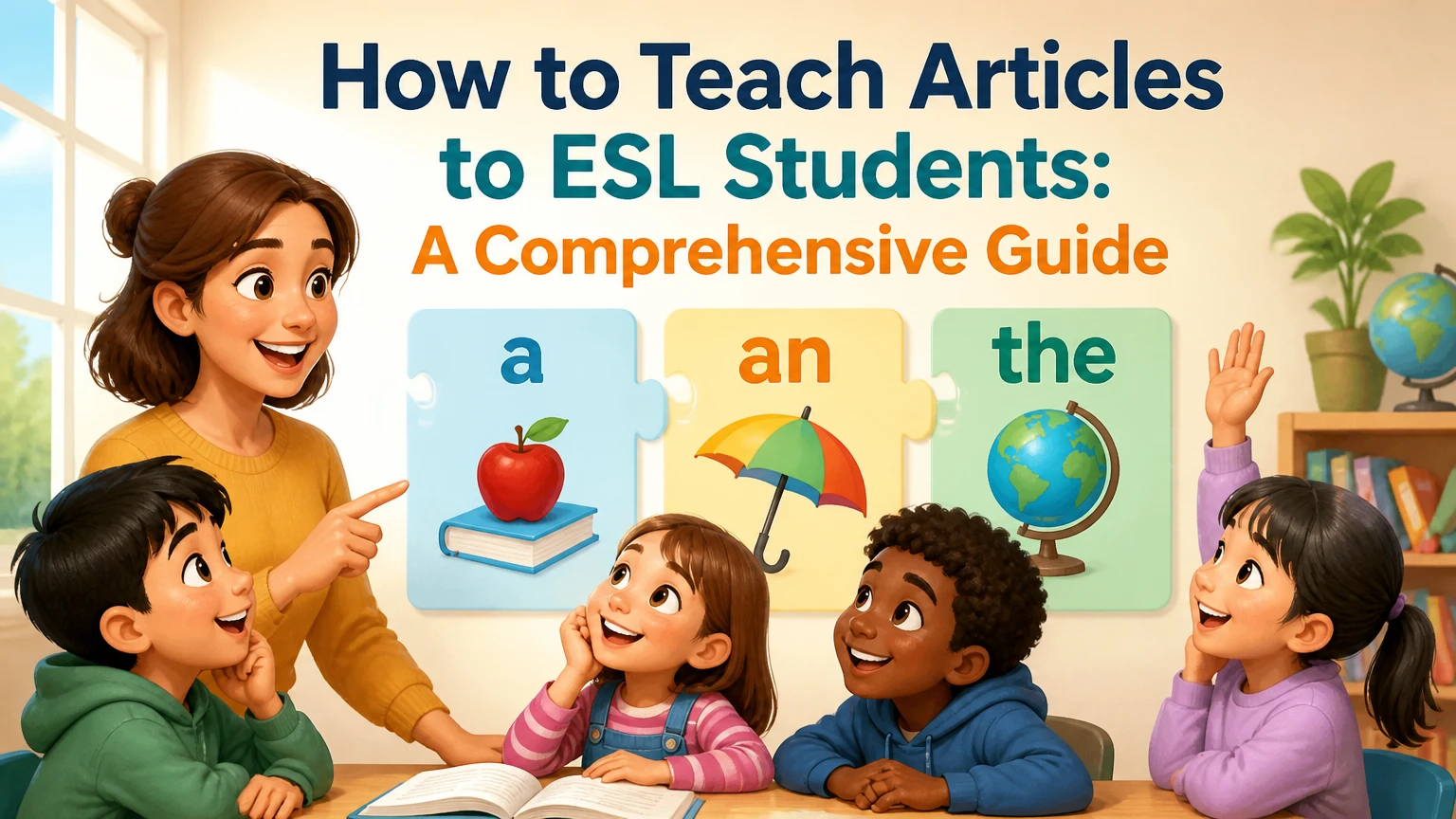
Articles represent one of the most challenging aspects of English grammar for English as a Second Language (ESL) students because they are often subtle, context-dependent, and sometimes entirely absent in a learner’s native tongue. These small but mighty words, including a, an, and the, serve as determiners that specify whether a noun is general or specific. Mastering their use is essential for achieving fluency, as articles provide the necessary signaling that helps a listener or reader identify the focus of a sentence. For instance, understanding the difference between a book and the book allows a student to navigate social interactions and academic writing with much greater precision. This guide is designed to provide teachers and learners with a robust framework for understanding, applying, and teaching these essential grammatical tools effectively.
Table of Contents
- Definition and Function of Articles
- Structural Breakdown of Article Usage
- Types and Categories of Articles
- Extensive Examples and Categorization
- Comprehensive Usage Rules and Exceptions
- Common Mistakes and Corrections
- Practice Exercises for Students
- Advanced Topics: Zero Article and Abstract Nouns
- Frequently Asked Questions (FAQ)
- Conclusion and Final Tips
Definition and Function of Articles
Articles are a subcategory of determiners. Their primary function is to define the noun that follows as either specific or unspecific. In linguistics, we often refer to this as “definiteness.” When we use an article, we are giving the listener a clue about whether we are talking about something they already know about, or something new to the conversation.
In English, there are only three main articles: a, an, and the. However, the “zero article” (the absence of an article) is also considered a grammatical choice in many contexts. These words act as a bridge between the speaker’s intent and the listener’s understanding. Without them, English sentences sound “broken” or “telegraphic,” which is a common trait in the speech of beginner ESL learners whose native languages (like Russian, Chinese, or Japanese) do not use a similar system.
The choice of article depends on several factors: whether the noun is countable or uncountable, whether it is singular or plural, and whether the noun starts with a vowel or consonant sound. Because these rules intersect, teaching articles requires a step-by-step approach that builds on a student’s existing knowledge of noun types.
Structural Breakdown of Article Usage
To teach articles effectively, we must break down the structure of the noun phrase. An article almost always precedes the noun it modifies. If there are adjectives modifying the noun, the article moves to the front of the entire phrase. This structural consistency is one of the few “easy” parts of English articles that students can rely on.
The basic formula is: Article + (Adjective) + Noun. For example, in the phrase the big blue house, the article “the” defines the specific “house,” even though adjectives sit between them. If a student says big the house, they are making a structural error that needs immediate correction.
Another structural consideration is the phonological rule for indefinite articles. We use a before consonant sounds and an before vowel sounds. It is vital to emphasize “sounds” rather than “letters.” For example, we say an hour because the ‘h’ is silent, and a university because the ‘u’ creates a ‘y’ consonant sound. This distinction is a frequent stumbling block for students who rely too heavily on spelling.
Types and Categories of Articles
The Indefinite Articles: A and An
The indefinite articles a and an are used to refer to a non-specific member of a group. They are only used with singular, countable nouns. When a speaker says, “I need a pencil,” they are not asking for a specific pencil; any pencil will do. This “one of many” concept is the foundation of indefinite article usage.
The Definite Article: The
The definite article the is used when the speaker and the listener both know exactly which entity is being discussed. This could be because the item was mentioned previously, because it is unique (like the sun), or because the context makes it obvious. Unlike indefinite articles, the can be used with singular, plural, and uncountable nouns.
The Zero Article
The “zero article” occurs when no article is used before a noun. This typically happens with plural countable nouns or uncountable nouns when speaking in general terms. For example, “I love music” (general) versus “I love the music playing now” (specific). Understanding when to omit the article is often more difficult for students than learning when to include one.
Extensive Examples and Categorization
To help students visualize these rules, it is helpful to provide tables that categorize nouns by their article requirements. The following tables provide a wide range of examples to illustrate how articles change based on the noun’s properties and the speaker’s intent.
The first table focuses on the Indefinite Articles (A/An). Notice how the choice depends entirely on the sound that follows the article, regardless of whether that sound comes from the noun itself or an intervening adjective.
| Noun/Phrase | Article | Reasoning |
|---|---|---|
| Apple | An | Starts with a vowel sound |
| Banana | A | Starts with a consonant sound |
| Elephant | An | Starts with a vowel sound |
| Dog | A | Starts with a consonant sound |
| Ice cream cone | An | Starts with a vowel sound |
| University | A | Starts with a “y” consonant sound |
| Hour | An | Starts with a vowel sound (silent H) |
| Honest man | An | Silent H, starts with vowel sound |
| European city | A | Starts with a “y” consonant sound |
| Umbrella | An | Starts with a vowel sound |
| One-way street | A | Starts with a “w” consonant sound |
| MP3 player | An | The letter M is pronounced “em” (vowel start) |
| Uniform | A | Starts with a “y” consonant sound |
| Unusual day | An | Starts with a vowel sound |
| History book | A | Starts with a consonant sound |
| F.B.I. agent | An | The letter F is pronounced “ef” |
| Yellow car | A | Starts with a consonant sound |
| Old man | An | Starts with a vowel sound |
| New car | A | Starts with a consonant sound |
| Interesting story | An | Starts with a vowel sound |
The next table illustrates the Definite Article (The) used with various noun types. This demonstrates that “the” is versatile and can be used with singular, plural, and uncountable nouns, provided the identity of the noun is specific.
| Noun Category | Example Phrase | Contextual Reason |
|---|---|---|
| Singular Countable | The moon | Unique entity |
| Singular Countable | The president | Specific person in a role |
| Plural Countable | The books on the shelf | Specific group of items |
| Plural Countable | The children in the park | Specific group of people |
| Uncountable | The water in this bottle | Specific quantity of liquid |
| Uncountable | The air in this room | Specific environment |
| Geographical | The Nile River | Names of rivers |
| Geographical | The Atlantic Ocean | Names of oceans |
| Geographical | The Himalayas | Mountain ranges |
| Geographical | The Netherlands | Plural country names |
| Superlatives | The tallest building | Only one can be the tallest |
| Ordinal Numbers | The first time | Specific position in a sequence |
| Musical Instruments | Play the piano | Standard usage for playing instruments |
| Decades | The 1920s | Specific period of time |
| Groups of People | The elderly | Adjective used as a noun for a group |
| Newspapers | The New York Times | Proper names of newspapers |
| Hotels/Museums | The Hilton / The Louvre | Specific institutions |
| Family Names | The Smiths | Referring to a whole family |
| Specific Directions | The North | Compass directions as regions |
| Unique Objects | The internet | Global unique system |
The third table explores the Zero Article. This is often the most confusing part for ESL students because they feel like a word is “missing.” These examples show when omitting an article is grammatically required.
| Noun Category | Example Phrase | Rule/Reason |
|---|---|---|
| General Plurals | I love cats. | Generalization about all cats |
| General Uncountable | Happiness is important. | Abstract concept |
| Languages | I speak Spanish. | Names of languages |
| Academic Subjects | She studies Math. | Fields of study |
| Sports | They play soccer. | Names of sports |
| Meals | Breakfast is ready. | Standard meals (general) |
| Single Mountains | Mount Everest | Individual peaks |
| Continents | Asia is large. | Names of continents |
| Most Countries | France is beautiful. | Singular country names |
| Cities | Paris is the capital. | Names of cities |
| Days/Months | Monday is busy. | Names of days or months |
| Routine Places | Go to bed. | Purpose of the place (sleep) |
| Routine Places | Go to school. | Purpose of the place (study) |
| Routine Places | Go to work. | Purpose of the place (employment) |
| Transportation | By bus / By car | Means of travel with “by” |
| Common Expressions | At night | Fixed prepositional phrases |
| Titles + Names | Queen Elizabeth | Title followed by a proper name |
| Colors | Blue is my favorite. | Colors as abstract concepts |
| Games | Play chess. | Board games or card games |
| Magazines | Read Time magazine. | Most magazine titles (unlike newspapers) |
Comprehensive Usage Rules and Exceptions
Teaching articles requires a deep dive into the specific rules that govern their use. While the basic “specific vs. general” rule covers about 80% of cases, the remaining 20% consists of nuances and exceptions that can frustrate learners. Here, we will break down these rules into manageable segments.
Rule 1: First Mention vs. Subsequent Mention
When we introduce a countable noun for the first time, we use a or an. Once the listener knows which item we are talking about, we switch to the. This is the “Introduction Rule.” For example: “I saw a dog. The dog was chasing a ball. The ball was red.” This progression helps establish a shared context between the speaker and the listener.
Rule 2: Uniqueness and Universal Truths
If there is only one of something in existence or in a specific environment, we use the. This applies to celestial bodies (the sun, the moon), the environment (the sky, the ground), and unique roles (the Pope, the CEO). Even if we haven’t mentioned it before, the listener knows exactly which one we mean because there is only one option.
Rule 3: Countable vs. Uncountable Distinction
This is where many ESL students struggle. A/An can never be used with uncountable nouns (like water, advice, information, furniture). You cannot say “an advice.” Instead, you must use “some advice,” “the advice,” or just “advice.” However, these nouns can take the definite article the if they are made specific: “The water in that glass is dirty.”
Rule 4: Geographical Exceptions
Geography provides a complex set of “mini-rules.” Generally, we do not use articles for individual countries, cities, or mountains. However, we do use the for:
- Countries with plural names or words like “Republic,” “Kingdom,” or “States” (The United Kingdom, The Philippines).
- Mountain ranges (The Andes).
- Oceans, seas, and rivers (The Pacific, The Thames).
- Groups of islands (The Bahamas).
Rule 5: Proper Nouns and Titles
We usually don’t use articles with names of people. However, if a title is used as a description without a name, we use the (the Queen). If the name follows the title, the article disappears (Queen Mary). This distinction is subtle but important for formal English.
Common Mistakes and Corrections
Identifying common errors helps teachers target their instruction. Most mistakes fall into three categories: omission (forgetting the article), over-insertion (using an article where none is needed), and incorrect choice (using a instead of the or vice versa).
The following table highlights these common errors and provides the correct version along with an explanation of the underlying rule.
| Incorrect Sentence | Correct Sentence | Explanation |
|---|---|---|
| I am student. | I am a student. | Singular countable nouns need an article. |
| He gave me an advice. | He gave me advice. | “Advice” is uncountable; “an” cannot be used. |
| I love the apples. | I love apples. | Use zero article for general plurals. |
| The Paris is beautiful. | Paris is beautiful. | No article for most city names. |
| I saw a movie. Movie was long. | I saw a movie. The movie was long. | Second mention requires “the.” |
| She plays a piano. | She plays the piano. | Musical instruments take “the” when playing them. |
| He is an honest. | He is honest. | Don’t use articles with adjectives alone. |
| He is an honest man. | He is an honest man. | Use “an” before a silent H (vowel sound). |
| I go to the school every day. | I go to school every day. | No article for routine places (as a student). |
| The happiness is key. | Happiness is key. | No article for abstract uncountable nouns. |
Practice Exercises for Students
To reinforce these concepts, students need varied practice. The following exercises progress from simple identification to contextual application.
Exercise 1: A, An, or Zero?
Fill in the blanks with a, an, or leave it blank (Ø) for the zero article.
- ____ university is a place of learning.
- I have ____ orange in my bag.
- ____ honesty is a great virtue.
- She wants to be ____ engineer.
- We usually have ____ lunch at noon.
- ____ cats are very independent animals.
- It took ____ hour to finish the test.
- I bought ____ new pair of shoes.
- He is ____ European citizen.
- I love listening to ____ music.
Exercise 2: A, An, or The?
Choose the correct article based on the context of the sentence.
| Question | Options | Correct Answer |
|---|---|---|
| 1. I saw ___ bird in the tree. ___ bird was blue. | a / the | a / the |
| 2. Can you turn off ___ light? | a / the | the (specific light) |
| 3. She is ___ tallest girl in class. | a / the | the (superlative) |
| 4. I need ___ umbrella because it’s raining. | a / an | an |
| 5. ___ sun rises in the east. | a / the | the (unique) |
| 6. Do you have ___ pencil I can borrow? | a / the | a (any pencil) |
| 7. He is ___ doctor. | a / an | a |
| 8. ___ water in this lake is cold. | a / the | the (specific) |
| 9. We visited ___ United Kingdom last year. | a / the | the (plural/political name) |
| 10. I’d like ___ cup of tea, please. | a / an | a |
Exercise 3: Error Correction
Each of the following sentences contains one article error. Find and fix it.
- The Mount Everest is the highest mountain in the world.
- I am looking for a work in the city center.
- An user must enter a password to log in.
- The children like the chocolate.
- She is an unique person with many talents.
- We go to the church on Sundays.
- I have a news for you.
- The Nile is a longest river in Africa.
- He is eating the breakfast right now.
- I saw a elephant at the zoo.
Advanced Topics: Zero Article and Abstract Nouns
As students reach higher levels of proficiency, the nuances of the zero article become a primary focus. One of the most difficult areas is the distinction between “institution” and “place.” For example, there is a significant difference between going to school and going to the school. The former refers to the activity of being a student (the institution), while the latter refers to physically visiting the building (the place).
Similarly, abstract nouns can be tricky. Words like education, life, fear, and time generally take no article when spoken of in a broad sense. However, as soon as we qualify them with a prepositional phrase or an adjective, we often require the. Compare: “Life is hard” vs. “The life of a sailor is hard.” This “qualification” rule is a key indicator of advanced English mastery.
Another advanced topic is the use of articles with “proper-noun-like” common nouns. For instance, we say the government, the police, the media. These are treated as unique entities within a society. Teaching students to recognize these as “fixed” definite nouns helps them sound more natural in formal discussions.
Frequently Asked Questions (FAQ)
1. Why do we say “a university” but “an umbrella”?
The choice between “a” and “an” is based on the sound of the following word, not the letter. “University” starts with a “y” sound (a consonant sound), so we use “a.” “Umbrella” starts with an “uh” sound (a vowel sound), so we use “an.”
2. Can I use “the” with plural nouns?
Yes, but only if you are talking about a specific group. “I like the cookies you baked” (specific) is correct, while “I like the cookies” (in general) is usually incorrect; you should just say “I like cookies.”
3. Is it “the hospital” or “hospital”?
In American English, we usually say “He is in the hospital.” In British English, it is common to say “He is in hospital” if he is a patient. This is an example of a regional variation in article usage.
4. Do I use articles with names of countries?
Generally, no (e.g., Japan, Brazil, Italy). However, if the name includes “Kingdom,” “Republic,” “States,” or is plural, use the (e.g., the USA, the Czech Republic, the Netherlands).
5. Why is it “the sun” but not “the Mars”?
We use “the” for unique celestial bodies that we see as part of our environment (the sun, the moon). Planets are treated as proper names (like names of people), so they do not take an article.
6. Can “a” or “an” be used with uncountable nouns?
Technically, no. You cannot say “a water.” However, in casual speech, people sometimes say “a water” as a shorthand for “a bottle of water” or “a glass of water.” For students, it is best to learn the strict rule first.
7. What is the “zero article”?
The zero article is simply the grammatical term for when no article is used. It is used for general plurals, uncountable nouns in a general sense, and most proper names.
8. How can I remember all these rules?
The best way is through “noticing.” When reading or listening, pay close attention to the articles. Ask yourself: “Is this noun specific or general? Is it the first time it’s mentioned?” Practice and exposure are more effective than memorizing a list of rules.
Conclusion and Final Tips
Teaching articles to ESL students is a marathon, not a sprint. Because articles are often unstressed in spoken English, students may not even hear them, making the acquisition process slower. The key to success is to provide constant, contextualized practice. Start with the “Introduction Rule” (A to The) and the “Phonetic Rule” (A vs. An), as these provide the most immediate benefit for clarity. As students progress, introduce the nuances of the zero article and geographical exceptions. Encourage students to read extensively, as this natural exposure helps the brain internalize the patterns of definiteness that are so unique to the English language. With patience and structured guidance, students will move from “broken” noun phrases to fluent, precise English communication.