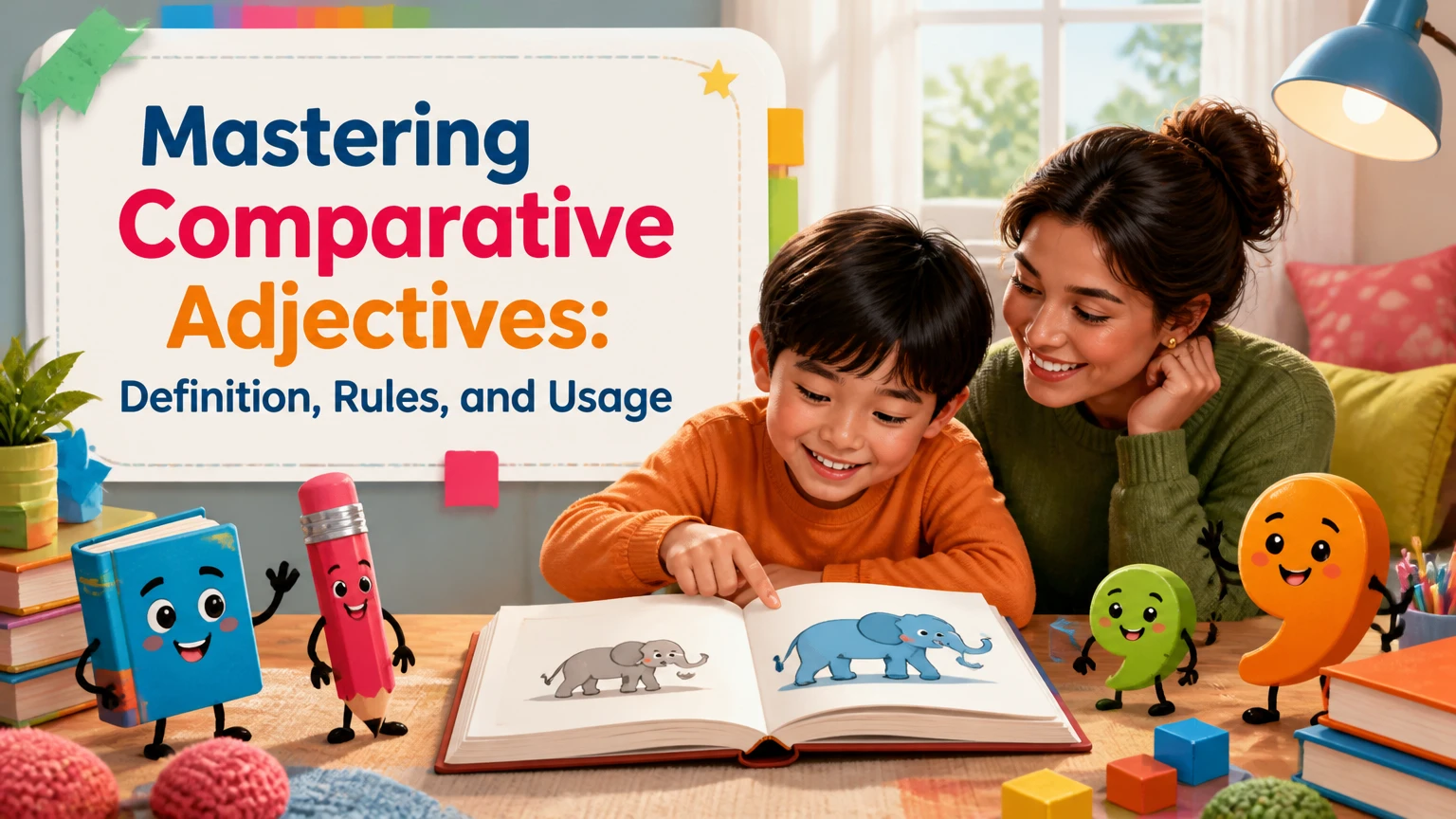
Comparative adjectives serve as the fundamental building blocks of descriptive English, allowing speakers and writers to evaluate the differences between two distinct entities. These specialized descriptors provide a framework for measuring quality, size, characteristic, or quantity by contrasting one noun against another in a clear and structured manner. In everyday conversation, we frequently utilize these terms to make choices or express preferences, such as faster, taller, more expensive, better, and smaller. By mastering these forms, learners can transition from simple declarations to nuanced observations, enabling them to describe the world with far greater precision and clarity. Whether you are comparing two cities, two career paths, or two products, understanding the mechanics of comparison is essential for effective communication in both academic and professional environments.
Table of Contents
- Definition and Purpose of Comparative Adjectives
- Structural Breakdown: How to Form Comparatives
- One-Syllable Adjectives: The “-er” Rule
- Two-Syllable Adjectives and the “Y” Ending
- Multi-Syllable Adjectives: “More” and “Less”
- Irregular Comparative Adjectives
- Extensive Example Tables for Mastery
- Comprehensive Usage Rules and Sentence Patterns
- Common Mistakes and How to Avoid Them
- Advanced Topics: Double Comparatives and Modifiers
- Practice Exercises with Answer Key
- Frequently Asked Questions (FAQ)
- Conclusion and Final Tips
Definition and Purpose of Comparative Adjectives
A comparative adjective is a specific form of an adjective used to compare the differences between the two objects they modify. In the hierarchy of English grammar, adjectives have three degrees of comparison: positive, comparative, and superlative. The positive degree is the basic form of the adjective (e.g., strong), while the comparative degree (e.g., stronger) highlights the relationship between two nouns.
The primary function of a comparative adjective is to indicate a higher or lower degree of a quality when two things are being contrasted. This contrast can involve people, places, objects, or even abstract concepts. For example, when we say “The blue car is faster than the red one,” we are using the comparative form of “fast” to establish a relationship of speed between two vehicles.
It is important to note that comparative adjectives are strictly used for comparing two items. If you are comparing three or more items, the superlative form (e.g., fastest) is required. The comparative form is almost always followed by the conjunction than, which introduces the second item in the comparison. However, in some contexts where the second item is implied, “than” may be omitted.
Beyond simple physical traits, comparatives allow us to discuss changes over time. We can say a situation is getting worse or that a student is becoming more diligent. This dynamic use of language helps in tracking progress, expressing evolution, and making informed arguments based on relative merits rather than absolute values.
Structural Breakdown: How to Form Comparatives
The formation of comparative adjectives is not arbitrary; it follows a set of predictable phonetic and orthographic rules based on the number of syllables in the original adjective. Understanding these rules is the first step toward grammatical accuracy. The most basic division occurs between short adjectives (one or two syllables) and long adjectives (three or more syllables).
For most short adjectives, we add the suffix -er to the end of the word. If the word already ends in “e,” we simply add “r.” If the word ends in a consonant-vowel-consonant pattern, we often double the final consonant before adding the suffix. These mechanical changes ensure that the word remains easy to pronounce while clearly signaling its comparative status.
Longer adjectives require a different approach. Instead of modifying the word itself with a suffix, we place the word more or less before the positive form of the adjective. This prevents the word from becoming overly long and cumbersome to say. For instance, “intelligent” becomes “more intelligent” rather than “intelligenter,” which would be difficult to articulate clearly.
There are also specific spelling shifts that occur when adjectives end in the letter “y.” In these cases, the “y” is typically replaced with an “i” before adding the “-er” suffix. This rule applies regardless of whether the adjective has one or two syllables, though it is most common in two-syllable words like “happy” or “funny.”
One-Syllable Adjectives: The “-er” Rule
One-syllable adjectives are the simplest to transform into comparatives. The general rule is to add -er to the base form. This applies to a vast majority of short English adjectives used in daily life. Words like tall, small, old, and young follow this straightforward pattern without any complex spelling changes.
However, there is a specific sub-rule for one-syllable adjectives that end in a single vowel followed by a single consonant (the CVC pattern). In these instances, you must double the final consonant to preserve the short vowel sound. For example, big becomes bigger and hot becomes hotter. If you failed to double the consonant, the pronunciation might change significantly.
If a one-syllable adjective already ends in “e,” such as wide or late, you do not need to add another vowel. You simply attach the “r” to the end. This keeps the spelling clean and follows the general phonetic rules of English suffixes. Below is a detailed table showing these variations in action.
The following table illustrates the transformation of common one-syllable adjectives into their comparative forms, categorized by their spelling patterns.
| Positive Form | Comparative Form | Spelling Rule Applied | Example Sentence |
|---|---|---|---|
| Fast | Faster | Add -er | The train is faster than the bus. |
| Small | Smaller | Add -er | This room is smaller than my old one. |
| Tall | Taller | Add -er | He is taller than his brother. |
| Big | Bigger | Double consonant + -er | London is bigger than Oxford. |
| Hot | Hotter | Double consonant + -er | Today is hotter than yesterday. |
| Thin | Thinner | Double consonant + -er | This paper is thinner than that one. |
| Wide | Wider | Add -r | The river is wider at this point. |
| Large | Larger | Add -r | I need a larger size for this shirt. |
| Late | Later | Add -r | It is later than I thought. |
| Cold | Colder | Add -er | Moscow is colder than Paris. |
| Short | Shorter | Add -er | February is shorter than March. |
| Long | Longer | Add -er | The Nile is longer than the Thames. |
| Bright | Brighter | Add -er | The sun is brighter than the moon. |
| Dark | Darker | Add -er | This blue is darker than that one. |
| Deep | Deeper | Add -er | The ocean is deeper than the lake. |
| High | Higher | Add -er | Prices are higher this year. |
| Low | Lower | Add -er | The temperature is lower tonight. |
| New | Newer | Add -er | This model is newer than that one. |
| Old | Older | Add -er | My grandfather is older than yours. |
| Rich | Richer | Add -er | He became richer after the investment. |
Two-Syllable Adjectives and the “Y” Ending
Two-syllable adjectives represent the most flexible category in comparative grammar. Some two-syllable adjectives take the -er suffix, while others require the word more. A general rule of thumb is that if an adjective ends in “y,” “le,” “er,” or “ow,” it is more likely to take the suffix form. However, there is significant overlap, and some words can technically use either form, though one is usually more common in natural speech.
The most important rule for two-syllable adjectives involves those ending in -y. For words like happy, busy, or easy, the “y” is changed to an “i” and the suffix -er is added. This is a consistent rule that learners should memorize early on. It is rare to see “more happy” in modern English; “happier” is almost always the preferred choice.
Other two-syllable adjectives, particularly those ending in “ing,” “ed,” “ful,” or “less,” almost always use more. For example, boring becomes more boring, and careful becomes more careful. Using “boringer” or “carefuller” is considered grammatically incorrect and sounds unnatural to native speakers. This distinction helps maintain the rhythmic flow of the English language.
The following table provides a comprehensive list of two-syllable adjectives and their comparative forms, highlighting the “y to i” transformation and other common endings.
| Positive Form | Comparative Form | Rule/Ending | Example Sentence |
|---|---|---|---|
| Happy | Happier | Ends in -y (change to -i) | She is happier now than before. |
| Lucky | Luckier | Ends in -y (change to -i) | He was luckier than his friend. |
| Funny | Funnier | Ends in -y (change to -i) | This movie is funnier than the last. |
| Easy | Easier | Ends in -y (change to -i) | The exam was easier than expected. |
| Heavy | Heavier | Ends in -y (change to -i) | Lead is heavier than aluminum. |
| Busy | Busier | Ends in -y (change to -i) | The street is busier on Mondays. |
| Friendly | Friendlier | Ends in -y (change to -i) | The staff is friendlier here. |
| Simple | Simpler | Ends in -le (add -r) | There must be a simpler way. |
| Gentle | Gentler | Ends in -le (add -r) | He has a gentler touch. |
| Narrow | Narrower | Ends in -ow (add -er) | The path became narrower. |
| Shallow | Shallower | Ends in -ow (add -er) | The water is shallower here. |
| Clever | Cleverer | Ends in -er (add -er) | She is cleverer than she looks. |
| Quiet | Quieter | Two-syllable (add -er) | The library is quieter than the cafe. |
| Famous | More famous | Ends in -ous (use more) | He is more famous than his brother. |
| Modern | More modern | Two-syllable (use more) | This design is more modern. |
| Careful | More careful | Ends in -ful (use more) | You must be more careful. |
| Useless | More useless | Ends in -less (use more) | This tool is more useless than that. |
| Boring | More boring | Ends in -ing (use more) | The sequel was more boring. |
| Tired | More tired | Ends in -ed (use more) | I am more tired than usual. |
| Honest | More honest | Two-syllable (use more) | He is more honest than most. |
Multi-Syllable Adjectives: “More” and “Less”
When an adjective consists of three or more syllables, the rules become very consistent. We never add a suffix to these long words. Instead, we use the adverbs more or less to indicate the direction of the comparison. This category includes many of the most descriptive and academic words in English, such as intelligent, beautiful, and expensive.
Using “more” indicates a higher degree of the quality (e.g., more adventurous), while using “less” indicates a lower degree (e.g., less adventurous). This provides a simple way to express comparison without changing the root word. It is a common error for beginners to try and attach “-er” to these long words, resulting in non-existent words like “beautifuler” or “interestinger.”
This rule also applies to many two-syllable adjectives that don’t fit the “-er” criteria mentioned previously. If you are ever in doubt about a two-syllable adjective, using “more” is often a safer bet than adding a suffix, as it is rarely considered “wrong” even if the suffix form is more common. However, for three-syllable words, “more” is the absolute and only correct choice.
The table below lists several multi-syllable adjectives and demonstrates how they are used in comparative contexts with “more” and “less.”
| Positive Form | Comparative (Higher) | Comparative (Lower) | Example Sentence |
|---|---|---|---|
| Beautiful | More beautiful | Less beautiful | The sunset is more beautiful today. |
| Intelligent | More intelligent | Less intelligent | Humans are more intelligent than cats. |
| Expensive | More expensive | Less expensive | Gold is more expensive than silver. |
| Interesting | More interesting | Less interesting | This book is more interesting. |
| Difficult | More difficult | Less difficult | Math is more difficult than history. |
| Important | More important | Less important | Health is more important than wealth. |
| Dangerous | More dangerous | Less dangerous | Driving is more dangerous than flying. |
| Comfortable | More comfortable | Less comfortable | This sofa is more comfortable. |
| Generous | More generous | Less generous | He is more generous than his peer. |
| Popular | More popular | Less popular | Soccer is more popular than golf. |
| Delicious | More delicious | Less delicious | This cake is more delicious. |
| Creative | More creative | Less creative | She is more creative than I am. |
| Expensive | More expensive | Less expensive | Renting is less expensive than buying. |
| Confusing | More confusing | Less confusing | The map was more confusing than helpful. |
| Successful | More successful | Less successful | The second launch was more successful. |
| Reliable | More reliable | Less reliable | This car is more reliable. |
| Sensitive | More sensitive | Less sensitive | Children are more sensitive to noise. |
| Attentive | More attentive | Less attentive | He is more attentive in class now. |
| Exciting | More exciting | Less exciting | The game became more exciting. |
| Powerful | More powerful | Less powerful | The new engine is more powerful. |
Irregular Comparative Adjectives
In every language, there are words that refuse to follow the standard rules, and English is no exception. Irregular comparative adjectives are words that change their form entirely rather than adding a suffix or using “more.” These are some of the most frequently used words in the language, so they must be memorized individually.
The most common irregulars are good and bad. We do not say “gooder” or “badder”; instead, we use better and worse. Similarly, far has two comparative forms: farther (usually referring to physical distance) and further (referring to metaphorical distance or “more”). These distinctions are vital for precise communication.
Other irregulars include little and much/many. When comparing quantities, “little” becomes less, and “much” or “many” becomes more. Understanding these shifts is crucial because they appear in almost every conversation involving preferences, measurements, or evaluations of quality.
The following table lists the most critical irregular comparative adjectives that every English learner should know by heart.
| Positive Form | Comparative Form | Context/Usage | Example Sentence |
|---|---|---|---|
| Good | Better | Quality/Standard | Your English is better than last year. |
| Bad | Worse | Quality/Standard | The weather is worse today. |
| Far | Farther | Physical distance | He ran farther than I did. |
| Far | Further | Metaphorical distance/Additional | We need further information. |
| Little | Less | Quantity (Uncountable) | I have less money than you. |
| Much | More | Quantity (Uncountable) | There is more water in this glass. |
| Many | More | Quantity (Countable) | She has more books than her sister. |
| Old | Elder | Family relationships | He is my elder brother. |
| Late | Latter | Sequence (The second of two) | I prefer the latter option. |
| Well (Adverb/Health) | Better | Health/Performance | I feel much better today. |
Extensive Example Tables for Mastery
To truly master comparative adjectives, one must see them used across a wide variety of contexts. The following tables provide a massive repository of examples to help solidify your understanding of how these words function in real-world sentences. We will look at physical descriptions, abstract qualities, and quantitative comparisons.
Table 1: Physical Descriptions and Sizes
This table focuses on adjectives used to describe the physical world, including size, weight, speed, and appearance.
| Adjective | Comparative | Example Sentence |
|---|---|---|
| Heavy | Heavier | This box is heavier than the other one. |
| Light | Lighter | The new laptop is much lighter. |
| Strong | Stronger | He is stronger than he was last summer. |
| Weak | Weaker | The signal is weaker in the basement. |
| Fast | Faster | Cheetahs are faster than lions. |
| Slow | Slower | The old computer is slower than the new one. |
| Clean | Cleaner | The kitchen is cleaner now. |
| Dirty | Dirtier | My shoes are dirtier than yours. |
| Dry | Drier | The desert is drier than the plains. |
| Wet | Wetter | The grass is wetter this morning. |
| Hard | Harder | Diamond is harder than glass. |
| Soft | Softer | This pillow is softer than that one. |
| Bright | Brighter | The living room is brighter with the new lights. |
| Dim | Dimmer | The light is dimmer in the hallway. |
| Thick | Thicker | This coat is thicker for winter. |
| Thin | Thinner | The ice is thinner near the edge. |
| Sharp | Sharper | This knife is sharper than the old one. |
| Dull | Duller | The pencil is duller after writing the essay. |
| Smooth | Smoother | The marble is smoother than the granite. |
| Rough | Rougher | The sea is rougher today. |
Table 2: Abstract Qualities and Personality Traits
Comparatives are frequently used to describe people’s characters, emotions, and intellectual abilities.
| Adjective | Comparative | Example Sentence |
|---|---|---|
| Kind | Kinder | She is kinder than anyone I know. |
| Mean | Meaner | Don’t be meaner than you need to be. |
| Happy | Happier | I feel happier in the sunshine. |
| Sad | Sadder | The movie was sadder than the book. |
| Smart | Smarter | He is smarter than he lets on. |
| Wise | Wiser | He grew wiser with age. |
| Friendly | Friendlier | The neighbors are friendlier here. |
| Polite | More polite | The waiter was more polite this time. |
| Rude | Ruder | That comment was ruder than expected. |
| Brave | Braver | The soldier was braver than he realized. |
| Funny | Funnier | The comedian was funnier last night. |
| Serious | More serious | The situation is more serious than it looks. |
| Patient | More patient | You need to be more patient with him. |
| Angry | Angrier | He became angrier as the day went on. |
| Calm | Calmer | The ocean is calmer this evening. |
| Proud | Prouder | I couldn’t be prouder of your success. |
| Honest | More honest | We need a more honest assessment. |
| Lazy | Lazier | He is lazier on the weekends. |
| Active | More active | She is more active than her brother. |
| Quiet | Quieter | The baby is quieter now. |
Comprehensive Usage Rules and Sentence Patterns
Using comparative adjectives correctly involves more than just knowing the word forms; you must also understand the sentence structures that support them. The most common pattern is: [Noun (Subject)] + [Verb] + [Comparative Adjective] + [Than] + [Noun (Object)]. For example: “The sun is larger than the earth.” In this structure, “than” is the essential bridge that connects the two things being compared.
Sometimes, the second part of the comparison is omitted because it is already understood from the context. If someone asks, “Do you want the big apple or the small one?” you might simply reply, “I’ll take the bigger one.” Here, “than the small one” is implied, making the sentence more concise. This is very common in spoken English where brevity is valued.
Another important rule concerns the use of modifiers to indicate the degree of difference. We can use words like much, far, a lot, slightly, or a bit to qualify the comparison. For instance, “This house is slightly more expensive than that one” suggests a small difference, whereas “This house is far more expensive” suggests a massive gap in price.
When we want to say that two things are equal, we don’t use comparative adjectives. Instead, we use the as + adjective + as construction. For example, “He is as tall as his father.” If we want to show they are not equal, we use not as + adjective + as (e.g., “He is not as tall as his father”). This is an alternative to using the comparative “shorter.”
Finally, avoid the “double comparative” error. This happens when a speaker uses both “more” and the “-er” suffix on the same word, such as saying “more taller.” You must choose one or the other based on the syllable rules. This is one of the most common pitfalls for English learners and even some native speakers in informal settings.
Common Mistakes and How to Avoid Them
Even advanced learners occasionally stumble when using comparative adjectives. One of the most frequent errors is the misuse of the word “than.” Many people mistakenly use “then” (a time marker) instead of “than” (a comparison marker). Remember: “than” is for comparison, “then” is for what happens next.
Another common mistake involves comparing two things that are not of the same category, known as a “faulty comparison.” For example, saying “The food in Paris is better than London” is technically incorrect because you are comparing food to a city. The correct way is to say, “The food in Paris is better than the food in London” or “better than that of London.”
The “double comparative” mentioned earlier is also a major hurdle. Learners often feel that adding “more” adds emphasis, leading them to say things like “more easier” or “more better.” This is always incorrect. If you want to add emphasis, use “much” or “far” (e.g., “much easier,” “far better”).
The table below summarizes these common mistakes and provides the correct versions to help you refine your grammar.
| Incorrect Sentence | Correct Sentence | Rule/Explanation |
|---|---|---|
| He is more taller than me. | He is taller than I am (or than me). | No “more” with -er suffixes. |
| This is the more better option. | This is the better option. | “Better” is already comparative. |
| She is more happy today. | She is happier today. | Two-syllable “y” words use -ier. |
| My car is faster then yours. | My car is faster than yours. | Use “than” for comparisons. |
| This task is more easier. | This task is easier. | Double comparative error. |
| His score is higher than his brother. | His score is higher than his brother’s. | Compare scores to scores. |
| I am more tireder than before. | I am more tired than before. | “Tired” uses “more,” not -er. |
| The weather is more bad today. | The weather is worse today. | “Bad” is an irregular adjective. |
| This is more good than that. | This is better than that. | “Good” is an irregular adjective. |
| It’s farer than I thought. | It’s farther than I thought. | “Far” is irregular (farther). |
Advanced Topics: Double Comparatives and Modifiers
For students looking to reach a higher level of fluency, understanding advanced comparative structures is essential. One such structure is the double comparative used to show cause and effect or progression. This follows the pattern: The + comparative, the + comparative. For example, “The harder you study, the better your grades will be.” This structure is very common in proverbs and persuasive writing.
Another advanced technique is the use of comparative + and + comparative to show that something is changing continuously. For instance, “The weather is getting colder and colder” or “The city is becoming more and more crowded.” This repetition emphasizes the ongoing nature of the change, adding a sense of momentum to the description.
We also use specific modifiers to show exactly how much difference exists between two things. While “much” and “slightly” are common, you can also use significantly, considerably, marginally, or infinitely. Using these adverbs allows for a more academic and precise tone. “The new drug is significantly more effective than the old one” carries more weight in a scientific report than simply saying it is “better.”
Finally, there is the concept of “comparing with itself.” Sometimes we compare the same object in two different situations or times. For example, “The river is higher than it was last week.” In this case, the two “objects” being compared are the same river at two different points in time. This is a subtle but frequent use of the comparative degree.
Practice Exercises with Answer Key
Test your knowledge with the following exercises. These are designed to cover various rules, including spelling changes, irregular forms, and the use of “more.”
Exercise 1: Fill in the Blanks
Complete the sentences using the correct comparative form of the adjective in parentheses.
- This puzzle is __________ (easy) than the one we did yesterday.
- Mount Everest is __________ (high) than Mount Kilimanjaro.
- A gold ring is __________ (expensive) than a silver one.
- The climate in Spain is __________ (hot) than in Scotland.
- My new job is __________ (good) than my old one.
- The traffic is __________ (bad) in the morning than at night.
- She is __________ (intelligent) than her classmates.
- This street is __________ (narrow) than the main road.
- I am __________ (hungry) now than I was an hour ago.
- The second chapter is __________ (interesting) than the first.
Exercise 2: Sentence Correction
Identify and correct the error in each of the following sentences.
- He is more strong than his brother.
- This cake is more tastier than the cookies.
- The sun is more bright today.
- My house is biger than yours.
- This exercise is more easy than the last one.
- I feel more bad today than yesterday.
- The Nile is more long than the Amazon.
- She is the more cleverer girl in class.
- Is your dog more old than mine?
- This book is interestinger than that one.
Answer Key
| Exercise 1 Answers | Exercise 2 Corrections |
|---|---|
| 1. easier | 1. stronger |
| 2. higher | 2. tastier |
| 3. more expensive | 3. brighter |
| 4. hotter | 4. bigger |
| 5. better | 5. easier |
| 6. worse | 6. worse |
| 7. more intelligent | 7. longer |
| 8. narrower | 8. cleverer (or more clever) |
| 9. hungrier | 9. older |
| 10. more interesting | 10. more interesting |
Frequently Asked Questions (FAQ)
1. When should I use “-er” and when should I use “more”?
Generally, use “-er” for one-syllable adjectives (fast -> faster) and two-syllable adjectives ending in “y” (happy -> happier). Use “more” for most other two-syllable adjectives and all adjectives with three or more syllables (more beautiful). If you are unsure about a two-syllable word, “more” is often acceptable, but “-er” is usually more natural for short words.
2. Is “funner” a real word?
While you may hear “funner” in very casual speech, it is technically considered incorrect in standard English. The adjective “fun” is an exception where “more fun” is the grammatically correct comparative form. For example: “The party was more fun than the movie.”
3. Can I use “more” with an “-er” adjective for emphasis?
No, this is a “double comparative” and is a grammatical error. To emphasize a comparison, use words like “much,” “far,” or “way” (slang). Instead of “more taller,” say “much taller” or “far taller.”
4. What is the difference between “farther” and “further”?
In strict grammar, “farther” refers to physical distance (e.g., “I can run farther than you”). “Further” refers to metaphorical distance, time, or additional depth (e.g., “We need to discuss this further”). However, in modern casual English, “further” is often used for both.
5. Do I always need to use “than” with a comparative?
Not always. You only need “than” when you are explicitly mentioning the second item being compared. If the second item is understood from the context, you can stop after the adjective. Example: “I have two cars. The red one is faster.”
6. Why do we double the consonant in “bigger” but not in “higher”?
We double the consonant when a one-syllable adjective ends in a single vowel followed by a single consonant (CVC pattern). “Big” fits this (B-I-G). “High” ends in “gh,” which is two consonants, so the rule doesn’t apply.
7. Is “cleverer” correct, or should it be “more clever”?
Both are actually correct! Some two-syllable adjectives are flexible. “Cleverer,” “narrower,” and “simpler” are very common, but “more clever,” “more narrow,” and “more simple” are also acceptable. The suffix form usually sounds a bit more traditional.
8. How do I compare things that are the same?
To indicate equality, use the “as + adjective + as” structure. For example, “This laptop is as fast as that one.” This indicates there is no difference in speed between the two devices.
Conclusion and Final Tips
Comparative adjectives are an indispensable part of the English language, providing the necessary tools to contrast and evaluate the world around us. By understanding the syllable-based rules for adding -er or using more, and by memorizing the handful of irregular forms like better and worse, you can significantly improve your descriptive capabilities. Remember to watch out for common pitfalls like double comparatives and the confusion between “than” and “then.” To truly master this concept, practice by comparing objects in your daily life—your phone, your commute, or even your favorite foods. The more you use these structures in context, the more natural they will become. Keep exploring, keep comparing, and your English will continue to grow stronger and more sophisticated every day.