Article generation failed: Error code: 402 – {‘error’: {‘message’: ‘Insufficient credits. Add more using https://openrouter.ai/settings/credits’, ‘code’: 402}}
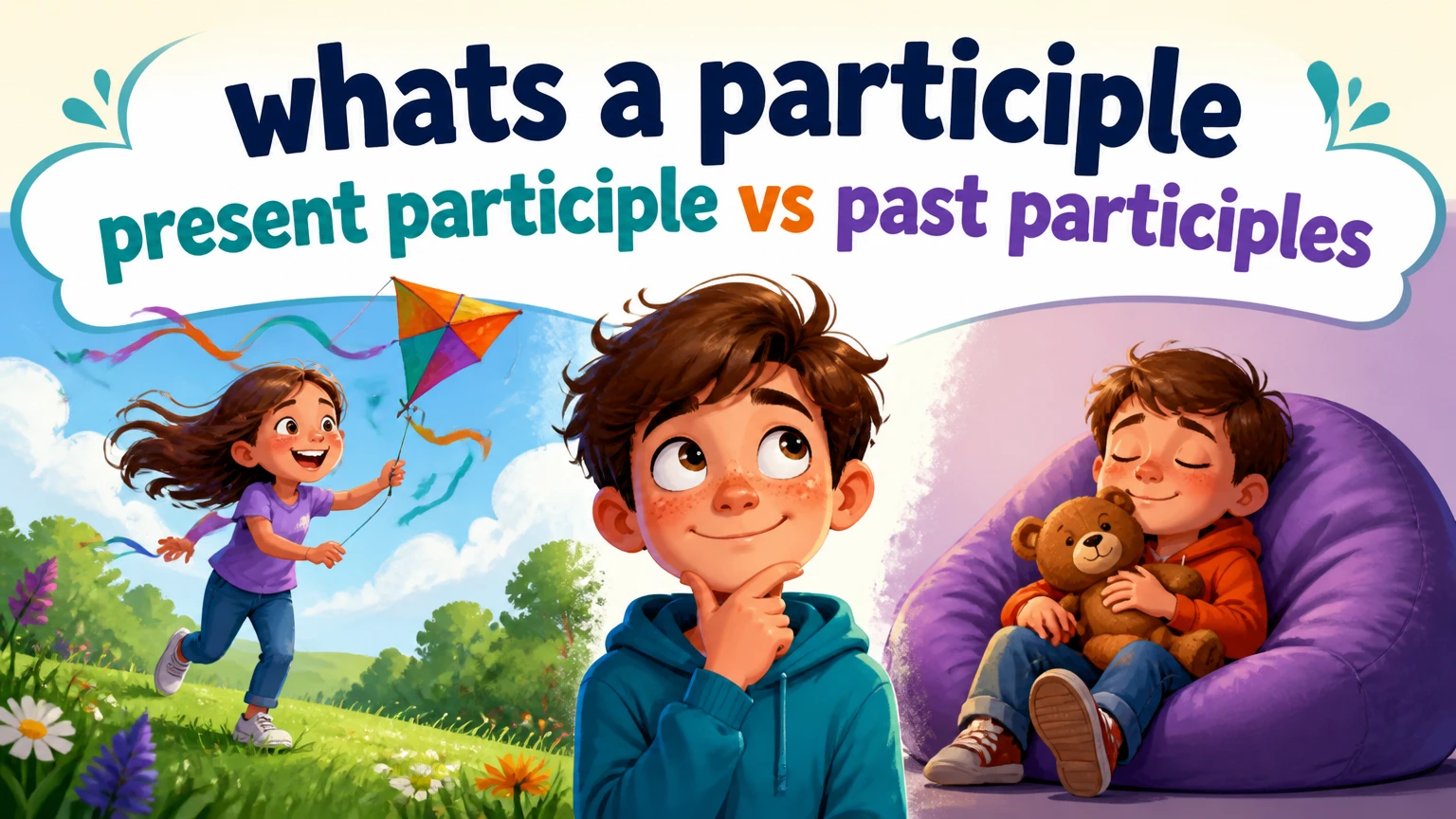
In the world of English grammar, a **participle** is a word formed from a verb that can function as an adjective or be used to create various verb tenses. It is often described as a “verbal,” meaning it looks like a verb but acts like a different part of speech.
Table of Contents
What is a Participle?
Think of a participle as a multi-tool. While its root is a verb (an action word), it can shift roles to describe a noun or help build complex timeframes in a sentence. There are two primary types of participles you will encounter: the present participle and the past participle.
The Present Participle (-ing)
The present participle is always formed by adding the suffix -ing to the base form of a verb. It has two main functions:
1. Creating Continuous Tenses
When paired with the auxiliary verb “to be,” the present participle forms continuous (progressive) tenses, indicating an ongoing action.
2. Acting as an Adjective
The present participle can describe a noun, usually indicating that the noun is the one performing the action or causing a feeling.
The Past Participle (-ed/-en)
Past participles are slightly more complex because their forms depend on whether the verb is regular or irregular.
- Regular Verbs: Add -ed (e.g., walked, talked, played).
- Irregular Verbs: These have unique forms (e.g., seen, broken, gone, written).
1. Creating Perfect Tenses
When paired with the auxiliary verb “to have,” the past participle forms perfect tenses.
2. Formulating the Passive Voice
The past participle is essential for showing that an action is being done to the subject.
Present vs. Past Participles: Key Differences
The most common confusion arises when using participles as adjectives. The choice between the two changes the meaning of the sentence entirely.
| Feature | Present Participle (-ing) | Past Participle (-ed/-en) |
|---|---|---|
| Focus | The cause of the feeling/action | The receiver of the feeling/action |
| Example (Bore) | The movie was boring. | The audience was bored. |
| Example (Excite) | The news is exciting. | The excited fans cheered. |
Understanding Participle Phrases
Participles can lead a group of words called a “participle phrase” to provide extra information about a noun in a sentence.
Past Phrase: Exhausted by the climb, the hikers took a break.
Common Mistakes to Avoid
1. Dangling Participles
A dangling participle occurs when the phrase doesn’t logically refer to the subject of the sentence.
Incorrect: Walking down the street, the trees were beautiful. (The trees weren’t walking!)
Correct: Walking down the street, I thought the trees were beautiful.
2. Confusing Gerunds with Present Participles
While both end in -ing, a gerund acts as a noun, while a participle acts as a verb or adjective.
Participle: The running water was cold. (Adjective)
Quick Practice
Choose the correct participle for the following sentences:
- The book was so (interesting / interested) that I couldn’t put it down.
- The (broken / breaking) vase lay on the floor in pieces.
Answers: 1. interesting, 2. broken