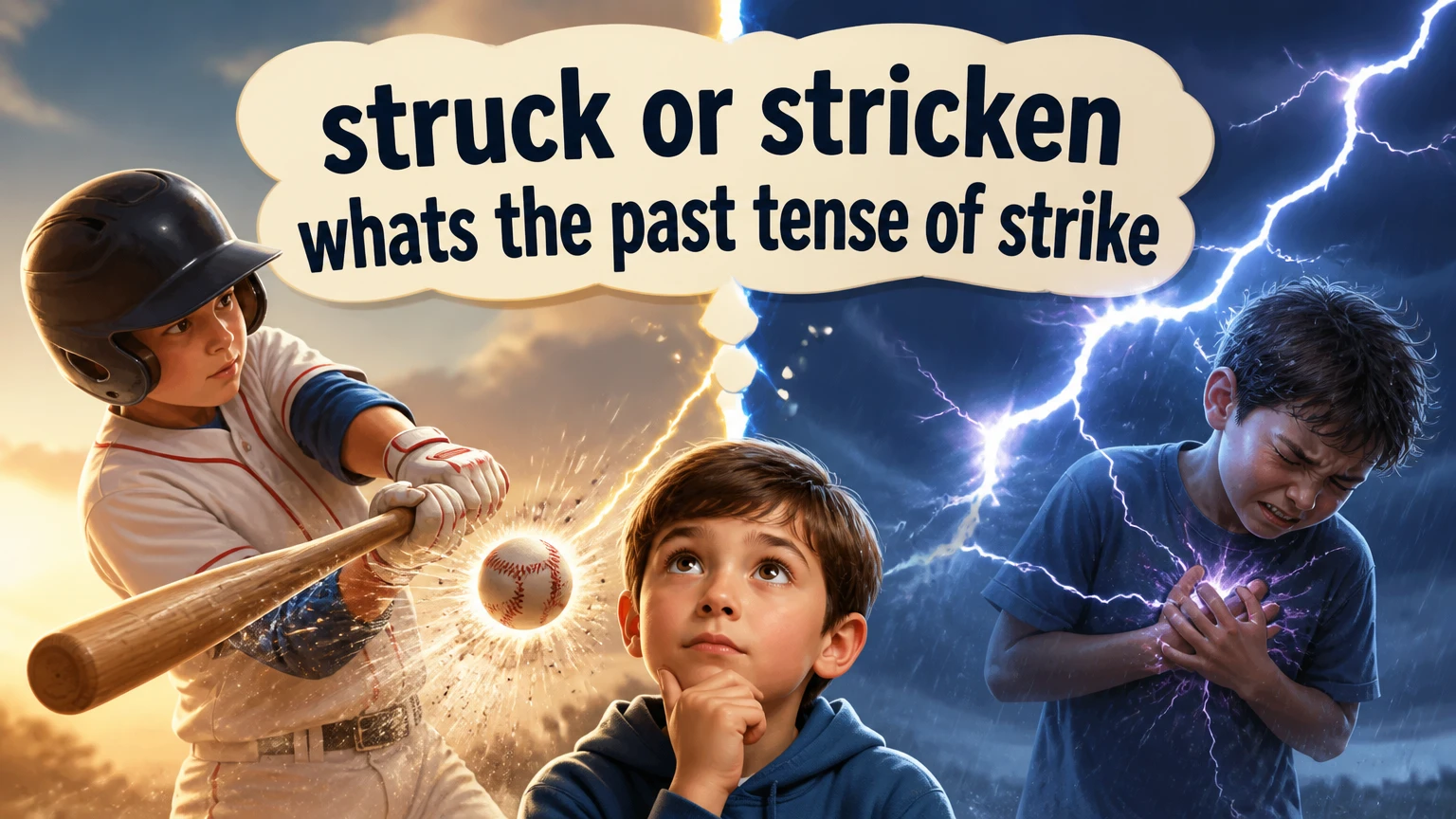
Article generation failed: Error code: 402 – {‘error’: {‘message’: ‘Insufficient credits. Add more using https://openrouter.ai/settings/credits’, ‘code’: 402}}
When it comes to the English language, irregular verbs often pose a significant challenge for writers and students alike. One of the most common points of confusion is determining when to use **struck** and when to use **stricken**. While both words are related to the verb *strike*, they are not interchangeable in modern usage.
Table of Contents
The Past Tense of Strike
In the simple past tense, the answer is straightforward: the past tense of strike is always struck. We use this form to describe an action that was completed in the past.
Example: The clock struck midnight just as we arrived.
Example: The lightning struck the old oak tree during the storm.
Struck vs. Stricken: The Past Participle
The confusion usually arises with the past participle form (used with helping verbs like has, have, or had). In modern English, struck is the standard past participle for most general meanings.
General Rule: Use struck for physical hitting, discovery, or general actions. Use stricken primarily as an adjective or in specific idiomatic contexts related to illness or misfortune.
When to Use Stricken
While struck is the workhorse of the two, stricken has carved out a niche for itself. It is most commonly used as an adjective to describe someone affected by a negative condition, such as a disease, poverty, or a powerful emotion.
- Grief-stricken: Overwhelmed by sadness.
- Poverty-stricken: Suffering from extreme lack of money.
- Panic-stricken: Suddenly overcome with fear.
- Cancer-stricken: Suffering from the disease of cancer.
Correct: The stricken vessel began to take on water.
Correct: She was stricken with a rare virus during her travels.
Legal and Idiomatic Expressions
In legal terminology, stricken is frequently used when referring to the removal of something from an official record.
Legal Note: A judge might order that a lawyer’s comment be “stricken from the record.” However, in casual conversation, many people would still say the comment was “struck from the record.” Both are technically acceptable, but stricken is the preferred formal legal term.
Summary Table
| Tense/Form | Word | Example Sentence |
|---|---|---|
| Present | Strike | They strike the gong every hour. |
| Simple Past | Struck | The boxer struck his opponent in the final round. |
| Past Participle | Struck | He has struck gold with his new business idea. |
| Adjective/Participle | Stricken | The poverty-stricken neighborhood needs more resources. |
Quick Practice
Which word fits best in the following sentences?
- The witness’s testimony was ______ from the court transcript.
- The town was ______ by a devastating earthquake.
- I was ______ by how much she looked like her mother.
Answers: 1. stricken, 2. struck (or stricken for emphasis on misfortune), 3. struck.
Frequently Asked Questions
Is “striking” the same as “stricken”?
No. “Striking” is the present participle used for ongoing actions (e.g., “He is striking the nail”) or as an adjective meaning attractive or noticeable (e.g., “She has striking blue eyes”).
Can I say “I was stricken by the idea”?
It is more common and natural to say “I was struck by the idea.” “Stricken” usually implies a negative affliction or a physical illness.
Is “stricken” becoming obsolete?
Not at all, but its usage is narrowing. It remains the standard choice for compound adjectives (like horror-stricken) and in formal legal contexts.