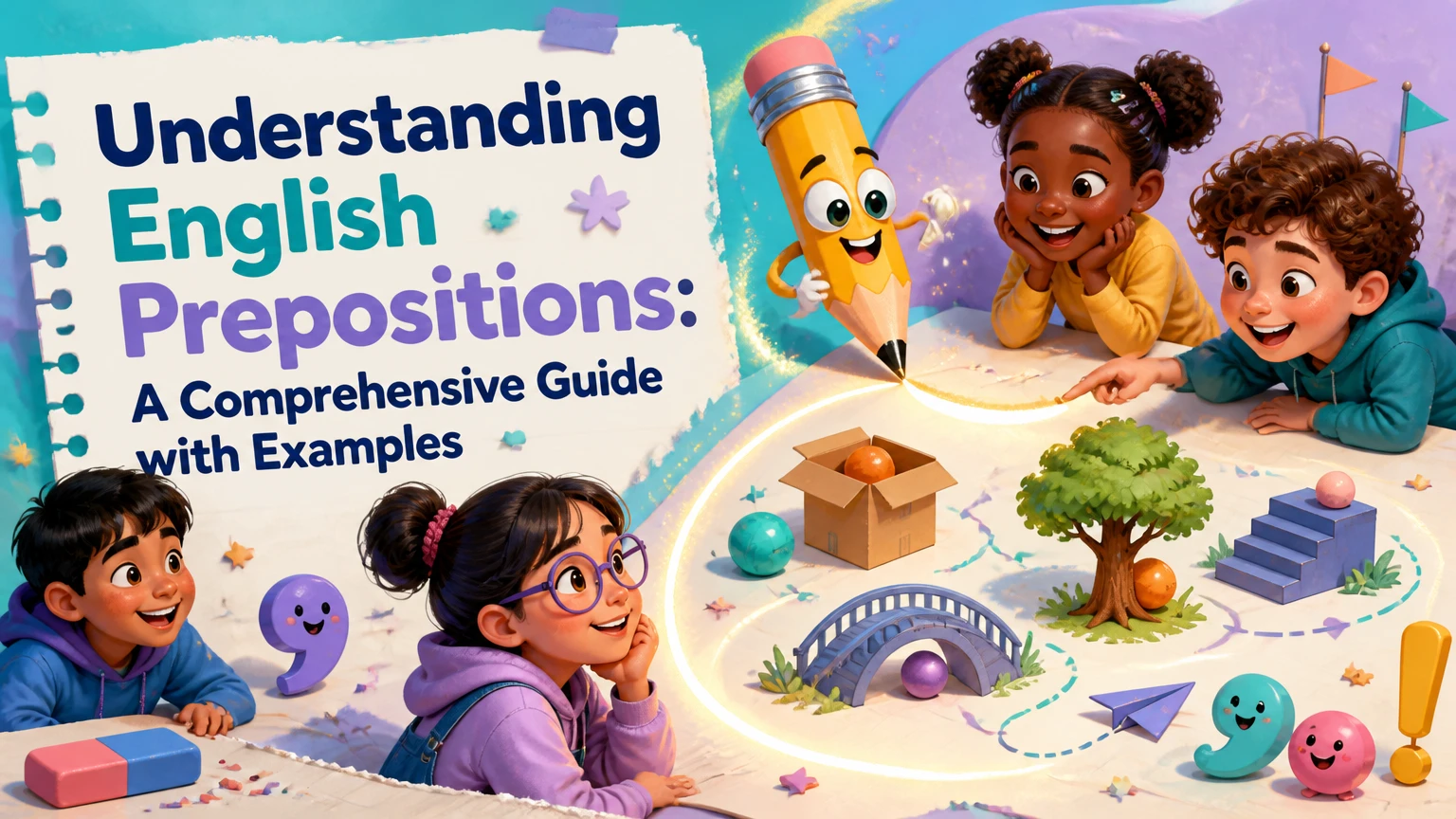
Prepositions are essential functional words that establish relationships between nouns or pronouns and other parts of a sentence, acting as the “glue” that holds our thoughts together. These versatile words describe various connections such as location, direction, time, and manner, including common terms like in, on, at, by, and from. Understanding prepositions is crucial for English learners because they provide the necessary context for where and when actions occur, making communication precise and professional. By mastering these small but mighty words, writers and speakers can avoid ambiguity and ensure their descriptions of the world are accurate and logical.
Table of Contents
- Comprehensive Definition of Prepositions
- Structural Breakdown and Sentence Patterns
- Prepositions of Place and Position
- Prepositions of Time and Duration
- Prepositions of Direction and Movement
- Prepositions of Agent and Instrument
- Extensive Example Tables
- Fundamental Usage Rules and Exceptions
- Common Mistakes and How to Fix Them
- Advanced Topics: Phrasal Verbs and Dependent Prepositions
- Practice Exercises for All Levels
- Frequently Asked Questions (FAQ)
- Conclusion and Final Learning Tips
Comprehensive Definition of Prepositions
A preposition is a word or group of words used before a noun, pronoun, or noun phrase to show direction, time, place, location, spatial relationships, or to introduce an object. In the hierarchy of English grammar, prepositions are considered a “closed class” of words, meaning that it is very rare for new prepositions to be added to the language over time, unlike nouns or verbs which grow constantly with technology and culture.
The term “preposition” comes from the Latin praeponere, which means “to put before.” This reflects their primary structural role: they are almost always placed before their object. The combination of a preposition and its object is known as a prepositional phrase. These phrases function as adjectives or adverbs within a sentence, providing more detail about the words they modify.
Functionally, prepositions clarify the relationship between the “trajector” (the thing being discussed) and the “landmark” (the reference point). For example, in the sentence “The cat sits under the table,” the cat is the trajector, the table is the landmark, and under defines the spatial relationship between them. Without prepositions, sentences would lack the spatial and temporal dimensions necessary for complex human interaction.
Structural Breakdown and Sentence Patterns
The structure of a prepositional phrase is remarkably consistent in English. It typically follows the pattern: Preposition + (Modifier) + Object. The object is usually a noun or a pronoun, but it can also be a gerund (a verb ending in -ing that acts as a noun). Understanding this structure helps learners identify where a phrase begins and ends.
Consider the phrase “to the very large house.” Here, “to” is the preposition, “the very large” are modifiers (an article and adjectives), and “house” is the noun object. This entire unit works together to answer the question “Where?” or “In what direction?” Structural variations occur when prepositions are used in questions or with relative clauses, sometimes appearing at the end of a sentence—a practice once frowned upon by strict grammarians but now fully accepted in modern English.
Another structural element is the complex preposition. These are groups of two or more words that function as a single prepositional unit. Examples include in spite of, on account of, and with respect to. Despite being multiple words, they occupy the same structural slot as a single-word preposition and require an object to complete their meaning.
Prepositions of Place and Position
Prepositions of place describe the physical location of an object relative to another. These are perhaps the most common prepositions used in daily conversation. They help us navigate our physical environment and describe the world around us with high specificity.
The most frequent prepositions in this category are at, in, and on. While they might seem interchangeable, they have specific geometric applications. At is used for a specific point or a precise address. In is used for an enclosed space or a large geographical area like a city or country. On is used for a surface or a line, such as a street or a river.
Other prepositions of place include under, over, between, among, behind, and in front of. These words help define 3D space. For instance, “between” is used when referring to two distinct items, while “among” is used when an item is part of a larger group or mass. Mastering these distinctions is a hallmark of an advanced English speaker.
Prepositions of Time and Duration
Prepositions of time allow us to sequence events and describe when things happen. Similar to place, the “big three” here are also at, in, and on, but they follow different rules for temporal concepts. Understanding these rules is essential for scheduling, storytelling, and historical reporting.
We use at for precise times (at 3:00 PM, at noon, at sunset). We use on for days and dates (on Monday, on Christmas Day, on July 4th). We use in for longer periods such as months, years, seasons, and centuries (in October, in 1995, in the summer). This logical progression from specific points to broad eras helps organize the English concept of time.
Beyond the “big three,” we use for to indicate duration (for two hours) and since to indicate a starting point in time (since 2010). During is used to describe an event that happens within the timeframe of another event, while until marks the point where an action stops. These words are vital for expressing the nuances of frequency and persistence.
Prepositions of Direction and Movement
Prepositions of direction describe how something moves from one place to another. Unlike prepositions of place, which are static, these prepositions are dynamic. They are almost always used with verbs of motion like go, run, walk, fly, and drive.
Common examples include to, into, onto, across, through, and toward. For example, “into” suggests movement from the outside to the inside of a space, whereas “in” simply describes being inside. “Across” suggests movement from one side of a surface to the other, while “through” suggests movement within a three-dimensional volume, like walking through a forest.
Directional prepositions can also be metaphorical. We can move towards a goal or look through a problem. This flexibility allows English speakers to use physical spatial concepts to describe abstract mental processes, which is a key component of idiomatic English fluency.
Prepositions of Agent and Instrument
These prepositions describe the “who” or “what” behind an action. Prepositions of agent are used to express that a specific person or thing performed an action, usually in passive voice sentences. The most common agent preposition is by (e.g., “The book was written by Hemingway”).
Prepositions of instrument describe the tool or object used to complete an action. The most common instrumental prepositions are with and by means of. For example, “He opened the lock with a key.” There is a subtle difference here: “by” often refers to the method or the person, while “with” refers to the physical tool used.
Understanding these helps in scientific and technical writing where the cause and effect or the methodology must be clearly stated. Using “with” instead of “by” can change the meaning of a sentence entirely, so precision is required when describing processes and procedures.
Extensive Example Tables
To help you master the various categories of prepositions, the following tables provide comprehensive lists of words paired with their typical usage and example sentences. These tables serve as a quick reference guide for your writing and speaking needs.
Table 1: 30 Common Prepositions of Place
This table covers 30 essential prepositions used to describe where objects are located in space. These are fundamental for basic descriptions and navigation.
| Preposition | Usage Context | Example Sentence |
|---|---|---|
| Above | Higher than something | The clock hangs above the door. |
| Across | On the other side of | The store is across the street. |
| Against | Touching for support | Lean the ladder against the wall. |
| Among | In a group of three or more | He felt comfortable among friends. |
| Around | In a circular path | They walked around the park. |
| At | Specific point/address | Meet me at the entrance. |
| Behind | At the back of | The car is parked behind the house. |
| Below | Lower than something | The temperature is below freezing. |
| Beneath | Directly under | The treasure was buried beneath the sand. |
| Beside | Next to | She sat beside her sister. |
| Between | In the middle of two things | The shop is between the bank and the cafe. |
| Beyond | Further than | The mountains are beyond the horizon. |
| By | Near or next to | The house is by the river. |
| Close to | Near | The school is close to the library. |
| Inside | Within a container | The keys are inside the drawer. |
| In front of | Opposite the back | Wait for me in front of the theater. |
| In | Enclosed space | The milk is in the fridge. |
| Near | A short distance away | I live near the airport. |
| Next to | Adjacent | The pen is next to the phone. |
| On | On a surface | The plate is on the table. |
| Opposite | Facing something | The post office is opposite the park. |
| Outside | Exterior of a space | The dog is outside the house. |
| Over | Directly above | The bridge goes over the river. |
| Past | Beyond a point | Drive past the church and turn left. |
| Round | Circular motion/position | The earth moves round the sun. |
| Through | Movement within a space | We walked through the tunnel. |
| Throughout | In every part of | The news spread throughout the city. |
| Toward | In the direction of | They walked toward the beach. |
| Under | Lower than/covered by | The cat is under the bed. |
| Underneath | Directly below | He wore a shirt underneath his sweater. |
Table 2: 25 Common Prepositions of Time
The following table illustrates how we use prepositions to organize time, sequence, and duration. These are critical for avoiding confusion in schedules and deadlines.
| Preposition | Usage Context | Example Sentence |
|---|---|---|
| After | Later than | I will call you after lunch. |
| At | Precise time | The movie starts at 8:00 PM. |
| Before | Earlier than | Wash your hands before dinner. |
| By | Not later than | Finish the report by Friday. |
| During | Within a period | She slept during the flight. |
| For | Amount of time | They stayed for two weeks. |
| From…to | Start and end time | The office is open from 9 to 5. |
| In | Months/Years/Centuries | I was born in 1990. |
| On | Days and dates | The party is on Saturday. |
| Past | Time after the hour | It is ten past five. |
| Since | From a point in the past | I haven’t seen him since Monday. |
| Throughout | During the whole period | It rained throughout the night. |
| Until | Up to a certain time | Wait until the rain stops. |
| Within | Inside a time limit | Please reply within 24 hours. |
| About | Approximate time | I’ll be there about noon. |
| Around | Approximate time | He arrived around 7 o’clock. |
| Between | Time interval | Call me between 2 and 4. |
| Beyond | Past a certain time | Don’t stay out beyond midnight. |
| Of | Time relative to hour | It is a quarter of ten. |
| To | Time before the hour | It is five to six. |
| Following | After something | Following the meeting, we had tea. |
| Pending | While waiting for | Pending the results, stay calm. |
| Prior to | Before | Check in prior to your flight. |
| Up to | No more than | It can take up to an hour. |
| Throughout | Entire duration | He worked throughout the weekend. |
Table 3: 20 Prepositions of Movement and Direction
Directional prepositions describe the path of an object. This table highlights how these words interact with verbs of motion to create a clear picture of activity.
| Preposition | Direction Description | Example Sentence |
|---|---|---|
| Across | From one side to another | He swam across the lake. |
| Along | In a line following a path | We walked along the shore. |
| Away from | Increasing distance | The deer ran away from us. |
| Down | Higher to lower point | She walked down the stairs. |
| Into | Entering a space | Put the milk into the fridge. |
| Off | Away from a surface | The cat jumped off the table. |
| Onto | Moving to a surface | He stepped onto the stage. |
| Out of | Leaving a space | Get out of the car. |
| Over | Passing above something | The bird flew over the house. |
| Past | Going by a point | Walk past the library. |
| Through | Entering and leaving a volume | Drive through the tunnel. |
| To | Destination | I am going to the office. |
| Towards | In the direction of | Walk towards the light. |
| Under | Moving below something | The boat went under the bridge. |
| Up | Lower to higher point | We hiked up the mountain. |
| Via | By way of | We traveled via Paris. |
| Against | Movement toward contact | The rain beat against the window. |
| Around | Circumnavigating | They ran around the track. |
| From | Point of origin | The flight from London is late. |
| Toward | In the general direction | She turned toward the door. |
Fundamental Usage Rules and Exceptions
Mastering prepositions requires understanding a few core rules, though English is famous for its exceptions. The first rule is that prepositions must have an object. If a word that looks like a preposition does not have an object, it is likely functioning as an adverb. For example, in “He fell down,” down is an adverb. In “He fell down the stairs,” down is a preposition because “the stairs” is its object.
The second rule concerns the placement of prepositions. While the traditional rule stated that you should never end a sentence with a preposition (e.g., “Who are you talking to?”), modern linguistics recognizes this as an artificial rule based on Latin grammar. In natural English, ending a sentence with a preposition is often more fluid and less formal. However, in strictly academic writing, some still prefer to move the preposition (e.g., “To whom are you talking?”).
A third rule involves the use of “to” after verbs. Many people confuse the preposition “to” with the infinitive marker “to.” If “to” is followed by a noun or a gerund, it is a preposition (e.g., “I look forward to meeting you”). If it is followed by a base verb, it is part of the infinitive (e.g., “I want to eat”). Distinguishing these is vital for correct verb conjugation.
Finally, prepositions are often dictated by the words that precede them rather than the logic of the physical world. These are called dependent prepositions. For example, we say “interested in,” “afraid of,” and “depend on.” There is no logical reason why we aren’t “interested at” or “afraid with”—these are simply fixed patterns that must be memorized through exposure and practice.
Common Mistakes and How to Fix Them
Even native speakers struggle with certain prepositional pairings. One of the most common errors is the confusion between in and into. “In” denotes position, while “into” denotes movement. Saying “I jumped in the pool” implies you were already in the water when you jumped; “I jumped into the pool” correctly describes the action of entering the water from the deck.
Another frequent mistake involves the usage of beside versus besides. “Beside” means next to (spatial), while “besides” means “in addition to” or “except for.” For example: “Sit beside me” (next to) vs. “Besides the rain, the trip was great” (in addition to). Adding that single ‘s’ changes the entire meaning of the sentence.
Table 4: Correct vs. Incorrect Preposition Usage
This comparison table highlights frequent errors made by learners and provides the corrected versions to help improve grammatical accuracy.
| Incorrect Usage | Correct Usage | Reason/Rule |
|---|---|---|
| I am angry at you. | I am angry with you. | We are angry “with” people but “at” situations. |
| Discuss about the problem. | Discuss the problem. | “Discuss” is a transitive verb; no preposition needed. |
| Married with a doctor. | Married to a doctor. | The verb “marry” takes the preposition “to.” |
| Go to home. | Go home. | “Home” acts as an adverb here; no preposition needed. |
| In the weekend. | On the weekend. | “On” is standard for days and specific timeframes. |
| Depends of the weather. | Depends on the weather. | “Depend” always pairs with “on.” |
| Divided in two parts. | Divided into two parts. | Movement/change of state uses “into.” |
| Arrive to London. | Arrive in London. | Use “in” for cities/countries, “at” for specific buildings. |
| By foot. | On foot. | Idiomatic expression for walking is “on foot.” |
| Similar with this one. | Similar to this one. | “Similar” always pairs with “to.” |
Advanced Topics: Phrasal Verbs and Dependent Prepositions
For advanced learners, the challenge shifts from simple spatial prepositions to phrasal verbs. A phrasal verb is a combination of a verb and a preposition (or adverb) that creates a meaning different from the original verb. For example, “give up” means to quit, which has nothing to do with the physical direction “up.” These are highly idiomatic and require significant memorization.
Another advanced area is prepositional idioms. These are phrases where the preposition’s meaning isn’t literal. Examples include at odds, by heart, in a nutshell, and under the weather. These phrases are the building blocks of natural-sounding English and are essential for reaching a C1 or C2 level of proficiency.
Finally, dependent prepositions after adjectives and nouns can be tricky. Why is someone “proud of” their work but “take pride in” it? Why do we have an “influence on” someone but “interfere with” them? These patterns are often historical remnants of the language. Advanced students should focus on learning these as “chunks” of language rather than individual words.
Table 5: Common Dependent Prepositions
The following table lists common adjectives and the specific prepositions they require. Learning these pairs together is the most effective way to master advanced English.
| Adjective/Noun | Required Preposition | Example Sentence |
|---|---|---|
| Accustomed | to | I am accustomed to the cold. |
| Addicted | to | He is addicted to caffeine. |
| Afraid | of | She is afraid of heights. |
| Aware | of | Are you aware of the risks? |
| Capable | of | You are capable of great things. |
| Different | from | This is different from that. |
| Famous | for | Paris is famous for the Eiffel Tower. |
| Good | at | He is good at math. |
| Interested | in | I am interested in history. |
| Kind | to | Be kind to animals. |
| Proud | of | They are proud of their son. |
| Responsible | for | Who is responsible for this mess? |
| Satisfied | with | I am satisfied with the results. |
| Sorry | for | He felt sorry for the mistake. |
| Typical | of | This is typical of his behavior. |
Practice Exercises for All Levels
Testing your knowledge is the best way to ensure these rules stick. Below are three sets of exercises designed to challenge your understanding of place, time, and dependent prepositions. Try to complete them without looking back at the tables first.
Exercise 1: Fill in the Correct Preposition (Place & Time)
Identify the most appropriate preposition (at, in, on, for, since) for each sentence.
- The meeting is scheduled ____ 10:30 AM ____ Tuesday.
- I have been living in this city ____ five years.
- There is a beautiful painting ____ the wall ____ the living room.
- We usually go skiing ____ the winter.
- The keys are ____ the table ____ the hallway.
- I haven’t seen my cousin ____ last Christmas.
- She was born ____ the 15th of May ____ 1992.
- Let’s meet ____ the bus stop ____ the corner.
- The cat is hiding ____ the sofa.
- They have been working ____ eight hours without a break.
Exercise 2: Identifying Errors
Each of the following sentences contains one prepositional error. Find it and correct it.
- I am looking forward to see you tomorrow.
- He is very good in playing the guitar.
- The book is different than the movie.
- We arrived to the airport two hours early.
- She is married with a famous actor.
- I am angry at my brother for losing my phone.
- Does this result depend of the test conditions?
- We discussed about the new project for an hour.
- I’ll see you on next Monday.
- The car crashed against a tree.
Exercise 3: Answer Key and Explanations
Use this table to check your answers and understand the reasoning behind each correct choice.
| Question | Correct Answer | Explanation |
|---|---|---|
| Ex 1.1 | at / on | “At” for time, “on” for days. |
| Ex 1.2 | for | “For” indicates a duration of time. |
| Ex 1.3 | on / in | “On” for surface, “in” for enclosed space. |
| Ex 1.6 | since | “Since” marks a specific starting point in the past. |
| Ex 2.1 | to seeing | “Look forward to” is a phrasal verb requiring a gerund (-ing). |
| Ex 2.2 | good at | “Good” always takes “at” for skills. |
| Ex 2.3 | different from | “Different from” is the standard comparative form. |
| Ex 2.5 | married to | “Married” always takes “to” when describing the partner. |
| Ex 2.8 | discussed (omit about) | “Discuss” is transitive and doesn’t need a preposition. |
Frequently Asked Questions (FAQ)
1. Can a sentence end with a preposition?
Yes, absolutely. While older grammar books influenced by Latin rules suggested avoiding this, modern English fully accepts ending a sentence with a preposition, especially in spoken and informal contexts. For example, “What are you looking at?” is much more natural than “At what are you looking?”
2. What is the difference between “at,” “on,” and “in” for place?
Think of it as a scale of specificity. “At” is a specific point (at the door). “On” is a surface or a line (on the table, on the street). “In” is an enclosed space or a large area (in the box, in London). Using this pyramid of specificity can help you choose the right one every time.
3. Are prepositions and adverbs the same?
They can look the same, but their function differs. A preposition always has an object (e.g., “The bird flew down the chimney“). An adverb modifies a verb and does not have an object (e.g., “The bird flew down“). If you can’t find a noun or pronoun following the word, it’s likely an adverb.
4. Why are prepositions so hard to learn?
Prepositions are difficult because they are often idiomatic and don’t always follow logical rules. Many are “dependent,” meaning they are tied to specific verbs or adjectives. The best way to learn them is through reading and listening to natural English rather than just memorizing rules.
5. Is “than” a preposition or a conjunction?
It can be both! In the sentence “He is taller than me,” it functions as a preposition. In “He is taller than I am,” it functions as a conjunction introducing a clause. Both are grammatically correct in modern usage, though “than me” is more common in conversation.
6. What are complex prepositions?
Complex prepositions are phrases of two or three words that function as a single preposition. Examples include according to, in front of, by means of, and in spite of. They follow the same rules as single-word prepositions and require an object.
7. How do I know which preposition to use with a verb?
Unfortunately, there isn’t one single rule. These are “collocations”—words that naturally go together. It is best to learn verbs and their prepositions together as a single unit (e.g., “listen to,” “wait for,” “belong to”). A good dictionary will always list the dependent preposition for a verb.
8. Can I use “into” and “in” interchangeably?
Generally, no. “Into” indicates movement or transformation (e.g., “He walked into the room”). “In” indicates a static position (e.g., “He is in the room”). Using “in” for movement is common in casual speech, but “into” is preferred for clarity and formal writing.
Conclusion and Final Learning Tips
Mastering prepositions is a journey that requires patience, observation, and practice. While the rules provide a helpful foundation, the true nuances of prepositions are found in how native speakers use them in context. Remember that these small words are the keys to expressing complex spatial and temporal relationships, making your English sound more natural and sophisticated. To continue improving, try to read extensively and pay close attention to how prepositions are paired with verbs and adjectives. Keep a notebook of common phrases, practice with the tables provided in this guide, and don’t be afraid to make mistakes—even the most advanced learners occasionally trip over these tricky parts of speech. With consistent effort, the “logic” of English prepositions will eventually become second nature.