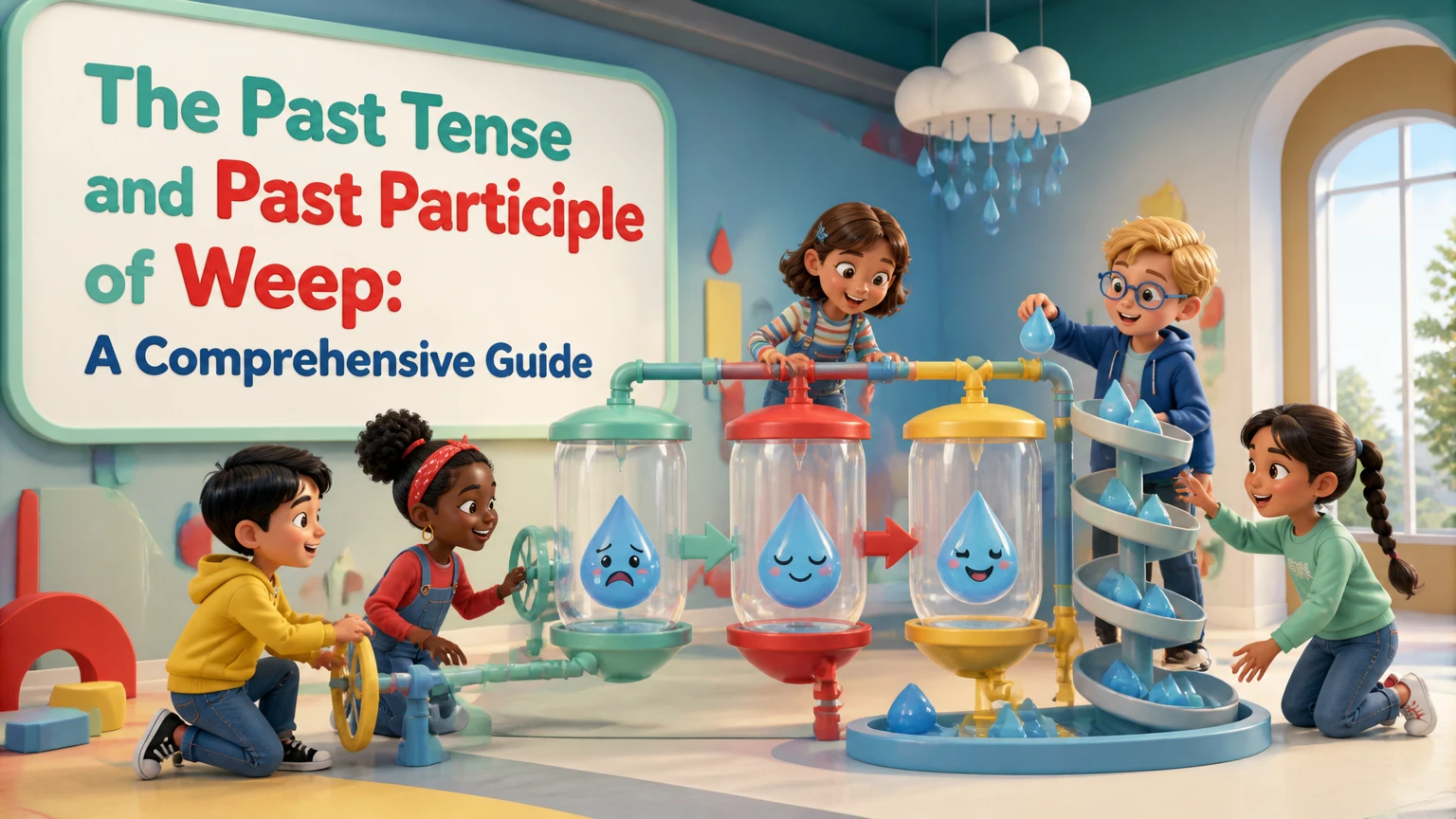
The English language is filled with irregular verbs that can often confuse even the most seasoned writers and students. One such verb is “weep,” a word that carries significant emotional weight and specific grammatical rules that distinguish it from standard regular verbs. When we explore the various forms of this verb, we encounter specific transformations such as wept, weeping, and weeps, which allow us to communicate sadness or intense emotion across different timelines. Understanding the correct conjugation of “weep” is essential for anyone looking to master English literature, creative writing, or formal communication, as it ensures that the tone and tense of a narrative remain consistent and evocative. By mastering these shifts, learners can avoid common pitfalls and express complex human experiences with greater precision and clarity.
Table of Contents
- Definition and Classification of “Weep”
- Structural Breakdown and Conjugation Patterns
- The Myth of “Weeped”: Why It Is Incorrect
- Tense Variations and Categorization
- Extensive Sentence Examples
- Usage Rules and Contextual Nuances
- Common Mistakes and How to Avoid Them
- Practice Exercises and Assessment
- Advanced Topics: Phrasal Verbs and Idioms
- Frequently Asked Questions (FAQ)
- Conclusion and Key Takeaways
Definition and Classification of “Weep”
To “weep” is primarily defined as the act of shedding tears as an expression of deep sorrow, grief, joy, or other powerful emotions. While it is often used synonymously with “cry,” weeping usually implies a more profound, quiet, or sustained state of emotional release. In a grammatical sense, “weep” is classified as an irregular verb because it does not follow the standard pattern of adding “-ed” to form the past tense and past participle.
Functionally, “weep” can be used as both an intransitive verb and a transitive verb. Most commonly, it is intransitive, meaning it does not require a direct object to complete its meaning. For example, in the sentence “She wept quietly,” the action is complete without further explanation. However, in poetic or literary contexts, it can be transitive, such as in the phrase “to weep bitter tears,” where “tears” functions as the object of the action.
The verb belongs to a specific group of English verbs that undergo a vowel shortening and a suffix change. Verbs like keep, sleep, sweep, and creep all follow the same pattern as weep, changing the double “ee” to a single “e” and adding a “t” at the end. This historical linguistic pattern is a remnant of Old English and Germanic influences that have persisted into modern usage, making “wept” the only standard and accepted past form.
Structural Breakdown and Conjugation Patterns
Understanding the structure of an irregular verb requires looking at its principal parts. For the verb “weep,” these parts consist of the base form, the past tense, the past participle, and the present participle. The shift from “weep” to “wept” involves a process known as vowel shortening, where the long /i:/ sound in “weep” becomes a short /ɛ/ sound in “wept.”
The table below provides a clear breakdown of the primary forms of the verb “weep.” This structural overview is the foundation for all further grammatical applications, ensuring that the speaker uses the correct form based on the intended timeframe of the action.
| Verb Form | Term | Example Usage |
|---|---|---|
| Weep | Base Form (Infinitive) | I often weep at sad movies. |
| Wept | Past Tense | She wept when she heard the news. |
| Wept | Past Participle | They have wept for their loss. |
| Weeping | Present Participle / Gerund | The weeping willow swayed in the wind. |
| Weeps | Third Person Singular | He weeps every time he says goodbye. |
The consistency between the past tense and the past participle (both being “wept”) makes this verb slightly easier to memorize than irregular verbs with three distinct forms, such as sing-sang-sung. However, the temptation to apply the regular “-ed” rule is why many learners mistakenly produce “weeped,” which is considered non-standard and incorrect in all formal dialects of English.
The Myth of “Weeped”: Why It Is Incorrect
A common question among English learners is whether “weeped” is a valid alternative to “wept.” In the evolution of the English language, many irregular verbs have slowly transitioned into regular forms (a process called regularization). However, “weep” has resisted this change. While you might occasionally see “weeped” in very old texts or specific regional dialects, it is universally rejected by modern dictionaries and style guides.
Using “weeped” in a professional, academic, or literary context is viewed as a grammatical error. The reason “wept” remains the standard is largely due to the frequency of its use in literature and the influence of the “vowel shortening + t” pattern found in other common verbs. When a verb follows a recognizable pattern with other high-frequency words (like keep/kept), it tends to remain irregular for much longer than isolated irregular verbs.
The following table compares the incorrect regularized form with the correct irregular form across different subjects to illustrate how the correct form should always be “wept.”
| Subject | Incorrect (Regularized) | Correct (Irregular) |
|---|---|---|
| I | I weeped. | I wept. |
| You | You weeped. | You wept. |
| He / She / It | She weeped. | She wept. |
| We | We weeped. | We wept. |
| They | They weeped. | They wept. |
Tense Variations and Categorization
To use “weep” effectively, one must understand how it functions across all twelve English tenses. Because “wept” serves as both the simple past and the past participle, it appears in all perfect tenses. The present participle “weeping” is used for all continuous (progressive) tenses. This versatility allows the speaker to pinpoint the exact timing and duration of the emotional expression.
In the simple tenses, “weep” describes general truths or completed actions. In the continuous tenses, it emphasizes the ongoing nature of the crying. In the perfect tenses, it links the act of weeping to another point in time or suggests that the action has been completed relative to another event. The following sections and tables will explore these variations in depth.
Simple Tenses
Simple tenses are used for facts, habits, or completed actions. The simple past “wept” is the most frequent form used in storytelling.
| Tense | Formula | Example |
|---|---|---|
| Simple Present | Subject + Base (s/es) | The child weeps for his mother. |
| Simple Past | Subject + Wept | The widow wept at the funeral. |
| Simple Future | Subject + will + Weep | He will weep when he sees the results. |
Perfect Tenses
Perfect tenses use the past participle “wept” combined with an auxiliary verb (have, has, had). These tenses are crucial for showing the relationship between two time periods.
| Tense | Formula | Example |
|---|---|---|
| Present Perfect | Subject + have/has + Wept | She has wept many times this week. |
| Past Perfect | Subject + had + Wept | He had wept before they arrived. |
| Future Perfect | Subject + will have + Wept | By then, they will have wept all their tears. |
Extensive Sentence Examples
To truly master a verb, one must see it used in various contexts. “Weep” is a highly atmospheric verb, often used to create a specific mood in writing. Below are 25 examples of the verb “weep” used in the simple past tense (wept) and 25 examples using the past participle (wept) within perfect constructions.
25 Examples of Simple Past Tense: Wept
| No. | Sentence |
|---|---|
| 1 | The soldier wept for his fallen comrades. |
| 2 | She wept bitter tears of disappointment. |
| 3 | The entire nation wept after the tragedy. |
| 4 | He wept with joy when his daughter was born. |
| 5 | The sky wept rain upon the grey city. (Metaphorical) |
| 6 | They wept together in the quiet room. |
| 7 | I wept until my eyes were red and swollen. |
| 8 | The protagonist wept at the end of the novel. |
| 9 | She wept silently so as not to wake the children. |
| 10 | He wept openly in front of the cameras. |
| 11 | The clouds wept over the valley. |
| 12 | We wept for the loss of our childhood home. |
| 13 | The musician wept during the final performance. |
| 14 | She wept uncontrollably after the accident. |
| 15 | He wept as he read the old love letters. |
| 16 | The congregation wept during the moving sermon. |
| 17 | I wept because I was so frustrated. |
| 18 | The trees wept dew in the early morning. |
| 19 | She wept for the opportunities she had missed. |
| 20 | He wept when he realized the truth. |
| 21 | The child wept over the broken toy. |
| 22 | They wept in relief when the danger passed. |
| 23 | The queen wept for her people. |
| 24 | I wept at the beauty of the sunset. |
| 25 | The actor wept on cue during the scene. |
25 Examples of Past Participle: Wept
| No. | Sentence |
|---|---|
| 1 | She has wept more today than ever before. |
| 2 | By the time help arrived, he had wept himself to sleep. |
| 3 | They have wept together through many hardships. |
| 4 | Has she wept since the news broke? |
| 5 | He had never wept in public until that day. |
| 6 | The statue appeared to have wept real tears. |
| 7 | I have wept for you every single night. |
| 8 | They had wept until they had no tears left. |
| 9 | The heavens have wept for forty days. |
| 10 | She will have wept a river by the time he returns. |
| 11 | Having wept, she felt a strange sense of peace. |
| 12 | He has wept over his past mistakes for years. |
| 13 | We had wept in anticipation of the bad news. |
| 14 | The character has wept in every chapter of the book. |
| 15 | I had wept long before anyone noticed. |
| 16 | Have they wept for their actions? |
| 17 | She has wept at every wedding she attended. |
| 18 | He might have wept if he weren’t so shocked. |
| 19 | The earth has wept under the weight of the war. |
| 20 | By midnight, she had wept her eyes dry. |
| 21 | I have never wept so hard in my life. |
| 22 | The saints have wept for the sins of the world. |
| 23 | Had he wept, they might have forgiven him. |
| 24 | She has wept for the loss of her innocence. |
| 25 | They have wept since the very beginning. |
Usage Rules and Contextual Nuances
While “weep” and “cry” are often used interchangeably, “weep” carries a specific set of connotations. Understanding these nuances is key to using the word correctly in various contexts. Generally, “weep” is considered more formal and literary than “cry.” You are more likely to find “weep” in a poem, a religious text, or a classic novel than in a casual text message or a modern sitcom.
One major rule of usage involves the intensity and sound of the action. “Crying” can involve loud wailing or sobbing, whereas “weeping” often suggests a more quiet, dignified, or prolonged shedding of tears. If someone is “weeping,” they are often deeply moved or profoundly sad, whereas “crying” could be a reaction to a stubbed toe or a minor frustration.
Additionally, “weep” is frequently used in metaphorical contexts. We describe “weeping wounds” to indicate that a physical injury is oozing fluid. We talk about “weeping willows,” a specific type of tree with drooping branches that resemble the posture of a person in mourning. In these cases, the verb “weep” moves beyond human emotion to describe physical characteristics that mimic the act of shedding tears.
| Context | Usage Description | Example |
|---|---|---|
| Literary | Used to evoke deep emotion or high drama. | “The hero wept for his lost kingdom.” |
| Medical | Used to describe a wound discharging fluid. | “The infection caused the sore to weep.” |
| Botanical | Used for plants with drooping branches. | “The weeping birch looked beautiful in the frost.” |
| Idiomatic | Used in set phrases like “read it and weep.” | “I have the winning ticket; read it and weep!” |
Common Mistakes and How to Avoid Them
The most frequent mistake regarding this verb is the use of “weeped.” As discussed earlier, the English brain often tries to simplify irregular verbs by applying the standard “-ed” ending. To avoid this, it is helpful to group “weep” with its linguistic “cousins”: keep, sleep, creep, and sweep. If you remember that the past of keep is kept, you will easily remember that the past of weep is wept.
Another common error is confusing the spelling of “wept” with “wepped.” Because the vowel sound is short, some learners assume the “p” should be doubled. However, in English, we do not double the consonant when the verb ends in a double vowel (ee) that is shortened. Therefore, “wept” remains the only correct spelling.
Finally, there is the confusion between “wept” and “weeped” in terms of regional English. Some learners believe “weeped” is acceptable in American English (similar to dreamed vs. dreamt). This is a misconception. Unlike dream/dreamed/dreamt or learn/learned/learnt, where both forms are often accepted, “weep” only has one accepted past form in all major varieties of English: wept.
| Incorrect Usage | Correct Usage | Reasoning |
|---|---|---|
| He weeped at the movie. | He wept at the movie. | “Weep” is an irregular verb. |
| She has wepped for hours. | She has wept for hours. | The “p” is not doubled in “wept.” |
| The wound is weepinged. | The wound is weeping. | Use the present participle for ongoing states. |
| They were weepting. | They were weeping. | The “-ing” form uses the base “weep.” |
Practice Exercises and Assessment
To solidify your understanding of “weep” and its forms, complete the following exercises. These are designed to test your ability to identify the correct tense and form in different grammatical contexts.
Exercise 1: Fill in the Blanks
Choose the correct form of “weep” (weep, weeps, wept, weeping) to complete the sentences below.
- Yesterday, she _______ for nearly an hour after hearing the news.
- The willow tree is _______ over the edge of the pond.
- He always _______ when he watches the end of “Titanic.”
- By the time I arrived, they had already _______ their fill.
- Please don’t _______; everything will be okay.
- The nurse noticed the wound was _______ slightly.
- I have _______ many times over the state of the world.
- The child _______ every morning when his father leaves for work.
- We _______ in silence as the funeral procession passed.
- She will _______ with joy when she sees her surprise.
Exercise 2: Identification and Correction
Identify if the following sentences are correct or incorrect. If incorrect, provide the correct version.
| Sentence | Status | Correction (if needed) |
|---|---|---|
| He weeped bitterly. | Incorrect | He wept bitterly. |
| She has wept for days. | Correct | – |
| The clouds are weeping. | Correct | – |
| I have weeped enough. | Incorrect | I have wept enough. |
| They wept together. | Correct | – |
| She weeps at weddings. | Correct | – |
| He had wepped. | Incorrect | He had wept. |
| We are weeping for you. | Correct | – |
| The sky weeped. | Incorrect | The sky wept. |
| I weeped as I left. | Incorrect | I wept as I left. |
Answers to Exercise 1
- wept
- weeping
- weeps
- wept
- weep
- weeping
- wept
- weeps
- wept
- weep
Advanced Topics: Phrasal Verbs and Idioms
In advanced English usage, “weep” appears in several idiomatic expressions and specific phrasal constructions. Understanding these can help you sound more like a native speaker and appreciate the depth of English literature. The most famous idiom involving this verb is “Read it and weep.” This phrase is typically used when someone is showing someone else a piece of information (like a winning poker hand or a superior test score) that will make the other person unhappy or envious.
Another advanced usage is the “weeping” adjective, which we touched on briefly with plants. In architecture or design, a “weeping” joint in masonry refers to a mortar joint that has been allowed to ooze out, creating a textured, rustic look. This shows how the verb’s core meaning—the slow release of fluid—is applied across various technical fields.
Furthermore, “weep” can be used in the phrasal verb “weep for [someone/something].” While this seems straightforward, it often implies a sense of advocacy or deep empathy. To “weep for the world” is not just to be sad, but to mourn the state of humanity. This usage is common in political and social commentary.
| Idiom / Phrase | Meaning | Example |
|---|---|---|
| Read it and weep | A playful or taunting way to show bad news or a defeat. | “I got the last promotion; read it and weep!” |
| Weep for joy | To cry because one is extremely happy. | “She wept for joy when she won the lottery.” |
| Weeping willow | A specific tree; also a metaphor for a sad person. | “She stood by the fence like a weeping willow.” |
| To weep buckets | To cry a very large amount. (Informal) | “I wept buckets at the end of that movie.” |
Frequently Asked Questions (FAQ)
Is “weeped” ever correct in English?
In modern, standard English, “weeped” is considered incorrect. While you might find it in archaic texts from hundreds of years ago, it has been replaced entirely by “wept.” Using “weeped” today is seen as a sign of poor grammar or a lack of familiarity with irregular verbs.
What is the difference between “weep” and “sob”?
“Weep” focuses on the shedding of tears and the emotional state of sadness. “Sob,” on the other hand, describes the physical act of crying loudly and convulsively, often with gasping breaths. You can weep silently, but you cannot sob silently.
Why is “wept” irregular?
“Wept” is a remnant of the Germanic origins of the English language. Many verbs that had a long vowel in the present tense shortened that vowel and added a “t” or “d” sound in the past tense. This is the same reason why “sleep” becomes “slept” and “feel” becomes “felt.”
Can “wept” be used as an adjective?
Is “weep” more common than “cry”?
No, “cry” is much more common in everyday conversation. “Weep” is reserved for more formal, dramatic, or literary contexts. If you are talking to a friend, you would likely say, “I cried last night.” If you are writing a novel, you might say, “She wept in the moonlight.”
How do I remember the past tense of weep?
The best way is to associate it with “keep.” Just as you wouldn’t say “keeped” (you say “kept”), you shouldn’t say “weeped.” Remember the “Keep/Kept, Weep/Wept” rhyme to keep the conjugation clear in your mind.
What is a “weeping” wound?
In a medical context, a “weeping” wound is one that is discharging or oozing clear fluid, pus, or blood. It is an analogy to the way eyes discharge tears when a person is weeping.
Is “wept” used in both British and American English?
Yes, “wept” is the standard past tense and past participle in all major dialects of English, including British, American, Canadian, and Australian English. There is no regional variation for this specific verb.
Conclusion and Key Takeaways
Mastering the verb “weep” is a significant step in refining your English proficiency, particularly in the realms of literature and expressive writing. The most important takeaway is that “weep” is an irregular verb whose past tense and past participle are both wept. You should strictly avoid using “weeped,” as it is non-standard and grammatically incorrect. By remembering the pattern shared with verbs like sleep and keep, you can easily recall the correct form. Whether you are describing a character’s profound sorrow in a story or identifying a “weeping” willow in a garden, using the correct forms—weep, weeps, weeping, and wept—will ensure your English is both accurate and sophisticated. Keep practicing these forms through writing and speech to make them a natural part of your vocabulary.