
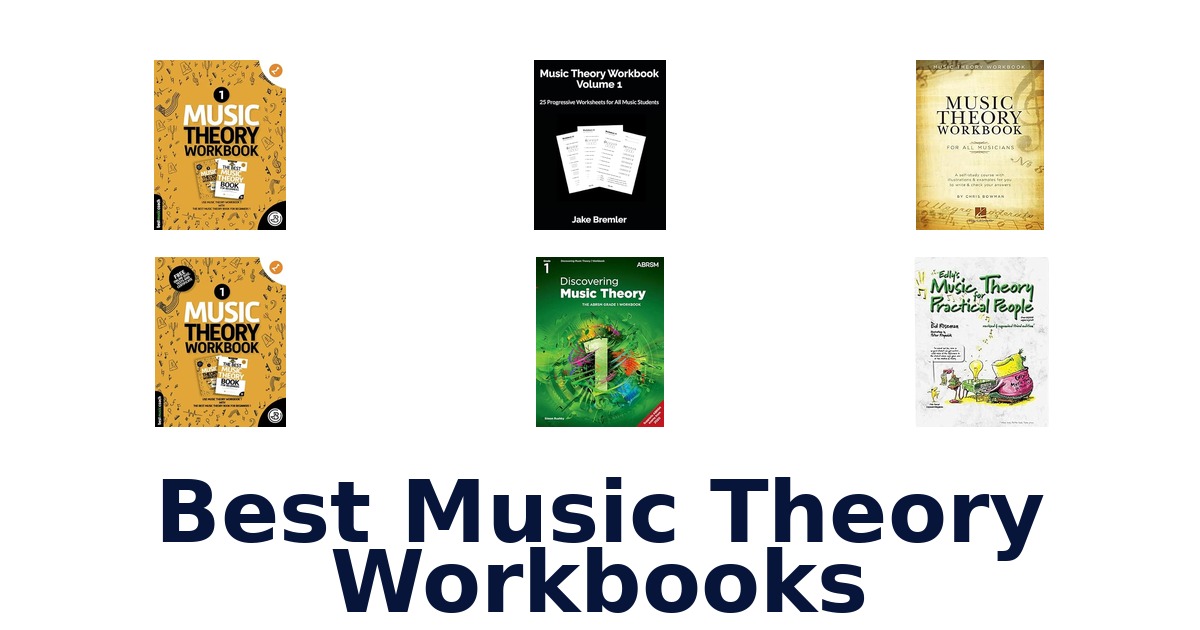
A strong music theory workbook gives learners a clear way to practise concepts, whether they are beginners studying alone, students following lessons, or teachers assigning work. The options here range from a self-study course with exercises and answer keys to progressive worksheets, a complete lessons-and-ear-training set, and a grade-specific workbook. Some titles emphasize practical application across instruments, while others name particular topics such as pitch, rhythm, vocabulary, sight-reading, and ear training.
The product details do not establish the difficulty of every exercise or whether materials suit a particular instrument, so use the stated level and structure as your first filter. This roundup compares the ten listed books by their described scope and workflow, not by unverified claims about teaching results or performance.
Music Theory Workbook – For All Musicians is the strongest overall fit because its description explicitly combines scales, chords, harmony, progressions, and sight-reading with exercises, answer keys, and practical applications in a self-study course. That makes its stated workflow unusually clear for independent learners seeking a broad workbook. For a lessons-and-ear-training format, consider Alfred’s Essentials of Music Theory, Complete; for progressive pitch, rhythm, and vocabulary worksheets, consider Music Theory Workbook Volume 1.
Our Top Picks
 Best Overall
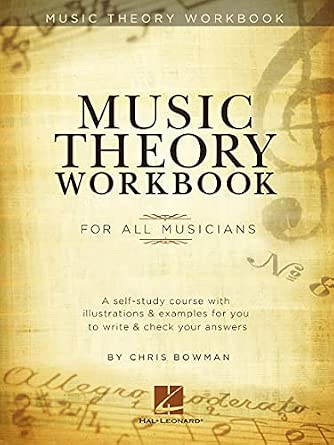
Hal Leonard Music Theory Workbook
Its self-study course covers scales, chords, harmony, progressions, and sight-reading, with exercises, answer keys, and practical applications.
View on Amazon Lessons and Ear Training
Alfred Essentials of Music Theory
The complete volume explicitly combines lessons, ear training, and workbook material; its title notes that CDs are not included.
View on Amazon Beginner to Intermediate
This second-edition workbook is identified for beginner-to-intermediate study, all instruments, and online audio.
View on Amazon- Broad Skill Range Edly’s Music Theory
- Progressive Worksheets Music Theory Workbook Volume 1
Compare These Music Theory Workbook Options
| # | Product | Buy |
|---|---|---|
| 1 | 1. Hal Leonard Music Theory WorkbookBest Overall | View on Amazon |
| 2 | 2. Alfred Essentials of Music TheoryLessons and Ear Training | View on Amazon |
| 3 | 3. Berklee Music Theory Book 1Beginner to Intermediate | View on Amazon |
| 4 |  4. Edly’s Music TheoryBroad Skill Range | View on Amazon |
| 5 |  5. Music Theory Workbook Volume 1Progressive Worksheets | View on Amazon |
| 6 |  6. Ultimate Music Theory Beginner ABeginner A lesson sequence | View on Amazon |
| 7 |  7. Ultimate Music Theory Beginner BBeginner B skills progression | View on Amazon |
| 8 |  8. Dan Spencer Best Music Theory WorkbookFast-start beginner workbook | View on Amazon |
| 9 |  9. Spencer and Slavkin Music Theory WorkbookBeginner theory starting point | View on Amazon |
| 10 |  10. ABRSM Grade 1 WorkbookABRSM Grade 1 theory study | View on Amazon |
Detailed Reviews: Best Music Theory Workbooks
#1 · Best Overall
1. Hal Leonard Music Theory Workbook
Best for: Broad self-study skills practice.
Why it ranks #1: Its self-study course covers scales, chords, harmony, progressions, and sight-reading, with exercises, answer keys, and practical applications.
Scales, chords, harmony, progressions, and sight-reading give this workbook a broad skills-based focus, while its self-study course format supports independent learning. Chris Bowman’s title also names exercises, answer keys, and practical applications, making it a particularly clear match for musicians who want structured work beyond a single theory topic.
The named coverage spans scales, chords, harmony, progressions, and sight-reading, so learners can work across several connected music skills in one workbook. Exercises and answer keys support self-study by pairing practice with a way to check responses; practical applications connect the course to music-making. The product is a paperback, and the supplied details do not specify audio or a particular instrument, so its clearest fit is a musician seeking print-based, multi-topic study.
- Covers scales, chords, harmony, and progressions
- Includes sight-reading
- Self-study course with exercises and answer keys
- Names practical applications
- The supplied details do not specify instrument-specific instruction or audio.
Skip it if you need a specified instrument focus or audio materials; this listing identifies a paperback self-study course instead.
Choose this for self-study across several core theory areas, especially if exercises, answer keys, and practical applications matter to your routine. Its supplied description does not identify instrument-specific content or audio, which may matter for your preferred learning format.
Listed on Amazon as: Music Theory Workbook – For All Musicians | Learn Scales, Chords, Harmony, Progressions, and Sight-Reading | Self-Study Course with Exercises, Answer Keys, and Practical Applications
View on Amazon#2 · Lessons and Ear Training
2. Alfred Essentials of Music Theory
Best for: Lessons plus ear-training approach.
Why it ranks #2: The complete volume explicitly combines lessons, ear training, and workbook material; its title notes that CDs are not included.
Lessons, ear training, and a workbook are brought together in Alfred’s complete Essentials of Music Theory, offering learners multiple ways to engage with theory. The title names a three-part learning approach, while its clear note that CDs are not included helps buyers understand an important boundary of the package.
The combination of lessons and workbook gives learners both explanatory material and a place to work through music theory, while ear training adds an aural dimension to the stated contents. That mix can suit students who want more than written exercises alone. However, the product listing explicitly says the CDs are not included, so buyers should not count on disc-based audio as part of this purchase; the supplied details do not identify other audio formats.
- Combines lessons with a workbook
- Includes ear training
- Presented as a complete music theory title
- Names the included components clearly
- CDs are not included.
Skip it if you require CDs as part of your learning materials; the listing explicitly states that they are not included.
This is a fitting option for learners seeking lessons, written workbook material, and ear training together. It is not the right choice if your plan depends on included CDs, since the product title expressly excludes them.
Listed on Amazon as: Alfred's Essentials of Music Theory, Complete (Lessons Ear Training Workbook)————– (CD's Not Included)
View on Amazon#3 · Beginner to Intermediate
3. Berklee Music Theory Book 1
Best for: Berklee method for all instruments.
Why it ranks #3: This second-edition workbook is identified for beginner-to-intermediate study, all instruments, and online audio.
Berklee Methods branding and online audio make this beginner-to-intermediate theory guide distinctive for learners who want a named method with listening support. Paul Schmeling’s Book 1 is presented as a music theory workbook for all instruments, giving players a broadly applicable route into study.
The beginner-to-intermediate level helps learners judge whether the material matches their current stage, while Book 1 identifies its place in the Berklee Music Theory series. Online audio adds a listening resource alongside the paperback workbook, which can complement written study. Its all-instruments description makes the stated audience broad rather than instrument-specific. The supplied facts do not name individual topics, exercise types, or the contents of the audio, so those should not be assumed.
- Berklee Methods music theory guide
- Identified as Book 1
- Online audio included in the title
- Stated beginner-to-intermediate level for all instruments
- The supplied details do not identify specific topics or the online audio content.
Skip it if you need a detailed topic list or know exactly what the online audio covers before selecting a workbook.
This fits beginner-to-intermediate learners looking for a Berklee-branded theory workbook with online audio and an all-instruments audience. The supplied description leaves the particular topics and audio contents unspecified, so consider that boundary when planning study.
Listed on Amazon as: Berklee Music Theory Book 1 2nd Edition | Berklee Methods Music Theory Guide with Online Audio | Beginner to Intermediate Music Theory Workbook for All Instruments | Sheet Music Study Book
View on Amazon#4 · Broad Skill Range
4. Edly’s Music Theory
Best for: Illustrated practical theory guide.
Why it ranks #4: The illustrated book includes exercises and is described for beginners through advanced players, all instruments, and singers.
Illustrations and exercises give Edly’s Music Theory for Practical People a visual, hands-on identity, while its stated range extends from beginners to advanced players. The third edition is described for all instruments and singers, making it a broadly aimed guide rather than a single-instrument workbook.
The illustrated instruction format can support learners who prefer visual explanations, and the included exercises provide a way to engage actively with the material. Its stated beginner-to-advanced range gives the book a wider intended audience than a level-specific workbook, while the all-instruments-and-singers description broadens its stated applicability. The supplied facts do not identify particular theory topics or the structure of the exercises, so buyers should rely on the listed format and audience rather than assume specific coverage.
- Illustrated music instruction
- Includes exercises
- States a beginner-to-advanced audience
- For all instruments and singers
- The supplied details do not specify the topics or progression of its exercises.
Skip it if you need a clearly stated grade level or a detailed topic sequence to organize your study.
This suits singers and instrumentalists seeking illustrated, exercise-based theory instruction across a broad skill range. Its listing does not provide a specific grade level or topic sequence, so learners needing a defined syllabus should account for that limit.
View on Amazon#5 · Progressive Worksheets
5. Music Theory Workbook Volume 1
Best for: Progressive classroom worksheets.
Why it ranks #5: Its 25 progressive worksheets focus on pitch, rhythm, and vocabulary, with stated classroom and independent-study uses.
Twenty-five progressive worksheets give this volume a defined, incremental format for music students. Jake Bremler’s materials focus on pitch, rhythm, and vocabulary, making the workbook relevant across instruments and easy for teachers to place into homework, independent study, or a regular course curriculum.
The 25 progressive worksheets provide a sequenced body of practice, while the stated focus on pitch, rhythm, and vocabulary gives students three clear areas to revisit. Teachers can assign the sheets for independent study, weekly homework, or course use, according to the supplied description. Because the workbook is presented as Volume 1 and targets all music students, it offers a broad starting point; the listing does not specify an instrument-specific pathway or answer key.
- Contains 25 progressive worksheets
- Focuses on pitch, rhythm, and vocabulary
- Can be used for homework or independent study
- Applicable to players of all instruments
- The supplied details do not specify answer keys or instrument-specific instruction.
Skip it if you need a listed answer key or an instrument-specific course rather than broad worksheets for music students.
Teachers needing assignable, progressive practice and students reviewing pitch, rhythm, and vocabulary are the clearest audience. Consider the stated general-student scope if you require a workbook tailored to one instrument or with answer keys.
Listed on Amazon as: Music Theory Workbook Volume 1: 25 Progressive Worksheets for All Music Students
View on Amazon#6
6. Ultimate Music Theory Beginner A
Best for: Beginner A lesson sequence.
Why it ranks #6: The Beginner A workbook provides 12 lessons, reviews, sight-reading, and ear training for learners starting a structured sequence.
Twelve fun and engaging lessons define the Beginner A workbook’s structure, with reviews, sight-reading, and ear training named as parts of the program. The Ultimate Music Theory title gives new learners a level-specific starting point and a mix of written and listening-related study areas.
The 12-lesson structure gives learners a defined sequence to follow, while reviews provide named opportunities to revisit material. Sight-reading and ear training add distinct skills alongside the workbook’s theory focus, making the stated program broader than lessons alone. Its Beginner A label helps learners identify the intended entry level. The supplied information does not specify answer keys, audio format, or individual lesson topics, so do not assume those components are included.
- Includes 12 lessons
- Includes reviews
- Names sight-reading and ear training
- Clearly labeled Beginner A
- The supplied details do not specify answer keys or an audio format.
Skip it if you need confirmed answer keys, an audio format, or a level beyond Beginner A.
This fits a new student seeking a structured Beginner A sequence with reviews, sight-reading, and ear training. Its stated level is specific, and the listing does not confirm answer keys or an audio format.
View on Amazon#7
7. Ultimate Music Theory Beginner B
Best for: Beginner B skills progression.
Why it ranks #7: The Beginner B workbook also includes 12 lessons, reviews, sight-reading, and ear training, making it a follow-on level to compare.
The Beginner B label distinguishes this workbook as a defined level within the Ultimate Music Theory Beginner Workbooks, with 12 lessons forming its stated structure. Reviews, sight-reading, and ear training broaden the named learning activities, making it a clear option for learners at this labeled stage.
Twelve lessons provide a sequence for working through the Beginner B material, while the stated reviews offer a way to revisit the course content. Sight-reading and ear training add named skill areas to the lessons, giving the workbook a wider scope than theory study alone. The listing does not identify lesson topics, answer keys, or an audio format, so buyers should select it for its stated level and activities rather than assume those specifics.
- Includes 12 lessons
- Includes reviews
- Names sight-reading and ear training
- Clearly labeled Beginner B
- The supplied details do not specify answer keys or an audio format.
Skip it if you need a beginner entry level or confirmed answer keys and audio materials before choosing.
Learners whose current stage matches Beginner B can use its 12-lesson format, reviews, sight-reading, and ear training as a structured option. Check the level fit, since the supplied listing does not detail lesson topics or supporting formats.
View on Amazon#8
8. Dan Spencer Best Music Theory Workbook
Best for: Fast-start beginner workbook.
Why it ranks #8: This paperback is explicitly presented as a fast, easy introduction to music theory for beginners, but lists fewer specific components.
Its beginner-focused promise of a fast and easy route into music theory gives newcomers a clear starting point for tackling foundational ideas. The first workbook in Dan Spencer’s series is aimed at readers who want an approachable introduction, rather than a title presented for advanced study or a specific examination.
The title identifies this as Workbook 1 and explicitly frames it for beginners, which helps a new learner choose a starting-level resource rather than a later volume. Its “fast and easy” approach signals a focus on accessible entry into music theory, useful for someone beginning independent study. The supplied information does not specify particular topics, exercises, answer keys, or audio, so buyers should select it for its stated beginner orientation, not for unlisted materials or coverage.
- Explicitly aimed at beginners
- Identified as the first workbook
- Presents music theory as approachable
- Paperback format
- The supplied details do not identify specific topics or included learning aids.
Skip it if you need named topics, answer keys, or audio confirmed in the supplied details before choosing a workbook.
This suits a newcomer seeking Dan Spencer’s explicitly beginner-oriented first workbook and a straightforward entry into music theory. It is a less certain fit when your choice depends on a detailed topic list or confirmed exercises and supplementary materials.
Listed on Amazon as: The Best Music Theory Workbook 1: The Fast and Easy Way to "Get" Music Theory For Beginners (The Best Music Theory Books for Beginners)
View on Amazon#9
9. Spencer and Slavkin Music Theory Workbook
Best for: Beginner theory starting point.
Why it ranks #9: This beginner-focused paperback shares the fast-and-easy introduction title and adds Eli Slavkin as a listed author.
A fast-and-easy beginner approach is the defining promise of Dan Spencer and Eli Slavkin’s first music theory workbook. Its title makes the intended starting level explicit, giving new learners a direct entry point without suggesting that the book is a graded exam workbook or an advanced reference.
Calling the book Workbook 1 identifies it as an initial volume, while the beginner wording signals that it is aimed at learners just starting music theory. The stated fast-and-easy approach can appeal to readers who want an accessible introduction rather than a title framed around a named grade. The supplied facts do not list lesson topics, exercises, answer keys, or audio, so the strongest basis for choosing it is its clearly stated beginner focus.
- Explicit beginner focus
- Identified as Workbook 1
- Presents an accessible approach to theory
- Paperback format
- The supplied details do not specify particular topics or supplementary learning materials.
Skip it if you need confirmed topics, exercises, answer keys, or audio rather than a workbook described primarily for beginners.
New learners looking for an explicitly beginner-oriented first volume are the best match. Those choosing by exact topic coverage or required supplementary materials should note that the supplied description does not enumerate those details.
Listed on Amazon as: The Best Music Theory Workbook 1: The Fast and Easy Way to "Get" Music Theory For Beginners
View on Amazon#10
10. ABRSM Grade 1 Workbook
Best for: ABRSM Grade 1 theory study.
Why it ranks #10: This workbook is specifically tied to ABRSM Grade 1, a useful fit for that defined path but narrower than general music theory study.
Its explicit ABRSM Grade 1 designation gives this workbook a clearly bounded examination-level focus, helping learners choose material aligned with that stage. Published as sheet music under the ABRSM theory-workbooks label, it is most directly relevant to students seeking structured Grade 1 theory study.
The Grade 1 label makes the intended level easy to identify, helping learners avoid choosing material whose stated stage does not match their current goal. Its place in the ABRSM theory workbooks series further anchors it to that examination-oriented pathway. The listing describes the format as sheet music, but does not specify particular lesson topics, exercises, answer keys, or audio. Buyers can assess its stated level and series fit without assuming additional components.
- Clearly identified as Grade 1
- Part of the ABRSM theory workbooks series
- Sheet music format
- Focused level makes it easy to match to a study goal
- The supplied details do not specify lesson topics, exercises, or answer keys.
Skip it if you are studying beyond Grade 1 or need confirmed exercises, answer keys, or audio in the listing.
ABRSM Grade 1 students seeking a workbook aligned with that named level are the natural audience. Its stated scope is specific, so choose another level if your current theory goal extends beyond Grade 1.
Listed on Amazon as: Discovering Music Theory, The ABRSM Grade 1 Workbook (Theory workbooks (ABRSM))
View on AmazonAvoid a mismatch between workbook and course path
A workbook can be a poor fit when its sequence does not match the learner’s class, exam route, or current level. The clearest path-specific option here is ABRSM Grade 1 Workbook, while the two Ultimate Music Theory titles distinguish Beginner A and Beginner B. Those labels offer orientation, but the supplied details do not establish that the books align with another school’s sequence or an exam syllabus beyond the named ABRSM title.
A general title such as Hal Leonard Music Theory Workbook or Edly’s Music Theory may be easier to consider across different study plans, but their descriptions do not confirm exact lesson order or prerequisite knowledge. Before choosing, compare a workbook’s stated level and topic sequence with the learner’s current materials.
If the course sequence matters, do not assume two books marked beginner are interchangeable.
Check the audio and answer-key workflow before buying
Audio and answer materials can change how independently a learner can use a workbook, so check exactly what the listing says is included. Hal Leonard Music Theory Workbook explicitly lists answer keys, while Berklee Music Theory Book 1 names online audio. Alfred Essentials of Music Theory identifies lessons and ear training, but its title specifically says CDs are not included; do not treat the mention of ear training as proof that audio discs come with it.
Ultimate Music Theory Beginner A and Beginner B list sight-reading and ear training, but the supplied details do not specify an audio format or answer-key inclusion. These distinctions matter when a student expects to practise without a teacher or needs listening examples.
Confirm the current edition’s access method and included materials before relying on an audio feature.
How to Choose a Music Theory Workbook
Study structure and level
Look for a stated level or sequence that matches how the learner plans to study. The options range from beginner-focused titles such as Dan Spencer Best Music Theory Workbook and the two Ultimate Music Theory beginner books to Berklee Music Theory Book 1, described as beginner to intermediate, and Edly’s Music Theory, described for beginners through advanced players. ABRSM Grade 1 Workbook is tied to a specific grade, while Hal Leonard Music Theory Workbook describes itself as a self-study course.
A learner starting alone may prefer a book that explicitly names beginner study or self-study; someone following a defined grade route should prioritize the grade label. Broad level claims do not reveal prerequisites, so check the contents where available.
Practice components
Choose based on the kinds of practice the learner needs, rather than assuming every workbook includes the same materials. Hal Leonard Music Theory Workbook names exercises, answer keys, practical applications, and topics including sight-reading. Alfred Essentials of Music Theory combines lessons, ear training, and workbook material, with CDs not included.
Berklee Music Theory Book 1 lists online audio, while the Ultimate Music Theory Beginner A and Beginner B titles each list reviews, sight-reading, and ear training. The Dan Spencer titles name a beginner introduction but do not list those components in the supplied details.
Independent learners may prioritize stated answer keys; learners practising listening should verify the audio or ear-training workflow before choosing.
Topic scope and intended use
Match the stated subject coverage to the learner’s goal. Hal Leonard Music Theory Workbook lists scales, chords, harmony, progressions, and sight-reading; Music Theory Workbook Volume 1 focuses on pitch, rhythm, and vocabulary across 25 progressive worksheets. Edly’s Music Theory is presented for all instruments and singers, and Berklee Music Theory Book 1 is identified for all instruments.
Music Theory Workbook Volume 1 also states that its worksheets can be used for independent study, homework, or classroom curriculum. A learner seeking broad topics may favor Hal Leonard’s named coverage, while a teacher wanting assignable worksheet units may prefer the progressive worksheet format.
The supplied information does not specify instrument-specific exercises, so verify that detail if it is essential.
Which Music Theory Workbook Should You Choose?
For broad self-study with named topics, exercises, and answer keys, choose Hal Leonard Music Theory Workbook. If lessons and ear training are central, Alfred Essentials of Music Theory combines those elements, but note that CDs are not included. Learners wanting beginner-to-intermediate study with online audio can consider Berklee Music Theory Book 1.
For a teacher or student who prefers short, progressive worksheets on pitch, rhythm, and vocabulary, Music Theory Workbook Volume 1 states that classroom and independent-study uses are supported. Choose ABRSM Grade 1 Workbook for that specific grade path, or Ultimate Music Theory Beginner A and Ultimate Music Theory Beginner B for their labeled sequence.
Edly’s Music Theory has the broadest stated learner range, while Dan Spencer Best Music Theory Workbook is a straightforward beginner-titled option.
Frequently Asked Questions
Do I need to read music before starting a music theory workbook?
Not necessarily. Some titles are explicitly aimed at beginners, while others include sight-reading or a broader mix of topics. Check the book’s stated level and contents, then choose one that matches what you already know.
If reading notation is new, a beginner-labeled workbook may be a more comfortable starting point.
Should I choose a general workbook or one tied to a grade or course?
Choose a general workbook for flexible study across topics, or a grade- or course-linked book when you want a defined path. The listed options include broad self-study, a Berklee beginner-to-intermediate book, and an ABRSM Grade 1 workbook. Match the format to your learning goal rather than assuming one suits everyone.
How can I tell whether a workbook will suit my instrument or learning style?
Look for explicit instrument coverage, lesson structure, and practice formats in the title or description. Some options are labeled for all instruments, while others emphasize worksheets, ear training, sight-reading, or self-study. If you prefer guided lessons, prioritize that format; if you learn by doing, look for exercises and review activities.
Are answer keys useful when studying on my own?
Yes, answer keys can help independent learners check completed exercises and identify where they need more practice. The all-musicians self-study workbook explicitly includes answer keys, exercises, and practical applications. If a workbook’s description does not mention answer keys, do not assume they are included; check its details before choosing.
What should I check about audio or other included materials?
Confirm whether the materials you want are included and how they are accessed. Berklee Music Theory Book 1 is described as having online audio, while Alfred’s Essentials of Music Theory notes that CDs are not included. If ear training or audio practice matters to you, compare those details before deciding.
Final Words
For a broad independent-study path, the all-musicians workbook is the clearest overall fit in this selection: its description names several core topics and includes exercises, answer keys, and practical applications. Choose Alfred’s for lessons and ear training, Berklee for beginner-to-intermediate study with online audio, or the ABRSM workbook for Grade For worksheet-led or sequenced study, consider Volume 1 or the Beginner A and B books; let your level and preferred format decide.