
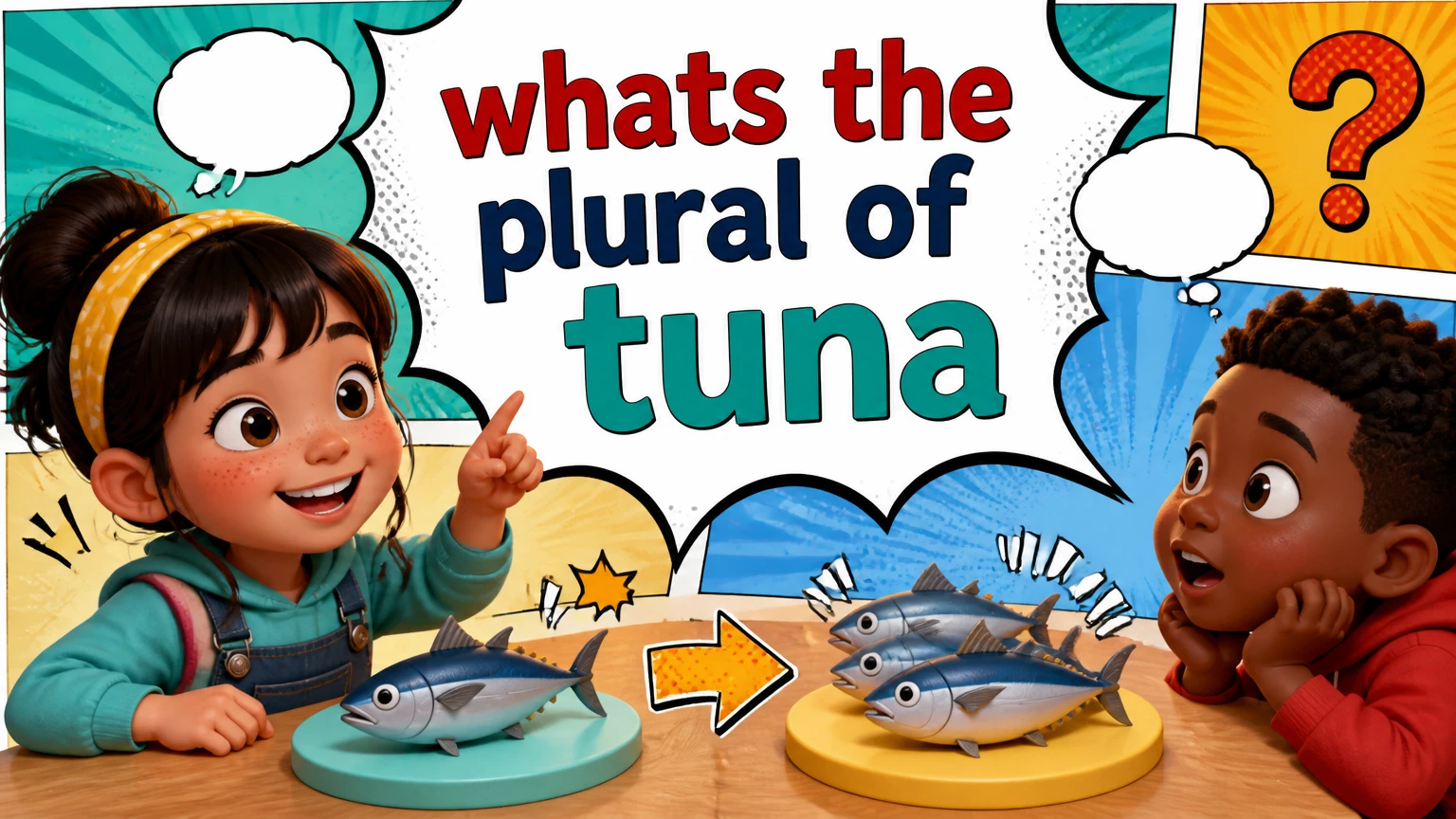
The plural of tuna can be tuna or tunas. Tuna is the usual choice when talking about several individual fish in everyday English. Tunas is also an accepted plural, including when discussing different kinds.
As a food name, tuna is commonly uncountable: “We bought some tuna.” In that use, it describes the food rather than separate fish.
Three ways to use tuna
| Meaning | Example | Grammar |
|---|---|---|
| One fish | A tuna swam below the boat. | Singular count noun |
| Several fish | Three tuna were nearby. | Plural count noun |
| Food | There is some tuna in the fridge. | Uncountable noun |
“Several tunas” is possible, but do not assume that every plural reference requires the -s ending. For general writing, “several tuna” is straightforward.
Let the surrounding words show number
Because tuna may look identical in singular and plural use, determiners and verbs help the reader:
- This tuna is unusually large.
- These tuna are moving toward deeper water.
- The tuna was fresh when we bought it.
The last sentence could refer to food or one fish. Context supplies the meaning.
Counting portions instead of fish
If you mean separate amounts of food, count the container or serving: “two cans of tuna,” “three tuna sandwiches,” or “four portions of tuna.”
In “tuna sandwiches,” tuna modifies sandwiches and does not need a plural ending. The same principle applies to “tuna salad recipes.”
Common mistakes
Avoid treating uncountable food as an ordinary plural in a sentence such as “We need three tuna for the sandwiches,” unless you actually mean three whole fish. “Three cans of tuna” is clearer when the intended unit is a can.
Do not use an apostrophe to make a plural. Tuna’s is possessive, as in “the tuna’s tail.” For several fish, use tuna or tunas without an apostrophe.
Practice
Choose the clearer form: “The recipe needs two ___ of tuna.” “Several tuna ___ swimming nearby.”
Answers: cans, portions, or another suitable unit; are.
Several fish versus several kinds
“Five tuna were swimming together” counts individual fish. “The exhibit describes several tunas” may draw attention to different kinds, though tunas is not restricted to scientific classification in every dictionary or usage.
When the distinction matters, make it explicit: “five individual tuna” or “three species of tuna.” Clear wording is better than assuming every reader interprets an -s ending in exactly the same way.
Choose the noun that matches the unit
A shopping list saying “two tuna” may suggest two whole fish. If the intended items are packaged food, write “two cans of tuna.” A café order might use a shortened expression such as “two tuna sandwiches,” but the head noun sandwiches supplies the count.
Editing exercise
Correct “These tuna is fresh,” “We bought three tuna’s,” and “The recipe needs two tuna” when the intended purchase is two cans.
Answers: “These tuna are fresh”; “We bought three tuna” or “three tunas,” without a plural apostrophe; “The recipe needs two cans of tuna.” Each correction addresses a different issue: agreement, plural punctuation, and the intended unit.
Frequently asked questions
Is tunas incorrect?
No. Dictionaries recognise it. Tuna is simply a common and convenient plural for ordinary references to the fish.
Is tuna always uncountable?
No. It is countable when referring to individual fish and commonly uncountable when referring to food. The intended meaning determines the grammar.