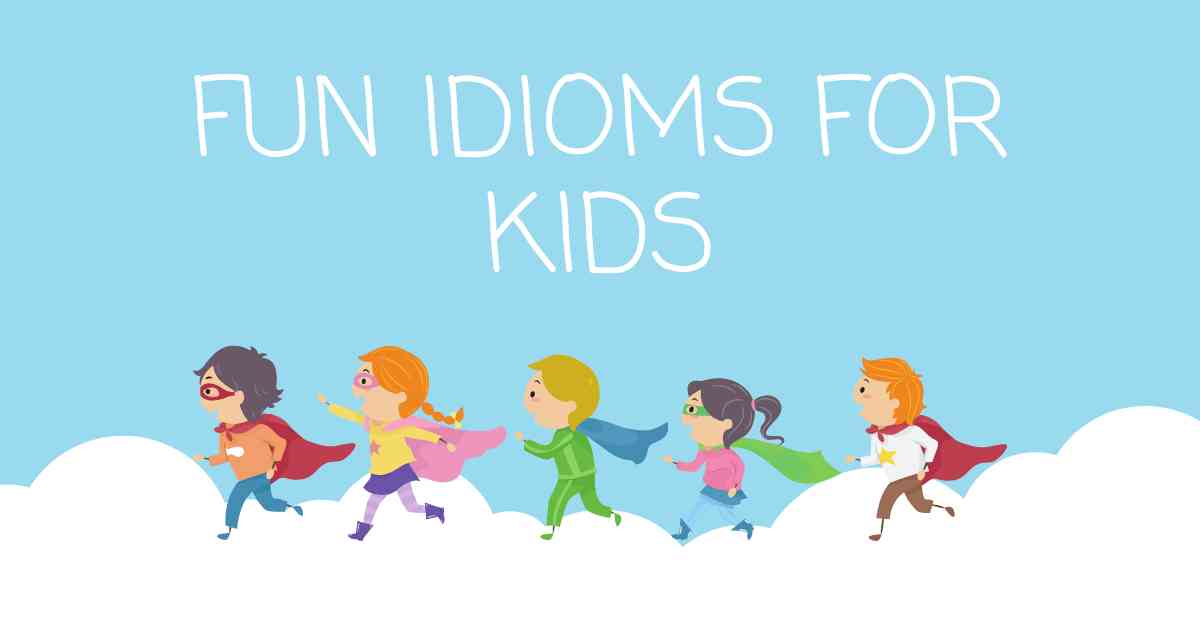
Idioms are unique expressions where the meaning of the phrase cannot be understood simply by looking at the individual words, making them a fascinating part of the English language. These colorful phrases allow children to express complex feelings or situations through vivid imagery, such as being all ears, feeling under the weather, piece of cake, break a leg, or crying over spilled milk. By learning these figurative expressions, young learners can move beyond literal translations and begin to appreciate the nuance, humor, and cultural richness of English. Understanding idioms is a vital step in developing social communication skills and reading comprehension, as these phrases appear frequently in storybooks, cartoons, and everyday conversations with teachers and peers.
Table of Contents
- What is an Idiom? Definition and Function
- The Structural Breakdown of Idiomatic Phrases
- Animal-Themed Idioms
- Food and Kitchen Idioms
- Body Part Idioms
- Nature and Weather Idioms
- Extensive Example Tables
- Usage Rules and Contextual Application
- Common Mistakes and Literal Pitfalls
- Practice Exercises for Students
- Advanced Idiomatic Concepts
- Frequently Asked Questions (FAQ)
- Conclusion and Final Learning Tips
What is an Idiom? Definition and Function
An idiom is a group of words established by usage as having a meaning not deducible from those of the individual words. In simpler terms, it is a phrase that says one thing but means another. For example, if someone says it is “raining cats and dogs,” they do not mean that animals are falling from the sky; rather, they are using a traditional expression to describe a very heavy downpour.
The function of idioms in the English language is primarily to add color, emphasis, and character to communication. They act as cultural shorthand, allowing speakers to convey a specific mood or situation quickly. For kids, learning idioms is like unlocking a secret code that helps them understand the creative side of language. It transforms a boring sentence into something memorable and descriptive.
Idioms also serve a cognitive function. They require the brain to move from literal processing (what the words say) to figurative processing (what the words represent). This mental flexibility is essential for high-level reading comprehension and creative writing. When a child learns that “holding your horses” means to be patient, they are learning to interpret context and tone rather than just vocabulary.
Furthermore, idioms are deeply rooted in history and culture. Many phrases we use today come from ancient seafaring, farming, or even Shakespearean plays. By studying these phrases, students gain a historical perspective on how language evolves over time. It shows them that language is a living, breathing entity that changes based on the experiences of the people who speak it.
The Structural Breakdown of Idiomatic Phrases
Idioms generally follow specific structural patterns, though they are often grammatically “frozen.” This means that you cannot usually change the tense or the words within the idiom without losing its specific meaning. For instance, you can say “he kicked the bucket,” but you rarely hear “the bucket was kicked by him” in a figurative sense. The structure is part of the identity of the phrase.
Most idioms consist of a verb and an object, or a prepositional phrase. Understanding these structures helps students identify where the idiom begins and ends in a sentence. For example, in the phrase “barking up the wrong tree,” the verb “barking” is followed by a prepositional phrase that completes the thought. This structure helps create a mental image that reinforces the figurative meaning.
Another common structure is the “pair” idiom, where two words are joined by “and.” Phrases like “spick and span” or “odds and ends” function as a single unit of meaning. Students should be taught to recognize these as unbreakable blocks of language. If you change “spick and span” to “span and spick,” the meaning might be clear, but it will sound incorrect to a native speaker.
Finally, some idioms are comparative, often using “as” or “like.” These are known as similes, but many have become so common they function as idioms. Examples include “as cool as a cucumber” or “like a fish out of water.” These structures are particularly helpful for kids because the comparison provides a hint about the meaning, making them easier to memorize and apply in their own writing.
Animal-Themed Idioms
Animals have always been a primary source of inspiration for idioms because their behaviors are easy to observe and relate to human actions. Kids often find these the easiest to remember because they can visualize the animal involved. Using animal idioms helps children describe personality traits or specific behaviors in a humorous and relatable way.
For instance, someone who is very brave might be called “lion-hearted,” while someone who is nervous might have “butterflies in their stomach.” These metaphors use the known characteristics of animals—the strength of a lion or the fluttery movement of a butterfly—to explain human emotions. It bridges the gap between the physical world and the internal world of feelings.
In the classroom, animal idioms can be used to describe social situations. If a student is being very quiet, a teacher might ask, “Cat got your tongue?” This lightens the mood while encouraging the student to participate. Similarly, if a group of children is being very loud, a parent might say they are “acting like a pack of wolves,” which creates a clear image of the chaotic behavior being corrected.
Food and Kitchen Idioms
Food is another universal topic that provides a wealth of idiomatic expressions. Since everyone eats and experiences different tastes, food idioms are incredibly relatable. They often describe the quality of an experience, the difficulty of a task, or the value of a person. These are frequently used in casual conversation and are essential for social fluency.
Consider the phrase “a piece of cake.” It is one of the first idioms children learn because it perfectly describes something very easy. On the other end of the spectrum, something “not my cup of tea” describes a personal preference or a lack of interest. These phrases allow children to express opinions politely and creatively without using the same basic adjectives repeatedly.
Kitchen-related idioms also deal with social dynamics. “Too many cooks spoil the broth” is a classic example used to explain why a group project might be failing because everyone is trying to lead at once. By using these phrases, kids learn to identify complex social problems through simple, everyday imagery that they can easily grasp and remember.
Body Part Idioms
Idioms involving parts of the body are among the most common in the English language. Because we are always inhabitating our bodies, using them as reference points for idioms feels natural. These phrases often describe physical sensations, intellectual states, or social interactions. They are highly expressive and help kids articulate how they are interacting with the world.
For example, “keeping an eye out” for something involves more than just looking; it implies a state of vigilance. “Break a leg” is a famous idiom from the theater world used to wish someone good luck. While it sounds painful literally, its figurative meaning is purely positive. Teaching these helps kids understand that language isn’t always what it looks like on the surface.
Body idioms also help with emotional intelligence. When a child is told to “get something off their chest,” they learn that talking about a problem can provide emotional relief. Similarly, learning to “keep a stiff upper lip” introduces the concept of stoicism and emotional control. These phrases provide a vocabulary for experiences that might otherwise be difficult for a child to name.
Nature and Weather Idioms
Nature and weather idioms use the environment to describe moods and life events. The unpredictability of the weather makes it a perfect metaphor for the ups and downs of life. For kids, these idioms are a great way to introduce the idea of personification and the relationship between nature and human emotion.
“Under the weather” is perhaps the most common idiom in this category, used to describe feeling slightly ill. Another example is “every cloud has a silver lining,” which teaches children about optimism and finding the good in a bad situation. These idioms carry important life lessons and moral values, making them more than just vocabulary words.
Storm-related idioms like “stealing someone’s thunder” or “a bolt from the blue” describe sudden social shifts or surprises. These are useful in storytelling and creative writing, as they help students create dramatic tension. By mastering nature idioms, students can make their descriptions of events much more vivid and engaging for their readers.
Extensive Example Tables
To help students and teachers navigate the vast world of idioms, we have organized several tables categorized by theme. These tables provide the idiom, its literal meaning (for context), and its actual figurative meaning. This structured approach helps in memorization and clarifies the “hidden” meaning behind the phrases.
The following table focuses on Animal Idioms. These are specifically chosen for their frequency in children’s literature and everyday speech. Pay attention to how the animal’s trait influences the meaning of the phrase.
| Idiom | Literal Imagery | Figurative Meaning |
|---|---|---|
| Busy as a bee | A bee moving from flower to flower | Very active and hardworking |
| Let the cat out of the bag | Releasing a cat from a sack | To reveal a secret accidentally |
| Hold your horses | Pulling back on a horse’s reins | To wait or slow down; be patient |
| Cold turkey | Eating cold leftover poultry | Stopping a habit immediately |
| Eager beaver | A beaver building a dam quickly | A person who is very excited to work |
| Fish out of water | A fish on dry land | Feeling uncomfortable in a new situation |
| Ants in your pants | Insects crawling in your clothes | Unable to sit still; restless |
| Black sheep | A sheep with different colored wool | A person who is different from the group |
| The lion’s share | A lion taking most of the prey | The largest part of something |
| Smell a rat | Sensing a rodent nearby | To suspect that something is wrong |
| Straight from the horse’s mouth | Hearing a horse speak | From the highest or original authority |
| Kill two birds with one stone | Hunting two birds with one throw | Accomplish two things with one action |
| Dog tired | A dog after a long run | Extremely exhausted |
| Elephant in the room | A giant animal standing in a house | An obvious problem people are avoiding |
| Early bird | A bird catching a worm at dawn | Someone who wakes up or arrives early |
| Copycat | A cat mimicking another | Someone who imitates someone else |
| Wolf in sheep’s clothing | A predator wearing a disguise | A dangerous person pretending to be nice |
| Bird-brained | Having a tiny bird brain | Acting silly or not very smart |
| Clam up | A clam closing its shell tight | To stop talking suddenly; stay quiet |
| Night owl | An owl awake in the dark | Someone who likes to stay up late |
| Bull in a china shop | A large animal in a fragile store | A person who is clumsy or careless |
| Wild goose chase | Chasing a bird that is hard to catch | A useless or hopeless search |
| Monkey business | Monkeys playing tricks | Silly or dishonest behavior |
| Pig out | A pig eating a lot of food | To eat a very large amount of food |
| Paper tiger | A tiger made of paper | Something that seems scary but isn’t |
Our next table focuses on Food and Kitchen Idioms. These are excellent for describing personality types and levels of difficulty. Notice how many of these refer to the sweetness or preparation of food.
| Idiom | Literal Imagery | Figurative Meaning |
|---|---|---|
| Piece of cake | Eating a slice of dessert | Something very easy to do |
| In a pickle | Being stuck inside a jar of pickles | In a difficult or messy situation |
| Smart cookie | A biscuit with a brain | A very intelligent person |
| Cool as a cucumber | A vegetable that stays cold | Very calm and relaxed |
| Couch potato | A vegetable sitting on a sofa | A lazy person who watches too much TV |
| Apple of my eye | The center of someone’s eye | Someone who is cherished or loved |
| Spill the beans | Knocking over a bowl of beans | To tell a secret |
| Big cheese | A large block of cheddar | An important or powerful person |
| Bread and butter | Basic food staples | Someone’s main source of income |
| Bring home the bacon | Carrying meat back to the house | To earn money for the family |
| Cry over spilled milk | Being sad about a small mess | To worry about something that already happened |
| Full of beans | Having a stomach full of beans | Having a lot of energy and excitement |
| Go bananas | Acting like a monkey with fruit | To become very excited or crazy |
| Hot potato | A potato too hot to hold | A controversial or difficult issue |
| In a nutshell | Fitting something inside a small shell | Summarized in a few words |
| Nutty as a fruitcake | A cake filled with many nuts | Very strange or crazy |
| One smart cookie | A clever snack | A person who makes good decisions |
| Piece of the pie | A slice of a larger dessert | A share of money or profits |
| Salt of the earth | Basic, essential mineral | A very good and honest person |
| Take it with a grain of salt | Adding flavor to a story | Don’t believe something completely |
| The icing on the cake | Adding frosting to a finished cake | An extra good thing added to something good |
| Top banana | The best fruit in the bunch | The leader or most important person |
| Walk on eggshells | Stepping carefully on thin shells | To be very careful not to offend someone |
| Egg on your face | Having breakfast stuck to your skin | To look foolish or embarrassed |
| Bad egg | A rotten egg | A person who is dishonest or mean |
The third table explores Body Part Idioms. These are vital for emotional expression and describing physical actions in a metaphorical way. They are frequently used in conversation to describe how we interact with others.
| Idiom | Literal Imagery | Figurative Meaning |
|---|---|---|
| All ears | Being made entirely of ears | Listening very carefully |
| Break a leg | Snapping a bone | Good luck (usually for a performance) |
| Cold feet | Ice-cold toes | Feeling nervous about doing something |
| Cost an arm and a leg | Trading limbs for an item | Very expensive |
| Give a hand | Handing someone your physical hand | To help someone |
| Head in the clouds | Head floating high in the sky | Daydreaming; not paying attention |
| Keep your chin up | Lifting your face upward | Stay positive during a hard time |
| Let your hair down | Untying a ponytail | To relax and have fun |
| Off the top of my head | Floating above the skull | Without thinking or researching first |
| On the tip of my tongue | A word sitting on the end of the tongue | Almost remembered but not quite |
| Pull someone’s leg | Grabbing a person’s ankle | To joke with or tease someone |
| Put your foot in your mouth | Sticking a foot inside the mouth | Saying something embarrassing or rude |
| See eye to eye | Looking directly at each other | To agree with someone |
| Sweet tooth | A tooth made of sugar | A love for sugary foods |
| Wash your hands of | Cleaning dirt off your palms | To stop being involved with something |
| Zip your lips | Closing a zipper on the mouth | To stop talking or keep a secret |
| Face the music | Looking at a band | To accept the consequences of actions |
| Heart of gold | A heart made of precious metal | A very kind and generous nature |
| Keep an eye on | Placing an eye on an object | To watch something carefully |
| Know by heart | Storing info in the chest | To have something memorized perfectly |
| My lips are sealed | Lips stuck together with wax | I promise not to tell anyone |
| Neck and neck | Heads side by side in a race | In a very close competition |
| Over my dead body | Lying on the ground | I will never allow this to happen |
| Play it by ear | Listening to music to learn it | To decide what to do as you go |
| Rule of thumb | Measuring with a finger | A general or practical rule |
Usage Rules and Contextual Application
Using idioms correctly requires an understanding of context and tone. Because idioms are informal, they are best suited for casual conversations, stories, and friendly letters. In formal academic writing, such as a science report or a history essay, idioms should generally be avoided because they can make the writing seem less professional or precise.
One of the most important rules for using idioms is “lexical integrity.” This means you must use the exact words of the idiom. You cannot change “a piece of cake” to “a slice of cake” and expect it to have the same meaning. The phrase is a set unit. If you alter the words, the reader will likely interpret the sentence literally, which can lead to confusion.
Tense changes are sometimes permissible, but they must be handled carefully. For instance, you can say “He spilled the beans” (past tense) or “He is spilling the beans” (present continuous). However, the core nouns and adjectives usually remain the same. “He spilled the peas” would not be recognized as an idiom. Students should practice using idioms in different tenses to see which ones feel natural.
Another rule involves the audience. Idioms are culture-specific. An idiom that makes sense in the United States might not make sense to a speaker from Australia or the UK. When communicating with people from different backgrounds, it is often better to use literal language to ensure clarity. Kids should be taught that idioms are a “special language” used with friends and family who share the same linguistic background.
Common Mistakes and Literal Pitfalls
The most common mistake kids make with idioms is taking them literally. This is especially true for younger children who are still developing their abstract thinking skills. If a teacher says, “You’re pulling my leg,” a child might look down at their hands in confusion. It is important to explicitly teach that idioms have a “surface meaning” and a “hidden meaning.”
Another mistake is using idioms in the wrong situation. For example, telling a grieving person to “get over it” using an idiom might come across as insensitive. Idioms often carry a lighthearted or humorous tone, so they are not always appropriate for serious or somber occasions. Students need to learn the emotional “weight” of the phrases they use.
Misquoting idioms is also a frequent error. This happens when two idioms are mixed together, sometimes called a “malaphor.” An example would be saying “We’ll burn that bridge when we come to it,” which mixes “burn your bridges” and “cross that bridge when we come to it.” While funny, these mistakes can make the speaker’s message unclear. Learning the specific origins of idioms can help students keep them straight.
| Incorrect Usage (Literal/Mixed) | Correct Idiomatic Usage | Why it was wrong |
|---|---|---|
| “I literally have butterflies in my stomach.” | “I have butterflies in my stomach.” | Using “literally” implies you ate insects. |
| “That test was a slice of pie.” | “That test was a piece of cake.” | Changing the food changes the idiom. |
| “He’s barking up the wrong bush.” | “He’s barking up the wrong tree.” | “Tree” is the required word for this idiom. |
| “Let’s kill two birds with one rock.” | “Let’s kill two birds with one stone.” | “Stone” is the traditional word used. |
| “She has a heart of silver.” | “She has a heart of gold.” | “Gold” signifies the highest value/kindness. |
Practice Exercises for Students
To master idioms, students need to practice identifying them and using them in context. The following exercises are designed to challenge a student’s understanding of figurative language. Try to complete these without looking back at the tables first!
Exercise 1: Match the Idiom to its Meaning
Draw a line or match the letter of the meaning to the correct idiom.
| Idiom | Meaning Options |
|---|---|
| 1. Under the weather | A. To reveal a secret |
| 2. Spill the beans | B. Feeling sick or unwell |
| 3. Piece of cake | C. To wait or be patient |
| 4. Hold your horses | D. Something very easy |
| 5. Break a leg | E. Good luck |
Exercise 2: Fill in the Blanks
Complete the sentences using the correct body part idiom from the list: all ears, cold feet, eye to eye, sweet tooth, zip your lips.
- I have such a ________; I want to eat chocolate every single day!
- We don’t always see ________, but we are still best friends.
- Tell me the story! I am ________.
- The surprise party is a secret, so make sure you ________.
- He was going to jump off the diving board, but he got ________ and climbed down.
Exercise 3: Literal vs. Figurative
Read the sentence and decide if the underlined phrase is Literal (really happening) or Figurative (an idiom).
- The chef had to spill the beans into the pot to make the soup. (________)
- Don’t spill the beans about the surprise party! (________)
- I was all ears when the teacher explained the field trip. (________)
- The monster in the movie was all ears and had no eyes. (________)
- My homework was a piece of cake tonight. (________)
Advanced Idiomatic Concepts
As students become more comfortable with basic idioms, they can begin to explore advanced concepts like etymology (the origin of words) and cultural variations. Many idioms have fascinating backstories. For example, “raining cats and dogs” may have come from old houses with thatched roofs where pets would hide in the straw; during heavy rain, the animals would lose their footing and fall, making it seem like it was raining animals. Exploring these stories makes learning idioms an integrated history and language lesson.
Another advanced topic is the use of ironic idioms. These are idioms used to express the opposite of what is happening. For instance, if it is pouring rain outside and someone says, “Lovely weather for a ducks, isn’t it?” they are using an idiom with an ironic twist. This requires a high level of social awareness and understanding of sarcasm, which are key components of advanced English proficiency.
Finally, students can look at proverbs versus idioms. While they are similar, proverbs like “don’t count your chickens before they hatch” usually offer advice or a moral lesson, whereas idioms like “in the same boat” simply describe a situation. Distinguishing between the two helps students understand the difference between descriptive language and instructional language. This distinction is crucial for analyzing literature and understanding an author’s purpose.
Frequently Asked Questions (FAQ)
Q: Why do we use idioms instead of just saying what we mean?
A: Idioms make language more interesting and creative! They allow us to share a “mental picture” with the listener. Instead of saying “I’m very busy,” saying “I’m running around like a chicken with its head cut off” conveys the stress and chaos of the situation much more effectively.
Q: Are idioms the same in every country?
A: No, idioms are very specific to different cultures and languages. For example, in Spanish, instead of saying “it’s raining cats and dogs,” they might say “está lloviendo a cántaros” (it’s raining pitchers). Learning idioms is a great way to learn about how different cultures see the world.
Q: Can I make up my own idioms?
A: While you can certainly create metaphors and similes, an idiom is only an idiom if many people use it and agree on its meaning. However, many famous authors, like William Shakespeare, actually invented phrases that became idioms we still use today, like “in a pickle”!
Q: How can I remember all these phrases?
A: The best way is to try and draw them! Drawing a person with “ants in their pants” helps your brain connect the funny image to the meaning (being restless). Also, try to use one new idiom every day when talking to your parents or friends.
Q: Is “break a leg” mean?
A: Not at all! In the world of theater, it is actually considered bad luck to wish someone “good luck.” So, people started saying “break a leg” as a way to trick fate into giving the performer a great show. It is a very kind thing to say to someone before a play or a presentation.
Conclusion and Final Learning Tips
Mastering idioms is a journey that turns language learning into an adventurous exploration of culture and creativity. By moving beyond the literal meaning of words like piece of cake or under the weather, children develop a deeper connection to the English language and its native speakers. These phrases add a layer of humor and sophistication to communication, helping students express themselves in ways that are both vivid and memorable. To continue growing, students should stay curious, read widely, and never be afraid to ask, “What does that phrase really mean?” Remember that language is not just a set of rules, but a colorful tool for sharing our unique perspectives with the world. Keep practicing, keep laughing at the funny imagery, and soon you will be using idioms like a pro!