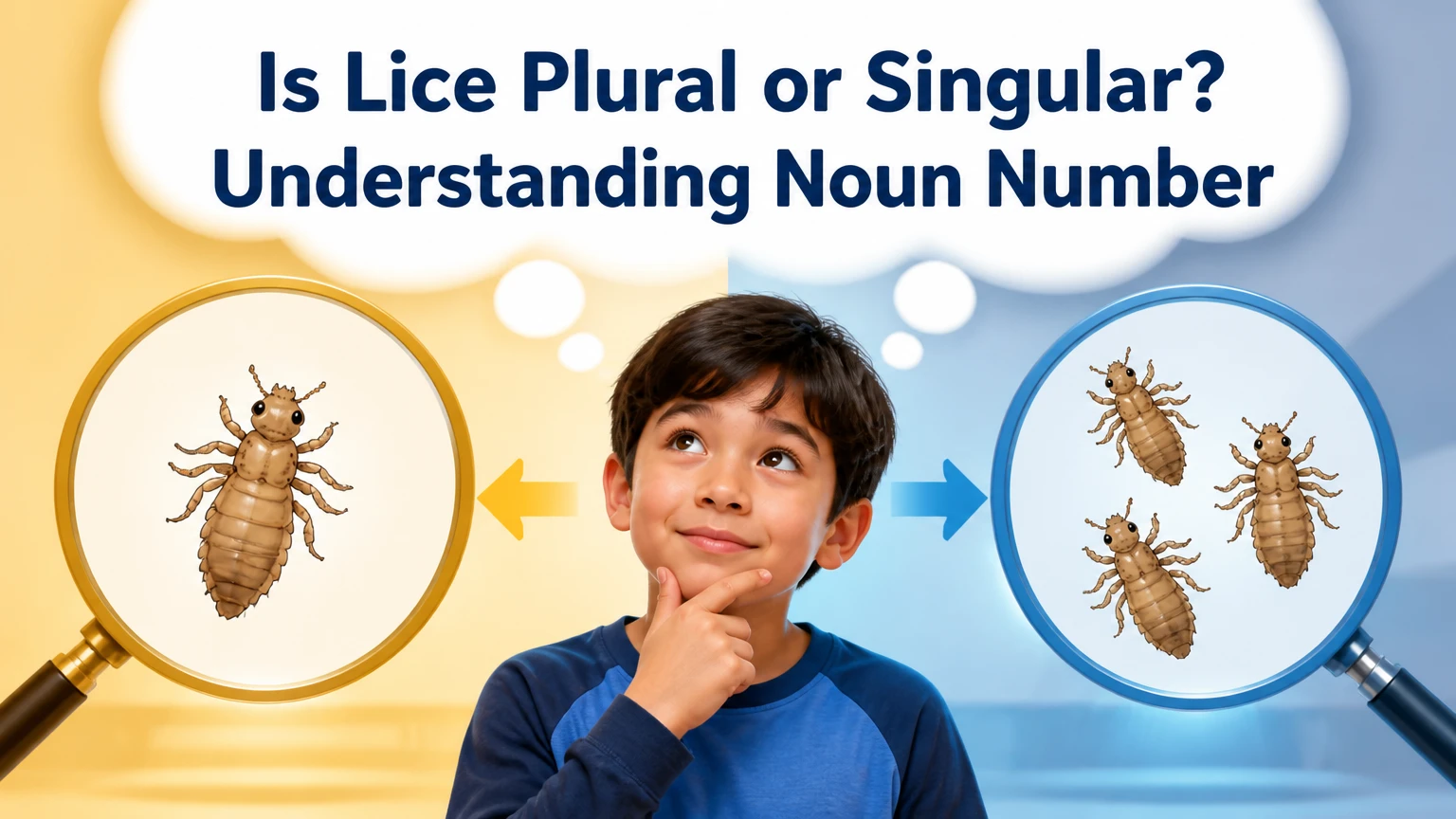
Determining whether a noun is singular or plural can sometimes be tricky, especially with irregular nouns like lice. While it might sound singular, similar to mice or dice, the word lice is actually the plural form of the singular noun louse. Understanding this distinction is crucial for correct grammar and clear communication. Misusing singular and plural forms can lead to confusion, such as saying “one lice” instead of “one louse” or “many louse” instead of “many lice.” This article provides a comprehensive guide to understanding the singularity and plurality of lice and louse, along with related rules and examples. Mastering this concept will enhance your writing and speaking skills, ensuring accuracy and precision in your language use, which is particularly important in fields like healthcare, education, and everyday conversation.
Table of Contents
- Definition of Louse and Lice
- Structural Breakdown: Singular vs. Plural
- Etymology and Historical Context
- Examples of Louse and Lice in Sentences
- Usage Rules for Louse and Lice
- Common Mistakes with Louse and Lice
- Practice Exercises
- Advanced Topics: Collective Nouns and Related Terms
- Frequently Asked Questions
- Conclusion
Definition of Louse and Lice
The word louse refers to a small, wingless parasitic insect that lives on the skin of mammals and birds. It feeds on blood and can cause itching and irritation. The term louse is a singular noun, indicating one such insect. In contrast, lice is the plural form of louse, referring to multiple of these insects. Understanding the distinction between these two words is essential for accurate communication, especially in contexts related to health, hygiene, and pest control.
In biological terms, lice belong to the order Phthiraptera. Different species of lice infest various hosts, including humans, animals, and birds. For humans, common types of lice include head lice (Pediculus humanus capitis), body lice (Pediculus humanus humanus), and pubic lice (Pthirus pubis). Each type has specific characteristics and preferred habitats on the human body. Proper identification and treatment rely on correctly using the singular and plural forms when describing these infestations.
Structural Breakdown: Singular vs. Plural
The difference between louse and lice exemplifies an irregular noun pluralization. Most nouns in English form their plural by adding “-s” or “-es” to the singular form (e.g., cat becomes cats, box becomes boxes). However, some nouns, often those with roots in older forms of English, follow different rules. These irregular nouns often change their internal vowel sounds to indicate plurality. Other examples of such nouns include mouse (plural: mice), goose (plural: geese), and foot (plural: feet). The singular form louse transforms to the plural lice through this vowel change, demonstrating a pattern common in Germanic languages.
Here’s a structural breakdown:
- Singular: louse (one parasitic insect)
- Plural: lice (more than one parasitic insect)
It’s important to note that there is no word “louses” in standard English. Using “louses” as the plural of “louse” is grammatically incorrect. The correct plural form is always “lice.”
Etymology and Historical Context
Understanding the etymology of louse and lice can provide further insight into their irregular pluralization. Both words originate from the Proto-Germanic word *lūs, which referred to the parasitic insect. Over time, the singular form evolved into louse in Old English (lūs), while the plural form evolved into lice (lȳs). This vowel change, known as i-mutation, is a common feature in the historical development of English and other Germanic languages. Many words that underwent this process retain their irregular plural forms in modern English.
The historical context also reveals why these irregular forms have persisted. In earlier stages of English, irregular plurals were more common. As the language evolved, many nouns were regularized, adopting the standard “-s” or “-es” pluralization. However, some words, particularly those frequently used in everyday speech, retained their older, irregular forms. Louse and lice fall into this category, as the terms have been in continuous use for centuries, maintaining their traditional singular and plural forms.
Examples of Louse and Lice in Sentences
To solidify your understanding, let’s look at several examples of louse and lice used correctly in sentences. These examples will illustrate the proper context and usage of each form.
Examples with “Louse” (Singular)
The following table provides examples of “louse” used in sentences:
| # | Sentence |
|---|---|
| 1 | The doctor found a louse on the child’s scalp. |
| 2 | He carefully removed the louse with tweezers. |
| 3 | The biologist studied the louse under a microscope. |
| 4 | One louse can lay several eggs in a day. |
| 5 | The farmer discovered a louse on his sheep. |
| 6 | She suspected her pet had a louse. |
| 7 | The entomologist identified the insect as a louse. |
| 8 | He found only one louse after the initial treatment. |
| 9 | The louse was tiny but visible to the naked eye. |
| 10 | A single louse can cause significant itching. |
| 11 | The researcher examined the louse‘s DNA. |
| 12 | The exterminator confirmed it was just one louse. |
| 13 | The child pointed out the louse to his mother. |
| 14 | The louse scurried quickly across the surface. |
| 15 | The scientist focused on the life cycle of the louse. |
| 16 | He was relieved to find only a single louse. |
| 17 | The louse was resistant to the initial insecticide. |
| 18 | She magnified the image of the louse on the screen. |
| 19 | The louse is a common parasite in many species. |
| 20 | The health inspector identified a louse during the examination. |
| 21 | The guide explained how to identify a louse. |
| 22 | The vet found a louse on the dog. |
| 23 | The louse can transmit diseases. |
| 24 | The professor lectured about the louse. |
| 25 | She documented the characteristics of the louse. |
Examples with “Lice” (Plural)
The following table provides examples of “lice” used in sentences:
| # | Sentence |
|---|---|
| 1 | The children were sent home from school because they had lice. |
| 2 | The veterinarian discovered lice on the dog’s fur. |
| 3 | The farmer treated his sheep for lice. |
| 4 | The constant scratching was a sign of lice. |
| 5 | The nurse checked the students for lice. |
| 6 | She used a special shampoo to get rid of the lice. |
| 7 | The exterminator sprayed the house to kill the lice. |
| 8 | The doctor confirmed that the itching was caused by lice. |
| 9 | The parents were concerned about the spread of lice in the classroom. |
| 10 | The animals were quarantined due to the presence of lice. |
| 11 | He noticed tiny insects, which turned out to be lice. |
| 12 | The infestation of lice required immediate attention. |
| 13 | The birds were pecking at their feathers, trying to remove the lice. |
| 14 | The product is designed to kill lice and their eggs. |
| 15 | The health department issued a warning about the outbreak of lice. |
| 16 | The researchers studied the behavior of lice. |
| 17 | The museum displayed specimens of different types of lice. |
| 18 | The report detailed the prevalence of lice in the community. |
| 19 | The seminar addressed the methods for preventing the spread of lice. |
| 20 | The company developed a new treatment for lice. |
| 21 | The government is working to reduce the incidence of lice. |
| 22 | The specialist gave advice on dealing with lice. |
| 23 | The community health worker identified several cases of lice. |
| 24 | The charity provides resources for families dealing with lice. |
| 25 | The organization is researching the genetics of lice. |
Comparative Examples: Louse vs. Lice
This table directly compares the usage of “louse” and “lice” in similar contexts to highlight the difference:
| # | Singular (“Louse”) | Plural (“Lice”) |
|---|---|---|
| 1 | I found a louse crawling on my arm. | I found lice crawling on my arm. |
| 2 | The doctor identified a single louse. | The doctor identified several lice. |
| 3 | This shampoo is designed to kill one louse. | This shampoo is designed to kill lice. |
| 4 | He removed the louse carefully. | He removed the lice carefully. |
| 5 | The biologist studied the anatomy of a louse. | The biologists studied the behavior of lice. |
| 6 | The child had a louse in their hair. | The child had lice in their hair. |
| 7 | The vet found a louse on the cat. | The vet found lice on the cat. |
| 8 | The exterminator spotted a louse. | The exterminator spotted lice. |
| 9 | The itching was caused by a louse. | The itching was caused by lice. |
| 10 | The product targets the louse. | The product targets lice. |
| 11 | She saw a louse under the microscope. | She saw lice under the microscope. |
| 12 | The research focused on the life cycle of a louse. | The research focused on the life cycle of lice. |
| 13 | The treatment aims to eliminate the louse. | The treatment aims to eliminate the lice. |
| 14 | He found a louse on his pet bird. | He found lice on his pet bird. |
| 15 | The scientist examined the louse‘s features. | The scientist examined the lice‘s features. |
| 16 | The teacher noticed a louse on the student. | The teacher noticed lice on the student. |
| 17 | The article discussed the dangers of a louse. | The article discussed the dangers of lice. |
| 18 | The investigation started with a single louse. | The investigation started with several lice. |
| 19 | The expert explained the behavior of a louse. | The expert explained the behavior of lice. |
| 20 | The program educated people about the risks of a louse. | The program educated people about the risks of lice. |
Usage Rules for Louse and Lice
The primary rule for using louse and lice is to use the singular form (louse) when referring to one insect and the plural form (lice) when referring to more than one. This rule applies across all contexts, whether in scientific writing, casual conversation, or formal reports. However, there are some additional considerations to keep in mind.
- Subject-Verb Agreement: Ensure that the verb agrees with the noun in number. For example: “The louse is small” (singular) versus “The lice are small” (plural).
- Pronoun Agreement: Use singular pronouns (it, he, she) with louse and plural pronouns (they, them, their) with lice. For example: “The louse lays its eggs” versus “The lice lay their eggs.”
- Contextual Clarity: In some cases, the context may make the number clear, even if the noun itself is not explicitly stated. For example: “The child has head lice, and they are causing intense itching.” In this case, the pronoun “they” clarifies that you are referring to multiple insects.
Keep in mind that the word “lice” is already plural, so avoid adding an “s” to it (i.e., “lices” is incorrect). Always use “lice” when referring to more than one louse.
Common Mistakes with Louse and Lice
Several common mistakes can occur when using louse and lice. Being aware of these errors can help you avoid them.
| Incorrect | Correct | Explanation |
|---|---|---|
| I saw one lice on my head. | I saw one louse on my head. | “Lice” is plural; use “louse” for the singular. |
| There were many louse in her hair. | There were many lice in her hair. | “Louse” is singular; use “lice” for the plural. |
| She used a shampoo to kill the lices. | She used a shampoo to kill the lice. | “Lice” is already plural; do not add an extra “s.” |
| The louse are causing itching. | The lice are causing itching. | “Louse” is singular; use “lice” for the plural. |
| The lice is very small. | The louse is very small. | “Lice” is plural; use “louse” for the singular. |
| One louse are hard to find. | One louse is hard to find. | Singular subject “louse” needs singular verb “is”. |
| Several louse was found. | Several lice were found. | Plural subject “lice” needs plural verb “were”. |
| The treatment killed the all louse. | The treatment killed all the lice. | Use “lice” for plural and correct the article placement. |
| Each louse have a different life cycle. | Each louse has a different life cycle. | Singular subject “louse” needs singular verb “has”. |
| The female louse lay many eggs. | The female lice lay many eggs. | While the singular *can* be used generically, the plural is more common when speaking about the species. |
Avoiding these common mistakes will significantly improve the clarity and accuracy of your communication when discussing lice.
Practice Exercises
Test your understanding of louse and lice with the following exercises. Fill in the blanks with the correct form of the word.
Exercise 1: Singular or Plural?
Choose the correct form (louse or lice) for each sentence.
| # | Sentence | Answer |
|---|---|---|
| 1 | The child has a _________ in their hair. | louse |
| 2 | The doctor found several _________ on the patient. | lice |
| 3 | One _________ can cause intense itching. | louse |
| 4 | The shampoo is designed to kill _________. | lice |
| 5 | The veterinarian examined the dog for _________. | lice |
| 6 | She carefully removed the _________ with tweezers. | louse |
| 7 | The infestation of _________ was severe. | lice |
| 8 | He only found one _________ after the treatment. | louse |
| 9 | The _________ were resistant to the insecticide. | lice |
| 10 | She suspected her child had _________. | lice |
Exercise 2: Correct the Sentence
Correct the following sentences that contain errors in the use of louse and lice.
| # | Incorrect Sentence | Corrected Sentence |
|---|---|---|
| 1 | I saw one lice crawling on my skin. | I saw one louse crawling on my skin. |
| 2 | There was many louse in the classroom. | There were many lice in the classroom. |
| 3 | The child has lices in their hair. | The child has lice in their hair. |
| 4 | The louse are spreading quickly. | The lice are spreading quickly. |
| 5 | One louse are hard to spot. | One louse is hard to spot. |
| 6 | The treatment killed the louses. | The treatment killed the lice. |
| 7 | Several louse was found on the dog. | Several lice were found on the dog. |
| 8 | The itching was caused by a lices. | The itching was caused by lice. |
| 9 | She removed the all louse from her child’s head. | She removed all the lice from her child’s head. |
| 10 | Each louse have a different life cycle. | Each louse has a different life cycle. |
Exercise 3: Fill in the Blanks (Advanced)
Complete the sentences with the correct form (louse or lice) and the appropriate verb form.
| # | Sentence | Answer |
|---|---|---|
| 1 | If you find even one _________, it _________ important to treat it immediately. | louse, is |
| 2 | Once _________ _________ present, the infestation can spread rapidly. | lice, are |
| 3 | The researcher studied how each _________ _________ and transmits diseases. | louse, feeds |
| 4 | These _________ _________ known to cause severe itching and discomfort. | lice, are |
| 5 | The vet confirmed that only one _________ _________ on the kitten. | louse, was |
| 6 | If _________ _________ detected early, treatment is more effective. | lice, are |
| 7 | Each _________ _________ a unique genetic makeup. | louse, has |
| 8 | The _________ _________ able to survive for a limited time off the host. | lice, are |
| 9 | The product targets the _________ and _________ its eggs. | louse, destroys |
| 10 | The presence of _________ _________ a sign of poor hygiene. | lice, is not always |
Advanced Topics: Collective Nouns and Related Terms
While louse and lice are straightforward in their singular and plural forms, related concepts can add complexity. One such concept is the use of collective nouns. Although there isn’t a specific collective noun exclusively for lice, understanding how collective nouns work can be helpful.
A collective noun refers to a group of things or people as a single unit. Examples include team (a group of players), family (a group of relatives), and swarm (a group of insects). While you wouldn’t typically say “a swarm of lice,” you might use a similar term like “infestation” to describe a large group of lice present on a host. The word “infestation” itself is a noun that indicates a state of being invaded or overrun by pests, and it often implies a large number of the pest in question.
Another related term is “nit,” which refers to the egg of a louse. The plural of nit is “nits.” Like louse and lice, it’s important to use the correct form depending on whether you’re referring to one egg or multiple eggs. For example: “She found a nit attached to her hair” (singular) versus “She found several nits attached to her hair” (plural).
Frequently Asked Questions
Here are some frequently asked questions about louse and lice to further clarify their usage.
- Is “louses” ever a correct plural form?
No, “louses” is not a correct plural form of “louse.” The correct plural form is always “lice.” - Can I use “lice” to refer to a single insect?
No, “lice” is strictly a plural form. To refer to a single insect, you must use the singular form, “louse.” - What is the difference between “louse” and “nit”?
A “louse” is the adult parasitic insect, while a “nit” is the egg of the louse. They refer to different stages in the louse’s life cycle. - How do I ensure I’m using “louse” and “lice” correctly in my writing?
Always check whether you are referring to one insect or multiple insects. If it’s one, use “louse”; if it’s more than one, use “lice.” Also, ensure that your verb and pronoun agreement match the noun’s number. - Is the term “head lice” singular or plural?
“Head lice” is plural. Even though it refers to an infestation on the head, the word “lice” indicates multiple insects. You would say, “The child has head lice,” not “The child has head louse.” - If I find only one louse, does that mean there are more?
It’s possible. While finding one louse doesn’t guarantee a full-blown infestation, it’s wise to check carefully for more, as lice often lay eggs (nits) that can hatch later. - Is it considered informal or incorrect to use “lice” in all situations, even when referring to one?
Yes, it is considered incorrect to use “lice” when referring to only one louse. Maintaining the distinction between singular and plural forms demonstrates proper grammar and clear communication. - Are there different types of lice, and does that affect the pluralization?
Yes, there are different types of lice (e.g., head lice, body lice, pubic lice), but the pluralization rule remains the same. Regardless of the type, “louse” is singular, and “lice” is plural.
Conclusion
Understanding the difference between louse and lice is a fundamental aspect of English grammar, particularly when discussing topics related to health, hygiene, and pest control. Remembering that louse is singular and lice is plural is crucial for accurate communication. Avoiding common mistakes, such as using “louses” or misusing the singular and plural forms, will enhance the clarity and correctness of your language use. By mastering these rules and practicing with examples, you can confidently use louse and lice in both your writing and speaking, ensuring that your message is clear and precise. Remember to always double-check your subject-verb agreement and pronoun agreement to maintain grammatical accuracy. With consistent practice, you’ll be able to navigate these irregular noun forms with ease.