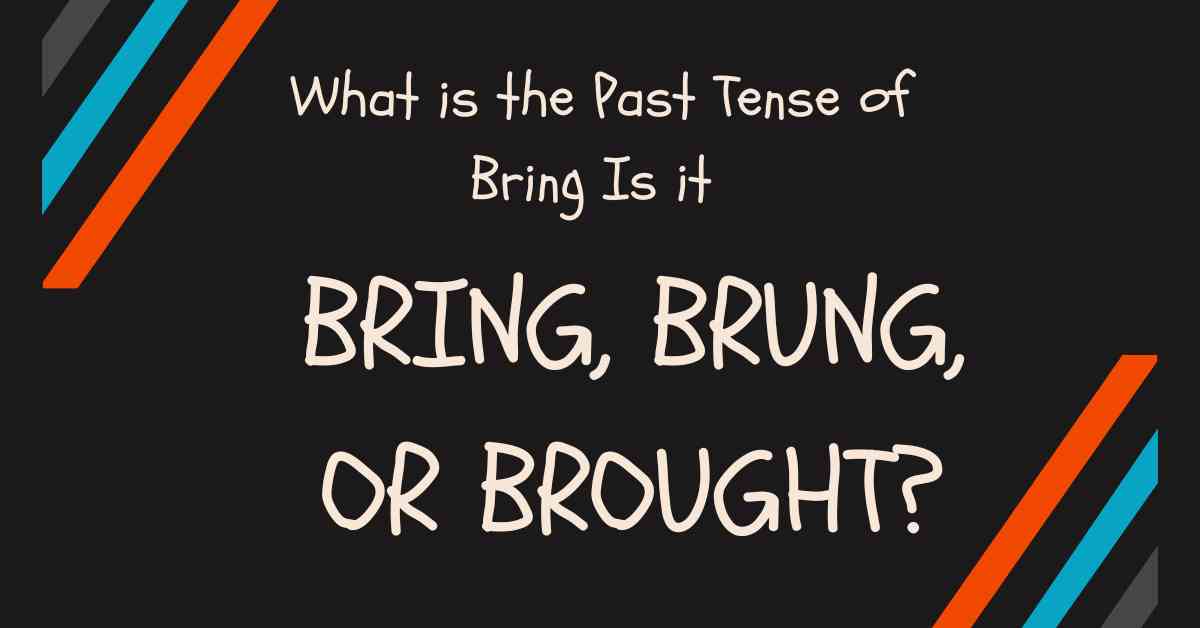
The English language is filled with irregular verbs that often challenge even the most fluent speakers, particularly when determining the correct past tense forms of common actions. One of the most frequent points of confusion involves the verb “to bring,” which requires a specific shift in spelling and pronunciation to indicate that an action occurred in the past. Understanding how to navigate these shifts involves recognizing the correct standard forms, such as brought, bringing, and brings, while avoiding non-standard variations that often arise in regional dialects. This article provides a deep dive into the linguistic history, grammatical rules, and proper application of this essential verb to help learners achieve mastery over their written and spoken English.
Mastering the past tense of “bring” is vital for clear communication in both academic and professional settings where precision is highly valued. Whether you are writing a formal report, engaging in a casual conversation, or preparing for a standardized English proficiency exam, knowing the difference between the standard “brought” and the dialectal “brung” is a hallmark of grammatical competence. By exploring the structural breakdown of the verb and practicing with varied examples, students can eliminate common errors and build the confidence necessary to use the English language effectively in any context.
Table of Contents
- Definition and Classification of the Verb “Bring”
- Structural Breakdown: The Principal Parts
- Brought vs. Brung: The Great Debate
- Historical Context: Why is it Irregular?
- Conjugation Patterns Across Tenses
- Comprehensive Usage Rules and Syntax
- Phrasal Verbs with Bring and Brought
- Common Mistakes and How to Avoid Them
- Extensive Examples and Reference Tables
- Advanced Topics: Subjunctive and Passive Voice
- Practice Exercises and Assessment
- Frequently Asked Questions (FAQ)
- Conclusion and Final Tips
Definition and Classification of the Verb “Bring”
The verb “bring” is a fundamental action word in the English language, primarily used to describe the act of carrying, conveying, or conducting something or someone to a specific place or person. It is classified as an irregular verb because it does not follow the standard pattern of adding “-ed” to form its past tense (as in “walk” becoming “walked”). Instead, it undergoes a significant internal vowel and consonant change.
In linguistic terms, “bring” is a transitive verb, meaning it requires a direct object to complete its meaning. You cannot simply “bring”; you must bring something or someone. For example, in the sentence “She brought the book,” “the book” serves as the direct object. Understanding this transitive nature is crucial for constructing sentences that make sense to the listener or reader.
Beyond its literal meaning of physical transport, “bring” is often used metaphorically to describe causing a state or condition to occur. One might “bring about change” or “bring a lawsuit.” This versatility makes it one of the most frequently used verbs in English, appearing in various registers from legal documents to nursery rhymes. Because it is so common, errors in its past tense form are particularly noticeable.
Structural Breakdown: The Principal Parts
To master any irregular verb, one must memorize its four principal parts. These parts serve as the building blocks for all the complex tenses in the English language. For the verb “bring,” these parts are distinct and must be learned individually as they do not follow a predictable suffix-based rule.
The first part is the base form (infinitive), which is “bring.” This is used for the present tense and with modal verbs like “can,” “will,” or “should.” The second part is the past simple, which is “brought.” This is used for actions that were completed at a specific time in the past. It is important to note that “brought” is the only standard form for this category.
The third part is the past participle, which is also “brought.” This form is used in perfect tenses (e.g., “have brought”) and in the passive voice. The fourth part is the present participle, “bringing,” which is used for continuous or progressive tenses. Unlike the past forms, the present participle follows the regular rule of adding “-ing” to the base form.
Table 1: Principal Parts of Bring
The following table outlines the four principal parts of the verb “bring” compared to a regular verb to highlight the irregularity of the past forms.
| Verb Type | Base Form | Past Simple | Past Participle | Present Participle |
|---|---|---|---|---|
| Irregular (Bring) | Bring | Brought | Brought | Bringing |
| Regular (Walk) | Walk | Walked | Walked | Walking |
| Regular (Play) | Play | Played | Played | Playing |
| Irregular (Buy) | Buy | Bought | Bought | Buying |
| Irregular (Catch) | Catch | Caught | Caught | Catching |
Brought vs. Brung: The Great Debate
One of the most common questions regarding this verb is whether “brung” is a legitimate past tense form. In standard English—the variety used in schools, businesses, and formal writing—“brung” is considered incorrect and non-standard. While you may hear it in certain regional dialects or informal speech, it should be avoided in any context where professional or academic clarity is required.
The form “brung” likely arose through analogy with other irregular verbs. In English, some verbs follow a pattern where the vowel changes to “u” in the past tense or past participle, such as “sing/sang/sung” or “ring/rang/rung.” Speakers subconsciously applied this pattern to “bring,” leading to the creation of “brung.” However, “bring” belongs to a different historical group of verbs that end in “-ought.”
Similarly, “brang” is sometimes heard as a past simple form (following the “sing/sang” pattern). Like “brung,” “brang” is also non-standard and incorrect. The only accepted past simple and past participle form for “bring” in modern English is brought. Using “brought” ensures that your language remains consistent with standard grammar rules across the English-speaking world.
Historical Context: Why is it Irregular?
To understand why “bring” becomes “brought” instead of “bringed” or “brung,” we have to look back at the history of the Germanic languages. English is a Germanic language, and many of our most common verbs are “strong verbs” or “weak verbs with vowel shifts” that date back over a thousand years to Old English.
The verb “bring” (Old English bringan) belongs to a specific class of verbs that underwent a process called Germanic Consonant Shift and Vowel Mutation. In Old English, the past tense was brōhte. Over centuries, the “h” sound evolved into the “gh” spelling we see today, which eventually became silent in modern pronunciation, while the vowel shifted to the “aw” sound found in “brought.”
This same historical evolution happened to other verbs like “think” (thought), “buy” (bought), “seek” (sought), and “fight” (fought). Because these verbs were used so frequently in daily life, they resisted the trend of becoming “regularized” (adding -ed). Their unique forms were preserved through constant use, which is why we still use these ancient-sounding words today.
Conjugation Patterns Across Tenses
Properly using “bring” requires understanding how it functions across all twelve major English tenses. While the base form and the past form “brought” are the primary components, they combine with various auxiliary verbs (like have, will, be) to indicate specific timing and duration of actions.
In the simple tenses, we use “bring” for the present, “brought” for the past, and “will bring” for the future. In the perfect tenses, which indicate completed actions or actions spanning a period of time, we always use the past participle “brought” combined with a form of the verb “to have.” For example, “I have brought,” “I had brought,” and “I will have brought.”
The continuous tenses focus on ongoing actions and utilize the present participle “bringing” combined with the verb “to be.” Examples include “I am bringing,” “I was bringing,” and “I will be bringing.” It is important to ensure that the auxiliary verb matches the subject in number and person, while the form of “bring” remains consistent within that specific tense structure.
Table 2: Full Conjugation of “Bring”
This table demonstrates the conjugation of “bring” across various tenses using the first-person singular “I” as the subject.
| Tense | Form | Example Sentence |
|---|---|---|
| Simple Present | bring / brings | I bring my lunch every day. |
| Simple Past | brought | I brought the cookies yesterday. |
| Simple Future | will bring | I will bring the map tomorrow. |
| Present Continuous | am/is/are bringing | I am bringing the guests inside now. |
| Past Continuous | was/were bringing | I was bringing the cake when I tripped. |
| Future Continuous | will be bringing | I will be bringing the supplies later. |
| Present Perfect | have/has brought | I have brought everything we need. |
| Past Perfect | had brought | I had brought the umbrella before it rained. |
| Future Perfect | will have brought | I will have brought the files by noon. |
| Present Perfect Continuous | have been bringing | I have been bringing water to the plants. |
Comprehensive Usage Rules and Syntax
Using “bring” correctly involves more than just knowing its past tense; it also requires understanding its directionality. In English, there is a subtle but important distinction between “bring” and “take.” Generally, bring implies movement toward the speaker or the listener (hither), while take implies movement away from the speaker or listener (thither).
For example, if you are at a party and you want a friend to come to you with a drink, you would say, “Please bring me a glass of water.” However, if you are at home and leaving for a party, you would say, “I am going to take some snacks to the party.” This distinction helps establish the spatial relationship between the speaker and the objects being moved.
Another rule involves the placement of objects. Since “bring” is transitive, it often takes two objects: a direct object (the thing being moved) and an indirect object (the person receiving it). You can say “Bring me the book” or “Bring the book to me.” Both are correct, but the latter requires the preposition “to” to clarify the relationship.
Phrasal Verbs with Bring and Brought
The verb “bring” is incredibly productive in forming phrasal verbs—expressions where the verb combines with a preposition or adverb to create a new meaning. These phrasal verbs are essential for natural-sounding English and often have meanings that cannot be guessed simply by looking at the individual words.
For instance, “bring up” can mean to mention a topic in conversation or to raise a child. “Bring about” means to cause something to happen, while “bring down” can mean to make someone sad or to cause a government to fall. When using these in the past tense, the verb “bring” changes to “brought,” but the preposition remains the same (e.g., “She brought up an interesting point”).
Table 3: Common Phrasal Verbs with “Bring”
This table explores common phrasal verbs, their meanings, and their use in the past tense.
| Phrasal Verb | Meaning | Past Tense Example |
|---|---|---|
| Bring up | To mention or raise a child | He brought up the budget during the meeting. |
| Bring about | To cause to happen | The new law brought about significant change. |
| Bring back | To return or remind | The smell brought back childhood memories. |
| Bring down | To reduce or overthrow | The scandal brought down the minister. |
| Bring along | To take with you | She brought along her brother to the party. |
| Bring in | To introduce or earn | The company brought in a new consultant. |
| Bring out | To reveal or publish | The author brought out a new book last year. |
| Bring off | To succeed in something difficult | They brought off the surprise party perfectly. |
Common Mistakes and How to Avoid Them
The most frequent mistake, as discussed, is using “brung” or “brang.” These are non-standard and should be strictly avoided in formal writing. Another common error is confusing “bring” with “bought.” While they sound similar, “bought” is the past tense of “buy,” not “bring.” This confusion often leads to sentences like “I bought the dog to the vet,” which implies you purchased the dog at the clinic rather than transporting it there.
To avoid the “brought” vs. “bought” confusion, remember the original verbs. Bring has an ‘r’, and so does brought. Buy does not have an ‘r’, and neither does bought. This simple mnemonic device—checking for the letter ‘r’—is one of the most effective ways to ensure you are using the correct word in your writing.
Additionally, speakers often struggle with the “bring” vs. “take” distinction. Remember that the choice depends on the destination. If the movement is toward the location of the conversation, use “bring.” If the movement is away from the current location, use “take.” Incorrect usage here doesn’t always make a sentence ungrammatical, but it can make the speaker’s meaning confusing or unnatural to native ears.
Table 4: Correct vs. Incorrect Usage
The following table highlights frequent errors and provides the corrected versions for study.
| Incorrect Sentence | Correct Sentence | Explanation |
|---|---|---|
| I brung my homework today. | I brought my homework today. | “Brung” is non-standard; use “brought.” |
| He brang his guitar to the gig. | He brought his guitar to the gig. | “Brang” is non-standard; use “brought.” |
| I bought my friend to the party. | I brought my friend to the party. | Use “brought” for carrying, “bought” for buying. |
| Can you take that book here? | Can you bring that book here? | Movement toward the speaker requires “bring.” |
| She has bringed the mail in. | She has brought the mail in. | “Bringed” is not a word; use “brought.” |
Extensive Examples and Reference Tables
To truly internalize the use of “brought,” it is helpful to see it used in various contexts, from simple descriptions to complex narrative structures. The following examples demonstrate how the past tense of “bring” functions across different types of sentences and subjects.
In simple declarative sentences, “brought” tells us what happened. “The mailman brought a package.” In negative sentences, we use the auxiliary “did not” followed by the base form, not the past tense: “The mailman did not bring a package.” This is a common point of failure for learners; remember that “did” already carries the past tense, so the main verb returns to its base form.
Table 5: 25 Examples of “Brought” in Context
This table provides a wide variety of sentences using the past tense “brought” to show its versatility.
| No. | Example Sentence | No. | Example Sentence |
|---|---|---|---|
| 1 | I brought my umbrella just in case. | 14 | The news brought great joy to the family. |
| 2 | She brought her new boyfriend to dinner. | 15 | The cat brought a mouse to the porch. |
| 3 | They brought extra chairs for the guests. | 16 | The storm brought down several power lines. |
| 4 | The waiter brought us the wrong order. | 17 | We brought back souvenirs from Italy. |
| 5 | He brought up a very valid point. | 18 | Who brought the donuts this morning? |
| 6 | The tide brought in a lot of seaweed. | 19 | The investigation brought out the truth. |
| 7 | I brought the car to a screeching halt. | 20 | She brought her A-game to the match. |
| 8 | They brought the meeting to a close. | 21 | The medicine brought the fever down. |
| 9 | The teacher brought the class to order. | 22 | He brought his children up to be kind. |
| 10 | We brought the dogs to the park. | 23 | The wind brought the smell of rain. |
| 11 | She brought a gift for the hostess. | 24 | The lawyer brought a suit against them. |
| 12 | The singer brought the house down. | 25 | I brought the documents you requested. |
| 13 | They brought the project in under budget. | – | – |
Advanced Topics: Subjunctive and Passive Voice
For advanced learners, understanding how “bring” behaves in more complex grammatical moods is essential. In the passive voice, the focus shifts from the person doing the bringing to the object being brought. The formula is: [Object] + [Form of Be] + [Brought]. For example, “The cookies were brought by Sarah.” This is often used when the “bringer” is unknown or less important than the item itself.
In the subjunctive mood, which expresses wishes, hypothetical situations, or demands, the form of the verb can stay as the base form “bring” regardless of the subject. For example, “It is essential that he bring the documents.” Notice it is not “brings.” In hypothetical “if” clauses involving the past, we use the past perfect: “If you had brought the map, we wouldn’t be lost.”
Another advanced nuance is the use of “bring” in causative structures. While “bring” isn’t a traditional causative verb like “make” or “have,” it functions similarly in phrasal forms like “bring someone to realize.” This implies a process of persuasion or education. Mastering these subtle uses elevates your English from basic proficiency to a more sophisticated, near-native level of expression.
Table 6: Active vs. Passive Voice with “Bring”
This table illustrates how to transform active sentences into the passive voice using “brought.”
| Active Voice | Passive Voice | Tense |
|---|---|---|
| He brings the mail. | The mail is brought by him. | Present Simple |
| She brought the cake. | The cake was brought by her. | Past Simple |
| They will bring the tools. | The tools will be brought by them. | Future Simple |
| We have brought the news. | The news has been brought by us. | Present Perfect |
| I was bringing the bags. | The bags were being brought by me. | Past Continuous |
Practice Exercises and Assessment
Testing your knowledge is the best way to ensure you have truly mastered the past tense of “bring.” Below are two sets of exercises designed to challenge your understanding of tenses, phrasal verbs, and common pitfalls.
Exercise 1: Fill in the Blanks
Complete the following sentences using the correct form of “bring” (bring, brings, bringing, or brought).
- Yesterday, I ________ my lunch to work because I wanted to save money.
- She is ________ her sister to the movie tonight.
- Have you ________ the keys with you?
- He always ________ a positive attitude to the office.
- They ________ about a change in policy last year.
- We would have ________ more food if we knew you were coming.
- The cat has ________ three mice into the house this week.
- I am ________ the car around to the front door now.
- The witness ________ forth new evidence during the trial.
- If you ________ the supplies, I will start the fire.
Exercise 2: Error Correction
Identify and correct the error in each of the following sentences. Some sentences may be correct.
- I brung the book you asked for.
- She has broughten the snacks already.
- They brought up their children in a small town.
- I bought my dog to the park yesterday.
- Did you brought the map?
- He has brang his guitar to every party this year.
- The rain brought relief to the farmers.
- We was bringing the boxes inside when it started to pour.
- It is important that he brings the contract.
- The news were brought to us by a messenger.
Table 7: Answer Key for Exercises
Use this table to check your work. If you missed more than two, review the “Usage Rules” and “Common Mistakes” sections.
| Question | Exercise 1 Answers | Exercise 2 Corrections |
|---|---|---|
| 1 | brought | brought (not brung) |
| 2 | bringing | brought (not broughten) |
| 3 | brought | Correct |
| 4 | brings | brought (not bought) |
| 5 | brought | bring (Did you bring…?) |
| 6 | brought | brought (not brang) |
| 7 | brought | Correct |
| 8 | bringing | were (We were bringing…) |
| 9 | brought | bring (subjunctive: that he bring) |
| 10 | bring | was (The news was brought…) |
Frequently Asked Questions (FAQ)
Is “brung” ever correct in English?
In standard, formal English, “brung” is never correct. It is considered a non-standard or dialectal form. While it may be used in specific regional English varieties (like some Southern American or British dialects), it should be avoided in writing, school, and professional environments.
What is the difference between “brought” and “bought”?
“Brought” is the past tense of “bring” (to carry something here). “Bought” is the past tense of “buy” (to purchase something with money). A good trick to remember is that “bring” and “brought” both contain the letter ‘r’, while “buy” and “bought” do not.
Can I say “I have bringed”?
No, “bringed” is not a word in the English language. Because “bring” is an irregular verb, it does not follow the “-ed” rule. The correct form for the past participle is “brought,” so you should say “I have brought.”
Why do some people say “brang”?
People say “brang” because they are subconsciously following the pattern of other irregular verbs like “sing/sang” or “ring/rang.” This is called over-regularization or analogy. However, “bring” does not follow that specific pattern, making “brang” incorrect in standard English.
Is “broughten” a word?
“Broughten” is a non-standard form that occasionally appears in some dialects, but it is not accepted in standard English. The past participle of “bring” is simply “brought.” You should never add “-en” to “brought.”
How do I know when to use “bring” vs. “take”?
Use “bring” when the movement is toward the speaker or the destination being discussed. Use “take” when the movement is away from the speaker. For example: “Bring the book to me” vs. “Take the trash out to the bin.”
Is “brought” used for both the past simple and past participle?
Yes. Unlike some verbs that have three different forms (like go/went/gone), “bring” uses the same form for the simple past and the past participle: “I brought it” and “I have brought it.”
What is the past tense of “bring up” (the phrasal verb)?
The past tense is “brought up.” In phrasal verbs, only the verb part changes its tense, while the preposition (up) remains the same. Example: “She brought up the issue yesterday.”
Conclusion and Final Tips
Understanding the past tense of “bring” is a fundamental step in mastering English grammar. While the forms “brung” and “brang” might appear in casual speech or regional dialects, the only standard and correct past tense and past participle form is brought. By remembering the historical roots of the word and its connection to other “-ought” verbs like “thought” and “bought,” you can avoid common pitfalls and speak with greater precision. Consistency is key in language learning, so practicing with various tenses and phrasal verbs will help solidify this knowledge.
To keep your skills sharp, always double-check your writing for the “r” in “brought” to distinguish it from “bought.” Pay close attention to the direction of movement to choose between “bring” and “take” correctly. With these rules in mind, you will be well-equipped to use this versatile verb in any situation, ensuring your communication is both professional and clear. Happy learning, and remember that even the most complex irregular verbs become second nature with regular practice and attention to detail.