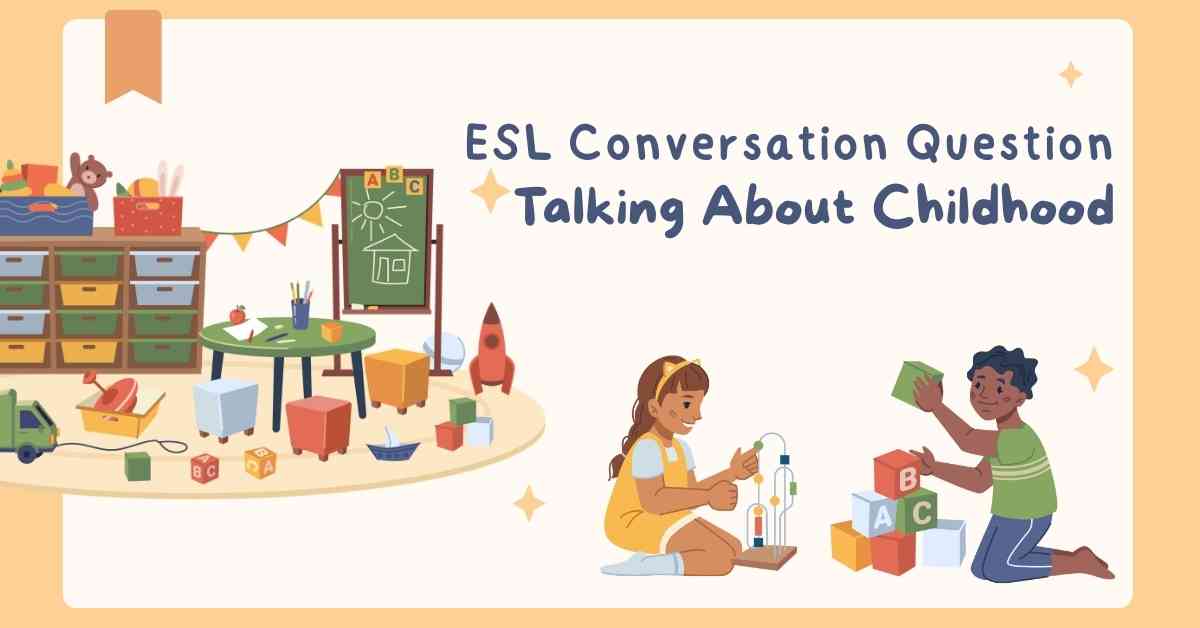
Discussing one’s upbringing is a fundamental aspect of language learning because it allows students to practice narrative tenses and descriptive vocabulary in a deeply personal context. When learners talk about their early years, they utilize specific grammatical structures such as “used to,” “would,” and the “past simple” to recount habits, states, and specific events. For example, students might use phrases like “I used to play outside,” “we would visit my grandmother,” “I grew up in a small town,” or “my favorite toy was a red bicycle” to share their history. These expressions are essential for building rapport and fluency, as they enable speakers to connect their past identities with their current selves while mastering the nuances of English temporal markers. Understanding how to frame these questions and answers helps both students and teachers navigate the complexities of memory and storytelling in a second language.
Table of Contents
- Defining Childhood Conversation in ESL
- Structural Breakdown of Past Tenses
- Habitual Past: Used To vs. Would
- Categories of Childhood Questions
- Vocabulary for Childhood Memories
- Extensive Question and Answer Examples
- Usage Rules and Grammar Constraints
- Common Mistakes and Corrections
- Practice Exercises and Drills
- Advanced Narrative Techniques
- Frequently Asked Questions
- Conclusion and Final Tips
Defining Childhood Conversation in ESL
In the context of English as a Second Language (ESL) instruction, talking about childhood refers to the functional use of language to describe life events, habits, and emotional states from birth until adolescence. This topic serves as a bridge between basic past simple usage and more complex narrative structures.
Functionally, these conversations require the speaker to distinguish between finished actions and ongoing past states. For instance, saying “I broke my arm when I was six” (a single event) requires a different mental framework than “I was a very shy child” (a continuous state). Mastery of this topic involves not just grammar, but also the cultural nuances of how different societies view upbringing and family dynamics.
Contextually, these questions are common in social settings, job interviews (when discussing background), and proficiency exams like IELTS or TOEFL. Learners must categorize their thoughts into themes such as education, family life, hobbies, and significant milestones. This classification helps in organizing long-turn speaking tasks where coherence and cohesion are evaluated.
Furthermore, discussing the past involves “stative” and “dynamic” verbs. Stative verbs like know, believe, and belong are treated differently in past narratives than dynamic verbs like run, play, and build. This distinction is crucial for learners to avoid common errors in progressive tenses.
Structural Breakdown of Past Tenses
To talk about the past effectively, learners must understand the hierarchy of past tenses. The most common is the Past Simple, used for completed actions. The structure is typically [Subject + Verb-ed] for regular verbs or the specific irregular form.
The Past Continuous ([Subject + was/were + Verb-ing]) is used to set the scene or describe an action that was in progress when another event occurred. For example, “I was playing in the garden when it started to rain.” This creates a “background” versus “foreground” effect in storytelling.
The Past Perfect ([Subject + had + Past Participle]) is often the most challenging for ESL students. It is used to describe an action that happened before another action in the past. In childhood stories, this might look like: “By the time I started school, I had already learned to read.” This adds a layer of chronological depth to the conversation.
Finally, we have Interrogative Structures. Questions about childhood often start with “Did you…?” for specific events or “Were you…?” for descriptions. More open-ended questions begin with “Wh-” words like “Where did you grow up?” or “Who was your best friend?” Mastering the inversion of subject and auxiliary verb is key to asking these questions naturally.
Habitual Past: Used To vs. Would
One of the most specific grammar points related to childhood is the use of “used to” and “would” to describe past habits. While they are often interchangeable, there are strict rules governing their use that students must learn to sound like native speakers.
Used to is the “workhorse” of past habits. It can be used for both past actions (“I used to ride my bike”) and past states (“I used to be short”). It implies that the situation is no longer true. It is the safest choice for students because it rarely results in a grammatical error when describing the past.
Would is more nostalgic and literary. However, it can only be used for repeated actions, never for states. You cannot say “I would be a happy child,” but you can say “Every summer, we would go to the beach.” Adding a time expression like “every weekend” or “whenever it rained” often makes the use of “would” feel more natural.
The negative and question forms of “used to” are also tricky. In the negative, it becomes “didn’t use to” (note the loss of the ‘d’), and the question is “Did you use to…?” Many native speakers mistakenly keep the ‘d’, but in formal ESL curricula, the ‘d’ is dropped after the auxiliary “did.”
Categories of Childhood Questions
To facilitate a 45-minute or hour-long conversation, it is helpful to categorize questions into thematic “buckets.” This prevents the conversation from becoming a repetitive list of dates and facts and turns it into a rich exchange of experiences.
Family and Home Life
These questions focus on the immediate environment. They often involve the Past Simple and “used to.” Examples include “Who lived in your house?” and “Did you have any pets?” These questions are usually the easiest for beginners because the vocabulary is concrete.
School and Education
School-related questions introduce vocabulary for subjects, teachers, and social hierarchies. Questions like “What was your favorite subject?” or “Were you a teacher’s pet?” allow students to discuss their early intellectual interests and social development.
Play and Leisure
This category is perfect for practicing “would” for repeated actions. “What would you do on Saturdays?” or “What games did you use to play with your neighbors?” These questions often elicit emotional responses and specific nouns (hide and seek, tag, marbles).
Milestones and Memories
These are more complex and often require the Past Perfect or specific time clauses. “What is your earliest memory?” or “Had you ever traveled abroad before you were ten?” These require more thought and longer, more descriptive answers.
Vocabulary for Childhood Memories
A conversation is only as good as the vocabulary available to the speaker. When discussing childhood, students need adjectives to describe personality and nouns to describe objects and places that no longer exist in their adult lives.
Adjectives like mischievous, obedient, imaginative, and carefree help define a child’s personality. Verbs like reminisce, recall, and look back are useful for framing the act of remembering itself. Phrasal verbs such as grow up, bring up, and look after are also essential components of this lexical set.
Furthermore, students should learn “noun-noun” combinations or collocations common to childhood, such as bedtime story, nursery rhyme, playground equipment, and childhood sweetheart. Using these specific terms makes the English sound more authentic and less like a direct translation from the student’s native language.
Extensive Question and Answer Examples
The following tables provide a massive repository of conversation starters and model answers. These can be used by teachers to create flashcards or by students for self-study.
Table 1: General Childhood Background Questions
This table focuses on the “where” and “who” of childhood, using primarily the Past Simple tense.
| Question | Grammar Focus | Sample Answer |
|---|---|---|
| Where did you grow up? | Past Simple (Intransitive) | I grew up in a small coastal town in Italy. |
| Were you born in a big city? | Past Simple (To Be) | No, I was born in a very rural village. |
| Who raised you? | Passive Voice / Past Simple | I was raised by my parents and my grandmother. |
| Did you have any siblings? | Past Simple (Possession) | Yes, I had two older brothers and a younger sister. |
| What was your house like? | Descriptive Past | It was a cozy apartment with a balcony. |
| Did you have a backyard? | Past Simple (Question) | Yes, we had a huge garden where we played. |
| Were you an only child? | Past Simple (To Be) | No, I come from a very large family. |
| Did you move a lot? | Past Simple (Frequency) | No, we lived in the same house for fifteen years. |
| Who was your favorite relative? | Superlative + Past | My Aunt Maria was my favorite because she was kind. |
| What was your bedroom like? | Descriptive Past | It was small and filled with posters of cars. |
| Did you have any pets? | Past Simple | We had a golden retriever named Goldie. |
| What did your parents do? | Past Simple (Occupations) | My father was a doctor and my mother was a teacher. |
| Were you a quiet child? | Past Simple (Adjective) | No, I was actually very loud and energetic. |
| Did you live near your cousins? | Prepositions of Place | Yes, they lived just down the street from us. |
| What was your first word? | Past Simple | My parents say my first word was “cookie.” |
| Did you look like your father? | Past Simple (Comparison) | I used to look like him, but now I look like my mom. |
| Where did you go on holidays? | Past Simple (Travel) | We usually went to the mountains every winter. |
| What was the name of your street? | Past Simple | It was called Maple Avenue. |
| Did you like your neighbors? | Past Simple (Opinion) | Yes, they were very friendly and gave us candy. |
| Was your childhood happy? | Past Simple (Abstract) | Yes, it was a very peaceful and happy time. |
Table 2: School and Social Life Questions
This table explores the educational and social aspects of growing up, incorporating “used to” and more specific adjectives.
| Question | Grammar Focus | Sample Answer |
|---|---|---|
| Did you like school? | Past Simple (Preference) | I loved it because I could see my friends. |
| What was your favorite subject? | Past Simple | My favorite subject was definitely History. |
| Who was your best friend? | Past Simple | My best friend was a boy named Leo. |
| Did you use to get good grades? | “Used to” (Question) | I used to get straight As in math. |
| Were you a rebellious student? | Past Simple (Adjective) | No, I was very obedient and followed the rules. |
| How did you get to school? | Past Simple (Method) | I used to walk to school with my neighbors. |
| Did you wear a uniform? | Past Simple (Habit) | Yes, we had to wear a blue blazer and tie. |
| What did you do during recess? | Past Simple (Action) | We would play football or trade cards. |
| Who was your favorite teacher? | Past Simple | Mr. Smith, because he made science fun. |
| Did you have a lot of homework? | Past Simple (Quantity) | Yes, I felt like I was always studying. |
| Were you in any clubs? | Past Simple (Membership) | I was in the chess club and the choir. |
| Did you ever skip school? | Past Simple (Negative/Ever) | No, I was too scared of getting in trouble. |
| What was your least favorite subject? | Past Simple | I hated Physics because it was too difficult. |
| Did you play any sports? | Past Simple | I played basketball for the school team. |
| How many students were in your class? | There was/were | There were about thirty students in my class. |
| Did you have a school crush? | Past Simple (Slang) | Yes, I had a crush on a girl in my art class. |
| Were you popular in school? | Past Simple (Social) | I wasn’t popular, but I had a good group of friends. |
| What did you eat for lunch? | Past Simple | I usually brought a sandwich from home. |
| Did you win any awards? | Past Simple (Achievement) | I won a spelling bee when I was ten. |
| What was your graduation like? | Descriptive Past | It was very emotional and my whole family came. |
Table 3: Habits, Hobbies, and Free Time
This table is designed for practicing the “would” structure and frequency adverbs in the past.
| Question | Grammar Focus | Sample Answer |
|---|---|---|
| What would you do on weekends? | “Would” for habits | We would often go to the park to fly kites. |
| Did you use to watch cartoons? | “Used to” | I used to watch them every Saturday morning. |
| What was your favorite toy? | Past Simple | My favorite toy was a set of wooden blocks. |
| Did you play outside often? | Adverbs of Frequency | Yes, I played outside almost every day. |
| What was your favorite book? | Past Simple | I loved “The Little Prince.” |
| Did you collect anything? | Past Simple (Habit) | I used to collect stamps and rare coins. |
| Were you into video games? | “To be into” (Past) | No, I preferred playing with my dolls. |
| What would you do when it rained? | “Would” + Condition | We would build forts out of blankets and pillows. |
| Did you learn an instrument? | Past Simple | I learned the piano for five years. |
| What was your favorite food? | Past Simple | I was obsessed with my mom’s lasagna. |
| Did you have a favorite hiding spot? | Past Simple | Yes, I used to hide in the cupboard under the stairs. |
| Were you allowed to stay up late? | Passive Voice (Permission) | Only on Friday and Saturday nights. |
| What did you want to be? | Past Simple (Ambition) | I wanted to be an astronaut or a pilot. |
| Did you go to summer camp? | Past Simple | Yes, I went to a scout camp every July. |
| What was your favorite movie? | Past Simple | I must have watched “The Lion King” fifty times. |
| Did you use to fight with your siblings? | “Used to” (Conflict) | We used to fight over the TV remote all the time. |
| What chores did you have to do? | “Had to” (Obligation) | I had to take out the trash and wash the dishes. |
| Did you have a nickname? | Past Simple | My family called me “Bean” because I was small. |
| What was your favorite holiday? | Past Simple | Christmas was always the most exciting time. |
| Did you believe in magic? | Past Simple (Belief) | Yes, I was convinced my toys came alive at night. |
Usage Rules and Grammar Constraints
When discussing childhood, learners must navigate several grammatical “traps.” The most significant is the distinction between finished time and unfinished time. Since childhood is a finished period, we almost exclusively use the Past Simple. Using the Present Perfect (“I have lived in London when I was a child”) is a major error because the time marker “when I was a child” is specific and completed.
Another rule involves the word “ever.” In childhood questions, “ever” is used to ask about a single instance in a finished period: “Did you ever break a bone?” It is not the same as the Present Perfect “Have you ever…?” which refers to your entire life up to now. This distinction is subtle but important for accuracy.
The negative form of “used to” is also a point of contention. While “I didn’t used to” is frequently seen in informal writing, the grammatically correct version for exams is “I didn’t use to.” Similarly, the question form is “Did you use to…?” without the ‘d’. Teachers should emphasize this to students preparing for formal certifications.
Regarding “would,” it is important to note that it cannot be used with stative verbs. You cannot say, “I would have a dog.” You must say, “I had a dog” or “I used to have a dog.” “Would” is strictly for actions that happened repeatedly, like “I would walk the dog every morning.”
Common Mistakes and Corrections
Identifying common errors helps students self-correct during conversation. The following table highlights the most frequent mistakes made by ESL learners when discussing their past.
| Incorrect Sentence | Correct Sentence | Explanation |
|---|---|---|
| I have lived in Paris when I was five. | I lived in Paris when I was five. | Don’t use Present Perfect with a specific past time. |
| I would be very shy in school. | I used to be very shy in school. | “Would” cannot be used with stative verbs like “be.” |
| Did you used to play football? | Did you use to play football? | Remove the ‘d’ in questions with “did.” |
| I use to go to the park every day. | I used to go to the park every day. | The affirmative form must have the ‘d’. |
| When I was a child, I was going to the beach. | When I was a child, I went/used to go to the beach. | Past Continuous is for specific moments, not general habits. |
| By the time I was ten, I visited Japan. | By the time I was ten, I had visited Japan. | Use Past Perfect for actions before a past point. |
| I was having a red bike. | I had a red bike. | “Have” (possession) is a stative verb; no -ing. |
| I grew up me in a small town. | I grew up in a small town. | “Grow up” is intransitive; it doesn’t take an object. |
Practice Exercises and Drills
To internalize these rules, students should complete a variety of exercises. These range from simple tense selection to more complex sentence transformations.
Exercise 1: Choose the Correct Form
Select the best option (Past Simple, Used to, or Would) for each sentence. In some cases, more than one may be correct, but choose the most natural one.
- When I was young, I ________ (have) a cat named Whiskers.
- Every Sunday, my dad ________ (make) pancakes for the whole family.
- I ________ (not like) broccoli when I was a kid.
- ________ you ________ (use to) live in a different country?
- I ________ (be) much shorter than I am now.
- We ________ (go) to Disney World once when I was seven.
- My grandmother ________ (always / tell) us stories before bed.
- I ________ (never / see) snow until I was twelve years old.
- What ________ (be) your favorite cartoon?
- I ________ (study) the violin for three years, but I hated it.
Exercise 2: Sentence Transformation
Rewrite the following sentences using the word in brackets without changing the meaning.
- I went to the park every day after school. [WOULD]
- She was a very talented pianist in her youth. [USED TO]
- We didn’t have a television when I was little. [USE TO]
- I finished my homework, and then I went outside. [AFTER / HAD]
- It was my habit to bite my nails. [USED TO]
- I visited my grandparents every summer. [WOULD]
- He was a very naughty boy. [USED TO]
- Did you have a lot of friends in primary school? [USE TO]
- I was in the middle of eating when the phone rang. [WHILE]
- I don’t play with dolls anymore. [USED TO]
Answer Key
| Ex 1 Answers | Ex 2 Answers |
|---|---|
| 1. had / used to have | 1. I would go to the park every day. |
| 2. would / used to make | 2. She used to be a very talented pianist. |
| 3. didn’t like | 3. We didn’t use to have a television. |
| 4. Did / use to | 4. After I had finished my homework, I went outside. |
| 5. was / used to be | 5. I used to bite my nails. |
| 6. went | 6. I would visit my grandparents every summer. |
| 7. would always tell | 7. He used to be a very naughty boy. |
| 8. had never seen | 8. Did you use to have a lot of friends? |
| 9. was | 9. While I was eating, the phone rang. |
| 10. studied | 10. I used to play with dolls. |
Advanced Narrative Techniques
For high-level students (C1-C2), simply answering questions is not enough. They should focus on narrative flow and evocative language. This involves using the Past Perfect Continuous to describe long actions leading up to a point in the past: “I had been begging my parents for a dog for years before they finally got me one.”
Advanced learners should also master the “Future in the Past.” This is used to describe things that were going to happen from a past perspective. For example, “I didn’t know then that I would eventually move to New York.” This structure (was/were going to or would) adds a sophisticated layer of foreshadowing to childhood stories.
Another technique is the use of sensory details. Instead of saying “The food was good,” an advanced learner might say, “The aroma of my grandmother’s baking would waft through the house every Sunday morning.” Encouraging students to use verbs related to the five senses (smell, taste, touch, sound, sight) makes their descriptions much more engaging.
Frequently Asked Questions
1. Can I use “would” to describe my childhood home?
No, because “would” is for repeated actions, not states. You should say “I used to live in a big house” or “My house was big.” You cannot say “My house would be big.”
2. What is the difference between “grew up” and “was raised”?
“Grew up” is something the child does (intransitive), while “was raised” is something the parents do to the child (passive). You can say “I grew up in Tokyo” or “I was raised in Tokyo by my parents.”
3. Is it “didn’t used to” or “didn’t use to”?
In formal English and on grammar exams, it is “didn’t use to.” The auxiliary “did” already carries the past tense, so the main verb returns to its base form.
4. How do I talk about a memory I’m not sure of?
You can use modal verbs of deduction in the past. For example, “I must have been four years old” or “I might have seen that movie, but I don’t clearly remember.”
5. Why can’t I use the Present Perfect to talk about my childhood?
The Present Perfect connects the past to the present. Since “childhood” is a finished period of time that does not continue into the present, we must use the Past Simple.
6. What does “teacher’s pet” mean?
It is an idiom for a student who is the teacher’s favorite and often tries too hard to please the teacher. It is a common term when discussing school memories.
7. Can I use “used to” for a single event?
No. “Used to” is only for habits or long-term states. For a one-time event, like “I broke my leg,” you must use the Past Simple.
8. How can I sound more natural when telling a story?
Use fillers and transition words like “actually,” “to be honest,” “believe it or not,” and “anyway.” These help bridge the gap between sentences and make the narrative feel less like a list of facts.
Conclusion and Final Tips
Mastering conversation questions about childhood is a vital step in achieving English fluency. By balancing the use of the Past Simple for specific events, “used to” for past states, and “would” for nostalgic habits, learners can provide rich, detailed accounts of their history. Remember that the goal of these conversations is connection; don’t be afraid to use descriptive adjectives and sensory details to bring your stories to life. Practice regularly using the tables provided, and pay close attention to the distinction between stative and dynamic verbs to avoid common pitfalls. With time, discussing your past will become as natural as talking about your present. Keep exploring new vocabulary, stay curious about others’ backgrounds, and always look for opportunities to share your unique journey.